Bishop Score Calculator for Labour Induction
In short: Free Bishop score calculator: score the five cervical factors from 0 to 13 to assess readiness for labour induction. Educational tool, not medical advice. Use the calculator above, then read the guide below to interpret your result and its limitations.
Score the five cervical factors from 0 to 13 to assess how ready the cervix is for induction of labour. A higher total means a more favourable cervix; the commonly applied cutoffs are 8 or more favourable in women who have given birth before and 9 or more in first-time mothers.
The calculator
Result
Not yet calculated
Select one option for each of the five factors
What the Bishop score measures
Induction of labour is offered when continuing the pregnancy carries more risk than delivering the baby: post-term pregnancy, pre-eclampsia, growth restriction, ruptured membranes without labour, and maternal medical conditions are among the common reasons. But induction only works well when the cervix is ready. A long, closed, firm, posterior cervix resists the process, and forcing the issue with oxytocin alone often ends in a long labour or a caesarean section. The Bishop score exists to answer one practical question before anyone starts: how favourable is this cervix?
Edward H. Bishop introduced the score in 1964 after studying women undergoing elective induction. He examined five features of the cervix and lower uterine segment on vaginal examination, assigned points to each, and showed that the total predicted whether induction would succeed. The system has barely changed since: it is still taught to every obstetric trainee and still used on labour wards worldwide, which is remarkable for a score built from clinical observation alone, without any laboratory test or imaging.
The five components
| Factor | 0 points | 1 point | 2 points | 3 points |
|---|---|---|---|---|
| Dilation | Closed | 1 to 2 cm | 3 to 4 cm | 5 cm or more |
| Effacement | 0 to 30% | 40 to 50% | 60 to 70% | 80% or more |
| Station | Minus 3 | Minus 2 | Minus 1 to 0 | Plus 1 to plus 2 |
| Consistency | Firm | Medium | Soft | Not scored |
| Position | Posterior | Mid position | Anterior | Not scored |
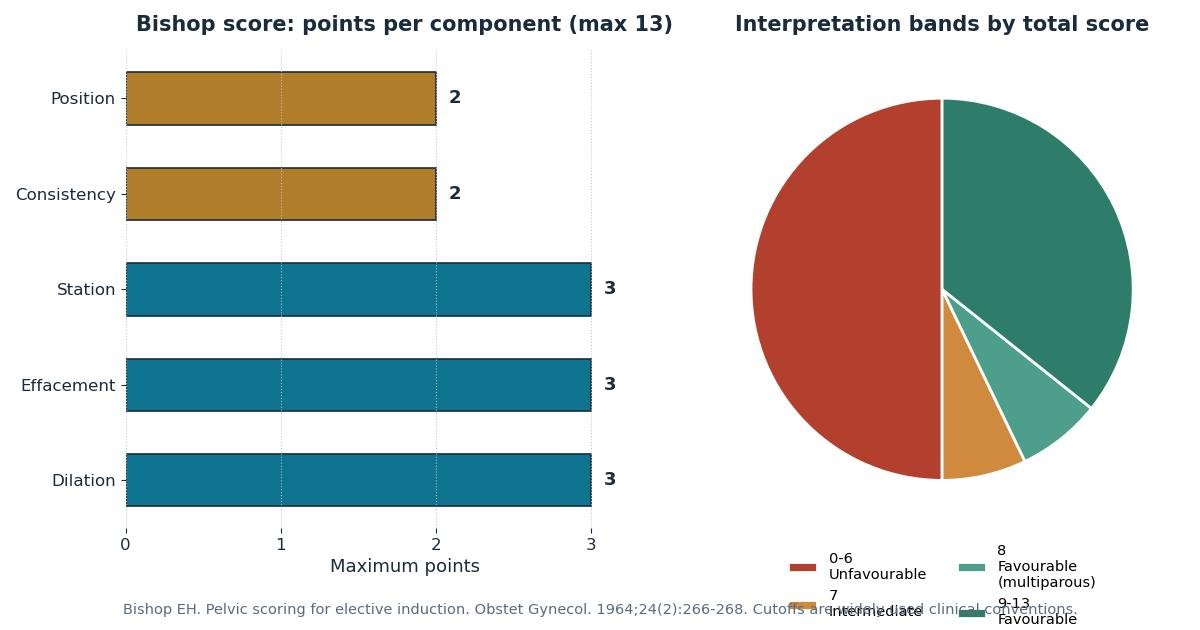
Dilation and effacement are the two most intuitive: an open, thinned cervix is further along the path to labour than a closed, thick one. Station describes how far the presenting part, usually the baby's head, has descended into the pelvis, measured in centimetres above or below the ischial spines: minus 3 is high and unengaged, plus 2 is low and nearly crowning. Consistency reflects the hormonal softening of cervical tissue that precedes labour, and position reflects the cervix swinging forward from its usual posterior tilt as labour approaches. Consistency and position are scored only 0 to 2, which is why the maximum total is 13 rather than 15.
Interpreting the total
The commonly applied cutoffs, carried forward from Bishop's original work as clinical convention, are:
- 9 to 13: favourable. Induction is likely to succeed, including in first-time mothers.
- 8: favourable in multiparous women. Women who have given birth before get a slightly lower bar because their cervices tend to respond more readily.
- 7: intermediate. Neither clearly favourable nor clearly not; the reason for induction and clinical judgement carry the decision.
- 0 to 6: unfavourable. The cervix is unlikely to respond well to oxytocin alone, and ripening is usually advised first.
It is worth being honest about what these cutoffs are: conventions, not validated prediction rules in the modern sense. Bishop derived them from a modest 1964 cohort, and obstetric practice has changed enormously since, with prostaglandins, balloon catheters, and better fetal monitoring. Later studies have questioned how well the score predicts outcomes, and simplified or modified versions have been proposed. The score remains in use because it is simple, standardised, and better than pure guesswork, not because it is precise.
What happens with an unfavourable score
An unfavourable score usually leads to cervical ripening before oxytocin. The common methods are prostaglandin preparations (dinoprostone gel or pessary, or oral misoprostol where protocols allow), mechanical methods such as a Foley balloon catheter that presses gently on the cervix, and membrane sweeping when the membranes are accessible. After ripening, the score is often reassessed, and induction proceeds when the cervix has become more favourable. None of this is automatic: the urgency of delivery, the baby's condition, and the mother's preferences all shape the plan.
How the score is used on the labour ward
In practice, the Bishop score is usually documented at the point of assessment and then rechecked after ripening, so the team can see whether the cervix has moved. Many units record it in the induction notes alongside the indication, the method chosen, and the plan for reassessment. Because the examination is brief and the arithmetic is trivial, it fits naturally into a busy triage workflow, which is part of why it has survived for sixty years while fancier prediction models have come and gone. Some centres use a simplified version that drops consistency and position, keeping only dilation, effacement and station, but the classic five-factor total remains the reference standard.
Limitations to know
The Bishop score is subjective. Two examiners can score the same cervix differently, particularly on consistency and position, and even dilation estimates vary by a centimetre or more between observers. It also captures only the cervix: it says nothing about the baby's size or position, the pelvis, or the reason induction is being considered. A favourable score does not guarantee a vaginal birth, and an unfavourable one does not make it impossible. Research has also shown that the score's predictive accuracy is modest, which is why many units treat it as one input among several rather than a gatekeeper.
What does the Bishop score measure?
The Bishop score measures how ready the cervix is for labour induction. It scores five factors found on vaginal examination: cervical dilation, effacement (thinning), station of the presenting part, cervical consistency, and cervical position. Each factor scores 0 to 2 or 0 to 3, giving a total from 0 to 13. A higher total means a more favourable cervix, which is associated with a greater chance that induction of labour will succeed.
What Bishop score is favourable for induction?
The commonly applied cutoffs are: a score of 9 or more is favourable in first-time mothers, and 8 or more is favourable in women who have given birth before. A score of 6 or less is generally considered unfavourable, meaning the cervix is unlikely to respond well to induction without ripening first. These thresholds come from the original 1964 study by Bishop and are widely used conventions, not hard rules.
What does each Bishop score component mean?
Dilation is how open the cervix is in centimetres. Effacement is how thin the cervix has become, as a percentage. Station is how low the baby's head sits relative to the ischial spines, scored from minus 3 to plus 2. Consistency is whether the cervix feels firm, medium or soft. Position is whether the cervix points backwards (posterior), to the middle, or forwards (anterior). Each is scored 0 to 2 or 0 to 3, and the five subscores are added.
Where does the Bishop score come from?
The score was introduced by Edward H. Bishop in a 1964 paper in the journal Obstetrics and Gynecology, based on observations of women undergoing elective induction. Bishop found that multiparous women with scores of 9 or more had successful inductions, while lower scores predicted failure. The system has been used ever since, with the cutoffs carried forward as clinical convention.
What happens if my Bishop score is low?
A low score does not mean induction is impossible. It usually means the clinician will ripen the cervix first, using methods such as prostaglandin gel or pessaries, a balloon catheter, or membrane sweeping, before starting oxytocin. The score is one factor among many: gestational age, the reason for induction, the baby's condition, and the mother's history all weigh on the plan.
Can I use the Bishop score to decide about my own induction?
No. The Bishop score is a clinical instrument scored during vaginal examination by a trained clinician, and its result must be interpreted alongside the full clinical picture. This calculator is educational: it shows how the score is built and what the cutoffs mean, but it cannot examine you and cannot advise whether induction is right for you. Decisions about induction belong with your obstetric team.
Key takeaways
- The Bishop score measures how ready the cervix is for labour induction.
- The commonly applied cutoffs are: a score of 9 or more is favourable in first-time mothers, and 8 or more is favourable in women who have given birth before.
- Dilation is how open the cervix is in centimetres.
- The score was introduced by Edward H.
References and further reading
Medical disclaimer
This calculator is an educational aid only. It does not examine you, does not predict your labour outcome, and does not advise on induction. The Bishop score is one instrument among many that obstetric teams use, and its result must be interpreted by a qualified clinician in the context of your full history, examination and pregnancy. If you have questions about induction of labour, discuss them with your midwife or obstetrician. Never make decisions about your pregnancy on the basis of a score alone.