PEWS Calculator: Paediatric Early Warning Score
In short: Free PEWS calculator: score the paediatric early warning score across behaviour, cardiovascular and respiratory domains plus escalation items. Total 0 to 13 with commonly applied action bands. Educational tool, not medical advice. Use the calculator above, then read the guide below to interpret your result and its limitations.
Score the paediatric early warning score across behaviour, cardiovascular and respiratory domains, each 0 to 3, plus two escalation items worth 2 points each. Total 0 to 13, with commonly applied action bands for ward escalation.
The calculator
Total PEWS: Not yet calculated
Select one option in each of the three domains to score.
What the paediatric early warning score is
Children can deteriorate quickly, and the earliest signs are often subtle: a child who stops playing, whose colour is slightly off, whose breathing is just a little harder than before. The paediatric early warning score, universally shortened to PEWS, exists to catch that drift before it becomes a crisis. It is a bedside track-and-trigger tool: a small set of observations is scored in a standardised way, the total is plotted or recorded, and rising scores trigger defined escalation steps. The idea is borrowed from adult early warning scores, which showed that structured observation beats gut feeling alone for spotting deterioration on general wards.
PEWS belongs to a family of systems rather than a single instrument. The version implemented on this page follows the widely taught three-domain structure, behaviour, cardiovascular and respiratory, each scored 0 to 3, with two escalation items worth 2 points each, giving a total from 0 to 13. An influential early description of this structure was given by Monaghan in Paediatric Nursing in 2005. Other systems exist, including the Bristol PEWS and the Bedside PEWS derived and validated by Parshuram and colleagues and published in The Lancet in 2011, which uses seven physiological items on a different scale. The scores from different systems are not interchangeable, so the first honest step is knowing which one your hospital uses.
The three domains, explained
Behaviour
Behaviour is the domain parents notice first and clinicians sometimes underweight. A child who is playing and appropriate for their age scores 0. A sleeping child scores 1, which surprises newcomers, but the logic is that sleep may mask how the child would otherwise behave, so it earns a cautious point. Irritability scores 2: the child is awake but unsettled, crying, or difficult to console. The top score of 3 covers lethargy, confusion, or a reduced response to pain, any of which suggests the brain is not getting what it needs. In practice, behaviour is often the domain that moves first, which is why experienced paediatric nurses treat a behaviour change as significant even when the vital signs still look acceptable.
Cardiovascular
The cardiovascular domain combines colour, capillary refill time and heart rate. Pink with a brisk refill of 1 to 2 seconds scores 0. Pallor or a dusky tinge with a 3-second refill scores 1. Grey or cyanotic colour with a 4-second refill, or a heart rate 20 beats above normal for age, scores 2. The maximum of 3 is reserved for grey and mottled skin with a refill of 5 seconds or more, a heart rate 30 above normal, or bradycardia, which in a child is an ominous sign. Capillary refill should be assessed with the limb at heart level and firm pressure for 5 seconds; cold rooms and cold hands both prolong refill and can mislead, so technique matters.
Respiratory
The respiratory domain scores rate, work of breathing and oxygen requirement together. Normal parameters with no recession score 0. A rate more than 10 above normal for age, visible accessory muscle use, or needing 30 percent oxygen or more scores 1. More than 20 above normal, visible retractions, or 40 percent oxygen scores 2. The top score covers a rate 5 below normal with retractions or grunting, or needing 50 percent oxygen or more: a child tiring out is more worrying than a child breathing fast and compensating well. Age-appropriate normal ranges must be to hand when scoring; adult ranges applied to children are a classic error.
The two escalation items
On top of the three domains, two situations each add a flat 2 points. The first is continuous nebuliser therapy: a child needing back-to-back nebulisers is by definition working hard to breathe, and the score should reflect that even if the domain scores have not caught up yet. The second is persistent vomiting following surgery, which flags the risk of dehydration, electrolyte disturbance and aspiration in the post-operative child. These items are deliberately blunt: they exist to force escalation for situations that the physiology scores alone might undersell.
What the total means
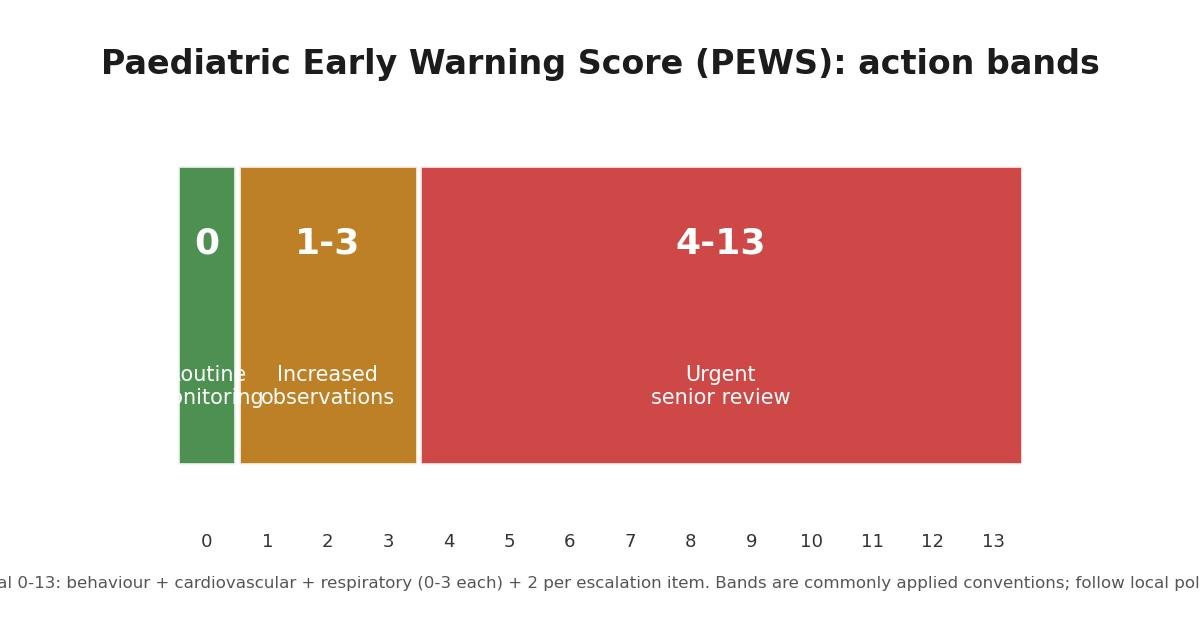
| Total PEWS | Commonly applied meaning | Usual response |
|---|---|---|
| 0 | Routine | Continue standard observations |
| 1 to 3 | Increased concern | Increase observation frequency, inform the nurse in charge |
| 4 or more | Urgent | Urgent senior review, usually via rapid response or outreach |
These bands are the commonly applied conventions, not a universal law. Individual hospitals set their own thresholds, observation frequencies and escalation pathways, and the local policy always wins over any calculator. What matters most is the trend: a child climbing from 1 to 3 over two hours is telling you something even before any threshold is crossed, which is why PEWS is charted over time rather than read as a single number.
Age-specific normal ranges you need at the bedside
Two of the three domains depend on knowing what is normal for the child's age, so keep a reference to hand. The ranges below are the commonly taught Advanced Paediatric Life Support reference values, rounded for bedside use; individual hospitals may use slightly different tables.
| Age | Heart rate (beats per minute) | Respiratory rate (breaths per minute) |
|---|---|---|
| Under 1 year | 110 to 160 | 30 to 40 |
| 1 to 2 years | 100 to 150 | 25 to 35 |
| 2 to 5 years | 95 to 140 | 25 to 30 |
| 5 to 12 years | 80 to 120 | 20 to 25 |
| Over 12 years | 60 to 100 | 15 to 20 |
Two practical points. First, a sleeping child's heart and respiratory rates fall, so score against awake norms with caution and note the state the child was in. Second, fever, pain, crying and anxiety all raise both rates; the score captures the physiology as observed, but the clinician interpreting it should know the context. A tachycardic, febrile, screaming toddler may score points that melt away once the fever settles, which is why PEWS is repeated and trended rather than acted on as a single snapshot.
Worked examples
Example 1. A 4-year-old admitted with gastroenteritis is sleeping between assessments, pink with a 2-second refill, breathing comfortably within normal parameters, and not on nebulisers. Behaviour 1, cardiovascular 0, respiratory 0, no escalation items: total 1. Increased observation frequency, nurse in charge informed, which is proportionate for a sleepy but otherwise stable child.
Example 2. A 7-year-old with asthma is irritable, pale with a 3-second refill, breathing 25 above normal for age with visible retractions on 40 percent oxygen, and on continuous nebulisers. Behaviour 2, cardiovascular 1, respiratory 2, plus 2 for the nebulisers: total 7. This crosses the urgent threshold comfortably and the child needs senior review now, which matches what any clinician would conclude at the bedside.
Example 3. A post-operative 10-year-old is playing appropriately, pink with brisk refill, breathing normally, but has vomited persistently since theatre. Domains all 0, plus 2 for post-operative vomiting: total 2. The escalation item does its job here, lifting an apparently well child into increased monitoring because of a situation the physiology scores miss.
Limitations worth knowing
PEWS was designed for general paediatric wards, and it performs less well at the extremes: neonates have different physiology, and children with chronic conditions may live permanently at scores that would alarm in a previously well child. The score also depends on the quality of the observations feeding it; a hurried capillary refill or a guessed respiratory rate produces a confident-looking number built on sand. Validation studies show PEWS discriminates deteriorating from stable children reasonably well, but no track-and-trigger system replaces the rule that staff should escalate whenever they are worried about a child, whatever the number says. Most paediatric policies now state that explicitly, and it is the most important sentence on this page.
Key takeaways
- The paediatric early warning score is a bedside track-and-trigger tool used on children's wards to spot deterioration early.
- The behaviour domain runs from playing and appropriate (0) through sleeping (1) and irritable (2) to lethargic, confused, or with reduced response to pain (3).
- In the commonly applied escalation conventions, a total of 0 means continue routine monitoring, 1 to 3 means increase the frequency of observations and inform the nurse in charge, and 4 or more means urgent review by a senior clinician, often through the hospital's rapid response or paediatric intensive care outreach team.
- Yes.