DAS28 Rheumatoid Arthritis Disease Activity Calculator
In short: Calculate DAS28-ESR and DAS28-CRP for rheumatoid arthritis. Enter tender and swollen joint counts, ESR or CRP, and patient global health to get a validated disease activity score with remission, low, moderate, and high bands. Use the calculator above, then read the guide below to interpret your result and its limitations.
Calculate your DAS28
Enter your 28-joint counts, inflammatory marker, and global health rating to calculate a validated DAS28 score for rheumatoid arthritis, with the standard activity bands from remission to high disease activity.
What the DAS28 measures
The Disease Activity Score in 28 joints, known as the DAS28, is a composite index that summarises how active rheumatoid arthritis is at a given moment. It was developed by Prevoo and colleagues and published in 1995, and it has since become one of the most widely used outcome measures in rheumatology clinics and in clinical trials of disease modifying drugs.
A single number cannot capture everything about a complex disease, so the DAS28 blends four separate pieces of information: how many of the 28 assessed joints are tender, how many are swollen, a blood marker of inflammation, and the patient's own rating of their general health. Each component is transformed mathematically and weighted, so that no single input dominates the result. The final score usually falls between 0 and 10, with higher values indicating more active disease.
The main strength of the DAS28 is consistency. Because everyone uses the same joints, the same formula, and the same cutoffs, a score measured in one clinic can be compared with a score measured years later or in a different country. That comparability is what makes it useful for tracking whether treatment is working and for deciding when treatment should be escalated.
The two formulae: DAS28-ESR and DAS28-CRP
The original DAS28 uses the erythrocyte sedimentation rate (ESR) as its inflammatory marker. The formula, from Prevoo et al. (Arthritis and Rheumatism, 1995), is:
An adapted version replaces ESR with C-reactive protein (CRP), a different and often faster responding marker of inflammation. Its formula is:
Both versions use square roots for the joint counts, which compresses the scale so that the difference between, say, 1 and 2 affected joints matters more than the difference between 20 and 21. The natural logarithm plays a similar role for the blood marker.
An honest and important point: the DAS28-CRP was designed to give similar numbers, but in practice DAS28-CRP scores tend to run slightly lower than DAS28-ESR scores for the same patient. The familiar activity cutoffs described below were originally validated for the ESR version. When following a patient over time, the safest practice is to stick to one variant at every visit so that changes in the score reflect changes in the disease rather than changes in the formula.
The 28 joints
The joint counts cover a fixed set of 28 joints: the two shoulders, the two elbows, the two wrists, the ten metacarpophalangeal joints of the hands, the ten proximal interphalangeal joints of the finger joints, and the two knees. Each joint is examined separately for tenderness (pain on pressure or movement) and for swelling (palpable synovial thickening or fluid).
Notably, several commonly affected joints are left out of the 28 joint set: the ankles, the small joints of the feet, the hips, and the joints of the spine. A patient can therefore have active disease in the feet while scoring relatively low on the DAS28. Clinicians are aware of this limitation and examine the whole patient rather than the 28 joints alone. Newer indices such as the Clinical Disease Activity Index (CDAI) and the Simplified Disease Activity Index (SDAI) use the same 28 joint framework, while some researchers prefer a 44 joint count in studies where foot involvement matters.
How to measure each input
Tender joint count (TJC28)
Tenderness is assessed by firm pressure or gentle movement of each of the 28 joints. The count is the number of joints that are tender, from 0 to 28. It must be a whole number: a joint is either tender or it is not. Tenderness reflects the patient's pain experience and can be influenced by factors beyond inflammation, such as coexisting fibromyalgia, which is one reason the score is always interpreted alongside the clinical picture.
Swollen joint count (SJC28)
Swelling is assessed by palpation for synovial thickening or effusion in each of the 28 joints. Like the tender count, it ranges from 0 to 28 as a whole number. Of the four components, the swollen joint count is generally considered the most direct clinical reflection of synovial inflammation, and experienced examiners take care to distinguish true joint swelling from bony enlargement or soft tissue oedema.
ESR or CRP
The erythrocyte sedimentation rate is reported in millimetres per hour and the C-reactive protein in milligrams per litre. Both rise with systemic inflammation, but they behave differently: CRP rises and falls within hours to days, while ESR responds more slowly and is influenced by age, anaemia, and immunoglobulin levels. Use the marker that matches the variant you selected, and record which variant was used so that future scores remain comparable.
Patient global health (GH)
The patient marks their general health on a visual analogue scale from 0 to 100, where 0 represents the best imaginable health and 100 the worst. Some clinics phrase the question as global assessment of disease activity rather than general health; either way, the number captures the patient's own perspective, which sometimes differs from what the joints and blood tests suggest. Both perspectives matter, and the DAS28 is deliberately built to include the patient's voice.
Disease activity bands
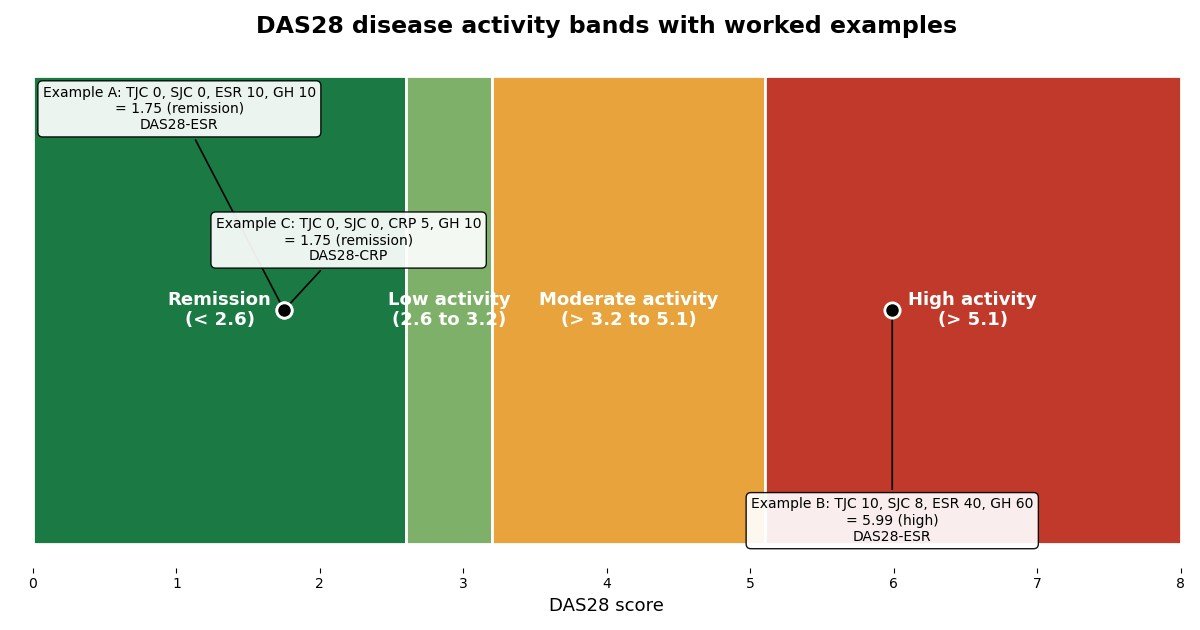
The same cutoffs are applied to both DAS28 variants in everyday practice:
| DAS28 score | Disease activity | What it means |
|---|---|---|
| Below 2.6 | Remission | No meaningful residual disease activity by this measure. |
| 2.6 to 3.2 | Low disease activity | Minimal activity; an acceptable state if remission cannot be reached. |
| Above 3.2 to 5.1 | Moderate disease activity | Ongoing inflammation that usually warrants treatment review. |
| Above 5.1 | High disease activity | Substantial activity; treatment escalation is usually considered. |
A widely used treatment target is a DAS28 below 3.2, with remission below 2.6 as the preferred goal when it can be achieved safely. These targets come from the treat to target paradigm, in which therapy is adjusted at regular intervals until the target is reached, rather than waiting for symptoms to force a change. Trials have shown that steering treatment by a numeric target produces better long term joint outcomes than symptom driven care alone.
Tracking response over time
A single score is a snapshot; the change between two scores tells you whether treatment is working. The EULAR response criteria, developed by van Gestel and colleagues, classify the response by combining the size of the improvement with the current score. An improvement of more than 1.2 points that ends at 3.2 or below is a good response. An improvement of more than 1.2 that still leaves the score above 3.2, or an improvement between 0.6 and 1.2 that ends at 5.1 or below, is a moderate response. Anything less is classed as no response.
In practice, rheumatologists review the score together with the patient's symptoms, the trend across visits, and any evidence of joint damage on examination or imaging. A falling score that remains above 3.2 after an adequate trial of therapy is often the trigger to switch or intensify treatment, while a stable score in remission supports continuing the current regimen.
Important limitations
The DAS28 is a validated and genuinely useful tool, but it has well recognised weaknesses. The 28 joint set omits the feet and ankles, so it can understate disease in patients whose arthritis concentrates there. The tender joint count and the patient global score are subjective and can be raised by pain from other causes, including osteoarthritis and fibromyalgia, which can inflate the score even when inflammation is controlled.
The blood markers have their own quirks. Some patients have active synovitis with a normal ESR or CRP, and the ESR in particular rises with age and anaemia for reasons unrelated to arthritis. Because DAS28-CRP tends to read slightly lower than DAS28-ESR, switching variants between visits can create an apparent improvement or worsening that is purely artefactual. Finally, the score summarises current activity but says nothing directly about accumulated joint damage, which is why imaging and physical examination remain part of follow up.
How to use this calculator
Select the ESR or CRP variant to match the blood test you have, then enter the four values. Joint counts must be whole numbers between 0 and 28. ESR is accepted from 1 to 300 mm/h, CRP from 0.1 to 300 mg/L, and global health from 0 to 100. The result shows the score rounded to two decimal places together with its activity band. If a value is missing, mistyped, or outside the accepted range, the calculator will tell you exactly which field needs attention instead of guessing.
Key takeaways
- Lower scores mean less disease activity.
- The original formula uses the erythrocyte sedimentation rate (ESR).
- The 28 joints are the shoulders, elbows, wrists, the ten metacarpophalangeal joints of the hands, the ten proximal interphalangeal joints of the fingers, and the knees.
- In active disease that is being treated to target, many clinics measure it every one to three months while treatment is adjusted.
Frequently asked questions
What is a good DAS28 score?
Lower scores mean less disease activity. A score below 2.6 indicates remission, and 2.6 to 3.2 indicates low disease activity. Most treat to target strategies aim for a score below 3.2, with remission as the preferred goal. Whether a score is good for you depends on your history and your treatment, so discuss your result with your rheumatologist.
What is the difference between DAS28-ESR and DAS28-CRP?
The original formula uses the erythrocyte sedimentation rate (ESR). An adapted formula replaces ESR with C reactive protein (CRP), a different blood marker of inflammation. In practice DAS28-CRP scores run slightly lower than DAS28-ESR scores for the same patient, and the familiar cutoffs were validated for the ESR version. For consistent follow up, use the same variant at every visit.
Which joints are counted in the DAS28?
The 28 joints are the shoulders, elbows, wrists, the ten metacarpophalangeal joints of the hands, the ten proximal interphalangeal joints of the fingers, and the knees. Ankles, feet, hips, and the joints of the spine are not included, which is one of the known limitations of the score.
How often should the DAS28 be measured?
In active disease that is being treated to target, many clinics measure it every one to three months while treatment is adjusted. Once remission or sustained low disease activity is reached, measurements are usually less frequent. Your rheumatologist decides the right schedule for your situation.
Can the DAS28 diagnose rheumatoid arthritis?
No. The DAS28 quantifies disease activity in people who already have rheumatoid arthritis. Diagnosis rests on clinical assessment, blood tests such as rheumatoid factor and anti CCP antibodies, and imaging, using classification criteria applied by a clinician.
What does a change in DAS28 mean for treatment?
Changes are interpreted with the EULAR response criteria, which combine the size of the improvement with the current score. An improvement of more than 1.2 points ending at 3.2 or below is a good response. Smaller improvements, or improvements that still leave the score high, are classed as moderate or no response. Treatment decisions always combine the score with your symptoms, joint damage, and other health factors, and are made with your clinician.
Sources
- Prevoo ML, van 't Hof MA, Kuper HH, van Leeuwen MA, van de Putte LB, van Riel PL. Modified disease activity scores that include twenty-eight-joint counts: development and validation in a prospective longitudinal study of patients with rheumatoid arthritis. Arthritis and Rheumatism. 1995;38(1):44-48. doi:10.1002/art.1780380107
- van Gestel AM, Prevoo ML, van 't Hof MA, van Rijswijk MH, van de Putte LB, van Riel PL. Development and validation of the European League Against Rheumatism response criteria for rheumatoid arthritis. Arthritis and Rheumatism. 1996;39(1):34-40.
Medically reviewed by Dr. Taimoor Asghar.