SLEDAI Score Calculator
In short: Free SLEDAI calculator: score lupus disease activity from 24 weighted items (0 to 105) with the commonly used activity bands. Educational tool, not medical advice. Use the calculator above, then read the guide below to interpret your result and its limitations.
Score lupus disease activity with the Systemic Lupus Erythematosus Disease Activity Index: 24 weighted items, 10 day recall, total 0 to 105.
The calculator
Tick each item that was present at any time in the last 10 days. The total updates live as you tick. Be honest about the window: only the last 10 days count.
Total SLEDAI score: 0 / 105
Activity band: No activity (0 to 0)
0 of 24 items selected.
Please note: SLEDAI measures disease activity in the last 10 days. It does not measure accumulated organ damage, which is recorded separately, for example with the SLICC/ACR Damage Index. This calculator is an educational aid. Treatment decisions need a clinician who knows your full history. This page does not diagnose lupus and does not advise on medication.
What the SLEDAI score measures
Systemic lupus erythematosus, usually called lupus or SLE, is an autoimmune condition in which the immune system attacks the body's own tissues. It can affect the skin, joints, kidneys, blood cells, lungs, heart and nervous system, and it usually follows an unpredictable course of flares, when symptoms worsen, and remissions, when they settle. Because two clinicians can look at the same patient and disagree about how active the disease is, rheumatology needed a standardised yardstick.
The Systemic Lupus Erythematosus Disease Activity Index, universally shortened to SLEDAI, was developed to be that yardstick. It was introduced by Bombardier and colleagues in a 1992 paper in Arthritis and Rheumatism (doi: 10.1002/art.1780350606) and has since become one of the most widely used activity measures in lupus care and research. The index is a checklist of 24 clinical and laboratory items. At each assessment, each item is marked as present or absent depending on whether it occurred in the previous 10 days. Each item carries a weight of 1, 2, 4 or 8 points according to its clinical importance, and the weights are added to give a single total between 0 and 105. A higher total means more active disease at that moment. Because the same list and the same weights are used every time, scores can be compared between visits, between doctors and between research studies, which is the whole point of the instrument.
How the score is worked out
Scoring SLEDAI is deliberately simple: there is no partial credit. Each of the 24 items is either present, and contributes its full weight, or absent, and contributes nothing.
The weights are not equal, and the inequality is the point. The eight items weighted at 8 points each, seizure, psychosis, organic brain syndrome, visual disturbance, cranial nerve disorder, lupus headache, cerebrovascular accident and vasculitis, are the manifestations that threaten the brain, the nerves, the eyes or the blood vessels, and each one alone is enough to push the score into a high band. The six items at 4 points each, arthritis, myositis, urinary casts, haematuria, proteinuria and pyuria, cover the joints, muscles and kidneys. The seven items at 2 points each, new rash, alopecia, mucosal ulcers, pleurisy, pericarditis, low complement and increased DNA binding, capture skin, serosal and immunological activity. The three items at 1 point each, fever, thrombocytopenia and leukopenia, are the lightest contributors.
A worked example helps. Suppose that in the last 10 days a patient had a seizure (8 points), psychosis (8 points), arthritis in several joints (4 points), a new inflammatory rash (2 points) and fever above 38°C (1 point). The total is 8 plus 8 plus 4 plus 2 plus 1, which is 23. As the band table below shows, 23 falls in the very high activity band. Change the picture to a new rash (2 points), new hair loss (2 points) and low complement (2 points) with nothing else, and the total is 6, which sits at the bottom of the moderate band. The same arithmetic, applied honestly to the 10 day window, is all there is to it.
Understanding the result bands
The original 1992 SLEDAI paper described how to build the score but did not fix cutoffs for treatment decisions, and it is worth being honest about that. The bands used on this page are the cutoffs commonly applied in the SLEDAI-2K literature and in lupus research generally. They are conventions for describing how active the disease looks, not rules that dictate treatment on their own.
| Band | Score range | What it usually means |
|---|---|---|
| No activity | 0 | No SLEDAI item present in the last 10 days. |
| Mild | 1 to 5 | Limited activity, often skin, mucosal or mild laboratory items. |
| Moderate | 6 to 10 | Several systems involved, or kidney or muscle items present. |
| High | 11 to 19 | Major organ involvement is likely. |
| Very high | 20 to 105 | Organ-threatening activity; 105 is the maximum possible score. |
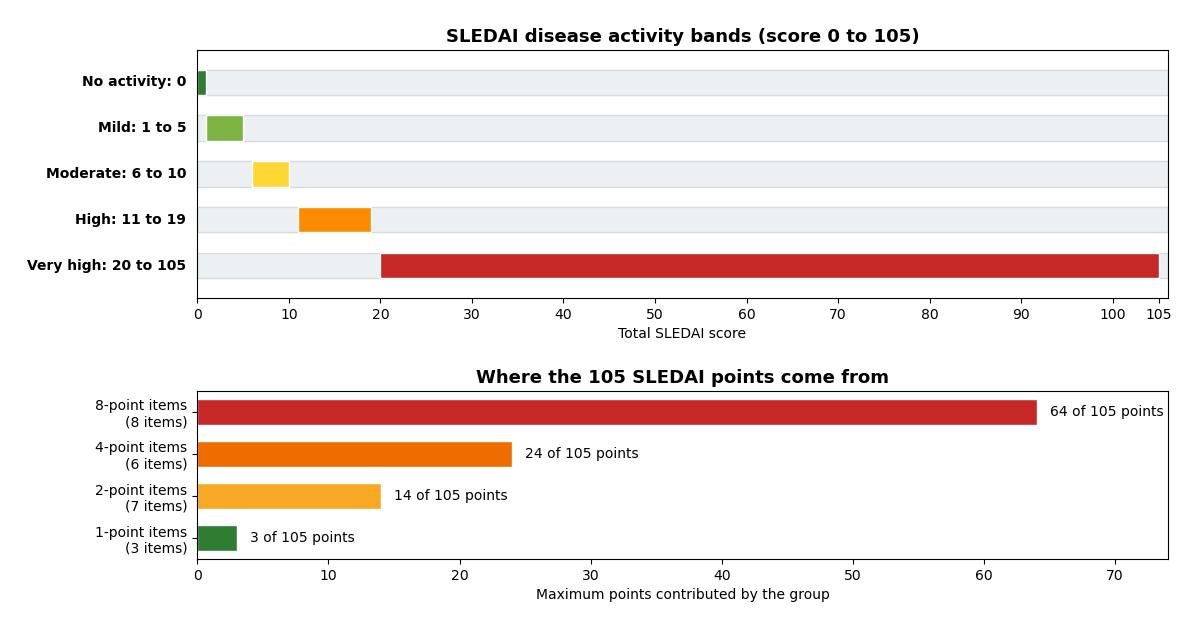
In practice the bands are read as follows. A score of 0 means no item on the checklist was present in the last 10 days, which is the definition of no measurable activity, though it does not guarantee the disease will stay quiet. Scores of 1 to 5 describe mild activity, often limited to skin, hair, mouth ulcers or mild laboratory changes. Scores of 6 to 10 describe moderate activity, where several systems are involved or a kidney item has appeared. Scores of 11 to 19 describe high activity, usually with major organ involvement. Scores of 20 or more describe very high activity, the range in which organ-threatening manifestations such as seizures, psychosis or vasculitis are typically driving the total.
Two cautions belong here. First, the same total can describe very different patients: 12 points from arthritis, rash, ulcers and low complement is a different clinical situation from 12 points driven by a single neurological item, even though the number is the same. Second, a falling score is good news only if the fall reflects genuine improvement rather than items being missed, which is why the same careful 10 day review matters at every visit.
Activity is not damage: an honest distinction
This is the most misunderstood point about SLEDAI, so it deserves its own section. SLEDAI measures activity, which is the reversible inflammation and immune disturbance happening right now. Damage is something else entirely: the irreversible change that remains after inflammation has done its work, such as a scarred kidney, a joint deformity or a stroke deficit that does not resolve.
Damage is measured with separate instruments, the best known being the SLICC/ACR Damage Index, which records permanent change present for at least six months and, by design, never goes down. SLEDAI, by contrast, is meant to go up and down as flares come and go.
The distinction matters for decisions. Immunosuppressive treatment targets activity, not damage: drugs can calm the inflammation that SLEDAI measures, but they cannot undo the scarring that a damage index records. A patient can therefore have a SLEDAI of 0 and still carry significant damage from earlier flares, or a high SLEDAI with no permanent damage yet if treatment acts quickly. When you read a SLEDAI score, read it as a weather report for the last 10 days, not as a biography of the disease.
How clinicians use the SLEDAI
In clinic, SLEDAI is most useful as a comparison, not as a single number in isolation. A score taken today means most when it is set against the score from the last visit: a fall from 14 to 4 suggests treatment is working, while a rise from 2 to 12 suggests a flare that needs attention, even though neither number alone would tell the full story.
In research, SLEDAI provides the common language that lets trials describe who was enrolled and whether the treatment changed disease activity. Response criteria used in lupus trials are often built on defined falls in SLEDAI, which is why the instrument's standardisation matters so much.
Some clinicians also use the score as a starting point for treat to target conversations, agreeing with the patient what level of activity is acceptable and adjusting therapy until the disease settles there. Used this way, the number supports a discussion; it never replaces the discussion. No guideline treats a SLEDAI band as an automatic prescription, and this calculator does not either.
Getting the inputs right
A score is only as honest as its inputs, and SLEDAI has a few traps for the unwary.
First, respect the 10 day window. It is tempting to include a dramatic symptom from three weeks ago, but the instrument is explicit: only the last 10 days count. Stretching the window inflates the total and can turn stable disease into an apparent flare.
Second, use recent laboratory results. Low complement, increased DNA binding, urinary casts, haematuria, proteinuria, pyuria, thrombocytopenia and leukopenia all need blood or urine tests from the assessment period, and the thresholds matter: proteinuria means more than 0.5 g in 24 hours, haematuria more than 4 red cells per high power field, pyuria more than 5 white cells per high power field, platelets below 100,000 and white cells below 3,000.
Third, exclude other causes before ticking an item. Fever should not be scored if infection explains it. Haematuria should not be scored if a stone or infection explains it. Low platelet or white cell counts should not be scored if a drug explains them. The original definitions insist on this attribution step, and skipping it is the commonest way to overestimate activity.
Fourth, some items genuinely need a clinician's judgement. Deciding whether confusion represents organic brain syndrome, whether a headache is a lupus headache, or whether a psychotic episode is attributable to lupus rather than to drugs or another illness, is not a do it yourself exercise. If you are scoring at home for your own understanding, leave uncertain items unticked, note them down, and raise them at your next appointment.
Limitations to keep in mind
SLEDAI is a strong instrument with known limits, and an honest page should name them.
It is binary: an item is present or absent, with no room for mild versus severe versions of the same manifestation. A faint rash and a widespread blistering eruption both score 2 points, which means the number can stay flat while the patient feels much worse, or improve on paper while important symptoms persist.
Attribution is difficult, as noted above: in real clinics, deciding whether a symptom belongs to lupus or to something else is often the hardest part of the assessment, and two experienced clinicians can reasonably disagree.
The checklist does not cover everything that matters to patients. Fatigue, for example, is one of the most burdensome symptoms in lupus and has no item of its own; joint pain without demonstrable inflammation is not scored either. A low SLEDAI therefore does not mean the patient feels well.
Finally, this page implements the original SLEDAI. The later SLEDAI-2K revision allows certain items, such as rash, alopecia, mucosal ulcers and proteinuria, to be scored when they are ongoing rather than only when new or recurrent. Scores from the two versions are close but not identical, so note which version was used when comparing with other records.
Medical disclaimer
This calculator is an educational tool. It does not diagnose systemic lupus erythematosus, it does not assess any individual patient, and it does not recommend treatment. Lupus is a complex multisystem disease, and its management needs a qualified clinician, usually a rheumatologist, who can examine you, review your history and interpret your laboratory results in context. Never start, stop or change any medication because of a score on this page. If you think you are having a flare, or if you develop worrying symptoms such as chest pain, breathlessness, a severe headache, confusion, a seizure or markedly reduced urine output, seek urgent medical care.
Key takeaways
- The SLEDAI score measures how active systemic lupus erythematosus is at the time of assessment.
- Every SLEDAI item is scored as present or absent depending on whether it occurred in the 10 days before the assessment.
- The commonly applied bands are: 0 means no activity, 1 to 5 is mild, 6 to 10 is moderate, 11 to 19 is high, and 20 or more is very high.
- No.
Frequently asked questions
What does the SLEDAI score measure?
The SLEDAI score measures how active systemic lupus erythematosus is at the time of assessment. It combines 24 clinical and laboratory items, each weighted by clinical importance, into a single total between 0 and 105. It reflects reversible disease activity over the previous 10 days, not permanent organ damage, and it is used to track change over time and to describe activity in a standardised way.
What is the 10-day recall window, and why does it matter?
Every SLEDAI item is scored as present or absent depending on whether it occurred in the 10 days before the assessment. The window matters because SLEDAI is designed to capture current activity rather than old history: a rash that cleared months ago should not raise today's score. Be honest about the window, because stretching it inflates the total and can make stable disease look like a flare.
What counts as a high SLEDAI score?
The commonly applied bands are: 0 means no activity, 1 to 5 is mild, 6 to 10 is moderate, 11 to 19 is high, and 20 or more is very high. These cutoffs are conventions used in the SLEDAI-2K literature rather than thresholds from the original 1992 paper, and a higher band describes more active disease, not a specific treatment decision.
Does a high SLEDAI score mean I have permanent organ damage?
No. SLEDAI measures disease activity, which is the reversible inflammation happening now, while permanent organ damage is measured separately with instruments such as the SLICC/ACR Damage Index. A high SLEDAI score means the disease is currently active; whether that activity has caused lasting damage is a different question that needs separate assessment by a clinician.
Can I use my SLEDAI score to change my treatment?
No. SLEDAI is an educational and research instrument, not a prescribing guide. Treatment decisions in lupus weigh the score alongside your full history, examination, laboratory results, other conditions, pregnancy plans, and the side effects of the drugs themselves. Only a clinician who knows your case should start, stop, or change any medication.
What is the difference between SLEDAI and SLEDAI-2K?
SLEDAI-2K is a later revision of the original SLEDAI that keeps the same 24 items and weights but allows some items, such as rash, alopecia, mucosal ulcers, and proteinuria, to be scored when they are ongoing rather than only when they are new or recurrent. The calculator on this page implements the original SLEDAI with its 10-day recall window for every item.