Winter's Formula Calculator: Expected pCO2 in Metabolic Acidosis
Enter the serum bicarbonate to get the expected arterial pCO2, the plus-or-minus-2 compensation band, and an interpretation of any measured pCO2 you provide.
In short: Enter the serum bicarbonate to get the expected arterial pCO2, the plus-or-minus-2 compensation band, and an interpretation of any measured pCO2 you provide. Use the calculator above, then read the guide below to interpret your result and its limitations.
Calculator
Expected pCO2 (mmHg) = (1.5 × serum HCO3−) + 8, ± 2. Use with the patient's arterial blood gas.
What Winter's formula is
Winter's formula is an equation that predicts the arterial pCO2 a patient should have if their lungs are compensating appropriately for a metabolic acidosis. In metabolic acidosis the primary disturbance is a fall in serum bicarbonate (HCO3−), and the expected respiratory response is hyperventilation, which blows off carbon dioxide and lowers the arterial pCO2. The formula converts the bicarbonate value into the pCO2 that this normal compensatory response should produce:
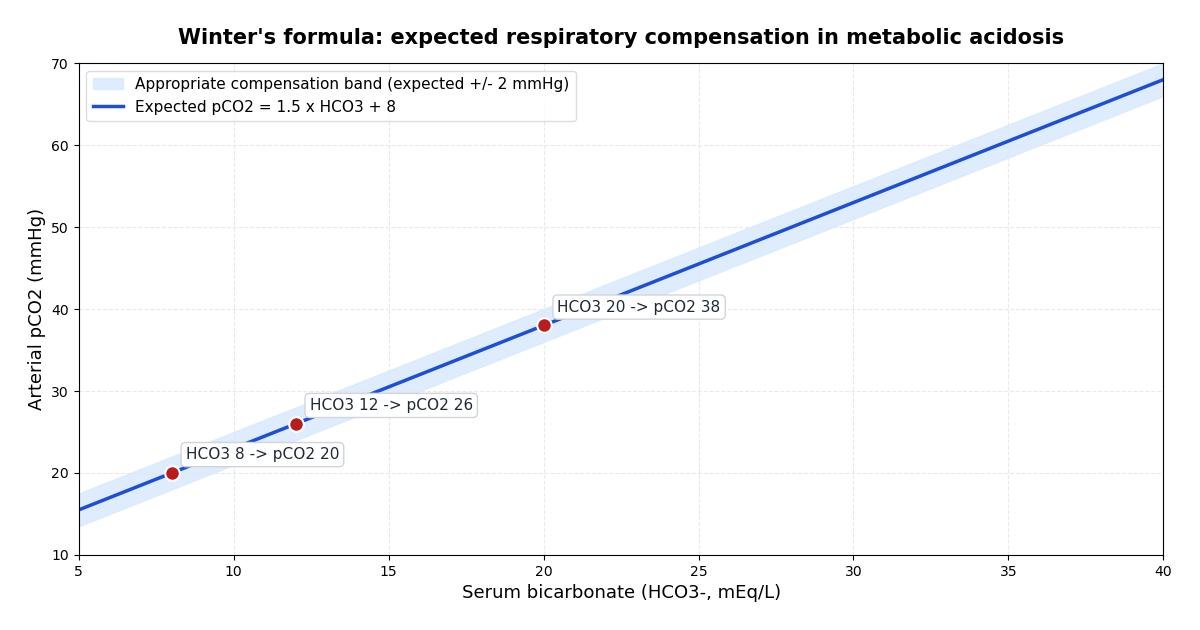
Expected pCO2 (mmHg) = (1.5 × serum HCO3− in mEq/L) + 8, ± 2.
The formula is named after R. W. Winters, an American physician and professor of pediatrics at Columbia University. In the 1960s he studied patients with varying degrees of metabolic acidosis, measuring blood pH, arterial pCO2, base excess, and plasma bicarbonate, and examined the relationship between pCO2 and bicarbonate. Winter's formula was derived from a linear regression of that relationship, which is why it is a straight-line equation: each 1 mEq/L fall in bicarbonate is associated with a 1.5 mmHg fall in the expected pCO2, and the ± 2 mmHg band captures the scatter of real patients around the regression line (source: the history section of the Winter's formula reference cited below).
The UCSF Hospital Handbook acid-base algorithm describes Winter's formula as the most precise method of estimating pCO2 compensation in metabolic acidosis, more precise than the rough rule that the expected pCO2 equals the serum bicarbonate plus 15, and more precise than the bedside rule that the expected pCO2 matches the last two digits of the pH. That handbook gives the formula exactly as above and defines the interpretation that this calculator implements.
How to use the calculator
Enter the serum bicarbonate from the chemistry panel (in mEq/L, which is numerically equal to mmol/L for bicarbonate). The calculator applies Winter's formula and returns three things: the expected pCO2, the acceptable range (expected − 2 to expected + 2 mmHg), and the arithmetic shown step by step so you can check it by hand. If you also enter the patient's actual arterial pCO2 from an arterial blood gas, the calculator compares the two and classifies the respiratory response.
Three worked examples show the arithmetic:
- HCO3− 12 mEq/L: (1.5 × 12) + 8 = 18 + 8 = 26 mmHg; acceptable range 24 to 28 mmHg.
- HCO3− 20 mEq/L: (1.5 × 20) + 8 = 30 + 8 = 38 mmHg; acceptable range 36 to 40 mmHg.
- HCO3− 8 mEq/L: (1.5 × 8) + 8 = 12 + 8 = 20 mmHg; acceptable range 18 to 22 mmHg.
Worked through by hand, the formula takes only seconds, which is why it survives as a bedside tool even though it was derived by formal regression. A useful memory check noted in teaching sources is that the expected pCO2 is roughly the bicarbonate plus 15 (the less precise rule from the UCSF algorithm), so a Winter's result far from that rough estimate should be rechecked.
What respiratory compensation means
Compensation is the body's attempt to defend the arterial pH against a primary acid-base disturbance. In metabolic acidosis the falling pH stimulates the peripheral chemoreceptors within minutes, and the respiratory center increases alveolar ventilation. The patient breathes faster and deeper, sometimes with the deep, labored Kussmaul pattern seen in severe acidosis, and each extra litre of ventilation washes out more carbon dioxide, lowering the arterial pCO2. Because carbon dioxide is an acid in the blood (it forms carbonic acid), lowering it partly offsets the low bicarbonate and defends the pH.
Two facts about compensation matter for interpretation. First, respiratory compensation for a metabolic disorder is nearly immediate, whereas metabolic (renal) compensation for respiratory disorders takes days because the kidneys must change acid excretion. So Winter's formula can be applied to an arterial blood gas taken early in the illness. Second, physiologic compensation never normalizes the pH: if the pH is normal in the presence of an acid-base disturbance, at least two primary disorders are present and offsetting each other (both points from the UCSF acid-base algorithm).
Interpreting the comparison
Once the expected pCO2 and its ± 2 mmHg band are known, the actual arterial pCO2 falls into one of three categories:
- Within the band (expected − 2 to expected + 2): respiratory compensation is appropriate, and the acid-base picture is a simple (single) metabolic acidosis.
- Above the top of the band (actual pCO2 > expected + 2): the patient is not blowing off enough carbon dioxide, which means a superimposed respiratory acidosis. Look for causes of hypoventilation such as CNS depression, airway obstruction, pneumonia, or respiratory muscle fatigue.
- Below the bottom of the band (actual pCO2 < expected − 2): the patient is hyperventilating beyond what the acidosis requires, which means a superimposed respiratory alkalosis. Consider causes such as hypoxemia, sepsis, salicylate intoxication, anxiety, or mechanical over-ventilation.
Two examples using the worked example above (HCO3− 12, expected pCO2 26, band 24 to 28 mmHg) make the pattern concrete. An actual pCO2 of 30 mmHg is above 28, so the interpretation is metabolic acidosis with superimposed respiratory acidosis. An actual pCO2 of 22 mmHg is below 24, so the interpretation is metabolic acidosis with superimposed respiratory alkalosis. Detecting the second disorder matters because mixed disorders change management: respiratory acidosis may signal impending ventilatory failure, while respiratory alkalosis in sepsis may signal the primary driver of the illness.
The meaning of the ± 2 mmHg band
The ± 2 is not a confidence interval in the statistical sense; it is the empirical scatter of real patients around the regression line from which the formula was derived. Biological systems do not sit exactly on a line, so Winters and the clinicians who validated his work accepted a 4 mmHg wide zone as the zone of appropriate compensation. Values just outside the band deserve clinical judgment rather than alarm: a pCO2 3 mmHg above expected in a drowsy patient may still be explained by mild hypoventilation, while the same gap in an alert patient warrants investigation. The band is a guide, not a wall.
At extreme bicarbonate values the linear relationship is also less trustworthy. The calculator accepts bicarbonate from 5 to 40 mEq/L; values outside that range are rejected because they lie beyond where the regression relationship has been usefully applied, and such values should prompt direct clinician review rather than a formulaic answer.
When Winter's formula does not apply
Winter's formula applies only when the primary disorder is metabolic acidosis. The UCSF acid-base algorithm explicitly notes that the expected-pCO2 calculation is omitted when the primary disorder is respiratory. Using Winter's formula on a primary respiratory acidosis or alkalosis produces a meaningless number because the causal direction is reversed: the pCO2 is the primary event, not the response.
It also does not apply to metabolic alkalosis, which has its own compensation relationship: the expected pCO2 rises by about 0.7 mmHg for each 1 mEq/L rise in bicarbonate (expected pCO2 = 0.7 × ([HCO3−] − 24) + 40, ± 2, per the UCSF algorithm). Mixing the two formulas is a common error, so the first step is always to confirm that the pH is low and the bicarbonate is low before reaching for Winter's equation.
The formula cannot detect a second metabolic disorder. A patient can have a high anion gap acidosis plus a normal anion gap acidosis, or an acidosis plus an alkalosis, and still have a pCO2 inside the Winter's band. That is why acid-base analysis continues after Winter's formula with the anion gap and the delta gap / delta bicarbonate comparison, which reveal metabolic disorders the pCO2 cannot see. Finally, Winter's formula assumes the arterial blood gas and the chemistry panel are drawn close together in time; a bicarbonate from yesterday paired with today's pCO2 can mislead.
Putting it into the acid-base workflow
In practice Winter's formula is one step in a standard sequence. First, look at the pH: below 7.35 is acidemia, above 7.45 is alkalemia. Second, identify the primary process: a low pH with a low bicarbonate points to metabolic acidosis. Third, apply Winter's formula to check the respiratory compensation and look for a second respiratory disorder, exactly as this calculator does. Fourth, calculate the anion gap (sodium minus the sum of chloride and bicarbonate) and adjust it for albumin, then compare the change in the anion gap with the change in bicarbonate to look for a second metabolic disorder. Fifth, search for the cause using the clinical context and mnemonics for the type of acidosis found. Each step constrains the next, and skipping the compensation step is how a superimposed respiratory failure gets missed.
Quantitative reviews of acid-base analysis in emergency medicine continue to present Winter's formula as the standard bedside estimate of expected pCO2 in metabolic acidosis (for example, the 2025 Journal of Emergency Medicine review of quantitative acid-base approaches cited below), and nephrology reviews of metabolic acidosis pathophysiology frame the same compensation physiology (for example, Kraut and Madias in Nature Reviews Nephrology, 2010). The formula is old, but the physiology it summarizes has not changed.
Key takeaways
- Winter's formula predicts the arterial pCO2 that should result from appropriate respiratory compensation during metabolic acidosis.
- Compare the patient's actual arterial pCO2 with the expected value.
- Winter's formula is used only when the primary acid-base disorder is metabolic acidosis, typically after a low serum bicarbonate and a low pH have identified the acidosis.
- The plus or minus 2 mmHg is the normal physiological variation around the regression line from which Winter's formula was derived.
Frequently asked questions
What is Winter's formula?
Winter's formula predicts the arterial pCO2 that should result from appropriate respiratory compensation during metabolic acidosis: expected pCO2 (mmHg) = (1.5 × serum bicarbonate in mEq/L) + 8, with an acceptable range of ± 2 mmHg. It was derived from a linear regression of measured pCO2 and bicarbonate values in patients with metabolic acidosis.
How do I interpret the result of Winter's formula?
Compare the patient's actual arterial pCO2 with the expected value. If the actual pCO2 falls within the expected range (expected ± 2), respiratory compensation is appropriate. If it is higher than the top of the range, there is a superimposed respiratory acidosis; if lower than the bottom, a superimposed respiratory alkalosis.
When should Winter's formula be used?
Only when the primary acid-base disorder is metabolic acidosis, typically after a low serum bicarbonate and a low pH have identified the acidosis. It should not be used for primary respiratory disorders, for metabolic alkalosis, or for chronic compensated states where a different relationship applies.
What does the ± 2 in Winter's formula mean?
The ± 2 mmHg is the normal physiological variation around the regression line from which the formula was derived. Actual pCO2 values within 2 mmHg of the calculated expected value count as appropriate compensation; values outside that band indicate a second, respiratory disorder on top of the metabolic acidosis.
Why does pCO2 fall when bicarbonate falls?
In metabolic acidosis the arterial pH drops, and peripheral chemoreceptors detect that acidemia within minutes. The respiratory center increases alveolar ventilation, which blows off carbon dioxide and lowers arterial pCO2. This respiratory compensation is essentially immediate, although it never returns the pH fully to normal.
What are the limitations of Winter's formula?
Winter's formula applies only to simple metabolic acidosis. It cannot distinguish mixed metabolic disorders, it does not account for chronic adaptation, and the linear relationship becomes less reliable at extreme bicarbonate values. It is a screening estimate to be interpreted alongside the full arterial blood gas, the anion gap, and the clinical picture, not a substitute for clinical judgment.
References
- Winters's formula. Wikipedia. Describes the formula (expected pCO2 = 1.5 × HCO3− + 8 ± 2), R. W. Winters' 1960s study of patients with metabolic acidosis, and the linear regression derivation. https://en.wikipedia.org/wiki/Winters%27s_formula
- Algorithm for Acid-Base Disorders. UCSF Hospital Handbook. Gives Winter's formula as the most precise method for estimating pCO2 compensation in metabolic acidosis, with the interpretation rules for measured pCO2 above or below expected. http://hospitalhandbook.ucsf.edu
- Quantitative Acid-Base: A Simplified Approach for the Emergency Physician. J Emerg Med. 2025;77:50-60. doi:10.1016/j.jemermed.2025.07.021
- Kraut JA, Madias NE. Metabolic Acidosis: Pathophysiology, Diagnosis and Management. Nat Rev Nephrol. 2010;6(5):274-285. doi:10.1038/nrneph.2010.37
- National Kidney Foundation
- Merck Manual Professional Edition
Related calculators: Acid-Base calculators