Anion Gap, Delta Gap and Delta Ratio Calculator
Compute the anion gap with optional albumin correction, then the delta gap and delta ratio to unmask mixed acid-base disorders.
In short: Compute the anion gap with optional albumin correction, then the delta gap and delta ratio to unmask mixed acid-base disorders. Use the calculator above, then read the guide below to interpret your result and its limitations.
Anion gap and delta calculator
What the anion gap measures
Plasma is electrically neutral: the total positive charge of cations must equal the total negative charge of anions. Routine laboratory panels measure only some of the ions: typically sodium on the cation side, and chloride plus bicarbonate on the anion side. The anion gap is the arithmetic difference between the measured cations and the measured anions:
This calculator follows the common convention of not including potassium in the gap (the "AG without K"). Some laboratories add potassium to the cation side, which raises the gap and its normal range by about 4 mEq/L. Because electrolyte values reported in mEq/L and mmol/L are numerically identical for these monovalent ions, no unit conversion is needed for sodium, chloride, or bicarbonate. The gap is not a measured substance; it is a calculated screen for unmeasured anions, and its main clinical job is to classify a metabolic acidosis as high-anion-gap or normal-anion-gap (hyperchloremic).
What actually sits in the gap: unmeasured anions
The gap exists because real plasma contains anions the basic panel does not report. The largest contributor by far is albumin, a negatively charged protein. Phosphate and sulfate add smaller amounts, and in disease states organic acids such as lactate, ketoacids (beta-hydroxybutyrate, acetoacetate), and the formate, glycolate, and oxalate of toxic alcohol ingestions add more. A widening gap therefore means unmeasured acid is accumulating. The classic causes of a high-anion-gap metabolic acidosis are taught with the MUDPILES mnemonic: methanol, uremia, diabetic ketoacidosis, propylene glycol, isoniazid and iron, lactic acidosis, ethylene glycol, and salicylates. Conversely, unmeasured cations shrink the gap, which is why multiple myeloma paraproteins, hypercalcemia, lithium, and bromide can produce a low gap.
Normal values, assay differences, and the assumed baseline
The assumptions behind this calculator must be stated explicitly, because the delta gap and delta ratio are anchored to assumed normal values. Classic teaching gives a normal anion gap of 8 to 12 mEq/L, while modern ion-selective electrode assays often report lower reference ranges, commonly 3 to 11 mEq/L. To avoid flagging ordinary modern-assay results as abnormal, this calculator reads 4 to 12 mEq/L as the normal band for interpretation (so a gap of 7 is normal here), flags a gap below 4 as low, and uses a baseline of 12 mEq/L with a baseline bicarbonate of 24 mEq/L for all delta maths. A gap of 9 may still be flagged as high by a modern laboratory while it sits comfortably inside the classic range, so always check your own laboratory's reference range before acting on a borderline result. A low gap is usually hypoalbuminemia rather than anything reassuring: correct for albumin before concluding the gap is normal.
Why the albumin correction matters
Because albumin is the dominant unmeasured anion, a low serum albumin narrows the gap and can conceal a real high-gap acidosis. In critically ill, septic, malnourished, or postoperative patients, hypoalbuminemia is the rule rather than the exception, and relying on the uncorrected gap misses acid loads. The standard adjustment is the Figge-Jabor-Kazda-Fencl correction:
In words: add roughly 2.5 mEq/L for every 1 g/dL that albumin falls below 4.0 g/dL. For example, a measured gap of 14 mEq/L with an albumin of 2.0 g/dL corrects to 14 + 2.5 × 2.0 = 19.0 mEq/L, which converts an apparently normal gap into a clearly high one. When albumin is provided, this calculator uses the corrected gap (not the raw gap) for the delta gap and delta ratio, because the delta maths are meant to compare the true unmeasured anion load against bicarbonate. Some institutions use a slightly different correction factor, so confirm local practice, but 2.5 per g/dL is the widely taught standard.
Delta gap and delta ratio: finding the hidden second disorder
A high-anion-gap metabolic acidosis is rarely the whole story, especially after resuscitation. When unmeasured acid enters the blood, each milliequivalent of acid consumes about one milliequivalent of bicarbonate, so the rise in the anion gap should roughly match the fall in bicarbonate. The delta gap and the delta ratio (also called the delta-delta) test that match. The delta gap subtracts the bicarbonate fall from the gap rise:
If the gap rose more than bicarbonate fell (delta gap above +6), extra bicarbonate is present from a concurrent metabolic alkalosis, for example vomiting or diuretic use. If bicarbonate fell more than the gap rose (delta gap below −6), a concurrent normal-anion-gap acidosis is consuming bicarbonate without widening the gap, a common pattern during recovery from diabetic ketoacidosis when urinary ketone loss leaves a hyperchloremic acidosis behind. A delta gap near zero fits a pure high-gap acidosis.
The delta ratio divides the same two changes instead of subtracting them:
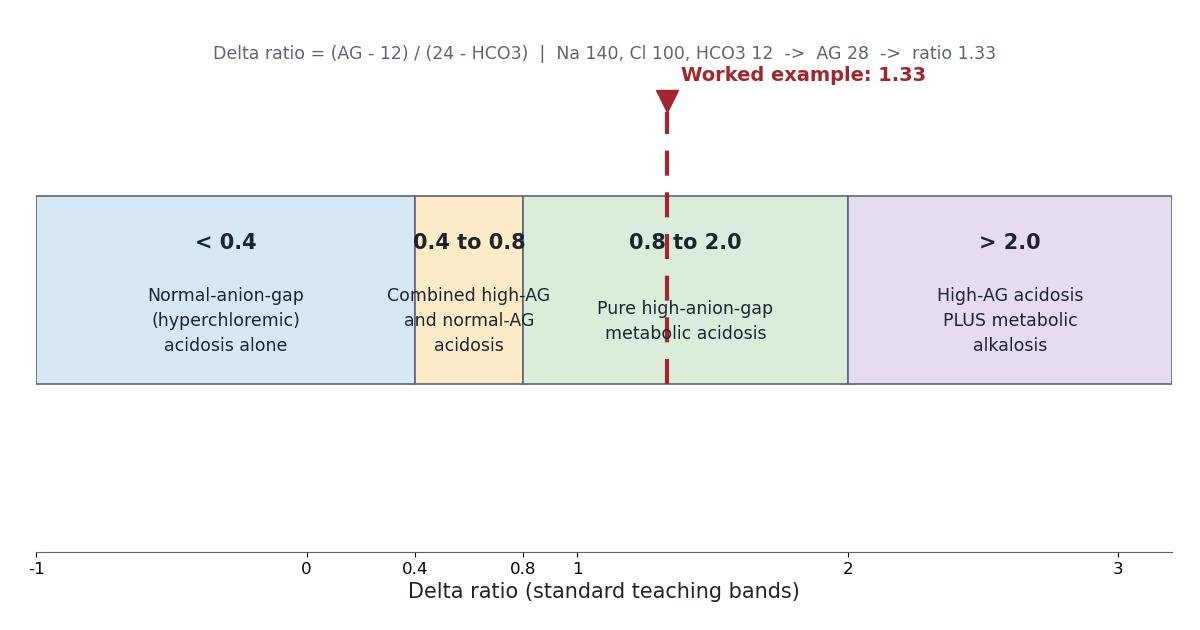
Standard teaching bands: below 0.4 indicates a normal-anion-gap (hyperchloremic) acidosis alone; 0.4 to 0.8 indicates combined high-gap and normal-gap acidosis; 0.8 to 2.0 indicates pure high-anion-gap metabolic acidosis; above 2.0 indicates high-gap acidosis plus metabolic alkalosis (or a chronic respiratory alkalosis that has retained bicarbonate). In practice, lactic acidosis averages around 1.6 on this scale while diabetic ketoacidosis sits near 1, partly because urinary ketone loss drags the ratio down. The ratio is often below 1 in the acidosis of renal failure, so a mixed picture there should be judged cautiously.
Worked examples
Example 1: pure high-gap acidosis. Sodium 140, chloride 100, bicarbonate 12 mEq/L. Anion gap = 140 − (100 + 12) = 28 mEq/L. The gap rise is 28 − 12 = 16 and the bicarbonate fall is 24 − 12 = 12. Delta gap = 16 − 12 = +4 mEq/L, and delta ratio = 16 / 12 = 1.33, which falls in the 0.8 to 2.0 band for pure high-anion-gap metabolic acidosis. This is the marker plotted on the chart above.
Example 2: normal gap. Sodium 140, chloride 115, bicarbonate 18 mEq/L. Anion gap = 140 − (115 + 18) = 7 mEq/L, which is normal. With a low bicarbonate and a normal gap, the pattern is a normal-anion-gap (hyperchloremic) metabolic acidosis, and the delta ratio is not an interpretable mixed-disorder check because there is no high-gap component.
Example 3: hidden high gap plus an inapplicable ratio. A measured gap of 14 mEq/L with albumin 2.0 g/dL corrects to 14 + 2.5 × (4.0 − 2.0) = 19.0 mEq/L, unmasking a high-gap acidosis. If the bicarbonate is 24 mEq/L, the delta ratio would divide by (24 − 24) = 0. Rather than returning infinity or an error, this calculator reports the ratio as not applicable and keeps the delta gap, which remains informative: with a corrected gap of 19 and bicarbonate of 24, the delta gap is (19 − 12) − (24 − 24) = +7 mEq/L, pointing toward a concurrent metabolic alkalosis.
| Delta ratio | Interpretation |
|---|---|
| < 0.4 | Normal-anion-gap (hyperchloremic) acidosis alone |
| 0.4 to 0.8 | Combined high-anion-gap and normal-anion-gap acidosis |
| 0.8 to 2.0 | Pure high-anion-gap metabolic acidosis |
| > 2.0 | High-anion-gap acidosis plus metabolic alkalosis (or chronic respiratory alkalosis) |
Limitations and pitfalls
The delta bands are teaching guides, not diagnoses. They assume the baseline gap of 12 and baseline bicarbonate of 24 stated above; in a patient whose true baseline differs, the arithmetic still runs but the interpretation shifts. A negative delta ratio in a patient with a genuinely elevated gap means the bicarbonate is above 24, which is itself abnormal and usually reflects a concurrent alkalosis rather than "no disorder". The delta maths cannot detect respiratory disorders at all: always check pH and pCO2, and use Winter's formula to judge whether respiratory compensation is appropriate before calling a disorder pure. When toxic alcohol ingestion is possible (methanol, ethylene glycol), calculate the osmolar gap instead of leaning on the anion gap alone, because early presentations can have a normal gap. Finally, hypoalbuminemia is the single most common reason the gap looks falsely reassuring, which is why the albumin field exists: never exclude an acid load from an uncorrected gap in a sick patient.
Sources
- Delta ratio: formula, derivation, and interpretation bands. en.wikipedia.org/wiki/Delta_ratio
- Anion gap calculator: albumin correction (2.5 mEq/L per 1 g/dL below 4.0), potassium convention, and delta ratio bands. onlycalculators.com anion gap calculator
- Tales of the Anion Gap, Part III: delta ratio examples, lactic acidosis average 1.6, DKA around 1, ratio above 2 with concurrent alkalosis. hcplive.com
- Brodkey FD. An Algorithmic Approach to the Patient with Metabolic Acidosis. J Emerg Med Trauma Surg Care 2016. Delta ratio definition and band interpretation. heraldopenaccess.us
- Figge-Jabor-Kazda-Fencl albumin correction equation and its use in critically ill patients. springermedizin.de and Springer Nature Archives of Public Health
- Acid-base assessment guidelines: delta ratio bands, albumin correction of 2.5 mEq/L per 1 g/dL, ratio often below 1 in renal failure acidosis. Academic Half Day acid-base reference sheet (PDF)
- MUDPILES and HARDUP mnemonics, albumin correction, and delta ratio teaching summary. kbrainmedstudies arterial blood gas interpretation notes
Related calculator: Osmolar gap (useful when toxic alcohol ingestion is suspected).
Key takeaways
- The anion gap is the difference between measured cations and measured anions in plasma: sodium minus (chloride plus bicarbonate), all in mEq/L.
- Albumin is the largest contributor to the normal anion gap.
- The delta gap compares the rise in the anion gap above 12 with the fall in bicarbonate below 24: (AG - 12) - (24 - HCO3).
- The delta ratio divides the rise in anion gap by the fall in bicarbonate: (AG - 12) / (24 - HCO3).