What is the osmolal gap?
The osmolal gap is the difference between the measured serum osmolality and the calculated serum osmolarity. The measured value comes from the laboratory, usually by freezing point depression, and it reflects every dissolved particle in the serum, whether the clinician expects it or not. The calculated value is an estimate built from the major measured solutes: sodium, urea (as BUN) and glucose, with ethanol added when the patient has been drinking. Subtracting the estimate from the measurement leaves the gap: the contribution of everything the formula does not count.
A normal serum osmolality sits roughly between 275 and 295 mOsm/kg. When the measured value exceeds the calculated value by more than about 10 mOsm/kg, unmeasured osmoles are present in meaningful amounts. The test is ordered when those unmeasured osmoles might be dangerous: suspected toxic alcohol ingestion, an otherwise unexplained high-anion-gap metabolic acidosis, coma or confusion of unknown cause, or monitoring during mannitol therapy. It is a screening calculation, not a definitive test. It tells you that something unmeasured is there; it does not tell you what it is.
The osmolal gap earned its place in emergency and critical care because the toxic alcohols are among the few immediately life-threatening causes of a widened gap, and because early treatment changes outcomes. Methanol and ethylene glycol poisonings progress from an osmolal gap (the parent alcohol circulating) to a high-anion-gap metabolic acidosis with organ injury (as the alcohol is metabolised to formate, glycolate and oxalate). Recognising the pattern early, as described in the approach of Kraut and Xing (American Journal of Kidney Diseases, 2011), is what makes the gap clinically valuable rather than merely academically interesting.
Osmolality versus osmolarity: an honest distinction
You will see both words, and the distinction is real even if clinicians often blur it. Osmolality is the number of osmoles per kilogram of water (the solvent); it is what the laboratory measures. Osmolarity is the number of osmoles per litre of solution; it is what the formula calculates. Strictly speaking, then, the "osmolal gap" is measured osmolality minus calculated osmolarity, a subtraction of two quantities with slightly different denominators.
In practice the difference is negligible. Plasma is about 93% water, so the two quantities differ by roughly one percent at physiological concentrations, far less than the clinical cut-offs in play. That is why the terms are used interchangeably at the bedside and in much of the literature, and why no correction between the two is applied in routine use. Purists object to equating them, and they have a point, but the clinical gap is defined and validated exactly as presented here: measured minus calculated, no conversion step. Some authors use the neutral term "osmol gap" when they want to sidestep the terminology debate entirely.
The formula, step by step
In conventional (US) units, with BUN and glucose in mg/dL and sodium in mEq/L:
Calculated osmolarity = 2 x Na + BUN / 2.8 + glucose / 18
Each part has a reason. Sodium is multiplied by two to account for its accompanying anions, principally chloride and bicarbonate, which contribute roughly as many osmoles as sodium itself. The divisor 2.8 converts BUN from mg/dL into mmol/L of urea: it folds together the molecular weight of urea and the fact that BUN measures only the nitrogen fraction. The divisor 18 converts glucose from mg/dL into mmol/L using the molecular weight of glucose (180). When ethanol is present, add ethanol / 4.6, which converts mg/dL of ethanol into mmol/L using its molecular weight of 46.
In SI units, where urea and glucose are already in mmol/L, the formula is cleaner:
Calculated osmolarity = 2 x Na + urea + glucose (+ 1.25 x ethanol)
The ethanol factor of 1.25 in SI units is the counterpart of the 4.6 divisor in conventional units, adjusted for the empirical observation (discussed below) that ethanol does not behave as a perfectly ideal osmole. This calculator offers both unit systems and applies the ethanol correction only when you tick the box and supply a value.
| Component | US units (mg/dL) | SI units (mmol/L) | What it represents |
|---|---|---|---|
| Sodium | 2 x Na (mEq/L) | 2 x Na (mmol/L) | Sodium plus its accompanying anions; the dominant term |
| Urea | BUN / 2.8 | urea | mg/dL of urea nitrogen converted to mmol/L of urea |
| Glucose | glucose / 18 | glucose | mg/dL converted to mmol/L (molecular weight 180) |
| Ethanol (optional) | ethanol / 4.6 | 1.25 x ethanol | Subtracted so ordinary drinking does not mimic poisoning |
Why ethanol gets its own correction
Ethanol is itself an osmotically active molecule. A patient who has simply been drinking will have a measurable osmolal gap from ethanol alone: for example, an ethanol concentration of 92 mg/dL contributes 20 mOsm/kg (92 divided by 4.6), which by itself pushes the gap above the normal cut-off. If ethanol is present but not included in the calculation, the gap is falsely inflated and can mimic a toxic alcohol ingestion that is not there.
The correction matters doubly because co-ingestion is common: people who ingest methanol or ethylene glycol have often been drinking ordinary alcohol as well, whether accidentally (contaminated beverages) or deliberately. The ethanol concentration should therefore be measured and its contribution subtracted before the gap is interpreted. One nuance worth knowing: the molecular weight of ethanol is 46, which gives the divisor 4.6 used here and in the standard references, but empirical data suggest ethanol does not act as an ideal osmole in solution, and some sources use a divisor of 3.7 instead. The difference shifts the gap by a few points at high ethanol concentrations; either way, the principle is the same: account for ethanol explicitly, or it will masquerade as something worse.
What counts as normal, and why the range is debated
The commonly taught reference range for the osmolal gap is -14 to +10 mOsm/kg, and a gap above 10 is considered elevated. That range is a teaching convention, and the honest version of the story is that the "normal" gap depends on which equation you use. A prospective study by Hoffman and colleagues (Annals of Emergency Medicine, 1993) measured the gap in 305 consecutive patients with the standard equation including the ethanol term and found a mean gap of -2 with a standard deviation of 6 mOsm/kg; different published equations shifted the average gap anywhere from -5 to +15. The authors' warning stands: absolute values are very dependent on the equation, and small gaps near the cut-off should not be used to rule out toxic alcohol ingestion.
Two practical consequences follow. First, compare like with like: if you follow a gap over time, use the same equation and the same laboratory each time, because switching equations can move the number by more than the clinical threshold. Second, treat the cut-off as a screening line, not a wall. A gap of 12 in a patient with a clear alternative explanation and no concerning history is different from a gap of 8 in a patient found confused next to an empty container of antifreeze. The calculator flags values outside -14 to +10, but the clinical context always governs what the number means.
What an elevated gap means
An elevated gap means osmotically active substances are circulating that the formula does not count. The differential diagnosis is short, which is precisely what makes the test useful. The urgent causes are the toxic alcohols. Methanol (molecular weight 32) is the most osmotically potent per unit concentration: 80 mg/dL corresponds to 25 mmol/L (800 mg per litre divided by 32), so it adds roughly 25 mOsm/kg to the gap. Ethylene glycol (molecular weight 62) adds about half as much at the same concentration, roughly 13 mOsm/kg for 80 mg/dL. Both are metabolised to acids that cause a high-anion-gap metabolic acidosis with end-organ injury: formate in methanol poisoning (optic nerve injury and blindness), glycolate and oxalate in ethylene glycol poisoning (renal failure from oxalate crystals).
Isopropanol (rubbing alcohol) is the instructive exception: it raises the osmolal gap but is metabolised to acetone, a ketone without an accompanying acidosis, so the classic picture is an elevated gap with ketosis but no high anion gap. Propylene glycol, a solvent in some intravenous medications such as lorazepam infusions, can raise the gap and, at high doses, cause a lactic acidosis. Mannitol, given therapeutically for raised intracranial pressure, is an unmeasured osmole by design and widens the gap while it circulates. Very high lactate concentrations can also nudge the gap upward slightly, which is worth remembering before attributing a modestly elevated gap in a critically ill patient to a toxin.
| Unmeasured osmole | Gap effect | Acidosis? | Notes |
|---|---|---|---|
| Methanol | Large: about 25 mOsm/kg per 80 mg/dL | Yes: high anion gap (formate) | Risk of blindness; medical emergency |
| Ethylene glycol | Moderate: about 13 mOsm/kg per 80 mg/dL | Yes: high anion gap (glycolate, oxalate) | Risk of renal failure; medical emergency |
| Isopropanol | Moderate | No: ketosis without acidosis | Gap without anion gap is the clue |
| Propylene glycol | Variable | Possible lactic acidosis at high doses | Consider with compatible IV infusions |
| Mannitol | Variable | No | Expected during therapy; not poisoning |
| Ethanol (uncorrected) | 20 mOsm/kg per 92 mg/dL | No | Correct for it; do not mistake it for poisoning |
The anion gap connection
The osmolal gap is most powerful when read together with the anion gap, which is the subject of the widely cited approach by Kraut and Xing (American Journal of Kidney Diseases, 2011; DOI 10.1053/j.ajkd.2011.05.012). Their framework starts from a simple observation: methanol and ethylene glycol poisonings evolve through two phases. Early on, the parent alcohol circulates unmetabolised, producing a high osmolal gap with little or no acidosis. Later, as alcohol dehydrogenase converts the parent compound into toxic acids, the osmolal gap falls and a high-anion-gap metabolic acidosis rises in its place.
The combination of an increased osmolal gap with a high-anion-gap metabolic acidosis is therefore the classic signature of methanol or ethylene glycol poisoning in its middle phase, when both the parent alcohol and its acid metabolites are present. An elevated gap without an anion gap points instead toward isopropanol (or ethanol, or mannitol). Co-ingested ethanol slows the metabolism of the toxic alcohols by competing for alcohol dehydrogenase, which stretches out the timeline and can keep the gap elevated longer while delaying the acidosis. This is also the pharmacological basis of treatment: blocking alcohol dehydrogenase with fomepizole (or, historically, ethanol itself) plus haemodialysis to remove the toxin and its metabolites. None of this is managed with a calculator; it is managed in an emergency department, urgently.
How to use this calculator
- Choose the unit system. US units expect BUN, glucose and ethanol in mg/dL; SI units expect urea, glucose and ethanol in mmol/L. Sodium is in mEq/L (US) or mmol/L (SI), which are numerically identical. The labels update when you switch.
- Enter the measured serum osmolality in mOsm/kg, exactly as the laboratory reported it.
- Enter sodium, BUN (or urea), and glucose from the same blood draw if possible. Values from samples drawn hours apart can create a misleading gap.
- Decide on the ethanol correction. If the patient has been drinking, or if ethanol intoxication is possible, tick the box and enter the serum ethanol. The calculator adds ethanol / 4.6 (US) or 1.25 x ethanol (SI) to the calculated value. If ethanol is unknown, leave it out and interpret cautiously.
- Press "Calculate osmolal gap". The result shows the calculated osmolarity with a component-by-component breakdown, the measured osmolality, the gap, and an interpretation: elevated (above 10), normal (-14 to +10), or below normal (recheck).
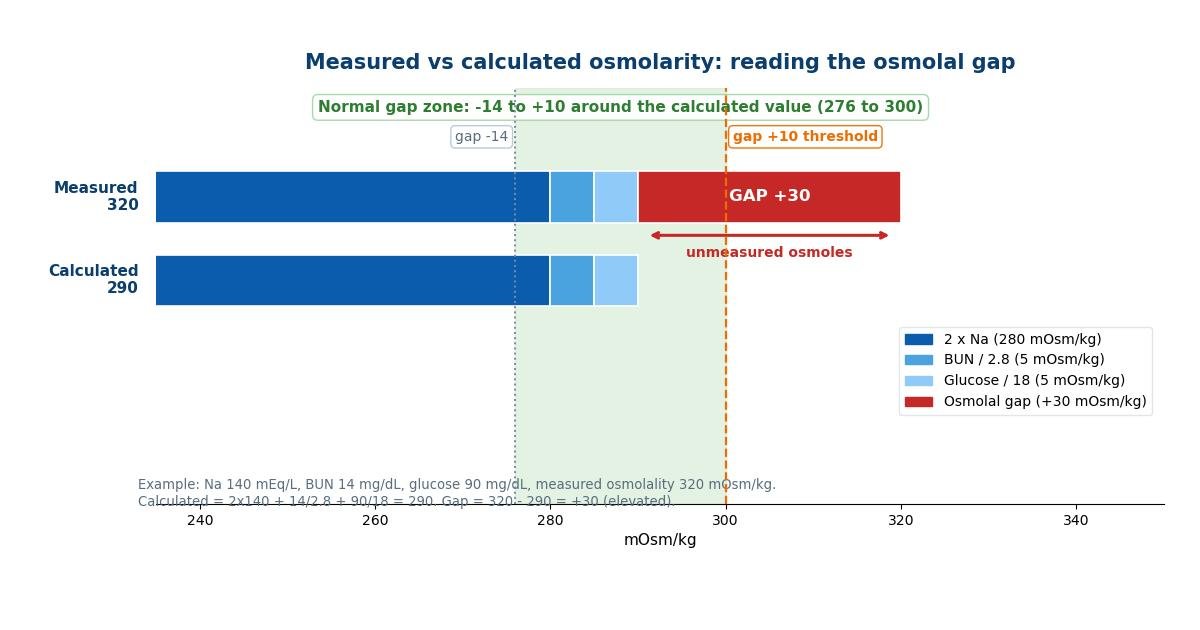
Worked example: sodium 140 mEq/L, BUN 14 mg/dL, glucose 90 mg/dL, measured osmolality 320 mOsm/kg, no ethanol. Calculated = 2 x 140 + 14 / 2.8 + 90 / 18 = 280 + 5 + 5 = 290. Gap = 320 - 290 = +30 mOsm/kg: elevated, suggesting a substantial load of unmeasured osmoles. The chart below visualises exactly this example: the stacked components of the calculated value, the red gap segment, and the normal band.
Limitations
The osmolal gap is a screening calculation with well-known blind spots, and using it safely means knowing them. First, timing dominates everything: very early after ingestion the gap can be normal because little has been absorbed, and late after ingestion it can be normal again because the parent alcohol has been fully metabolised to acids. The most dangerous presentations can therefore coincide with the least impressive numbers. A normal gap never rules out toxic alcohol poisoning when the history or the anion gap is concerning.
Second, the gap does not identify the substance. Methanol, ethylene glycol, isopropanol and the rest all look identical as far as the arithmetic is concerned; distinguishing them requires the clinical picture, the anion gap, specific assays where available, and sometimes the response to therapy. Third, the calculation is only as good as its inputs: samples drawn at different times, haemolysed specimens, pseudohyponatraemia from severe hyperlipidaemia or hyperproteinaemia, and uncorrected ethanol all distort the result. A markedly negative gap (below -14) is usually a signal to recheck rather than a physiological finding.
Finally, the cut-offs are population-derived screening lines, validated as clues rather than as diagnostic criteria. Small gaps near the threshold carry the least information, as the Hoffman study demonstrated, and the gap must always be read alongside the anion gap, the arterial blood gas, the clinical history, and the tempo of the illness. When toxic alcohol poisoning is genuinely suspected, the correct response is urgent emergency care and confirmatory testing, not a second opinion from a calculator.
Key takeaways
- The osmolal gap is the measured serum osmolality minus the calculated serum osmolarity.
- In conventional units: 2 x sodium (mEq/L) + BUN (mg/dL) / 2.8 + glucose (mg/dL) / 18, plus ethanol (mg/dL) / 4.6 if ethanol is present.
- The commonly taught reference range is -14 to +10 mOsm/kg, and a gap above 10 is considered elevated.
- An elevated gap means osmotically active substances are present that the formula does not count.
Frequently asked questions
What is the osmolal gap?
The osmolal gap is the measured serum osmolality minus the calculated serum osmolarity. The measured value comes from the laboratory (usually by freezing point depression) and reflects every dissolved particle in the serum. The calculated value estimates the osmolarity from the major measured solutes: sodium, urea and glucose, plus ethanol if present. When the measured value is higher than the calculated value by more than about 10 mOsm/kg, unmeasured osmoles are present, and toxic alcohol ingestion is one of the most important possibilities.
How is the calculated osmolarity derived?
In conventional units: 2 x sodium (mEq/L) + BUN (mg/dL) / 2.8 + glucose (mg/dL) / 18, plus ethanol (mg/dL) / 4.6 if ethanol is present. Sodium is doubled to account for its accompanying anions, mainly chloride and bicarbonate. The divisors 2.8, 18 and 4.6 convert mg/dL into mmol/L using the molecular weights of urea nitrogen, glucose and ethanol. In SI units the same formula is 2 x sodium + urea + glucose + 1.25 x ethanol, all in mmol/L.
What is the normal osmolal gap?
The commonly taught reference range is -14 to +10 mOsm/kg, and a gap above 10 is considered elevated. The exact normal range depends on which equation is used to calculate osmolarity: one prospective study of 305 patients found a mean gap of -2 with a standard deviation of 6 using the standard equation, and different equations shifted the average gap anywhere from -5 to +15. For that reason, small gaps near the cut-off should be interpreted cautiously and in clinical context.
What causes an elevated osmolal gap?
An elevated gap means osmotically active substances are present that the formula does not count. The clinically urgent causes are the toxic alcohols: methanol, ethylene glycol and diethylene glycol. Other causes include isopropanol (which raises the gap without causing metabolic acidosis), propylene glycol from intravenous medications, mannitol therapy, and, rarely, severe lactic acidosis or diabetic ketoacidosis. The gap does not identify which substance is present; it only shows that unmeasured osmoles exist.
Why does ethanol need its own correction?
Ethanol is itself an osmole, so a patient who has been drinking will have an elevated osmolal gap from ethanol alone. If ethanol is present but not subtracted in the calculation, the gap is falsely inflated and can mimic a toxic alcohol ingestion. Co-ingestion of ordinary ethanol with a toxic alcohol is common, so the ethanol concentration should be measured and its contribution (ethanol in mg/dL divided by 4.6, or 1.25 times ethanol in mmol/L) subtracted before the gap is interpreted.
Can the osmolal gap be normal in toxic alcohol poisoning?
Yes, and this is one of the most dangerous traps. Very early after ingestion, before much is absorbed, the gap can still be normal. Late after ingestion, when the parent alcohol has been metabolised to its toxic acids (formate from methanol, glycolate and oxalate from ethylene glycol), the gap falls back toward normal while a severe high-anion-gap metabolic acidosis develops. Co-ingested ethanol slows this metabolism and changes the timing further. A normal gap therefore never rules out toxic alcohol poisoning when the clinical suspicion is high.
References and further reading
Medically reviewed by Dr. Taimoor Asghar, Physician and Community Medicine Researcher. Key reference: Kraut JA, Xing M. Approach to the evaluation of a patient with an increased serum osmolal gap and high-anion-gap metabolic acidosis. Am J Kidney Dis. 2011;58(3):482-494. DOI: 10.1053/j.ajkd.2011.05.012.