What the BUN to creatinine ratio tells you
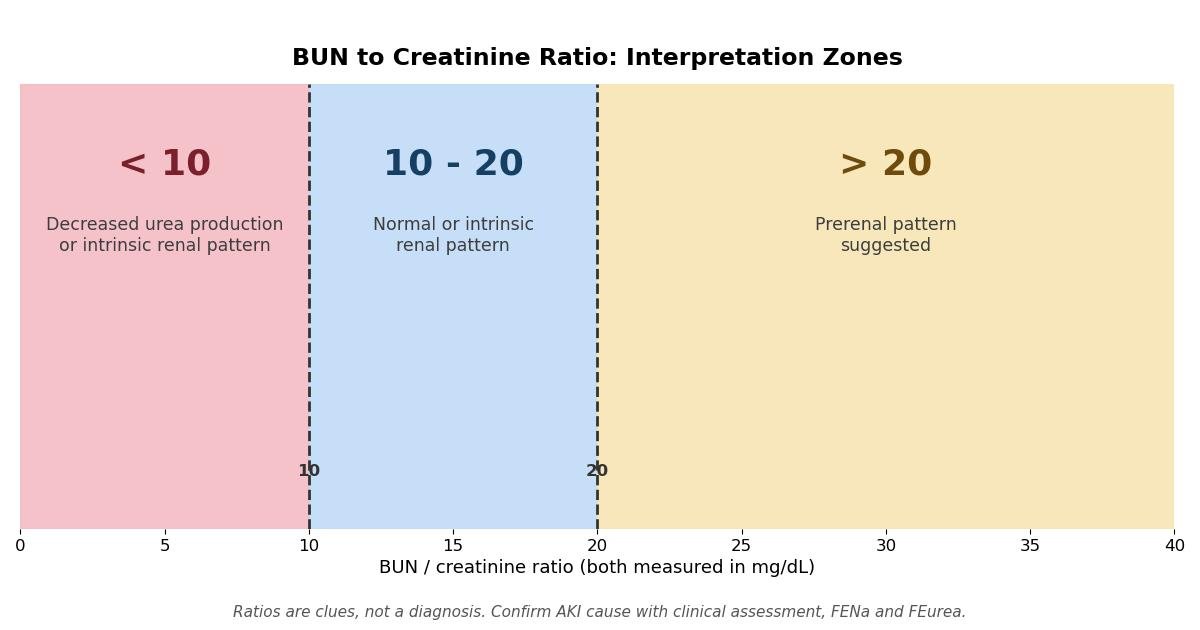
When kidney function tests come back abnormal, clinicians often look beyond the individual numbers and at the relationship between them. The BUN to creatinine ratio is one of the oldest bedside tools for this purpose. Both blood urea nitrogen (BUN) and serum creatinine rise when the kidneys filter less blood, but they do not rise in lockstep, and the pattern of their rise carries information. A BUN of 28 mg/dL with a creatinine of 1.0 mg/dL gives a ratio of 28, while a BUN of 18 mg/dL with the same creatinine gives a ratio of 18, and those two results point in different clinical directions even though the creatinine is identical. This calculator computes the ratio from your values, converts SI units to mg/dL automatically, and places the result into the standard interpretation bands taught in clinical medicine: above 20 suggesting a prerenal pattern, 10 to 20 typical of normal physiology or intrinsic renal causes, and below 10 suggesting decreased urea production or intrinsic renal disease.
It is important to say plainly what this ratio is and is not. It is a clue. It helps a clinician decide which further tests to order and which mechanisms to consider first. It does not diagnose the cause of kidney injury by itself, and no treatment decision should rest on it alone. The fractional excretion of sodium (FENa) and the fractional excretion of urea (FEurea) are better discriminators between prerenal and intrinsic renal causes, and the clinical history, physical examination, medication review, and urinalysis remain the foundation of evaluation. The sections below explain the physiology behind each band, the common traps that distort the ratio, and how to use the number responsibly.
What BUN actually reflects
BUN measures the nitrogen component of urea in the blood. Urea is the end product of protein metabolism: amino acids are broken down, their nitrogen is converted to ammonia, and the liver converts ammonia into urea through the urea cycle. Urea then travels in the blood to the kidneys, where it is filtered at the glomerulus. Unlike creatinine, urea is substantially reabsorbed as tubular fluid flows through the nephron, and the amount reabsorbed varies with the body's state of hydration and perfusion. Many laboratories report a typical adult reference range of roughly 7 to 20 mg/dL for BUN, although exact ranges differ between laboratories.
Because urea production begins with protein, anything that increases protein breakdown or protein intake raises BUN: a high protein diet, gastrointestinal bleeding (digested blood is a large protein load), tissue injury, and corticosteroids, which accelerate protein catabolism. Conversely, anything that reduces urea production lowers BUN: liver disease, because the liver is where urea is made, and a low protein intake. BUN is also sensitive to water balance. When the body is volume depleted, the kidneys reabsorb more water and more urea along with it, so BUN rises even before filtration itself has fallen much. This sensitivity to volume status is precisely why BUN is paired with creatinine: the two solutes behave differently under stress, and the difference is informative.
What serum creatinine reflects
Creatinine comes from a completely different source. It is the breakdown product of creatine phosphate in skeletal muscle, produced at a fairly steady rate that depends mainly on muscle mass. Creatinine is filtered freely at the glomerulus, is not reabsorbed to any meaningful degree, and a modest fraction is actively secreted by the renal tubules. Because production is steady and elimination is almost entirely by the kidney, serum creatinine is the most widely used endogenous marker of glomerular filtration. Many laboratories report a typical adult reference range of roughly 0.6 to 1.2 mg/dL, with higher values expected in people with greater muscle mass.
The steadiness of creatinine production is both its strength and its weakness as a marker. On the strength side, a rising creatinine usually means filtration has fallen. On the weakness side, creatinine reflects muscle mass as well as kidney function: a frail older adult with little muscle may have a "normal" creatinine despite significantly reduced filtration, while a muscular young adult may sit at the upper end of the reference range with perfectly healthy kidneys. Creatinine also lags behind acute changes in filtration, sometimes by a day or more, because it takes time for the blood level to reach a new steady state. And several common drugs raise serum creatinine without changing true filtration at all, by blocking the tubular secretion of creatinine. Trimethoprim and cimetidine are the classic examples. These quirks matter for the ratio, because anything that moves creatinine independently of BUN moves the ratio too.
Why the ratio rises in prerenal states
In prerenal azotemia the kidneys themselves are structurally intact but under-perfused: less blood is reaching them because of volume depletion, heart failure, or other causes of reduced effective circulating volume. The kidney responds exactly as it is designed to respond to perceived volume loss. It conserves sodium and water, and in doing so it reabsorbs more urea from the tubular fluid. Urea reabsorption is flow dependent: when tubular flow slows, urea spends more time in contact with the tubular epithelium and more of it is reclaimed, partly under the influence of antidiuretic hormone, which upregulates urea transporters in the collecting duct. BUN therefore climbs out of proportion to the fall in filtration.
Creatinine behaves differently in the same situation. It is filtered and secreted but not reabsorbed, so its blood level rises roughly in proportion to the fall in filtration, without the extra reabsorptive boost that urea gets. The result is a BUN that rises faster than creatinine, and a ratio that climbs above 20. This is the physiological basis of the classic teaching: a disproportionately high BUN relative to creatinine suggests that the problem is perfusion rather than intrinsic kidney damage. The same mechanism explains why aggressive diuresis or gastrointestinal fluid losses can push the ratio up: the kidney is doing its job of conserving volume, and urea reabsorption is part of that program.
Gastrointestinal bleeding, protein intake, and corticosteroids
Not every high ratio is about perfusion. BUN can rise independently of kidney function whenever urea production increases, and three common situations do exactly that. In upper gastrointestinal bleeding, blood entering the gut is digested like a massive protein meal: hemoglobin is broken down, its amino acids are absorbed, and the liver converts the extra nitrogen into urea. BUN can rise substantially while creatinine barely moves, producing a high ratio that reflects blood in the gut rather than poor kidney perfusion. This is why a rising BUN to creatinine ratio in a patient with melena or suspected bleeding prompts a search for the bleed, not just an assessment of volume status.
A very high protein intake has a milder version of the same effect, increasing the nitrogen load the liver must convert to urea. Corticosteroids act more powerfully: they increase protein catabolism throughout the body, raising urea production and therefore BUN, which pushes the ratio upward. In all three cases the ratio is telling the truth about urea production, but the clinical meaning is completely different from prerenal azotemia. The lesson is that the ratio must always be read alongside the history: recent bleeding, diet, and steroid use are essential context before a high ratio is labeled prerenal.
Why the ratio falls: liver disease, low protein intake, and overhydration
A ratio below 10 points in the opposite direction: toward decreased urea production or an intrinsic renal process. The liver manufactures urea, so when liver function fails, less urea is produced and BUN falls even if the kidneys are filtering normally. A patient with advanced liver disease may therefore have a low BUN, a normal or elevated creatinine, and a low ratio, and the low ratio reflects hepatic failure rather than anything the kidney is doing wrong. Similarly, a diet very low in protein reduces the nitrogen substrate for urea synthesis and lowers BUN and the ratio.
Overhydration lowers the ratio by a simpler mechanism: dilution and increased urea excretion. With generous water intake or intravenous fluids, tubular flow is brisk, less urea is reabsorbed, and BUN falls relative to creatinine. Pregnancy has a related effect through increased plasma volume and glomerular filtration. Intrinsic renal disease can also produce a low ratio, because when the tubules themselves are damaged, as in acute tubular injury, the kidney loses its ability to reabsorb urea efficiently, so BUN and creatinine rise more in parallel and the ratio stays low or normal. Sorting among these possibilities requires the clinical picture: signs of liver disease, dietary history, volume assessment, and urine findings.
Worked examples and unit conversion
The ratio is defined only when both values are expressed in mg/dL. The formulas are fixed: BUN in mg/dL equals BUN in mmol/L multiplied by 2.8, and creatinine in mg/dL equals creatinine in micromol/L divided by 88.4. Consider a patient with a BUN of 28 mg/dL and a creatinine of 1.0 mg/dL. Dividing 28 by 1.0 gives a ratio of 28, which falls in the prerenal band above 20. Now consider a BUN of 18 mg/dL with the same creatinine of 1.0 mg/dL: the ratio is 18, squarely in the 10 to 20 band typical of normal physiology or intrinsic renal causes. A BUN of 8 mg/dL with a creatinine of 1.2 mg/dL gives 8 divided by 1.2, which is approximately 6.67, a low ratio suggesting decreased urea production or intrinsic renal disease.
For SI units, take a BUN of 10 mmol/L and a creatinine of 88.4 micromol/L. Converting, 10 multiplied by 2.8 equals 28 mg/dL, and 88.4 divided by 88.4 equals 1.0 mg/dL, so the ratio is 28, identical to the first example, as it must be, because the conversion is exact arithmetic on the same underlying values. Boundary behavior is worth noting: a ratio of exactly 20.0 falls in the 10 to 20 band, while 20.1 crosses into the prerenal band, and 9.9 falls into the low band. Near the boundaries, small laboratory variations can shift the band, which is one more reason the ratio is a clue rather than a verdict.
| Ratio | Suggested pattern | Common contexts |
|---|---|---|
| Above 20 | Prerenal pattern suggested | Volume depletion, GI bleeding, high protein intake, corticosteroids |
| 10 to 20 | Normal or intrinsic renal pattern | Healthy baseline; intrinsic renal causes of AKI |
| Below 10 | Decreased urea production or intrinsic renal pattern | Liver disease, low protein intake, overhydration, intrinsic renal disease |
Limitations you must know
The most important limitation is also the simplest: the ratio alone cannot diagnose the cause of acute kidney injury. Acute kidney injury is defined and staged by the KDIGO Clinical Practice Guideline for Acute Kidney Injury (Kidney International Supplements, 2012, volume 2, pages 1 to 138), which bases diagnosis on creatinine changes and urine output, not on this ratio. Determining whether kidney injury is prerenal, intrinsic, or postrenal requires the history, examination, medication review, urinalysis with microscopy, and often imaging of the urinary tract. The ratio contributes one piece of evidence to that assessment, and it can mislead when read in isolation.
Medications are a frequent source of misleading ratios. Trimethoprim and cimetidine inhibit the tubular secretion of creatinine, raising serum creatinine without any change in true glomerular filtration; the ratio falls, and a clinician unaware of the drug might suspect intrinsic renal disease. Corticosteroids push the ratio up by increasing urea production. Diuretics can create a prerenal pattern. Muscle mass confounds creatinine in both directions, as described above, and because the ratio has creatinine in the denominator, a muscular patient and a frail patient with identical kidney function can have meaningfully different ratios. Age, sex, diet, hydration, liver function, and pregnancy all move the components independently. For distinguishing prerenal from intrinsic renal causes, the fractional excretion of sodium and the fractional excretion of urea are better discriminators and should be used when the distinction matters for treatment, for example before giving large volumes of fluid or starting diuretics.
When to discuss results with a clinician
Anyone can compute a ratio, but interpreting it belongs in a clinical conversation. Discuss your results with a clinician promptly if the ratio is markedly high or low, if BUN or creatinine themselves are outside their reference ranges, or if you have symptoms such as reduced urine output, swelling, shortness of breath, confusion, or vomiting. Bring the full context: recent illnesses with vomiting or diarrhea, bleeding, new medications (especially diuretics, trimethoprim, cimetidine, or steroids), changes in diet or fluid intake, and any known liver or kidney disease. A single ratio is a snapshot; clinicians look for trends across repeated measurements, and a rising creatinine over days carries more weight than any single ratio value. If you are acutely unwell, do not wait to calculate anything: seek urgent care.
The interpretation bands used here reflect standard clinical teaching passed down through nephrology education. They are presented as what they are: well established bedside heuristics, not numbers derived from a single definitive trial, and this page makes no claim about the sensitivity or specificity of the ratio for any diagnosis. Used with an understanding of its physiology and its limits, the BUN to creatinine ratio remains a useful first step in making sense of abnormal kidney tests.
Key takeaways
- Standard clinical teaching places a typical BUN to creatinine ratio between 10 and 20 when both values are measured in mg/dL.
- A ratio above 20 suggests prerenal azotemia, meaning the kidneys may be under-perfused.
- A ratio below 10 points toward decreased urea production or an intrinsic renal process.
- Multiply BUN in mmol/L by 2.8 to get mg/dL.
Frequently asked questions
What is a normal BUN to creatinine ratio?
Standard clinical teaching places a typical BUN to creatinine ratio between 10 and 20 when both values are measured in mg/dL. Ratios in this range are seen in healthy people and in intrinsic renal causes of kidney injury. A ratio above 20 suggests a prerenal pattern, while a ratio below 10 suggests decreased urea production or intrinsic renal disease. These are clues for further evaluation, not a diagnosis on their own.
What does a BUN/creatinine ratio over 20 mean?
A ratio above 20 suggests prerenal azotemia, meaning the kidneys may be under-perfused. Common reasons include volume depletion, gastrointestinal bleeding, a high protein intake, and corticosteroid use. In prerenal states the kidney reabsorbs more urea while creatinine continues to be filtered and secreted, so BUN rises out of proportion to creatinine. The finding still needs clinical confirmation, because the ratio alone cannot diagnose the cause of kidney injury.
What causes a low BUN/creatinine ratio under 10?
A ratio below 10 points toward decreased urea production or an intrinsic renal process. The liver makes urea, so liver disease lowers BUN and therefore the ratio. A low protein diet reduces the nitrogen load that becomes urea. Overhydration dilutes BUN. Intrinsic renal disease can also produce a low ratio. The clinical picture, medication history, and urine studies help sort out which mechanism applies.
How do I convert BUN from mmol/L to mg/dL and creatinine from micromol/L to mg/dL?
Multiply BUN in mmol/L by 2.8 to get mg/dL. Divide creatinine in micromol/L by 88.4 to get mg/dL. The ratio must always be calculated on the mg/dL values. For example, a BUN of 10 mmol/L equals 28 mg/dL, and a creatinine of 88.4 micromol/L equals 1.0 mg/dL, giving a ratio of 28.
Can medications change the BUN/creatinine ratio?
Yes. Trimethoprim and cimetidine block the tubular secretion of creatinine, which raises serum creatinine without any real change in glomerular filtration and lowers the ratio. Corticosteroids increase protein breakdown and hepatic urea production, raising BUN and the ratio. Diuretics and volume depletion can produce a prerenal pattern with a high ratio. Always interpret the ratio alongside the medication list.
Can the BUN/creatinine ratio alone diagnose the cause of acute kidney injury?
No. The ratio is a clue, not a diagnosis. Acute kidney injury is classified by the KDIGO Clinical Practice Guideline for Acute Kidney Injury (Kidney International Supplements, 2012, volume 2, pages 1 to 138), and determining the cause requires the clinical history, examination, medication review, urinalysis, and often urine electrolyte studies. The fractional excretion of sodium (FENa) and the fractional excretion of urea (FEurea) are better discriminators between prerenal and intrinsic renal causes than the BUN to creatinine ratio.
Sources
- Kidney Disease: Improving Global Outcomes (KDIGO) Acute Kidney Injury Work Group. KDIGO Clinical Practice Guideline for Acute Kidney Injury. Kidney International Supplements. 2012;2:1-138. (Cited for the AKI classification context; the ratio interpretation bands above reflect standard clinical teaching.)