Corrected Sodium for Hyperglycemia Calculator
Adjust measured serum sodium for the diluting effect of high blood glucose, using the classic Katz formula or the Hillier refinement.
In short: Adjust measured serum sodium for the diluting effect of high blood glucose, using the classic Katz formula or the Hillier refinement. Use the calculator above, then read the guide below to interpret your result and its limitations.
Sodium correction tool
Why sodium falls when glucose rises
Glucose is an osmotically active solute that, in the absence of insulin, cannot enter most cells freely. When blood glucose climbs, plasma osmolality rises, and water is drawn out of the intracellular compartment into the extracellular space to balance the osmotic gradient. This shift of water dilutes the sodium already present in the extracellular fluid, so the laboratory reports a low serum sodium even though the total amount of sodium in the body has not changed. This is the physiology of hypertonic hyponatraemia, and it is distinct from the far more common hypotonic hyponatraemia caused by water excess or sodium loss.
The dilution is real, not a laboratory error, and the plasma is genuinely hypertonic: total effective osmolality rises because the extra glucose contributes more osmotically active particles than the diluted sodium loses. This is why the measured sodium in diabetic ketoacidosis or the hyperosmolar hyperglycaemic state can look alarmingly low while the patient is actually water-depleted. As glucose is brought down with insulin and fluids, water shifts back into the cells and the measured sodium rises again, often by several milliequivalents per litre. Clinicians who do not expect this rise may worry that the patient is developing hypernatraemia, when in fact the sodium is simply returning to the value it would have shown had the glucose never been high. The corrected sodium is that value: an estimate of the sodium concentration at a normal glucose, and therefore the more meaningful number for judging the patient's true tonicity and for choosing the tonicity of replacement fluids.
The Katz formula, with a worked example
In 1973, M. A. Katz published a short calculation in the New England Journal of Medicine that has become the standard bedside correction: for every 100 mg/dL that glucose rises above 100 mg/dL, serum sodium falls by about 1.6 mEq/L (Katz, N Engl J Med 1973; 289: 843-844). Turned around, the corrected sodium is:
Take a worked example. A patient has a measured sodium of 128 mEq/L and a glucose of 600 mg/dL. The glucose is 500 mg/dL above the 100 mg/dL reference, which is 5 units of 100 mg/dL. The correction is 1.6 x 5 = 8.0 mEq/L, so the corrected sodium is 128 + 8.0 = 136.0 mEq/L. The measured value looked low, but the corrected value is within the normal range, telling the clinician that tonicity is roughly preserved and that no hypotonic state needs correcting beyond the glucose itself.
Expressed in SI units, the same rule is a fall of 1.6 mmol/L of sodium for every 5.6 mmol/L rise in glucose above 5.6 mmol/L, because 100 mg/dL of glucose equals 5.6 mmol/L. Sodium in mEq/L and mmol/L are numerically identical for a monovalent ion, so the formula needs no adjustment for SI sodium units; only the glucose units matter. The reference glucose of 100 mg/dL (5.6 mmol/L) is simply the normal fasting level at which no correction is applied.
The Hillier 2.4 refinement and when it applies
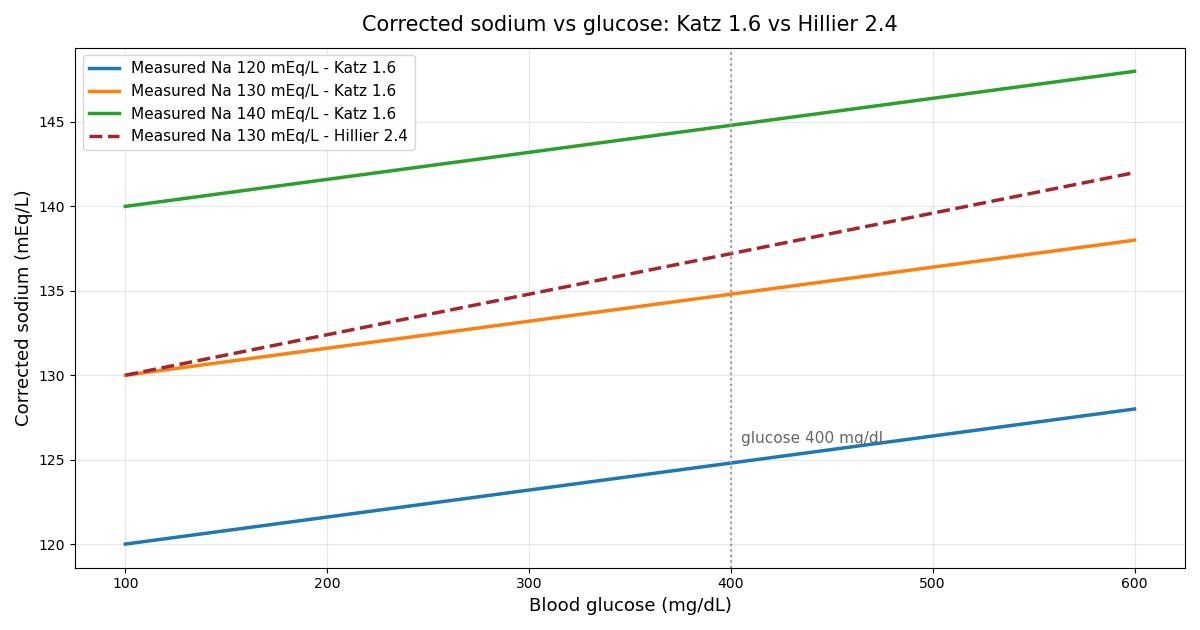
The 1.6 factor is a theoretical and widely validated default, but it was never derived from a controlled experiment. In 1999, T. A. Hillier, R. D. Abbott and E. J. Barrett set out to test it directly (Am J Med 1999; 106: 399-403). They infused somatostatin to block endogenous insulin in six healthy volunteers, raised plasma glucose above 600 mg/dL within an hour with a dextrose infusion, then restored glucose with insulin, measuring glucose and sodium every ten minutes. The average sodium fall was 2.4 mEq/L for every 100 mg/dL rise in glucose, significantly greater than the standard 1.6 (P = 0.02). The relationship was also nonlinear: up to 400 mg/dL the standard 1.6 factor fitted well, but at the highest glucose levels a larger factor fitted better, and the authors concluded that 2.4 mEq/L per 100 mg/dL is the better overall estimate, especially when glucose exceeds 400 mg/dL.
This calculator therefore offers the Hillier 2.4 factor as a clearly labelled alternative alongside the Katz 1.6 default. For the worked example above, the Hillier factor gives a correction of 2.4 x 5 = 12.0 mEq/L and a corrected sodium of 140.0 mEq/L instead of 136.0 mEq/L: a clinically meaningful difference of 4 mEq/L that could change a fluid prescription. Which factor is right remains debated; some later analyses have reported that the true coefficient varies with the population and with the severity of hyperglycaemia, and that very high glucose levels may need different handling again. The honest approach is to pick the factor deliberately, state which one was used, and remember that both are estimates of a physiologic response that differs between patients.
Unit conversions
Glucose is reported in mg/dL in the United States and in mmol/L in most other countries, including the United Kingdom and Denmark. The conversion uses the molar mass of glucose, 180.156 g/mol: 1 mmol/L equals 18.018 mg/dL. To convert mmol/L to mg/dL, multiply by 18.018; to convert mg/dL to mmol/L, divide by 18.018. So a glucose of 33.3 mmol/L is about 600 mg/dL (33.3 x 18.018 = 599.99), and the 100 mg/dL reference point of the Katz formula equals about 5.6 mmol/L. This calculator accepts glucose in either unit and shows both, so the arithmetic is never a source of error.
| mg/dL | mmol/L (approx.) | Katz correction for Na 130 mEq/L |
|---|---|---|
| 100 | 5.6 | 0.0 (reference point) |
| 200 | 11.1 | +1.6, corrected 131.6 |
| 400 | 22.2 | +4.8, corrected 134.8 |
| 600 | 33.3 | +8.0, corrected 138.0 |
| 800 | 44.4 | +11.2, corrected 141.2 |
The mmol/L values in the table are the mg/dL values divided by 18.018 and rounded to one decimal place.
Limitations and caveats
First, the corrected sodium is a prediction, not a measurement. It estimates what sodium would be at normal glucose assuming nothing else changed, which is never exactly true: osmotic diuresis causes real losses of water and electrolytes, and the patient's volume status, potassium, and renal function all matter. Direct measurement of plasma osmolality is always preferable when management decisions are difficult, because measured osmolality captures every solute, not just glucose and sodium.
Second, correcting the number does not treat the patient. The low measured sodium of hyperglycemia does not need hypotonic fluids or salt; it needs the glucose brought down and the underlying emergency, such as diabetic ketoacidosis or the hyperosmolar hyperglycaemic state, managed. The corrected value is mainly useful for choosing the tonicity of replacement fluids and for recognising when a low measured sodium hides a real water deficit that will unmask itself as glucose falls.
Third, watch the direction of travel. During treatment, the measured sodium should rise as glucose falls while effective osmolality declines steadily. Evidence-based guidance proposes that serum tonicity should not fall faster than about 3 mOsm/L per hour, because rapid falls in osmolality are associated with cerebral edema, a devastating complication most feared in ketoacidosis (see the review literature on hyperglycemic emergencies). If the measured sodium fails to rise as glucose falls, suspect true hypotonic hyponatraemia, for example from excess free water intake or administration.
Fourth, do not confuse hyperglycemic hyponatraemia with pseudohyponatremia from severe hyperlipidemia or hyperproteinemia. That is a different entity entirely: a laboratory artefact in which indirect ion-selective electrodes, which dilute the sample before measurement, report a falsely low sodium because lipids or proteins occupy part of the sample volume. Plasma water sodium, and plasma tonicity, are normal in that situation, and direct ion-selective electrodes, which measure without dilution, are unaffected. The Katz correction applies only to glucose-driven osmotic shifts, never to the lipid or protein artefact.
Finally, the factors themselves are approximations. Katz's 1.6 is the clinical standard, Hillier's 2.4 is the best experimental estimate and is preferred by some guidelines for marked hyperglycemia, and a large cohort study of patients with extreme hyperglycemia found that sodium corrected with the 2.4 factor predicted 90-day mortality and intensive care outcomes better than the uncorrected measured sodium (published in the peer-reviewed literature). None of this replaces clinical judgment, measured osmolality, and serial electrolytes during treatment.
Key takeaways
- Corrected sodium is an estimate of what the serum sodium would be if the blood glucose were normal (100 mg/dL).
- Hillier and colleagues (Am J Med 1999) experimentally infused glucose in healthy volunteers and found the average sodium fall was 2.4 mEq/L per 100 mg/dL glucose rise, significantly more than the 1.6 standard.
- Multiply mmol/L by 18.018 to get mg/dL, or divide mg/dL by 18.018 to get mmol/L.
- As glucose falls, water moves back from the extracellular to the intracellular space, reconcentrating sodium.
Frequently asked questions
What is corrected sodium in hyperglycemia?
Corrected sodium is an estimate of what the serum sodium would be if blood glucose were normal (100 mg/dL). It is calculated as measured sodium plus 1.6 mEq/L for every 100 mg/dL of glucose above 100 mg/dL (Katz, NEJM 1973). It predicts tonicity after glucose normalisation and helps guide the choice of replacement fluid tonicity.
When should I use the Hillier 2.4 factor instead of the Katz 1.6 factor?
Hillier and colleagues (Am J Med 1999) infused glucose in healthy volunteers and found the average sodium fall was 2.4 mEq/L per 100 mg/dL of glucose rise, significantly more than the 1.6 standard. The 1.6 factor fitted well up to a glucose of 400 mg/dL, while at markedly higher glucose the larger estimate was closer overall. Use 2.4 as a labelled alternative in marked hyperglycemia, and always state which factor was used.
How do I convert glucose between mg/dL and mmol/L?
Multiply mmol/L by 18.018 to get mg/dL, or divide mg/dL by 18.018 to get mmol/L. Thus 100 mg/dL equals about 5.6 mmol/L, and a rise of 5.6 mmol/L depresses sodium by the same 1.6 mEq/L as a rise of 100 mg/dL under the Katz formula.
Why does the measured sodium rise while hyperglycemia is being treated?
As glucose falls, water moves back from the extracellular to the intracellular space, reconcentrating sodium. A rising measured sodium during glucose control is expected and usually means the correction was working, provided effective osmolality is falling. A measured sodium that fails to rise as glucose falls suggests true hypotonic hyponatraemia or ongoing free water excess.
Is this the same as pseudohyponatremia from high lipids or proteins?
No. Pseudohyponatremia from severe hyperlipidemia or hyperproteinemia is a laboratory artefact: indirect ion-selective electrodes dilute a lipid-rich sample and report a falsely low sodium while plasma water sodium is normal. Hyperglycemic hyponatraemia is real dilution from osmotic water shifts, with raised tonicity. Direct ion-selective electrodes are unaffected by the lipid artefact.
Can the corrected sodium replace measuring plasma osmolality?
No. The correction is only a prediction of what sodium would be at normal glucose, not a substitute for measured osmolality or for treating the hyperglycemia itself. During fluid replacement and glucose control, monitor plasma osmolality directly, because the measured sodium can rise while osmolality is falling too fast, which risks cerebral edema.
References
- Katz MA. Hyperglycemia-induced hyponatremia: calculation of expected serum sodium depression. N Engl J Med. 1973; 289: 843-844. (Source of the 1.6 mEq/L per 100 mg/dL correction factor.)
- Hillier TA, Abbott RD, Barrett EJ. Hyponatremia: evaluating the correction factor for hyperglycemia. Am J Med. 1999; 106(4): 399-403. (Experimental derivation of the 2.4 mEq/L per 100 mg/dL factor; 1.6 fitted well up to 400 mg/dL; nonlinear response above 400 mg/dL.)
- Seldin DW, Tarail R. The metabolism of glucose and electrolytes in diabetic acidosis. J Clin Invest. 1950; 29: 552-565. (Early description of glucose-driven osmotic water shifts lowering serum sodium.)
- Adrogue HJ, Madias NE. Hypernatremia. N Engl J Med. 2000; 342: 1493-1499. (Review covering tonicity, effective osmolality, and the distinction between measured and corrected sodium.)
- Peer-reviewed cohort evidence that sodium corrected with the 2.4 factor predicts clinical outcomes (90-day mortality, ICU admission) in extreme hyperglycemia better than uncorrected measured sodium. (Cited for the claim that the corrected value carries prognostic information.)
- KDIGO Clinical Practice Guidelines
- National Kidney Foundation