What is creatinine clearance?
Creatinine is a waste product formed when muscles use energy. It is produced at a fairly steady rate from the breakdown of creatine phosphate in muscle tissue, released into the bloodstream, and removed almost entirely by the kidneys. Because production is steady and excretion depends on kidney function, the concentration of creatinine in the blood rises as the kidneys filter less effectively.
Creatinine clearance describes how much blood plasma the kidneys clear of creatinine per minute, expressed in millilitres per minute (mL/min). Conceptually, it answers a simple question: if the kidneys removed every molecule of creatinine from a certain volume of blood each minute, how large would that volume be? A higher clearance means more effective filtration; a lower clearance signals reduced kidney function.
The most direct way to measure clearance is a timed urine collection, usually over 24 hours, combined with a blood sample. The patient collects all urine produced in the period, the total creatinine in the urine is compared with the blood concentration, and the clearance is calculated from the ratio. This works, but it is cumbersome: collections are frequently incomplete, which introduces error, and the process is inconvenient for routine use. For that reason, clinicians usually estimate clearance from a single blood measurement of serum creatinine using a validated equation. The Cockcroft-Gault equation, published in 1976, was the first widely adopted method for doing this and remains in everyday use.
The Cockcroft-Gault equation
In 1976, Donald W. Cockcroft and M. Henry Gault published a paper in Kidney International proposing that creatinine clearance could be predicted from serum creatinine together with three easily known patient characteristics: age, body weight, and sex (Cockcroft DW, Gault MH, Kidney Int 1976;9(3):96-104, DOI 10.1038/ki.1976.28). Their equation is:
Each part of the equation has a physiological reason behind it. Serum creatinine sits in the denominator because clearance and blood concentration move in opposite directions: when the kidneys clear less creatinine, more of it accumulates in the blood. The term (140 − age) reflects the fact that kidney function declines with age, so the predicted clearance falls as age rises. Body weight appears in the numerator because larger people generally have more muscle mass and therefore produce more creatinine each day; without a weight term, a muscular person and a slight person with the same serum creatinine would receive the same estimate, which would be misleading.
The factor of 0.85 for women adjusts for the average difference in muscle mass between the sexes: at the same weight and serum creatinine, a woman is predicted to have a clearance 15 percent lower than a man. The constant 72 in the denominator has no physiological meaning of its own; it balances the units of the other terms so that the final result comes out in millilitres per minute when creatinine is entered in mg/dL.
Unit handling matters. The equation as published expects serum creatinine in mg/dL. Laboratories in many countries report creatinine in micromol per litre (µmol/L) instead. To convert, divide the µmol/L value by 88.4, because 1 mg/dL of creatinine equals 88.4 µmol/L (creatinine has a molar mass of about 113.12 g/mol, from which this factor follows). So a reported value of 88.4 µmol/L becomes exactly 1.0 mg/dL. Some references print a shortcut form of the equation for direct use with µmol/L: ((140 − age) × weight × 1.23) ÷ serum creatinine in µmol/L for men, with 1.04 in place of 1.23 for women. The 1.23 is simply 88.4 divided by 72, rounded; the shortcut is algebraically equivalent to converting first, and any tiny difference between the two routes comes from that rounding.
How to use this calculator
Enter your age in years, your body weight in kilograms, your sex, and your serum creatinine value from a blood test, selecting the unit your laboratory used. The calculator accepts ages from 18 to 120, weights from 20 to 300 kg, and creatinine values from 0.2 to 20 mg/dL or 18 to 1770 µmol/L; anything outside these ranges, or any missing entry, produces a specific error message explaining what to correct.
When you calculate, the tool first converts µmol/L values to mg/dL by dividing by 88.4, then applies the Cockcroft-Gault equation exactly as published, and shows the estimated clearance rounded to one decimal place. Below the headline number you will see the substituted calculation, so you can verify every step. KDIGO G categories are not shown because they are defined using indexed eGFR, not Cockcroft-Gault CrCl. For example, a 55-year-old man weighing 70 kg with a serum creatinine of 1.0 mg/dL gives ((140 − 55) × 70 × 1.0) ÷ (72 × 1.0) = 82.6 mL/min; the same woman gives 70.2 mL/min because of the 0.85 factor.
Why this result is not a CKD G stage
Cockcroft-Gault estimates unindexed creatinine clearance in mL/min and remains used by many medicine labels. KDIGO G1-G5 categories are based on GFR indexed to 1.73 m². The values are not interchangeable; use a validated CKD-EPI eGFR for CKD staging and the medicine-specific method requested by its label for dosing.
Why creatinine clearance matters
The most consequential everyday use of estimated creatinine clearance is in prescribing. Many medicines are cleared by the kidneys, so their doses must be reduced when kidney function is impaired to avoid accumulation and toxicity. Approved drug labels commonly express these kidney-related dose adjustments as creatinine clearance ranges, and regulatory guidance on studying drugs in renal impairment historically directed sponsors to the Cockcroft-Gault equation. As a result, a large number of dose recommendations in current use were developed against Cockcroft-Gault estimates, and pharmacists still reach for this equation when checking whether a prescribed dose is safe for a patient's kidneys.
Beyond dosing, estimated clearance is used to track kidney function over time, to assess risk before procedures or treatments that stress the kidneys, and to decide when a patient should be referred to a nephrologist. A falling estimate across successive blood tests can reveal a gradual decline that no single creatinine value would flag, because each person's baseline differs. In all of these uses the estimate is interpreted alongside the clinical picture: trends matter more than isolated numbers, and sudden changes prompt a search for reversible causes such as dehydration, infection, or a newly started medicine.
Cockcroft-Gault versus eGFR equations
You may have seen the term eGFR, estimated glomerular filtration rate, on a lab report. Creatinine clearance and eGFR describe related but different quantities, and the distinction is worth understanding. Creatinine is removed from the blood in two ways: it is filtered through the glomeruli, and a smaller amount is additionally secreted directly by the renal tubules. Creatinine clearance captures both routes, so it runs higher than the true glomerular filtration rate, and the gap between the two widens as kidney function declines.
Equations such as CKD-EPI, by contrast, are designed to estimate the glomerular filtration rate itself. They use serum creatinine (and in newer versions, cystatin C, a protein less dependent on muscle mass) together with age and sex, fitted against directly measured GFR in large study populations. Most laboratories now report an eGFR automatically with every creatinine result, which makes CKD-EPI the number most patients encounter.
The two approaches therefore serve overlapping but distinct roles. Automated eGFR reporting is convenient for detecting and monitoring chronic kidney disease in the general population, while Cockcroft-Gault remains the reference equation for kidney-related drug dosing, because the dose recommendations on drug labels were built on it. Neither equation measures kidney function directly, both depend on a stable serum creatinine, and neither replaces clinical judgment about the individual patient.
Limitations of the equation
Like every estimating equation, Cockcroft-Gault works best for people similar to those in whom it was developed and validated: adults with stable kidney function. Outside that setting, its accuracy falls, and the direction of the error is often predictable.
Because the equation treats body weight as a stand-in for muscle mass, anything that breaks the link between the two distorts the result. Frail or elderly people with little muscle produce less creatinine than their weight suggests, so the equation overestimates their clearance and can make kidney function look better than it is. Very muscular people get the opposite error. Which weight to enter for people with obesity is a long-debated question: entering actual body weight can inflate the estimate, and clinicians often substitute an ideal or adjusted body weight instead. There is no single universally agreed rule, which is one reason dosing decisions in obesity involve clinical judgment rather than a calculator alone.
The equation also assumes a steady state, meaning creatinine production and excretion are in balance. In acute kidney injury, where creatinine is rising or falling rapidly, that assumption fails and the estimate is meaningless until the situation stabilises. It was not developed or validated for pregnancy, during which kidney physiology changes substantially, so it should not be applied there. Certain medicines, including trimethoprim and cimetidine, block the tubular secretion of creatinine and raise the blood level without changing true filtration; any estimate made while taking them will understate kidney function. Even diet can nudge the number: a meal rich in cooked meat transiently raises serum creatinine. Finally, the result is an estimate rounded to one decimal place, not a measurement; when precision truly matters, a measured clearance or a formal GFR measurement is the appropriate tool.
Key takeaways
- Creatinine clearance is an estimate of how much blood plasma the kidneys clear of creatinine each minute, expressed in millilitres per minute (mL/min).
- You need four values: age in years (18 to 120), body weight in kilograms (20 to 300), sex (male or female), and serum creatinine from a blood test, entered either in mg/dL (0.2 to 20) or in micromol/L (18 to 1770).
- Enter the value exactly as your lab reported it and select micromol/L as the unit; the calculator divides it by 88.4 to convert it to mg/dL, because 1 mg/dL of creatinine equals 88.4 micromol/L.
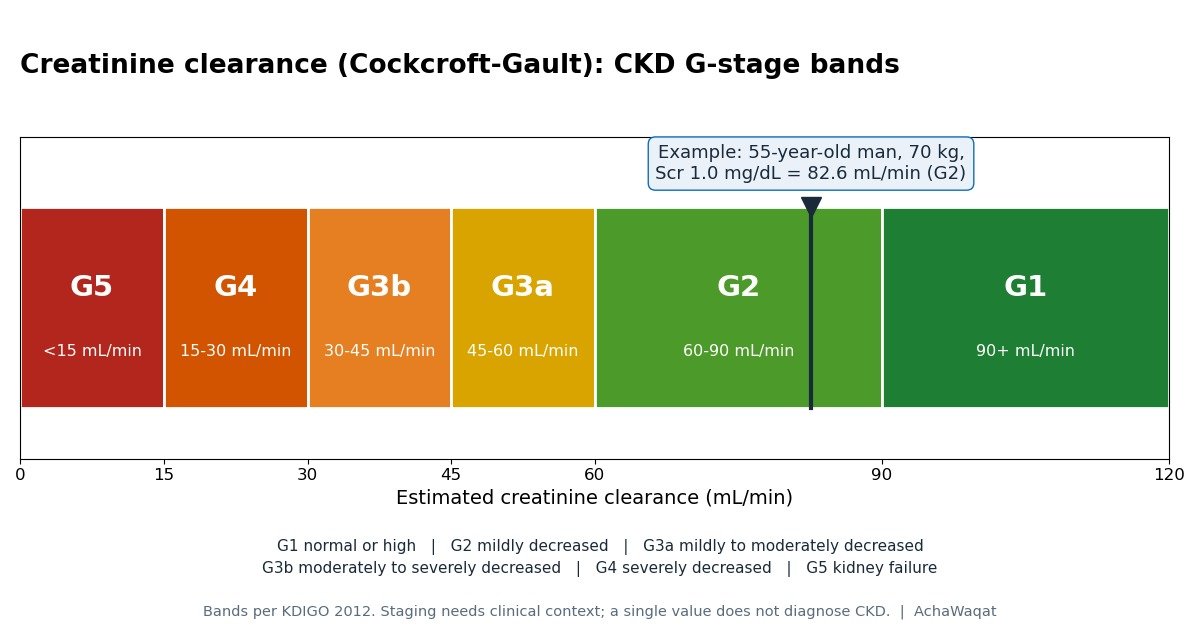
- G1 to G5 are the kidney function categories used in chronic kidney disease staging: G1 is 90 mL/min or above (normal or high), G2 is 60 to 89 (mildly decreased), G3a is 45 to 59 (mildly to moderately decreased), G3b is 30 to 44 (moderately to severely decreased), G4 is 15 to 29 (severely decreased), and G5 is below 15 (kidney failure).
Frequently asked questions
What is creatinine clearance?
Creatinine clearance is an estimate of how much blood plasma the kidneys clear of creatinine each minute, expressed in millilitres per minute (mL/min). Creatinine is a waste product of muscle metabolism that the kidneys filter out of the blood, so the rate at which it is cleared reflects how well the kidneys are filtering. It can be measured directly with a timed urine collection, but it is more often estimated from a single blood test for serum creatinine using an equation such as Cockcroft-Gault.
What do I need to use this calculator?
You need four values: age in years (18 to 120), body weight in kilograms (20 to 300), sex (male or female), and serum creatinine from a blood test, entered either in mg/dL (0.2 to 20) or in micromol/L (18 to 1770). The calculator converts micromol/L to mg/dL by dividing by 88.4 before applying the Cockcroft-Gault equation, then shows the estimated clearance rounded to one decimal place without assigning a KDIGO G stage, which requires indexed eGFR.
My lab reports creatinine in micromol/L. What do I enter?
Enter the value exactly as your lab reported it and select micromol/L as the unit; the calculator divides it by 88.4 to convert it to mg/dL, because 1 mg/dL of creatinine equals 88.4 micromol/L. For example, 88.4 micromol/L becomes 1.0 mg/dL. Some references print a shortcut form of the equation for use with micromol/L directly, ((140 minus age) x weight x 1.23) / serum creatinine, where 1.23 is 88.4 divided by 72 rounded; it is algebraically equivalent to converting first and may differ by a tenth or two because of that rounding.
What do the G1 to G5 stages mean?
G1 to G5 are the kidney function categories used in chronic kidney disease staging: G1 is 90 mL/min or above (normal or high), G2 is 60 to 89 (mildly decreased), G3a is 45 to 59 (mildly to moderately decreased), G3b is 30 to 44 (moderately to severely decreased), G4 is 15 to 29 (severely decreased), and G5 is below 15 (kidney failure). These cut-offs come from the KDIGO 2012 guideline. Staging needs clinical context: a single estimated value does not diagnose chronic kidney disease, which guidelines define by abnormalities of kidney structure or function persisting for more than three months, and full staging also considers albuminuria and the underlying cause.
Is creatinine clearance the same as eGFR?
No. Creatinine clearance and estimated glomerular filtration rate (eGFR) describe related but different things. Creatinine is both filtered by the glomeruli and secreted by the renal tubules, so creatinine clearance runs higher than the true glomerular filtration rate, and the gap widens as kidney function falls. Equations such as CKD-EPI estimate GFR itself and are what laboratories usually report automatically, while Cockcroft-Gault estimates creatinine clearance and remains the equation behind kidney-related dose adjustments on many drug labels.
When should I not rely on this equation?
Do not rely on it when kidney function is changing rapidly, such as in acute kidney injury, because the equation assumes a steady state between creatinine production and excretion. It is less reliable at extremes of muscle mass: frail or elderly people and amputees tend to get overestimates, while very muscular people tend to get underestimates. It was not developed for pregnancy, and the choice of which body weight to enter for people with obesity is debated, since actual body weight can inflate the result. Drugs that block tubular creatinine secretion, such as trimethoprim and cimetidine, raise serum creatinine without changing true filtration and will distort the estimate.
References
1. Cockcroft DW, Gault MH. Prediction of creatinine clearance from serum creatinine. Kidney Int. 1976;9(3):96-104. DOI: 10.1038/ki.1976.28
2. Kidney Disease: Improving Global Outcomes (KDIGO) CKD Work Group. KDIGO 2012 Clinical Practice Guideline for the Evaluation and Management of Chronic Kidney Disease. Kidney Int Suppl. 2013;3:1-150. Publisher: kdigo.org