What fractional excretion means physiologically
Fractional excretion is a way of asking how the kidney handles a substance that it filters. Your kidneys filter blood through the glomeruli, forming roughly 180 litres of filtrate per day in a healthy adult. Almost everything in that filtrate is then reabsorbed as it travels through the tubules: water, sodium, glucose, amino acids. Only a small fraction of each filtered substance escapes reabsorption and ends up in the urine. Fractional excretion expresses that escaped fraction as a percentage of what was filtered. A fractional excretion of sodium of 0.5% means that for every 100 millimoles of sodium filtered by the glomeruli, only half a millimole reaches the final urine; the rest was reclaimed along the way. Creatinine serves as the reference substance because it is freely filtered and is neither reabsorbed nor secreted in significant amounts, so its clearance approximates the glomerular filtration rate. Comparing the clearance of sodium with the clearance of creatinine therefore cancels out the effect of urine concentration: the ratio is the same whether the urine is dilute or concentrated. That is what makes fractional excretion useful at the bedside. It tells you about tubular handling of sodium, independent of how concentrated the urine happens to be.
The FENa formula and what it needs
The FENa formula compares the clearance of sodium with the clearance of creatinine: FENa (%) = (urine sodium x serum creatinine) / (serum sodium x urine creatinine) x 100. You need four numbers from a single time point: a spot urine sodium in mEq/L, a serum (blood) sodium in mEq/L, a spot urine creatinine in mg/dL, and a serum creatinine in mg/dL. The critical requirement is that the urine sodium and urine creatinine come from the same spot urine sample, and the serum sodium and serum creatinine come from blood drawn at about the same time. Because the formula is a ratio of ratios, the units must be consistent within each pair: sodium over sodium in mEq/L and creatinine over creatinine in mg/dL, exactly as this calculator requests. If your laboratory reports creatinine in micromoles per litre instead of mg/dL, use the same unit for both the urine and the serum creatinine so the units cancel. Swapping units, or mixing a morning urine with an evening blood draw, produces a meaningless number. This is a spot test, not a 24-hour collection: one urine sample and one blood sample are enough.
Why sodium handling differs in prerenal azotemia and acute tubular necrosis
Acute kidney injury has many causes, and the first fork in the road is between prerenal causes, where the kidney itself is intact but under-perfused, and intrinsic causes, where the kidney tissue is damaged. In prerenal azotemia, something outside the kidney has reduced blood flow to it: dehydration, blood loss, heart failure, or an infection lowering perfusion pressure. The kidney responds the way a healthy organ should when it senses low volume: it holds onto sodium and water to restore circulating volume. Hormonal signals, including the renin-angiotensin-aldosterone system, increase sodium reabsorption along the tubule, so very little sodium escapes into the urine. The result is concentrated urine that is low in sodium, and a fractional excretion of sodium below 1%. In acute tubular necrosis (ATN), by contrast, the tubular cells themselves are injured, for example by prolonged ischemia or a toxin. Damaged tubules cannot reabsorb sodium properly, so filtered sodium spills past them into the urine. Even though the kidneys are failing, the injured tubules waste sodium, and the fractional excretion rises above 2%. This is the physiological logic behind FENa: intact tubules avidly retain sodium and produce a low FENa, while injured tubules cannot retain it and produce a high FENa.
Interpreting the result: the three zones
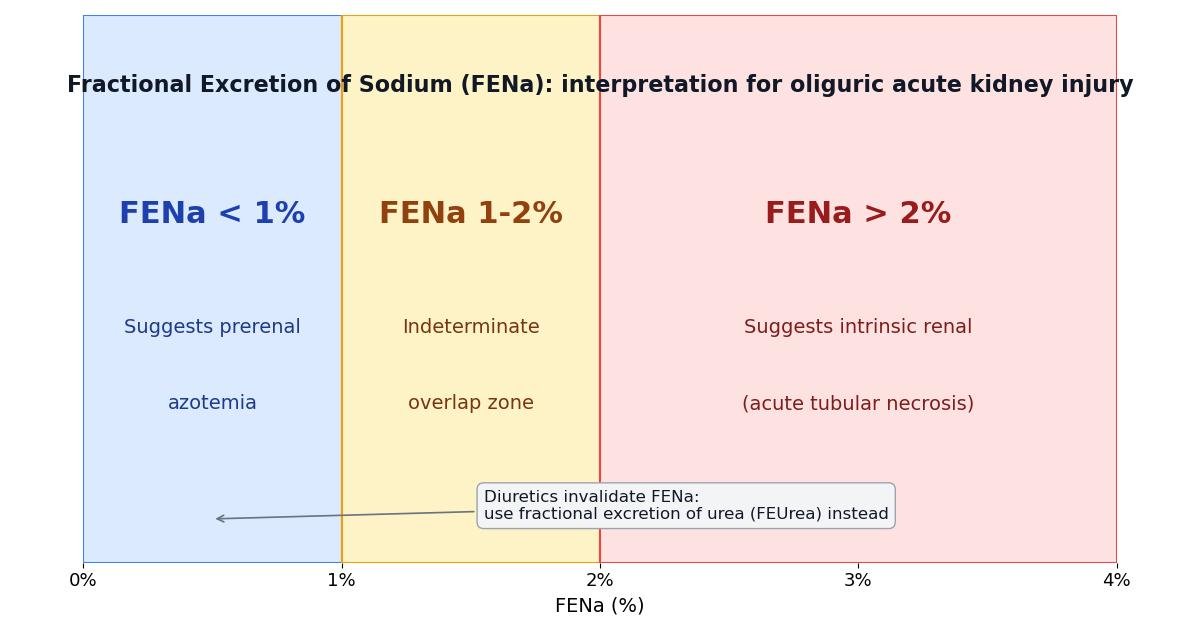
A FENa below 1% suggests prerenal azotemia, provided the patient is oliguric, meaning producing little urine. A FENa above 2% suggests intrinsic renal disease, most commonly acute tubular necrosis. A FENa between 1% and 2%, inclusive, sits in an overlap zone: prerenal and intrinsic causes can both land there, so the number is indeterminate and must not be used to decide. These cutoffs are teaching thresholds from the nephrology literature, popularised by Espinel in JAMA in 1976. They are clues, not a diagnosis. They were described in oliguric patients, and they lose meaning in patients making normal amounts of urine, because a non-oliguric kidney with ATN can still conserve sodium and produce a low FENa. Never treat the number alone. The same FENa in two different patients can mean different things, and the clinical story (volume status, medications, urine output, the trend of the serum creatinine) always carries more weight than any single laboratory ratio.
Why diuretics invalidate FENa, and what to use instead
Diuretics are the single most important reason FENa gives a misleading answer, and they are extremely common in exactly the patients in whom clinicians want to use the test. Loop diuretics such as furosemide, and thiazide diuretics, work by blocking sodium reabsorption in the tubules. That is their entire purpose: they force the kidney to excrete sodium it would otherwise have kept. When a patient is on a diuretic, the urine is sodium-rich because of the drug, not because the tubules are injured. A patient with straightforward prerenal azotemia who recently received furosemide can easily have a FENa above 2%, which would falsely point toward ATN. In that situation, use the fractional excretion of urea (FEUrea) instead. Urea handling in the nephron is largely unaffected by most diuretics, so FEUrea remains interpretable when FENa does not. The rule is simple and absolute: if the patient has received a diuretic recently, do not calculate FENa; calculate FEUrea. This calculator displays the warning next to every result, because acting on a diuretic-contaminated FENa can lead the team down the wrong diagnostic path.
Other conditions that make FENa unreliable
Diuretics are the classic pitfall, but they are not the only one. In chronic kidney disease, the surviving nephrons adapt by excreting more sodium per nephron, so the baseline FENa is already high and the prerenal cutoff loses its meaning. Contrast-induced nephropathy can produce a low FENa despite intrinsic injury, because its pathophysiology differs from classic ATN and tubular sodium handling may be preserved early on. Myoglobinuria from rhabdomyolysis also breaks the usual pattern: pigment injury to the tubules can coexist with sodium retention, producing misleadingly low values. Bicarbonaturia, seen with metabolic alkalosis or after bicarbonate administration, drags sodium with it into the urine as the kidney excretes the excess base, raising FENa without any tubular injury. In each of these settings, the physiological assumptions behind the test (intact tubules retain sodium, injured tubules waste it) no longer hold. The test was designed for oliguric acute kidney injury in a previously healthy kidney. Move outside that population and the number becomes noise.
Worked example
Suppose a patient with acute kidney injury has these results from a spot urine and a simultaneous blood draw: urine sodium 10 mEq/L, serum sodium 140 mEq/L, urine creatinine 100 mg/dL, serum creatinine 1.0 mg/dL. Apply the formula step by step. Multiply urine sodium by serum creatinine: 10 x 1.0 = 10. Multiply serum sodium by urine creatinine: 140 x 100 = 14,000. Divide the first product by the second: 10 / 14,000 = 0.000714. Multiply by 100 to express it as a percentage: about 0.071%. A FENa of 0.071% is well below the 1% threshold, so in an oliguric patient with no invalidating conditions this suggests prerenal azotemia: the tubules are intact and are retaining sodium avidly in response to low perfusion. Now consider a different patient: urine sodium 60 mEq/L, serum sodium 140 mEq/L, urine creatinine 40 mg/dL, serum creatinine 2.0 mg/dL. The numerator is 60 x 2.0 = 120. The denominator is 140 x 40 = 5,600. Dividing gives 0.0214, or 2.14% after multiplying by 100. A FENa of 2.14% is above the 2% threshold and suggests intrinsic renal disease such as acute tubular necrosis, again assuming oliguria and no invalidating conditions. Notice how the same formula tells two opposite stories depending on whether the tubules are holding or wasting sodium.
Limitations you must respect
First, FENa is described for oliguric acute kidney injury: patients producing little urine. In non-oliguric ATN, the injured kidney may still produce a litre or more of urine per day and can retain enough sodium to give a FENa below 1%, falsely suggesting a prerenal cause. Second, the 1% and 2% cutoffs are teaching thresholds, not hard biological boundaries. Real patients fall in the 1 to 2% overlap zone regularly, and the correct response to a number in that zone is "indeterminate", not a guess. Third, FENa is a snapshot: it reflects tubular sodium handling at the moment the samples were drawn. It does not tell you what caused the injury, how it will evolve, or whether the patient needs dialysis. Fourth, it requires simultaneous samples; numbers from a morning urine and an evening blood draw are not comparable. Finally, no laboratory ratio replaces clinical assessment. Volume status on examination, a medication review (especially diuretics), urine output trends, the trajectory of serum creatinine, and often the urine sediment and imaging together build the diagnosis. FENa contributes one clue to that process, and it is a mistake to let it outweigh the rest.
When not to order or trust FENa
Do not order FENa in a patient who is not oliguric and expect the classic cutoffs to apply. Do not order it after diuretics have been given, or in established chronic kidney disease, or when you know the patient has rhabdomyolysis, recent contrast exposure, or a metabolic alkalosis driving bicarbonaturia, without understanding that the result may mislead. Do not repeat it every few hours hoping the number will make the decision for you. And do not document it as the diagnosis. What FENa does well is narrow the differential in a specific scenario: an oliguric patient with a rising creatinine, no recent diuretics, and no chronic kidney disease, where you need to know whether the kidneys are under-perfused or injured. Used that way, as one piece of evidence alongside the examination and the rest of the workup, it has survived fifty years of clinical use since Espinel's original description. Used outside its lane, it misleads with the confidence of a precise number.
Reference
Espinel CH. The FENa test: use in the differential diagnosis of acute renal failure. JAMA. 1976;236(6):579-581. doi:10.1001/jama.1976.03270060029023.