What eGFR estimates and why creatinine is used
Your kidneys filter blood through tiny structures called glomeruli, removing waste and extra fluid while keeping useful substances in the body. The glomerular filtration rate, or GFR, is the volume of blood the kidneys filter each minute. Because people come in different sizes, GFR is standardized to a body surface area of 1.73 square meters, which is why results are reported in mL/min/1.73 m2. A healthy young adult typically has a GFR near the top of the scale, and it declines gradually with age.
The true GFR can only be measured directly by injecting a tracer substance and tracking how fast the kidneys clear it from the blood. That procedure is expensive, time consuming and impractical for everyday care, so doctors estimate GFR from substances already present in the blood. The estimate is called eGFR. The most widely used marker is serum creatinine, a waste product formed when muscles break down creatine during normal activity. Creatinine is produced at a fairly steady rate in most people, travels in the blood to the kidneys, and is filtered out by the glomeruli with a small amount also secreted by the kidney tubules. When filtration falls, less creatinine is cleared and its level in the blood rises, which makes it a useful mirror of kidney function.
Creatinine became the standard marker for practical reasons. The blood test is cheap, available in almost every laboratory in the world, and its measurement has been standardized so that results are comparable across laboratories and countries. Decades of research have mapped the relationship between creatinine levels and directly measured GFR, which is what makes equations like CKD-EPI possible. The equation adjusts for age and sex because creatinine production depends on muscle mass: on average, creatinine runs lower in women than in men and changes with age as muscle mass changes. These adjustments are statistical proxies, not perfect corrections, which is why the estimate is less reliable in people whose muscle mass is far from average. Still, for the majority of adults a creatinine-based eGFR is a reliable and repeatable way to track kidney function over time, and it is the test behind almost every CKD diagnosis made in routine practice.
The 2021 race-free change and why it was made
Before 2021, the standard equation was the CKD-EPI 2009 creatinine equation, which included a race coefficient: for patients identified as Black, the calculated eGFR was multiplied upward. That coefficient came from observed average differences in creatinine between groups in the original study populations, but over time it became clear that the practice was problematic. Race is a social construct, not a biological category, and people assigned to the same racial group vary enormously in ancestry, muscle mass and diet. Applying a single multiplier based on race risked misclassifying individual patients, and the direction of the error mattered: inflating eGFR could delay the recognition of kidney disease, delay referral to a kidney specialist, and affect eligibility decisions that depend on kidney function thresholds.
In response, a task force convened by the National Kidney Foundation and the American Society of Nephrology recommended refitting the estimating equations without race. The result was published by Inker and colleagues in the New England Journal of Medicine in 2021: new creatinine-based and cystatin C-based equations to estimate GFR without race (Inker LA, Eneanya ND, Coresh J, et al. New creatinine- and cystatin C-based equations to estimate GFR without race. N Engl J Med. 2021;385:1737-1749. doi:10.1056/NEJMoa2102953). The 2021 equations were developed and validated in the development and validation cohorts assembled for that paper, and the creatinine equation in this calculator is that equation. It applies exactly the same formula to every adult, replacing the 2009 race-based equation as the recommended standard.
How this calculator works
This calculator implements the CKD-EPI 2021 creatinine equation exactly as published: eGFR equals 142 times min(Scr/kappa, 1) raised to the power alpha, times max(Scr/kappa, 1) raised to the power negative 1.200, times 0.9938 raised to the power of age in years, times 1.012 for women. The constant kappa is 0.7 for women and 0.9 for men, reflecting the average difference in creatinine production, and the exponent alpha is negative 0.241 for women and negative 0.302 for men, which shapes how the equation responds to creatinine values below kappa. The factor 0.9938 raised to the power of age models the gradual decline of kidney function with each year of life, and the 1.012 multiplier adjusts for the average difference between women and men that remains after accounting for creatinine itself.
You enter your age, your sex, and your serum creatinine from a blood test, choosing whether the laboratory reported it in mg/dL or in micromol/L. Values in micromol/L are divided by 88.4 to convert to mg/dL before the equation is applied. The result is rounded to the nearest whole number and reported in mL/min/1.73 m2, together with the matching CKD stage. The equation is only validated for adults, so this calculator accepts ages from 18 to 100 years and creatinine values from 0.3 to 15 mg/dL after conversion, and it shows a named error message if an entry falls outside those ranges.
How to read each CKD stage
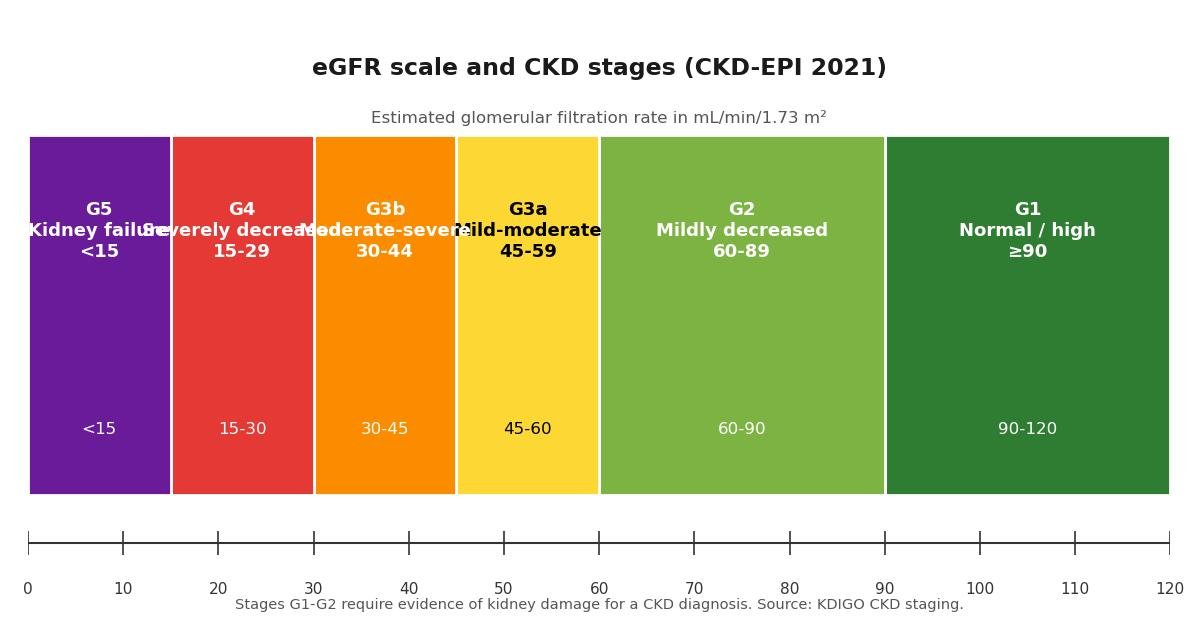
Chronic kidney disease is staged by eGFR into six categories that describe how far filtration has fallen from normal. The table below lists each stage with its eGFR range.
| Stage | eGFR (mL/min/1.73 m2) | Description |
|---|---|---|
| G1 | 90 or above | Normal or high |
| G2 | 60 to 89 | Mildly decreased |
| G3a | 45 to 59 | Mildly to moderately decreased |
| G3b | 30 to 44 | Moderately to severely decreased |
| G4 | 15 to 29 | Severely decreased |
| G5 | Below 15 | Kidney failure |
The split of stage G3 into G3a and G3b is deliberate. An eGFR between 45 and 59 is only mildly to moderately reduced, and many people in this range remain stable for years, especially when there is no protein in the urine. An eGFR between 30 and 44 is moderately to severely reduced and carries a clearly higher risk of progression and of complications such as anemia, bone and mineral problems, and cardiovascular events. Separating the two helps clinicians match the intensity of monitoring and treatment to the actual level of risk instead of treating the whole 30 to 59 range as one group.
Two important qualifications apply to every stage. First, stages G1 and G2 do not by themselves mean chronic kidney disease: an eGFR of 90 or above, or between 60 and 89, only counts as CKD when there is separate evidence of kidney damage, such as albumin in the urine, abnormal findings on kidney imaging, or a biopsy showing kidney injury. Many healthy older adults have an eGFR in the 60s or 70s with no kidney damage at all. Second, eGFR is only one half of the standard classification: clinical guidelines pair these GFR categories with albuminuria categories based on the urine albumin to creatinine ratio, because protein in the urine predicts progression independently of eGFR. A low eGFR without albuminuria and a low eGFR with heavy albuminuria are very different clinical situations, which is why a follow-up urine test is a standard next step after a reduced result.
When eGFR is unreliable
The CKD-EPI 2021 equation was built on an important assumption: that creatinine in the blood is at a steady state, meaning production and clearance are balanced. Whenever that assumption breaks down, the estimate can mislead. The clearest example is acute kidney injury, where kidney function drops suddenly and creatinine is still climbing toward its new level; a creatinine drawn during that climb understates how far function has fallen, and one drawn during recovery overstates the remaining damage. The equation should not be used to judge kidney function in the middle of an acute illness.
Muscle mass is the other major source of error because creatinine comes from muscle. A very muscular person, such as a bodybuilder, produces more creatinine than average, so the equation can underestimate their true GFR and make healthy kidneys look diseased. The opposite happens with muscle wasting from prolonged illness, frailty, or limb amputation: less muscle means less creatinine, so the equation can overestimate GFR and hide real kidney disease. Diet matters too. People eating very little meat or following strict vegetarian diets produce less creatinine from food, while creatine supplements taken for workouts raise blood creatinine without any change in kidney function. Pregnancy changes the picture as well, because blood volume expands and the kidneys filter more than usual, so pregnancy-specific interpretation is needed. Certain medicines, including trimethoprim and cimetidine, block the tubular secretion of creatinine and raise its blood level slightly without harming filtration. In any of these situations the number from a creatinine equation should be treated with caution, and a clinician may turn to cystatin C or to a directly measured GFR to get a clearer answer.
Creatinine versus cystatin C
Cystatin C is an alternative blood marker for estimating GFR. It is a small protein produced by nearly all nucleated cells in the body at a relatively constant rate, and unlike creatinine it is barely influenced by muscle mass or diet. That makes it valuable precisely in the situations where creatinine misleads: very muscular or very frail patients, amputees, and people with unusual diets. The same 2021 paper that produced the race-free creatinine equation also published a combined equation using both creatinine and cystatin C, which generally gives the most accurate estimate of the three options. In practice, creatinine remains the first-line test because it is cheaper and universally available, and cystatin C is ordered as a confirmatory test when the creatinine-based eGFR does not fit the clinical picture. If your doctor suspects your result is distorted by muscle mass or another factor above, asking whether a cystatin C test would help is a reasonable question.
What to do after a low result
A low eGFR on this calculator is a starting point for a conversation with your clinician, not a diagnosis. The first step is usually confirmation: a repeat blood test checks whether the result is stable or was affected by dehydration, a recent illness, or a laboratory fluctuation. Kidney function is best judged by trends over months, because a single value can be noisy while a declining trend is meaningful. Your clinician will also typically check for albumin in the urine, since the combination of reduced eGFR and albuminuria defines both the stage and the urgency of follow-up.
Beyond testing, the most useful actions address the common drivers of kidney decline. Keeping blood pressure and blood sugar within the targets you agree with your clinician, reviewing medicines that can strain the kidneys such as regular anti-inflammatory painkillers, avoiding dehydration during illness, and not smoking all protect remaining kidney function. Your clinician may adjust the doses of medicines that are cleared by the kidneys and will decide whether a referral to a kidney specialist is warranted based on the stage, the trend, the urine findings and your overall health. People in stage G4 and G5 need specialist care to plan ahead, while many people in G3a with no albuminuria simply need regular monitoring. Whatever the stage, bring this calculator result to your appointment along with your full medication list so the discussion starts from complete information.
Key takeaways
- eGFR (estimated glomerular filtration rate) approximates how much blood the kidneys filter per minute, standardized to a body surface area of 1.73 m2.
- The 2009 CKD-EPI equation included a race coefficient that raised estimated GFR for Black patients.
- CKD stages are defined by eGFR ranges: G1 is 90 or above, G2 is 60 to 89, G3a is 45 to 59, G3b is 30 to 44, G4 is 15 to 29, and G5 is below 15 mL/min/1.73 m2.
- The equation assumes creatinine is at a steady state, so it is unreliable during acute kidney injury when creatinine is still rising or falling.
Frequently asked questions
What is eGFR and why is it estimated from creatinine?
eGFR approximates how much blood the kidneys filter per minute, standardized to 1.73 m2 of body surface area. It is estimated from serum creatinine because the test is cheap, widely available and standardized, and creatinine rises predictably when filtration falls.
What changed in the CKD-EPI 2021 equation compared with 2009?
The 2009 equation applied a race-based multiplier; the 2021 equation removed race entirely because race is a social construct and the adjustment risked misclassification and inequitable care. The 2021 equation was validated in the cohorts of the Inker et al. paper and applies one formula to everyone.
What do the CKD stages G1 to G5 mean?
Stages run from G1 (90 or above) down to G5 (below 15 mL/min/1.73 m2), with G3 split into G3a (45 to 59) and G3b (30 to 44) to separate lower-risk from higher-risk moderate disease. G1 and G2 only count as CKD with separate evidence of kidney damage.
When is a creatinine-based eGFR unreliable?
During acute kidney injury, with very high or very low muscle mass, in amputees, during pregnancy, with vegetarian diets or creatine supplements, and with medicines such as trimethoprim or cimetidine that alter creatinine handling.
What is the difference between creatinine and cystatin C for estimating GFR?
Cystatin C is produced steadily by most cells and is largely unaffected by muscle mass or diet, so it is a useful confirmatory test when a creatinine-based eGFR looks inconsistent with the clinical picture.
What should I do if my eGFR result is low?
Confirm it with repeat testing, ask about a urine albumin test, review medicines and blood pressure and blood sugar control with your clinician, and track the trend over time rather than acting on one value.