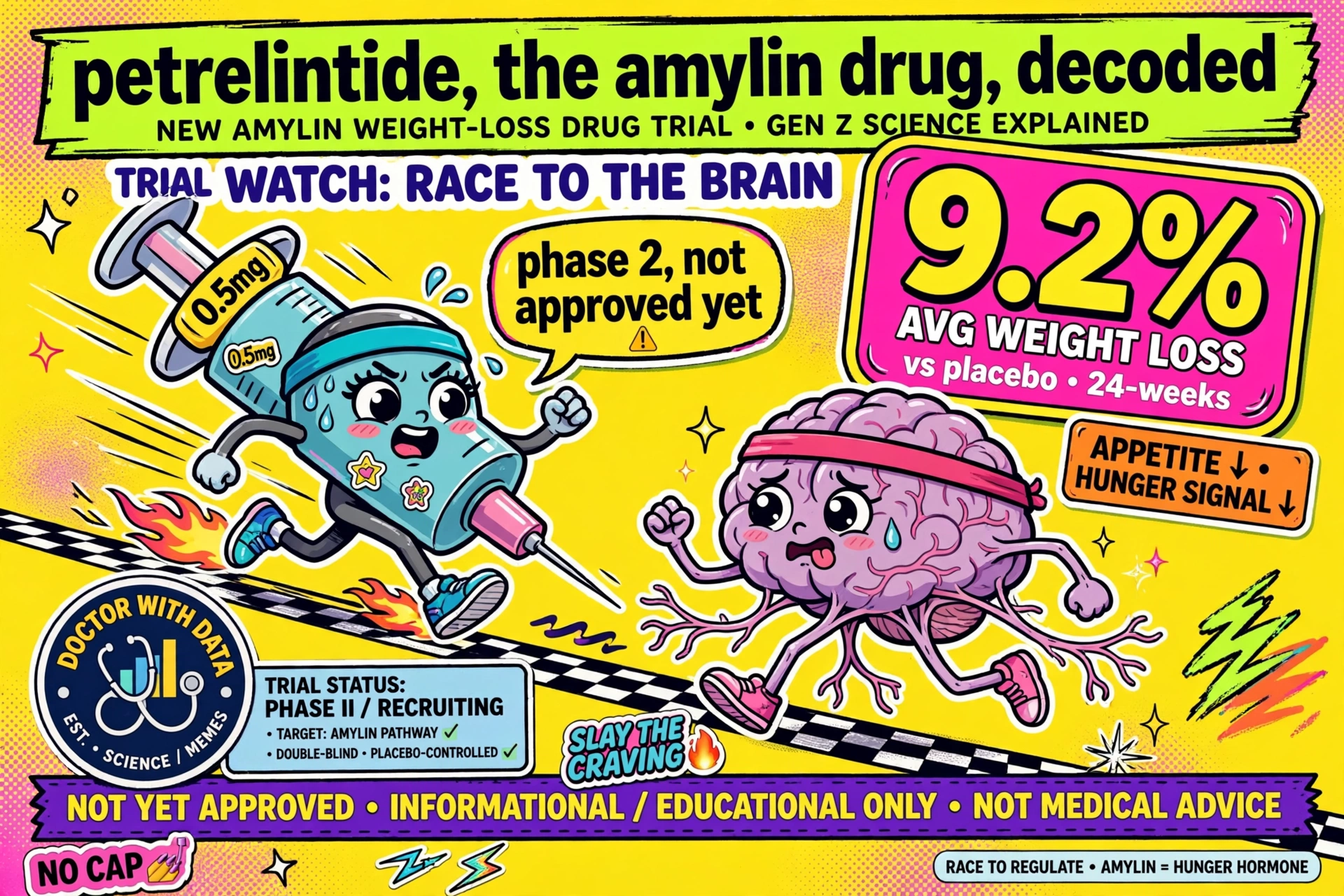
What is petrelintide? It is a once-weekly injection being tested as a new kind of weight-loss drug, and on 7 October 2026 its maker, Zealand Pharma, announced the first Phase 2 results in people living with type 2 diabetes. The headline number was striking: up to 9.2% average weight loss over 28 weeks, compared with 2.0% for placebo. But a trial headline is not the same as the trial. This article decodes the study itself: how it was designed, what the numbers actually show, and what a Phase 2 trial can and cannot prove.
What is petrelintide and what does amylin do?
The short answer: petrelintide is a long-acting copy of amylin, a natural satiety hormone, designed as a weekly injection. It works through a different pathway from the GLP-1 drugs most people know.
Amylin is a hormone made in the beta cells of the pancreas and released alongside insulin after meals. When amylin receptors are activated, three things happen: food leaves the stomach more slowly, the liver releases less glucose, and the brain registers fullness sooner. One proposed mechanism is especially interesting for people with obesity: amylin appears to restore sensitivity to leptin, the body’s own “I am full” signal. Many people with obesity develop leptin resistance, meaning their brain stops hearing the signal even when plenty of leptin is circulating. If amylin can turn the volume back up, the same amount of food triggers a stronger stop message.
That is what makes petrelintide genuinely different from the current weight-loss giants. Drugs like semaglutide (Wegovy, Ozempic) and tirzepatide (Zepbound, Mounjaro) mimic GLP-1, and in tirzepatide’s case GIP as well, which are gut hormones that reduce appetite through partly overlapping pathways. Petrelintide, by contrast, is a long-acting human amylin analogue built for once-weekly injection under the skin. Zealand Pharma designed it to stay chemically stable at neutral pH, which matters because it opens the door to combining it in one injection with other peptide drugs.
The industry has noticed. In 2025, Zealand Pharma signed an exclusive collaboration with Roche to co-develop petrelintide, and a Phase 2 trial combining it with Roche’s GLP-1/GIP dual agonist enicepatide (CT-388) is planned to start in the second half of 2026. The logic is the same one behind CagriSema, a combination of the amylin analogue cagrilintide with semaglutide that is further along in development: attack appetite from two hormonal directions at once.
How was the ZUPREME-2 trial designed?
The short answer: a 28-week, randomised, double-blind, placebo-controlled Phase 2b trial in 220 US adults with overweight or obesity and type 2 diabetes. This is the strongest basic design available for testing whether a drug works.
Each of those design words carries weight, so here is what they mean in plain language.
Phase 2b. Drug development runs in phases. Phase 1 asks “is this safe in humans?” Phase 2 asks “does it seem to work, and at what dose?” Phase 3 asks “does it work at scale, across diverse populations, with outcomes regulators care about?” A Phase 2b trial is mid-stage work: large enough to detect a real signal, small enough that the signal still needs confirming. Nothing in Phase 2 is the final word.
Randomised, double-blind, placebo-controlled. Participants were randomly assigned to one of three petrelintide doses or a placebo, and neither the participants nor the researchers knew who received what until the trial ended. Randomisation balances out the unknown differences between people; blinding stops expectations from shaping behaviour or measurement; the placebo group reveals what would have happened anyway. This is the design you want when asking “does the drug cause the effect?”
The participants. ZUPREME-2 enrolled 220 people in the United States, all with overweight or obesity and type 2 diabetes. Their average body mass index was 36.3 kg/m2 and their average HbA1c, the standard three-month blood sugar measure, was 8.0%. Everyone was taking metformin, with or without an SGLT2 inhibitor, which are standard first-line diabetes medicines.
What everyone received. This detail matters more than most headlines suggest. Every participant, including those on placebo, followed a reduced-calorie diet and increased physical activity throughout the trial. The trial was not “drug versus nothing”: it was “drug plus lifestyle programme versus placebo plus the same lifestyle programme”. Any extra weight loss on petrelintide happened on top of the diet and exercise support both groups received.
The schedule. Doses were increased every fourth week for up to 16 weeks, then held steady for a maintenance period until week 28, with follow-up continuing to week 38. The primary endpoint, the single question the trial was designed to answer, was the percentage change in body weight from baseline to week 28.
What did the petrelintide trial find?
The short answer: the trial met its primary endpoint. Average weight loss across the three doses ranged from 7.4% to 9.2% at 28 weeks, versus 2.0% with placebo, with a tolerability profile that looked remarkably like placebo.
Start with the headline numbers, all taken from Zealand Pharma’s 7 October announcement. Petrelintide achieved up to 9.2% mean body weight reduction at week 28, against 2.0% with placebo. The range across the three treatment arms was 7.4% to 9.2%. So “up to 9.2%” refers to the best-performing dose’s average, not to what every participant achieved. Averages hide spread: roughly half of participants lost more than the mean, and roughly half lost less. The company has not yet released the responder rates, the share reaching at least 5% or 10% weight loss, which were secondary endpoints. Expect those at the scientific conference presentation.
The announcement also reports results under two different “estimands”, a technical word worth decoding. An estimand is simply the question the analysis was set up to answer. The efficacy estimand asks: “what did the drug do in people who actually took it as planned?” The treatment regimen estimand asks the messier real-world question: “what happened when we offered this treatment, including the people who stopped taking it?” Results were “largely consistent” under both, which is a genuinely good sign: the effect was not propped up by quietly excluding the people who dropped out.
Blood sugar improved too. Petrelintide produced a placebo-adjusted HbA1c reduction of 0.61 to 0.88 percentage points across doses: up to a 0.65 percentage point fall on the drug, versus a 0.23 percentage point rise on placebo. Note the direction on placebo, a small rise despite the diet and exercise programme, which hints at how hard glycaemic control is to maintain in type 2 diabetes over time.
Then there is tolerability, arguably the most surprising part of the announcement. Stopping treatment because of gut-related side effects happened in 1.9% of petrelintide participants versus 1.7% on placebo: essentially the placebo rate. Most gastrointestinal events were mild and clustered in the dose-escalation period. For comparison, the GLP-1 drugs that currently dominate weight management are well known for nausea and vomiting that drives a meaningful share of users to quit. A weight-loss drug with a placebo-like gut profile would be unusual, and that claim will face its real test in the much larger Phase 3 programme.
What do these percentages mean for a real person?
Percentages are abstract, so translate them. On a starting weight of 100 kg, 9.2% is 9.2 kg and 2.0% is 2 kg: roughly 7 kg of extra loss attributable to the best dose of the drug, on top of the lifestyle programme everyone followed. On 90 kg, the same maths gives about 8.3 kg versus 1.8 kg.
Two cautions keep this honest. First, the placebo group also lost weight, which shows the lifestyle programme was doing real work, and it shows why placebo-controlled design matters: without it, the drug would have been credited with weight loss the diet programme produced. Second, these are 28-week results. Weight-loss trials routinely show the strongest loss in the first six to twelve months, followed by some regain. Nothing in this trial tells us what happens at two or five years.
How does petrelintide compare with Ozempic-style drugs and CagriSema?
The short answer: you cannot rank drugs from different trials, but the early numbers sit in a plausible range, with the important caveat that people with type 2 diabetes typically lose less weight than those without it.
Comparing drugs across trials is like comparing athletes who ran different races in different weather: the numbers are suggestive, never proof. With that warning, here is the landscape, using figures reported in peer-reviewed publications and company announcements.
In STEP 1 (New England Journal of Medicine, 2021), semaglutide 2.4 mg produced 14.9% average weight loss versus 2.4% with placebo over 68 weeks, in people without diabetes. In STEP 2 (The Lancet, 2021), the same drug in people with type 2 diabetes managed 9.6%: a full five percentage points less. Diabetes blunts weight-loss drug effects, consistently, across every drug class studied.
CagriSema, the amylin-plus-GLP-1 combination, reported 15.7% versus 3.1% with placebo in the REDEFINE 2 trial of 1,206 adults with type 2 diabetes over 68 weeks. Against semaglutide alone in the REIMAGINE 2 trial, also in type 2 diabetes, the combination achieved 14.2% versus 10.2% for semaglutide over 68 weeks. And cagrilintide alone, the amylin component, produced about 10.8% versus 3.0% with placebo over 26 weeks in its Phase 2 trial (The Lancet, 2021).
Set ZUPREME-2 alongside those: up to 9.2% versus 2.0% placebo, in type 2 diabetes, over 28 weeks. The duration is much shorter than the 68-week trials above, so this is an early read, not a ranking. What you can fairly say is that an amylin analogue alone is posting weight loss in the same neighbourhood as a GLP-1 drug in the diabetes population at this stage, with a notably gentle side-effect profile. The planned combination with a GLP-1/GIP drug is where the bigger numbers are expected.
What can this Phase 2 trial not prove?
The short answer: most of what a patient would actually want to know. Phase 2 establishes a signal; Phase 3 establishes the medicine.
Be precise about the gaps:
Small and short. 220 people, 28 weeks of treatment, all in the United States. Rare side effects, effects in different ethnic groups, and anything that takes years to emerge are invisible at this scale.
No hard outcomes. The trial measured weight and blood sugar, not heart attacks, strokes, kidney failure, or diabetes remission that lasts. Regulators increasingly want to see those outcomes for obesity drugs, and they are the whole point of Phase 3.
Topline, not peer-reviewed. What we have is a company announcement, not a published paper. Topline announcements are summaries written by the party with the most to gain from a positive spin. Full results are expected at a scientific conference, and independent scrutiny begins when the data are shown in detail. Treat today’s numbers as provisional.
Real-world effectiveness is untested. Everyone in ZUPREME-2 got structured diet and exercise support. In ordinary care, most people do not. Drugs almost always look better in trials than in clinics.
It is not approved anywhere. Petrelintide is an investigational drug. There is no pharmacy, clinic, or website that can legitimately sell it to you today, and anything marketed under its name now is something else. The Phase 3a programme has started: ZUPREME-3 in people with overweight or obesity without type 2 diabetes, ZUPREME-4 in those with type 2 diabetes, and ZUPREME-5 in people with established cardiovascular disease, enrolling about 7,000 participants in total, with the first participants already treated. Realistic timelines put any approval years away.
This article is educational, not medical advice. If you are considering weight-loss treatment, discuss the licensed options with your own clinician rather than waiting on a trial drug.
Frequently asked questions
What is petrelintide?
What is petrelintide in one sentence? It is an investigational once-weekly injection that mimics amylin, a natural satiety hormone, and is being developed by Zealand Pharma (in collaboration with Roche) for chronic weight management. It is not approved for use anywhere.
How much weight did people lose on petrelintide in the trial?
In ZUPREME-2, average weight loss at 28 weeks ranged from 7.4% to 9.2% across the three doses, compared with 2.0% for the placebo group. Everyone in the trial also followed a reduced-calorie diet and increased physical activity.
Is petrelintide better than Ozempic or Wegovy?
That cannot be answered from these data. Petrelintide has never been tested head-to-head against a GLP-1 drug, and comparing results across separate trials is unreliable because populations and durations differ. What can be said is that its early weight-loss numbers sit in a similar range to semaglutide’s in people with type 2 diabetes, with a milder gut side-effect profile so far.
What are the side effects of petrelintide?
In ZUPREME-2, the most common side effects were gastrointestinal and mostly mild, occurring mainly during dose escalation. Only 1.9% of participants stopped treatment because of gut side effects, versus 1.7% on placebo. Because the trial was small and short, rarer or longer-term effects remain unknown.
When will petrelintide be available?
Not soon. It is in Phase 3 testing (the ZUPREME-3, ZUPREME-4 and ZUPREME-5 trials, enrolling about 7,000 people), and drugs typically need successful Phase 3 results plus regulatory review before approval. Be sceptical of any product sold under its name before then.
Does petrelintide work for people without diabetes?
ZUPREME-2 only enrolled people with type 2 diabetes. A separate 42-week Phase 2 trial, ZUPREME-1, tested petrelintide in people with overweight or obesity without diabetes, and Zealand Pharma says the safety and tolerability profile was consistent. The dedicated Phase 3 trial in people without diabetes, ZUPREME-3, is now recruiting.
Sources
- Zealand Pharma, Company announcement No. 54/2026: positive Phase 2 ZUPREME-2 topline results for amylin analogue petrelintide, 7 October 2026.
- ZUPREME-2 trial registration: ClinicalTrials.gov, NCT06926842.
- Wilding JPH et al., Once-weekly semaglutide in adults with overweight or obesity (STEP 1), New England Journal of Medicine, 2021.
- Davies M et al., Semaglutide 2.4 mg once a week in adults with overweight or obesity, and type 2 diabetes (STEP 2), The Lancet, 2021.
- Enebo LB et al., Safety and efficacy of cagrilintide, a long-acting amylin analogue, in patients with type 2 diabetes, The Lancet, 2021.
If you want to keep practising how to read health studies, our decoded guide to the new mRNA flu vaccine trial breaks down a 40,000-person Phase III study, our look at whether statins lower Alzheimer’s risk explains why observational findings need a different kind of caution from randomised ones, and our piece on whether you can reverse prediabetes decodes a 20-year follow-up with a hopeful number for people with high blood sugar. For the primary source behind this article, see the Zealand Pharma ZUPREME-2 announcement.