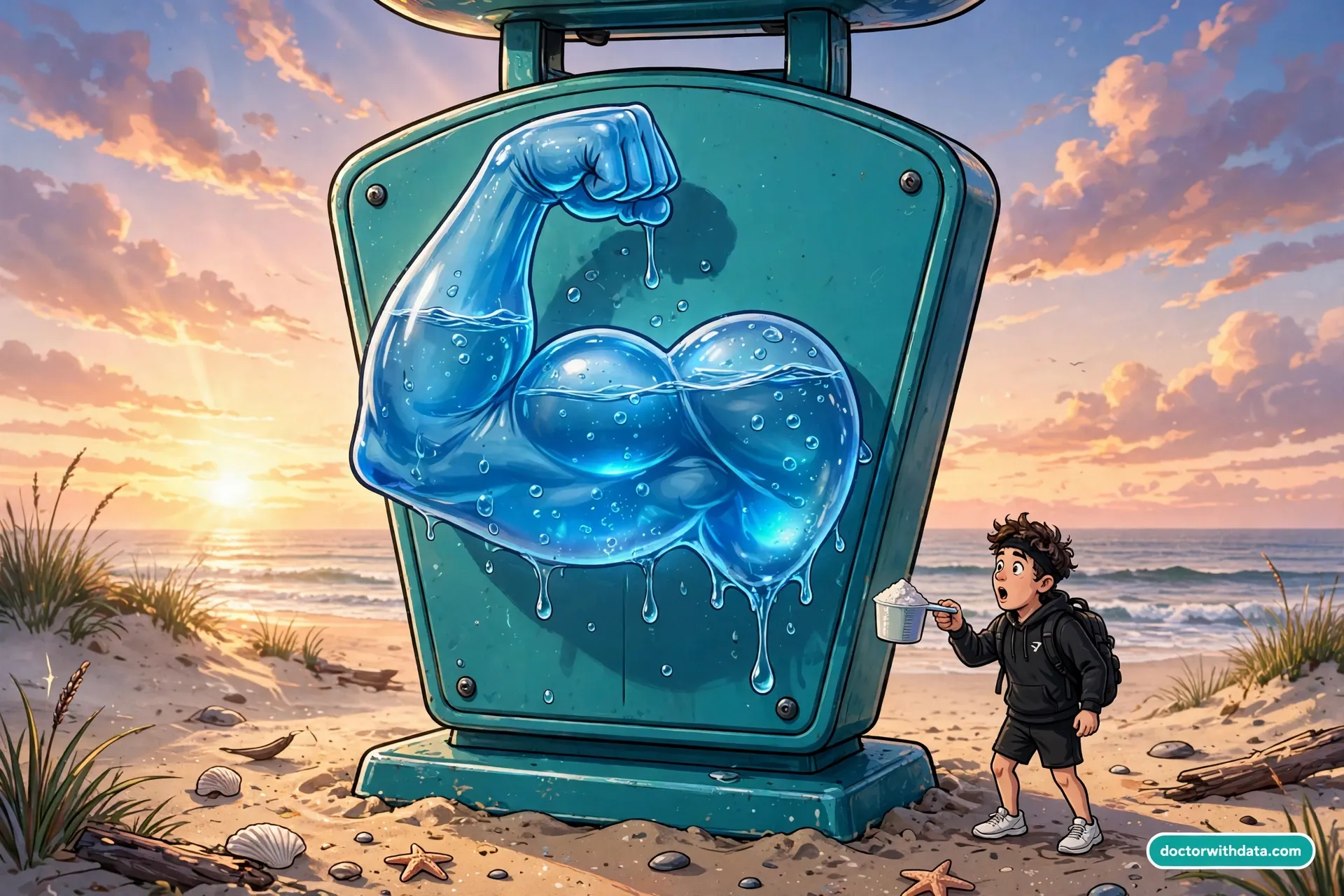
You start creatine, the scales jump by 10 pounds, and the obvious worry follows: have you just gained 10 pounds of fat? For most people, the short answer is no. Creatine does not turn into body fat, and the trials behind it find no increase in fat mass. What creatine does reliably do is pull extra water into your muscles as your muscle creatine stores fill up. That water is real weight, it shows on the scales, and it can arrive fast. But 10 pounds, about 4.5 kilograms, is more than creatine alone usually explains, especially if it appeared in a week or two. The honest reading is usually a mix: some creatine water, plus training, food and weighing changes that arrived at the same time. This article separates those parts, with the numbers the studies actually report, so you can judge your own gain instead of guessing.
The short answer: what 10 pounds after creatine usually means
Why did I gain 10 pounds after taking creatine? Most of the early gain is water held inside muscle cells, not fat and not the puffy water retention people picture under the skin. A pooled analysis of 61 trials combining creatine with resistance training found body mass rose by an average of 0.89 kilograms compared with placebo, with fat-free mass up 1.39 kilograms and no significant change in fat mass. That average is a long way from 4.5 kilograms, which is why a full 10 pound jump deserves a second look at the timeline and at what else changed. If the gain appeared in the first week of a loading phase, the likeliest story is a larger than average water shift plus normal daily fluctuation, a heavier meal pattern, or a different weighing routine. If it built up over months of training, part of it may be genuine lean tissue, helped along by creatine, with the rest coming from food and training. Either way, creatine alone is rarely the whole explanation for 10 pounds, and fat is the least likely explanation of all.
Why creatine adds weight at all
Creatine works by topping up the creatine stored in your muscles, which helps regenerate energy during short, hard efforts. Muscle cells take creatine up through a sodium dependent transporter, and water follows it into the cell to keep the concentration balanced. This is the key mechanism behind the scale change: as stores fill, each muscle cell holds a little more fluid, so total body water rises and body weight rises with it. The International Society of Sports Nutrition position stand describes early loading studies as showing roughly 0.5 to 1.0 litres of short term fluid retention, and notes weight gain as the only consistently reported side effect of creatine. A litre of water weighs a kilogram, so even that early fluid shift alone accounts for roughly 1 to 2 pounds before any training effect enters the picture.
Where the water sits matters as much as how much there is. A classic trial by Powers and colleagues followed adults doing resistance training for 28 days, taking 25 grams of creatine a day for the first week and then 5 grams a day for three weeks. Muscle creatine rose, body weight rose and total body water rose, but the split between water inside cells and water outside them did not change. That finding is reassuring in one specific way: the puffiness people fear, extra water sitting under the skin, would show up as extra water outside cells, and it did not. The 2021 review by Antonio and colleagues reached a similar conclusion for the short term, attributing the rise mainly to water inside cells, while noting that longer term studies often found no change in total body water relative to muscle mass once stores were full. In plain language, the water goes into muscle, it levels off once stores are saturated, and it does not keep accumulating month after month.
How much weight does creatine usually add?
The answer depends on the dose protocol, because loading and daily dosing reach the same destination at very different speeds. A loading phase means about 20 grams a day, usually split into four 5 gram servings, for five to seven days, followed by 3 to 5 grams a day. Reviews of loading studies commonly describe a first week gain of 1 to 3 kilograms, mostly water, which is roughly 2 to 7 pounds. The International Society of Sports Nutrition position stand gives the underlying protocol as about 0.3 grams per kilogram of body weight a day for at least three days, then 3 to 5 grams a day to maintain stores, and notes that smaller daily doses of 2 to 3 grams will also fill stores over three to four weeks. So a loading week can plausibly add several pounds, while a steady 3 to 5 gram daily dose spreads the same water shift across a month, where it is much harder to notice against normal daily fluctuation.
The pooled trial averages are smaller than the loading week range, and that gap is informative. The 2025 pooled analysis of 61 trials found body mass up 0.89 kilograms versus placebo, alongside fat-free mass up 1.39 kilograms. Those figures average across protocols, body sizes and study lengths, so they describe the typical trial participant, not the largest possible response. A bigger, more muscular person stores more creatine and therefore holds more associated water, which is one reason reported ranges run from under a kilogram to 3 kilograms rather than settling on a single number. Someone starting with low muscle creatine stores, for example someone who eats little or no meat, may also see a larger filling effect, though individual response still varies widely. None of this stretches the typical creatine-only effect to 10 pounds in a week. Even the top of the loading range, 3 kilograms, is about 6.6 pounds, and most people land below it.
What about muscle gain over months?
Over weeks and months of training, a second, slower kind of weight gain enters the picture: lean tissue. A 2024 systematic review and meta-analysis by Desai and colleagues pooled 12 randomised trials in adults under 50 doing resistance training for four to eleven weeks, and found creatine users gained 1.14 kilograms more lean body mass than those training without it, while losing 0.73 kilograms more fat mass and reducing body fat percentage by 0.88 points. That is an extra gain on top of what training alone produced, not a total gain, and it took weeks of consistent training. It helps explain how a scale reading can keep climbing after the initial water step has levelled off, but it does not explain a sudden 10 pound jump. Lean tissue accrues slowly, in hundreds of grams, not in a single week. If your 10 pounds arrived gradually over three to six months of hard training and eating more, lean tissue plus water plus food is a plausible mix. If it arrived in seven days, it is almost certainly water plus weighing and food factors, not new muscle.
The timeline test: a week, a month, three months
Timeline is the fastest way to judge your own gain. In the first week, especially during loading, expect water only: a rise of up to about 3 kilograms at the top end, typically less, with no new fat and no new muscle yet. If you gained 10 pounds in that first week, creatine water can account for part of it, but not all of it, and the rest needs another explanation from the checks below. Over the first month on a steady daily dose, the same water shift arrives gradually, stores reach saturation over three to four weeks, and the scale step is usually small enough to hide inside normal fluctuation. Over three months or more of training, the picture changes again: water has plateaued, lean mass may be genuinely up by a kilogram or so more than training alone would give, and any further steady climb is more likely to be food intake than creatine. A gain that keeps rising month after month, long after stores are full, is not a creatine effect still unfolding. Something else is driving it.
Five other explanations for the extra pounds
First, food. Many people start creatine at the same time as a new training plan, and a new training plan often comes with eating more, deliberately or not. Extra food brings extra carbohydrate, and carbohydrate is stored with water, plus extra sodium, which also holds water, plus simply more food sitting in the gut at weighing time. None of that is creatine, but all of it lands on the same scale reading. Second, weighing conditions. Body weight swings by a kilogram or more across a day with meals, drinks, clothing and toilet timing, so comparing a light morning weight before creatine with a heavy evening weight after it can manufacture several pounds out of nothing. Weighing first thing in the morning, after the toilet, in similar clothing, gives the only comparison worth trusting.
Third, new training itself. Starting or intensifying resistance training causes muscle soreness and repair, and repairing muscle holds extra fluid in the short term, independent of any supplement. Fourth, other products. Pre-workout drinks, mass gainers and protein powders add calories and sometimes creatine of their own, and a mass gainer in particular can add hundreds of calories a day that quietly become body fat over weeks. Fifth, medicines and health changes. Some medicines cause fluid retention or weight gain, and a sudden, unexplained gain alongside swelling, breathlessness or other new symptoms is a reason to speak to a clinician rather than to blame the supplement. None of these five needs a study citation to check: they are questions to ask about your own routine, and together they usually account for the gap between the typical creatine effect and a full 10 pounds.
Is it fat? How to tell without guessing
The trial evidence says no, at least not from creatine itself. The 2025 pooled analysis found no significant effect of creatine on fat mass, and the Desai meta-analysis found creatine users lost slightly more fat than those training without it. Antonio and colleagues, reviewing the common questions about creatine in 2021, likewise found no evidence that creatine increases fat mass. That does not prove your own gain contains no fat: if you started eating substantially more at the same time, some of the gain over months could be fat, but the fat would come from the extra calories, not from the creatine molecule. Practical checks help more than speculation. If your clothes fit the same around the waist but your muscles look fuller and your training weights are up, water and lean tissue fit the picture. If your waist measurement is climbing steadily week after week, food intake is the likelier driver, and it is worth tracking what you eat for a fortnight before changing anything about creatine.
What to do if you do not want the water weight
You have three reasonable options, and none of them requires stopping creatine in a panic. The simplest is to skip loading altogether: take 3 to 5 grams a day from the start, accept that stores take three to four weeks to fill, and let the water arrive so gradually that the scales barely notice it. The second is to keep loading but weigh yourself properly, once a week at the same time under the same conditions, and judge the trend over a month rather than reacting to a single reading. The third, if the number on the scales genuinely bothers you more than the training benefit, is to stop creatine: muscle stores drift back to their starting level over about four to six weeks, and the water held with them goes too. What you should not do is chase the number with dehydration, diuretics or crash dieting, which will move the scales without telling you anything useful about body composition. And if you compete in a weight class sport, plan around the water explicitly: a loading phase in the week before a weigh-in is the worst possible timing.
When to get checked rather than reassured
Most creatine weight gain is benign and self limiting, but not every rapid gain is. Seek medical advice promptly if a fast gain comes with swollen ankles or face, breathlessness, markedly reduced urination, or other new symptoms, or if you have kidney disease, heart failure or another condition where fluid balance matters. Those symptoms are not typical creatine effects, and they deserve a clinician’s assessment rather than an article’s reassurance. The same applies if you take medicines known to affect weight or fluid, or if the gain continues month after month despite stable food and training. This article explains what the research shows for the general population; it is not personal medical advice, and anyone with a relevant health condition should discuss supplements with their own clinician, as our earlier guide on who should never take creatine sets out.
The bottom line
Why did I gain 10 pounds after taking creatine? Because creatine fills your muscles with creatine and water, and that water weighs something, but the trials put the typical creatine effect at under a kilogram on average and at most about 3 kilograms during a loading week. Ten pounds is about 4.5 kilograms, which sits beyond what creatine alone usually delivers. The most likely full story is creatine water plus one or more fellow travellers: more food, a new training stimulus, different weighing conditions, or extra calories from another product. Check the timeline first, then the weighing routine, then the food, and the mystery usually shrinks to a sensible size. The gain is very unlikely to be fat created by creatine, it will reverse over several weeks if you stop, and it is no reason on its own to abandon a supplement that, in the trials, helped people gain lean mass while training.
Frequently asked questions
Is 10 pounds of weight gain from creatine normal?
Not from creatine alone. Typical trial averages are under a kilogram, and even loading weeks usually add 1 to 3 kilograms. A 10 pound gain, about 4.5 kilograms, usually means creatine water plus other factors such as food, training changes or weighing conditions.
Does creatine make you gain fat?
The trials say no. A pooled analysis of 61 trials found no significant effect on fat mass, and a 2024 meta-analysis found creatine users lost slightly more fat than those training without it. Extra calories eaten alongside creatine can become fat, but that fat comes from the food, not from creatine itself.
How long does creatine water weight last?
As long as you keep taking creatine, because muscle stores stay full and the water stays with them. If you stop, stores drift back to their starting level over about four to six weeks, and the water weight goes with them. Any lean tissue built through training stays, provided training continues.
Will skipping the loading phase stop the weight gain?
It will not remove it, but it will spread it out. A steady dose of 3 to 5 grams a day fills muscle stores over three to four weeks instead of one week, so the same water shift arrives gradually and is much less visible on the scales.
Does creatine bloat your face?
The measured evidence does not support facial puffiness as a typical effect. In the Powers trial, total body water rose but the split between water inside and outside cells did not change, and the water outside cells is where visible puffiness would sit. A puffy face appearing with rapid weight gain is worth getting checked rather than attributing to creatine.
Should I stop creatine because of the weight gain?
Only if the weight itself matters more to you than the training benefit, for example in a weight class sport. Otherwise, switching to a steady daily dose and weighing yourself consistently is usually the better move. Stopping will reverse the water over several weeks, but it will also give up the performance and lean mass support the trials found.
Sources
- Powers ME, Arnold BL, Weltman AL, Perrin DH. Creatine supplementation increases total body water without altering fluid distribution. Journal of Athletic Training. 2003;38(1):44 to 50. PubMed
- Kreider RB and colleagues. International Society of Sports Nutrition position stand: safety and efficacy of creatine supplementation in exercise, sport, and medicine. Journal of the International Society of Sports Nutrition. 2017;14:18. PubMed
- Antonio J and colleagues. Common questions and misconceptions about creatine supplementation: what does the scientific evidence really show? Journal of the International Society of Sports Nutrition. 2021;18:13. Repository record
- Desai I and colleagues. The effect of creatine supplementation on resistance training-based changes to body composition: a systematic review and meta-analysis. Journal of Strength and Conditioning Research. 2024;38(10):1813 to 1821. Article record
- Creatine supplementation and resistance training: a comparison between novice and experienced lifters, a systematic review and dose-response meta-analysis. Journal of the International Society of Sports Nutrition. 2025. PubMed