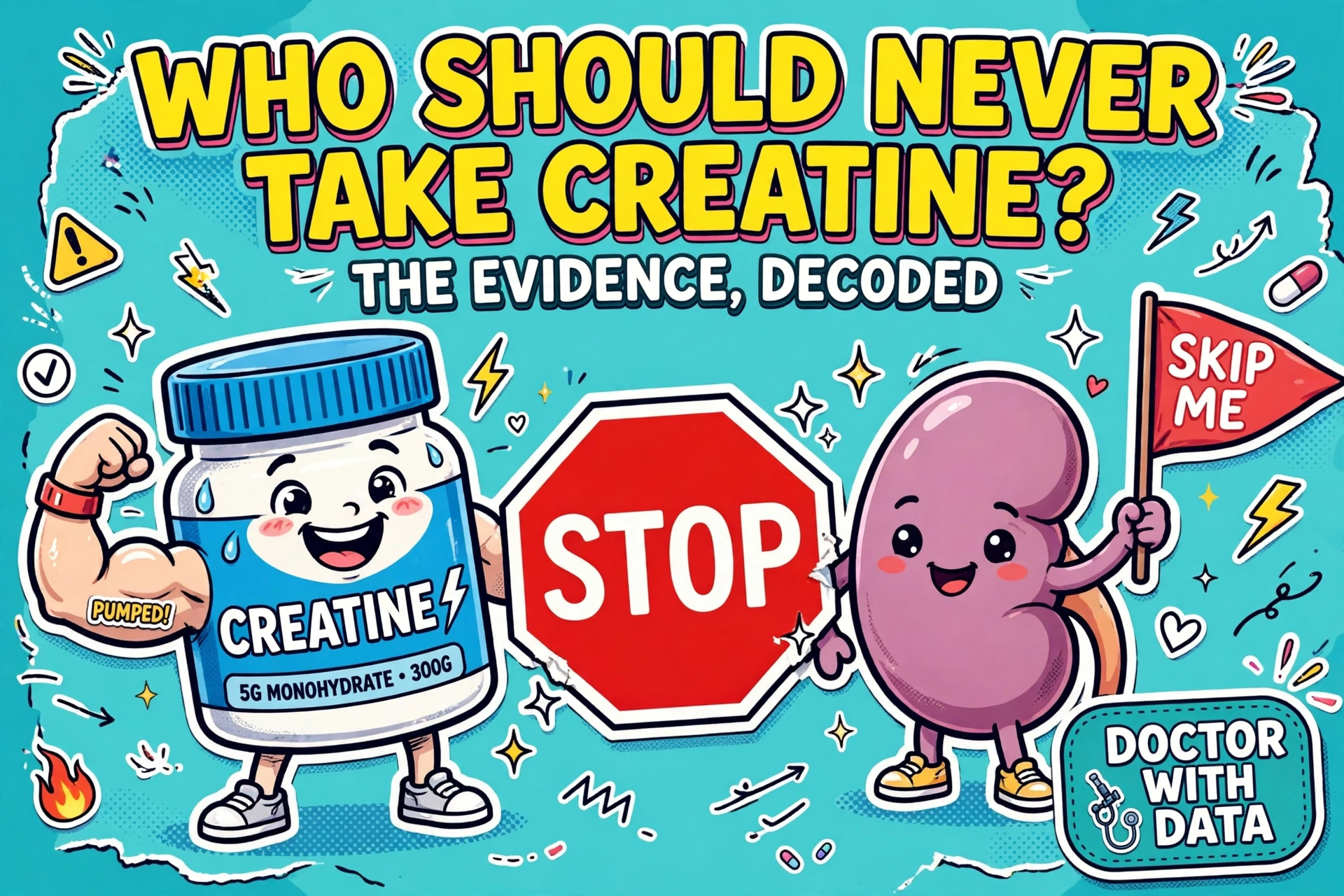
The short answer: Most healthy adults can take creatine without problems, and hundreds of studies back that up. But creatine is not for everyone. The evidence supports a clear no for people with chronic kidney disease, and a strong “ask your doctor first” for people who are pregnant or breastfeeding, children and teenagers, people with bipolar disorder, and anyone taking medicines that strain the kidneys.
Creatine is one of the most popular supplements in the world, and also one of the most studied. That is exactly why the question “who should never take creatine?” has a better answer than most supplement questions: researchers have actually looked. Here is what the evidence says, group by group, with the honest caveats where the data run out.
First, the good news: creatine is remarkably well studied
Before the warnings, some context. The International Society of Sports Nutrition published a position stand on creatine in 2017, after reviewing hundreds of trials, and concluded that creatine monohydrate is the most effective nutritional supplement available for increasing high-intensity exercise capacity and lean body mass during training. On safety, its verdict was equally clear: short and long term use, including doses of up to 30 grams a day for five years, showed no detrimental effects in otherwise healthy individuals, and there is no compelling evidence that creatine harms kidney function in healthy people.
A later European safety review of creatine forms reached a similar conclusion for ordinary doses: a daily intake of 3 grams is unlikely to pose safety concerns in healthy adults. Note the qualifier, though. That review explicitly excluded pregnant and breastfeeding women from its safety conclusion. “Safe for healthy adults” is not the same as “safe for everyone”, and the groups below are where the distinction matters.
1. People with chronic kidney disease
This is the single clearest “do not take it” group. Nearly all the reassuring safety trials were done in people with healthy kidneys, and meta-analyses explicitly note that further studies in people with pre-existing kidney disease are still needed. You cannot apply “safe in healthy adults” to damaged kidneys.
Clinical guidance on creatine and kidney disease is consistent: people with chronic kidney disease or reduced kidney function should avoid creatine, or use it only under direct medical supervision. Some clinical decision guidance uses an estimated glomerular filtration rate (eGFR) below 45 as a practical line for avoidance. Kidney specialists also discourage creatine in kidney donors and people with a single kidney, on the principle that remaining kidney function is too precious to gamble with. Protein in the urine, a sign of kidney damage, is another reason to stay away.
There are two reasons for the caution. First, creatine breaks down into creatinine, the very substance doctors measure to assess kidney function. Supplementation can raise serum creatinine by around 0.2 to 0.3 mg/dL without any actual kidney damage, which can look like acute kidney injury on a blood test and even lead to a mistaken diagnosis of chronic kidney disease. Second, while direct evidence of harm in humans with kidney disease is thin, that is because the studies have not been done, not because they came back clean. One animal study in rats with cystic kidney disease found that creatine worsened disease progression.
Two common conditions make this group larger than it looks. Diabetes is one of the leading causes of chronic kidney disease, so anyone with diabetes should treat creatine as a “doctor first” supplement rather than an over-the-counter decision. And high blood pressure quietly damages the kidneys over time, with one analysis of 1.4 million health records finding that most hypertension goes undiagnosed. If your kidney function has never been checked, that check should come before the creatine.
2. People taking medicines that strain the kidneys
Creatine on its own does not appear to damage healthy kidneys, but combinations matter. Drug interaction references give creatine a moderate interaction rating with medicines that can harm the kidneys, because rare case reports have linked creatine to kidney injury and the combination may increase the chance of damage.
The medicines in this category include non-steroidal anti-inflammatory drugs such as ibuprofen and naproxen, certain antibiotics including the aminoglycosides, and immunosuppressants such as cyclosporine. If you take any of these regularly, or you take several medicines and are not sure which ones affect the kidneys, talk to your doctor or pharmacist before adding creatine. This is not a reason to panic about an occasional ibuprofen tablet, but it is a reason to have the conversation.
3. People who are pregnant or breastfeeding
There is simply not enough reliable information about creatine safety in pregnancy or breastfeeding. The European safety review discussed above deliberately excluded these groups from its conclusions, and clinical references advise staying on the safe side and avoiding use.
This is a data gap, not a proven harm: nobody has shown that creatine harms a pregnancy. But pregnancy changes how the body handles almost everything, including kidney filtration and fluid balance, and no trial has established a safe dose for mother or baby. Until that research exists, the cautious answer is the correct one.
4. Children and teenagers
This group gets the most nuanced answer, because the science and the labels point in slightly different directions. The ISSN position stand argues that under-18 warnings on creatine labels are mainly a legal precaution: studies in infants, children and adolescents, some at relatively high doses, found benefits without evidence of harm. It concludes that creatine is acceptable for young athletes provided there is proper supervision, serious and supervised training, a balanced diet, knowledge of correct use, and no dose exceeding.
Paediatric-focused reviews lean the other way, recommending that children and adolescents avoid creatine because long term safety data in developing bodies do not exist. The American Academy of Pediatrics guidance cited in clinical reviews likewise does not recommend it for adolescents given the absent safety data.
The honest reading: there is no scientific scandal here, but there is also no reason for a 15-year-old to take a supplement whose long term effects on a developing body are unstudied. If a young athlete is considering it, that decision belongs with a paediatrician or sports medicine doctor, not a supplement aisle.
5. People with bipolar disorder
This is a smaller group, but the signal is worth knowing. There have been case reports of manic episodes in people with bipolar disorder who took creatine daily for four weeks, and clinical references warn that creatine might make mania worse.
Case reports are the weakest form of evidence: they describe events, they do not prove cause. Still, mania is a serious outcome, and the cost of caution here is low. Anyone with bipolar disorder should discuss creatine with their psychiatrist before trying it, and stop and seek advice promptly if mood symptoms shift.
6. Anyone about to have kidney blood tests
This one is practical rather than medical. Because creatine raises serum creatinine by roughly 0.2 to 0.3 mg/dL through normal breakdown, not through kidney damage, it can make your kidney function look worse than it is. Estimated GFR calculations assume stable conditions and become unreliable during supplementation, which can lead to misclassification of kidney function.
The fix is simple: tell your doctor you take creatine before any kidney blood test. If kidney function needs assessing accurately while you supplement, ask about cystatin C, a kidney marker that is not affected by muscle mass or creatine use.
What if none of these apply to you?
Then the evidence is reassuring. In healthy adults taking standard doses of 3 to 5 grams a day, creatine is among the safest supplements ever studied. Several myths have not survived the data: controlled trials have found no good evidence that normal creatine use causes hair loss, dehydration, or muscle cramping in healthy people.
Two real but minor effects are worth knowing. Creatine pulls water into muscle cells, so the scales may rise by 1 to 3 kilograms in the first weeks; that is water in muscle, not fat, and it is not a sign anything is wrong. And some people get stomach cramps, bloating or loose stools, especially with large single doses or loading phases; taking it with food and water usually helps.
One last boundary: this article is about who should avoid creatine, not a buying guide. If you do supplement, creatine monohydrate is the form with the evidence behind it, and more is not better.
Frequently asked questions
Is creatine bad for your kidneys?
In healthy people, no. The ISSN position stand found no compelling evidence that creatine harms kidney function in healthy individuals, even at high doses over several years. The concern applies to people who already have kidney disease or reduced kidney function, where the safety studies simply were not done.
Can I take creatine if I have high blood pressure?
High blood pressure on its own is not a listed contraindication, but it is a major risk factor for chronic kidney disease, so it moves you into the “ask your doctor first” group. Get your kidney function checked, and read our explainer on why most high blood pressure goes undetected.
Is creatine safe during pregnancy?
There is not enough reliable safety data to say. Clinical references advise avoiding creatine while pregnant or breastfeeding, and safety reviews have explicitly excluded these groups from their conclusions.
Can teenagers take creatine?
The evidence is mixed. The ISSN considers supervised use acceptable for young athletes meeting strict conditions, while paediatric reviews recommend avoidance because long term data in developing bodies do not exist. Either way, it is a decision for a doctor, not a teenager alone.
Does creatine cause hair loss?
There is no good evidence for this in healthy adults. The claim traces back to a single small study suggesting a rise in DHT, a hormone linked to hair loss, but controlled trials have not confirmed actual hair loss, and large reviews do not list it as an established side effect.
Should I tell my doctor that I take creatine?
Yes. It can raise your serum creatinine reading and confuse kidney function tests, so mention it before any blood work. It also matters if you take regular medication, have any chronic condition, or fall into one of the caution groups above.
Sources
- Kreider RB et al. International Society of Sports Nutrition position stand: safety and efficacy of creatine supplementation in exercise, sport, and medicine. Journal of the International Society of Sports Nutrition. 2017;14:18. Full text (PDF)
- Scripps Health. Does creatine damage your kidneys? What to know (Dr Solhjou). Scripps Health
- MinClinic. Creatine: health benefits, special precautions and warnings (pregnancy, bipolar disorder, kidney disease, nephrotoxic drug interactions). MinClinic supplement reference
- A review of creatine supplementation: side effects and improvements in athletic performance. ResearchGate. Publication page
- Contraindications for creatine supplementation: research synthesis (Kim 2011; Antonio 2021; Kreider 2025). Consensus
- Creatine and creatine forms intended for sports nutrition: safety review record (3 g/day assessment in healthy adults, excluding pregnant and breastfeeding women). AGRIS record
This article is for information only and is not medical advice. Talk to your doctor or pharmacist before starting, stopping, or changing any supplement, especially if you have a health condition or take regular medication.