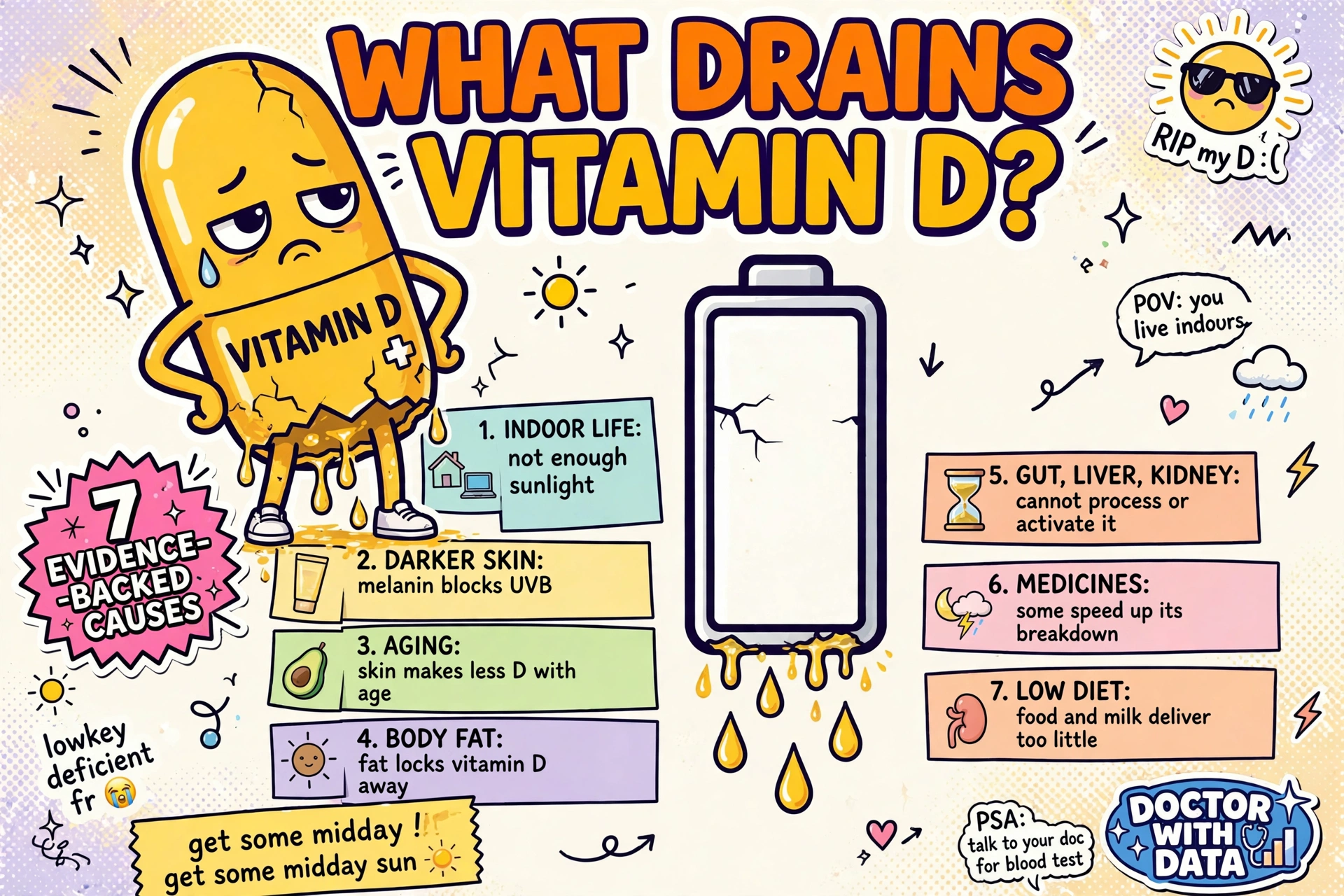
If your blood test comes back low in vitamin D, the result can feel like a puzzle. You eat reasonably well, you go outside, and yet the number is below the line. So what drains vitamin D from your body? The short answer is that several ordinary things quietly reduce how much you make, absorb or keep: limited ultraviolet light reaching your skin, darker skin pigmentation, getting older, body fat storing vitamin D away, gut or organ conditions that block absorption and activation, certain medicines that speed up its breakdown, and diets or feeding patterns that supply too little in the first place. None of these is rare. Vitamin D deficiency affects roughly one in three people worldwide by the commonly used threshold, and around 40 percent of Europeans fall below 50 nmol/L, the cut-off many labs use for deficiency. Understanding which drains apply to you is the first step to fixing the number.
How vitamin D moves through your body
It helps to know the route, because every drain on this list attacks a different point along it. Most of your vitamin D starts in the skin, where UVB light converts a cholesterol-like substance called 7-dehydrocholesterol into vitamin D3. The liver then converts it into 25-hydroxyvitamin D, written 25(OH)D. This is the form blood tests measure, and it circulates for weeks rather than days. Finally the kidneys convert it into the active form, calcitriol, which helps your gut absorb calcium and keeps bones, muscles and the immune system working. A breakdown at any of these steps, from sunlight to kidneys, leaves you with less usable vitamin D.
1. Your skin is not seeing enough UVB
For most people, sunlight is the main vitamin D supply. According to the US National Institutes of Health’s MedlinePlus service, not getting enough sun exposure is one of the primary reasons people become deficient, alongside low dietary intake and poor absorption. Several everyday realities cut the UVB dose your skin receives: spending most daylight hours indoors, working night shifts, living at northern latitudes where winter sun is too weak, heavy air pollution, and covering most of your skin with clothing.
Sunscreen sits in an interesting corner of this story. In laboratory settings, SPF 30 sunscreen blocks more than 95 percent of vitamin D synthesis in the skin. That does not make sunscreen the villain it sounds like: it protects against sunburn and skin cancer, and no serious guidance recommends abandoning it. The practical takeaway from the research is simpler: you do not need to bake. Brief, regular midday exposure of the hands, forearms and face through the sunnier months is the pattern most guidance describes, with supplements covering the darker half of the year. Our autumn vitamin D guide looks at what that means in practice for UK readers.
2. Darker skin makes less vitamin D from the same sun
Melanin, the pigment that gives skin its colour, competes with 7-dehydrocholesterol for the same UVB light. MedlinePlus lists people with dark skin among those at higher risk of deficiency precisely because their skin has less ability to produce vitamin D from sunlight. Studies comparing synthesis across skin types have found that darker skin may need several times more sun exposure than fair skin to make the same amount of vitamin D.
This is not a cosmetic footnote. It is one reason vitamin D deficiency shows up at high rates in populations of African, South Asian and Middle Eastern descent living in northern countries, where the sun is already weak for part of the year. If you have darker skin and live above the Mediterranean latitudes, the sunlight half of your vitamin D supply is working with a handicap, and the food and supplement half of the equation matters more.
3. Ageing slows the factory
Older adults appear on every at-risk list, and for two separate reasons. First, the skin itself becomes less productive: research reviews note that ageing reduces the concentration of 7-dehydrocholesterol in the epidermis and lowers total previtamin D3 production after the same sun exposure. Second, the kidneys of older adults are less able to convert vitamin D into its active form, as MedlinePlus explains.
This double hit matters because older people also tend to spend more time indoors and may wear more covering clothing outdoors, layering the sunlight problem on top of the biological one. It is also why deficiency in older adults is linked to the conditions vitamin D protects against: bone density loss, muscle weakness and fractures.
4. Body fat locks vitamin D away
People with obesity consistently show lower blood levels of vitamin D, and for years researchers argued about which way the arrow pointed. A large bi-directional Mendelian randomisation study by Vimaleswaran and colleagues, published in PLoS Medicine in 2013, settled the direction: using genetic markers across 21 cohorts and more than 42,000 adults, the team found that higher body mass index causes lower 25(OH)D levels, with each 10 percent higher BMI linked to about 4.2 percent lower vitamin D. The reverse, low vitamin D causing obesity, was not supported.
The mechanism is physical. Vitamin D is fat-soluble, so excess body fat sequesters it in deep adipose stores and dilutes it across a larger body mass, leaving less circulating in the blood where the test measures it. Reviews of weight-loss trials find that losing weight tends to raise 25(OH)D levels modestly. In our companion piece on whether low vitamin D causes weight gain, we walk through this evidence in full, including why the arrow runs from weight to vitamin D and not the other way round.
5. Your gut, liver or kidneys cannot process it
Even a good supply can be wasted if the machinery fails. Because vitamin D is fat-soluble and depends on bile and fat absorption in the gut, conditions that damage the intestinal lining or shortcut digestion impair it: coeliac disease, Crohn’s disease, ulcerative colitis and cystic fibrosis are all named by MedlinePlus, as is gastric bypass surgery, which bypasses part of the small intestine where vitamin D is absorbed.
Then there are the organs that activate it. Chronic liver disease impairs the first conversion step, the 25-hydroxylation in the liver. Chronic kidney disease impairs the second step, the 1-alpha-hydroxylation in the kidneys, which is why people with advanced kidney disease are often treated directly with active vitamin D analogues. If your deficiency keeps returning despite sensible sun and diet, these are the conditions a clinician will quietly be ruling out.
6. Medicines that speed up the breakdown
Several widely used medicines interfere with vitamin D, and MedlinePlus lists them as a distinct cause of deficiency: certain anti-seizure medicines, steroid medicines, cholesterol medicines and weight-loss medicines. The pharmacology is straightforward in most cases. Anti-seizure drugs such as carbamazepine and phenytoin, and the tuberculosis drug rifampicin, induce liver enzymes including CYP3A4, which accelerates the catabolism of 25(OH)D into inactive breakdown products. Bile-acid medicines such as cholestyramine reduce fat absorption in the intestine, taking vitamin D down with it. The weight-loss drug orlistat works the same way by design: it blocks fat absorption, and fat-soluble vitamins follow.
Glucocorticoid steroids, taken long term for asthma, arthritis or inflammatory conditions, disrupt vitamin D metabolism and reduce calcium absorption at the same time. If you take any of these medicines regularly, your vitamin D level is worth a conversation with your clinician or pharmacist rather than a guess.
7. Breast milk and food deliver too little
Food is the weakest of the three supply routes. Few foods contain meaningful amounts of vitamin D naturally: oily fish such as salmon, mackerel and sardines, egg yolks and liver are the genuine sources, with fortified dairy, orange juice and cereals filling the gap where fortification programmes exist. A diet low in these foods is listed by MedlinePlus as a direct cause of deficiency.
Breastfeeding is the sharper version of the same problem. Human milk is a poor source of vitamin D, which is why MedlinePlus advises that breastfed infants receive a supplement of 400 IU of vitamin D every day. Exclusively breastfed babies, and lactating mothers who are themselves low, are classic cases of deficiency that has nothing to do with sunlight at all.
What the evidence says you can do about it
The fixes follow the drains. If the issue is sunlight, regular brief midday exposure in the sunnier months plus a supplement through autumn and winter is the pattern most public health guidance describes. If the issue is skin pigmentation, age or obesity, food and supplements have to carry more of the load. If it is a gut, liver or kidney condition, that condition needs managing first. If it is a medicine, the answer is a conversation with your prescriber, not stopping the medicine.
And get tested before supplementing aggressively. Vitamin D status is measured as 25(OH)D in a blood test, with deficiency commonly defined below 20 ng/mL (50 nmol/L) and sufficiency at or above 30 ng/mL, per Endocrine Society guidelines. Taking large doses without knowing your level is how people end up at the other extreme, vitamin D toxicity, which carries its own risks. Our piece on whether low vitamin D affects sleep covers the testing thresholds in more detail.
Frequently asked questions
How do I know if my vitamin D is low?
The only reliable way is a blood test measuring 25-hydroxyvitamin D, usually written 25(OH)D. Deficiency is commonly defined as below 20 ng/mL (50 nmol/L), insufficiency as 20 to 29 ng/mL, and sufficiency at 30 ng/mL or above. Mild deficiency is often symptom-free, so you cannot reliably feel your way to a diagnosis.
Can sunscreen cause vitamin D deficiency?
In laboratory conditions, SPF 30 sunscreen blocks more than 95 percent of vitamin D synthesis in the skin. In real life the picture is less clear, because sunscreen users tend to spend more time outdoors. Sunscreen is not considered a primary cause of deficiency, and protecting your skin from sunburn and skin cancer takes priority.
Do I need more sun if I have darker skin?
Yes. Melanin absorbs UVB that would otherwise make vitamin D, so darker skin needs several times more sun exposure than fair skin to produce the same amount. In northern countries this makes the autumn and winter supplement habit particularly important for people with darker skin.
Can I get enough vitamin D from food alone?
It is difficult. Oily fish, egg yolks, liver and fortified foods are the realistic sources, but most people cannot reliably reach adequate levels from food alone without fortification or supplements, especially in winter.
Will losing weight raise my vitamin D?
Probably, modestly. Mendelian randomisation evidence shows higher BMI causes lower vitamin D levels through sequestration in fat tissue and dilution across body mass, and reviews of weight-loss trials find 25(OH)D rises as weight falls. Vitamin D supplements, by contrast, do not cause weight loss.
Should I take a vitamin D supplement?
If you are in a risk group, limited sun, darker skin, older age, obesity, gut or kidney conditions, or on medicines that interfere, a supplement is worth discussing with your clinician or pharmacist. Get your level tested first so the dose matches the gap, and see our autumn guide for the seasonal picture.
Sources
- MedlinePlus (US National Library of Medicine): Vitamin D Deficiency, causes and who is at risk. https://medlineplus.gov/vitaminddeficiency.html
- Vimaleswaran KS et al. Causal Relationship between Obesity and Vitamin D Status: Bi-Directional Mendelian Randomization Analysis of Multiple Cohorts. PLoS Medicine, 2013; 10(2): e1001383. https://pmc.ncbi.nlm.nih.gov/articles/PMC3564800/
- Prevalence of Vitamin D Deficiency in Healthy Adults: A Systematic Review and Meta-Analysis, Bratislava Medical Journal (Springer, 2025). https://link.springer.com/article/10.1007/s44411-025-00411-2
- Vitamin D Deficiency, Obesity, and Metabolic Parameters in Chilean Older Adults (review of thresholds and ageing effects), Journal of Personalized Medicine (MDPI, 2026). https://mdpi.com/2075-4426/16/2/90
- Cui et al. 2023 global prevalence meta-analysis (7.9 million participants, 308 studies), summarised in PMC11740202. https://pmc.ncbi.nlm.nih.gov/articles/PMC11740202/
- Drincic et al. Volumetric dilution, rather than sequestration best explains the low vitamin D status of obesity. Obesity, 2012. https://onlinelibrary.wiley.com/doi/10.1038/oby.2011.404
Related reading
- Will Low Vitamin D Cause Weight Gain? What the Evidence Shows
- Can Low Vitamin D Affect Your Sleep? What the Studies Say
- Do You Need Vitamin D Tablets This Autumn?
Medical disclaimer: This article explains published research in plain language and is not medical advice. If you are concerned about vitamin D deficiency, speak to your clinician or pharmacist before starting or changing supplements.