Do You Need Vitamin D Tablets This Autumn? What Outdoor Runners Taught Scientists
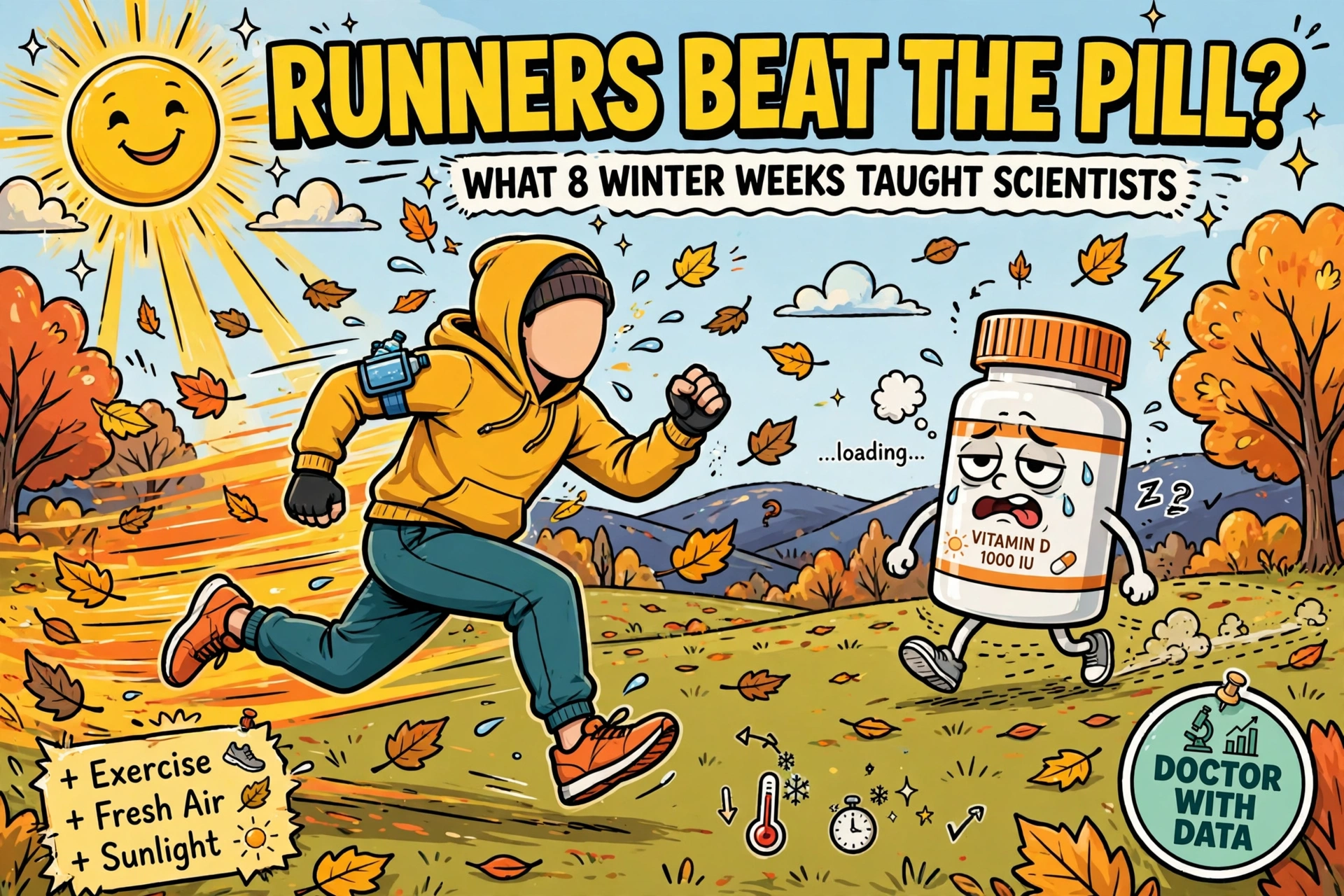
If you are worried about vitamin D deficiency symptoms this autumn, the short answer is that most adults in the UK should consider a daily 10 microgram vitamin D supplement from October to early March, when sunlight is too weak for the skin to make enough. But a new study gives the pills an unexpected rival: after eight weeks of autumn and winter, outdoor runners who took no supplements had vitamin D levels very similar to non-runners who took daily pills. Here is the study, decoded.
Searching for vitamin D deficiency symptoms? This guide explains what the study of runners and non-runners actually found, how to recognise the signs of low vitamin D, who should start supplements this autumn, and whether a run can really stand in for a tablet.
What did the runner vitamin D study actually test?
The study was run by Marco Gervasi and colleagues at the University of Urbino in Italy, in collaboration with researcher Eneko Fernández-Peña at the University of the Basque Country in Spain, and published in Scientific Reports in February 2026 (Gervasi et al., 2026;16(1):10094).
The design was clean. Adult runners and non-runners were split into groups. Some took a daily vitamin D supplement for eight weeks across autumn and winter; the others took nothing. Everyone had blood tests and physical tests at the start and the end, and the researchers checked blood markers again about twelve weeks after the supplements stopped, to see what happened by March.
Vitamin D matters here because the body makes roughly 80 percent of it through the skin in response to UVB sunlight, with the rest coming from food. Around a billion people worldwide are thought to be vitamin D deficient, and in winter the UVB reaching the skin in northern countries is barely enough to keep levels up.
What are vitamin D deficiency symptoms?
Before the headline result, here is the question most readers are actually asking. Low vitamin D builds quietly, so its signs are easy to mistake for the general autumn slump. The signs most often linked with vitamin D deficiency symptoms are:
- Persistent tiredness and low energy that does not lift with rest
- Aching bones, sometimes worst in the legs, ribs and joints
- Muscle weakness and cramps, including slow recovery after activity
- A low mood that seems tied to the darker months, feeling flat from October onward
- Catching colds and infections more often, since vitamin D helps keep the immune system balanced
In severe, prolonged deficiency, the signs stop being vague. Children can develop rickets, where softening bones lead to bowed legs and growth problems. Adults can develop osteomalacia, the softening of bones that causes severe pain and fractures. These are the conditions the supplement guidance is really designed to prevent, and they are why at-risk groups get year-round advice.
None of these symptoms on their own confirms a deficiency. Tiredness, aches and low mood have dozens of causes. A blood test for 25-hydroxyvitamin D, ordered through your GP, is the only reliable way to know where you stand. If your symptoms are new, severe or unexplained, speak to a clinician rather than diagnosing from a list.
What did the runners find? Exercise matched the pill
Here is the result that surprised the researchers. As expected, vitamin D levels rose in everyone who took the supplement. But after the two-month period, the vitamin D levels of the runners who did not take the supplement and the non-runners who did were very similar. A routine of outdoor running held vitamin D levels as well as a daily pill did, at least over these eight weeks.
The numbers behind it are worth decoding:
- Supplemented runners raised their 25(OH)D3 by 20.82 percent.
- Supplemented non-runners raised theirs by 28.78 percent.
- Unsupplemented runners stayed stable, neither rising nor falling.
- Unsupplemented non-runners fell by 32.23 percent, a steep drop in just eight weeks.
The runners’ advantage came from exposure, not fitness. They train outdoors, in the sun, with more skin exposed than someone sitting inside. The researchers were blunt about it: being outside more in the winter is an effective strategy, and just going outside for a 20 to 30 minute run at your own pace, several times a week, can make a real difference.
Can an outdoor run really replace a vitamin D tablet?
Mostly, with caveats. The study answers a specific question in a specific setting. The runners were amateurs, not elite athletes, and they trained outdoors through an autumn and winter in Italy and Spain, where winter sun is stronger than in the UK or Scandinavia. In darker northern winters, the same routine may buy less protection.
Three more limits matter:
- The runners started slightly ahead. An earlier snapshot study by the same team, published in Nutrients in 2024, found runners already had significantly higher autumn vitamin D than non-runners (around 30 to 31 ng/mL versus 23 to 25 ng/mL), with insufficiency in 63.6 percent of non-runners against 34.8 percent of runners. The runners in the 2026 trial began with slightly insufficient but higher levels, reflecting their existing outdoor exposure.
- Deep winter still wins eventually. At the March follow-up, vitamin D had fallen in every group. The supplemented groups lost most of their gains within about twelve weeks of stopping, and even the unsupplemented runners slipped as deep winter cut into their outdoor training. Nobody coasts through winter on stores alone.
- Not all outdoor time is equal. A run in a long-sleeved top at dusk exposes far less skin than one at midday in a vest. The dose depends on skin exposed, time of day and latitude.
So the honest reading is this: for an active person who trains outdoors regularly, winter vitamin D may hold up better than they feared, and for a sedentary person, a daily supplement is doing exactly what the outdoor exposure does for the runner. The study compares two working strategies, not a winner and a loser.
When should you start taking vitamin D in autumn?
The official UK guidance is straightforward. From October to early March, sunlight in the UK is generally not strong enough for the body to make vitamin D through the skin, so the NHS advises that everyone should consider taking a daily supplement containing 10 micrograms (400 IU) of vitamin D during autumn and winter. That is the point of the calendar we are now entering.
Some groups should not wait for October. People with darker skin, people who cover their skin for religious or cultural reasons, and people who are rarely outdoors should take a supplement all year round. Babies and young children have their own year-round advice. Food helps but rarely closes the gap: oily fish such as salmon and mackerel are the richest sources, with smaller amounts in red meat, egg yolks and fortified cereals, but the NHS notes it is difficult to get enough from food alone.
One safety note: more is not better. Adults should not regularly take more than 100 micrograms (4,000 IU) a day unless a doctor directs it, because excessive vitamin D over time can cause calcium to build up and damage the kidneys and heart. Check the strength on the bottle, especially if you take several supplements.
Do vitamin D tablets make you faster or stronger?
This was the part the athletes in the study will find hardest to hear. The trial also measured physical performance, and the supplements did not improve it. Maximum oxygen consumption, explosive leg power and isometric leg strength were all unchanged by supplementation. The researchers’ conclusion was blunt: despite correcting vitamin D insufficiency, no ergogenic benefits were observed in aerobic capacity or explosive power.
What the supplements did affect was immune stability. Neutrophil counts, a type of white blood cell, fell in the groups that took nothing, while supplemented groups held steadier. That lines up with vitamin D’s known role in balancing the immune system rather than building fitness. If you are choosing supplements to get faster, the evidence says save your money; if you want steadier winter immunity, the evidence is friendlier.
The decoded verdict: tablets or trainers?
Here is the plain-language bottom line of the runner study, combined with the official guidance:
If you run or exercise outdoors several times a week through autumn and winter, your vitamin D levels are likely to hold up far better than those of someone sedentary, roughly as well as a daily supplement did in this study. Keep it up, favour daylight hours, and do not assume your summer stores will carry you through March.
If you are mostly indoors, start the tablet now. An 8-week fall of more than 30 percent in the sedentary, unsupplemented group is the clearest warning in the paper. A daily 10 microgram supplement is cheap, safe at that dose, and it is exactly what the NHS recommends from October to early March.
If you have vitamin D deficiency symptoms, get tested. Tiredness, bone aches, muscle weakness and winter low mood are common in this population at this time of year. A blood test through your GP turns a guess into a number, and a confirmed deficiency gets a doctor-led dose, not a guess from the supplement aisle.
One last reason this matters for bones specifically: vitamin D helps the body absorb calcium, which is the mineral bone density depends on. If bone health is on your mind, it is worth checking our free bone health calculators alongside this advice, and keeping up the weight-bearing exercise that the research favours for bone formation (see our piece on what 95,000 sleep trackers say about deep sleep and the new mRNA flu vaccine trial for more decoded health studies). This article is educational, not medical advice: your clinician or pharmacist knows your history better than any explainer.
Frequently asked questions about vitamin D deficiency symptoms
What are the early vitamin D deficiency symptoms?
The most common early vitamin D deficiency symptoms are persistent tiredness, aching bones, muscle weakness or cramps, a low mood that tracks the darker months, and catching colds and infections more often. None of these confirms a deficiency on its own; a blood test through your GP is the only reliable way to check.
Do I need vitamin D tablets in autumn?
The NHS advises that adults should consider a daily 10 microgram vitamin D supplement from October to early March, when UK sunlight is too weak for the skin to make enough. People with darker skin, those who cover their skin, and those who are rarely outdoors are advised to supplement all year round.
Can outdoor running replace a vitamin D supplement?
Over eight weeks of autumn and winter, unsupplemented outdoor runners in a 2026 study (Gervasi et al., Scientific Reports) maintained vitamin D levels very similar to sedentary people taking daily supplements. But all groups, including runners, had declined by March, so outdoor exercise delays the winter slide rather than ending it.
How much vitamin D should I take per day?
The UK guidance for adults is 10 micrograms (400 IU) daily during autumn and winter. Do not regularly exceed 100 micrograms (4,000 IU) a day unless medically directed, as excessive vitamin D over time can cause calcium build-up that damages the kidneys and heart.
Do vitamin D supplements improve athletic performance?
No. In the 2026 runner trial, eight weeks of supplementation did not improve maximum oxygen consumption, jump power or leg strength. The benefit was in immune stability, with white blood cell counts holding steadier in the supplemented groups.