CDAI Calculator: Crohn's Disease Activity Index
In short: Free CDAI calculator: score Crohn's disease activity from 8 weighted variables (7-day diary, examination and blood tests) with the standard remission and activity bands. Educational tool, not medical advice. Use the calculator above, then read the guide below to interpret your result and its limitations.
Score Crohn's disease activity with the Crohn's Disease Activity Index: 8 weighted variables from a 7-day diary, examination and blood tests, read against the standard activity bands.
The calculator
Work through the four groups below. The total updates live as you type or tick. Base the diary answers on the last 7 days, and be honest: the score is only as good as the inputs.
Total CDAI score: 0 (reference maximum at the stated input bounds: 655)
Activity band: Remission (below 150)
| Variable | Points |
|---|---|
| Liquid or very soft stools | 0 |
| Abdominal pain | 0 |
| General well-being | 0 |
| Complications | 0 |
| Antidiarrhoeal use | 0 |
| Abdominal mass | 0 |
| Haematocrit deviation | 0 |
| Weight deviation | 0 |
Please note: this calculator follows its own stated scoring (daily averages and ratings, with haematocrit and weight shortfalls floored at 0). The original 1976 paper summed the full 7-day diary, so scores here sit on a lower scale than original-paper scores; do not compare the two directly. This is an educational aid, not a diagnosis, and it does not advise on treatment.
What the CDAI measures
Crohn's disease is a long-term inflammatory bowel disease that can inflame any part of the digestive tract, from the mouth to the anus, though it most often affects the end of the small intestine and the start of the colon. It usually follows an unpredictable course: flares of abdominal pain, diarrhoea, fatigue and weight loss alternate with quieter spells. Because "how active is the disease right now?" is partly a matter of judgement, gastroenterology needed a standardised way to answer it.
The Crohn's Disease Activity Index, universally shortened to CDAI, was built to be that standard. It was developed by Best and colleagues and published in Gastroenterology in 1976 (volume 70, pages 439 to 444; doi: 10.1016/S0016-5085(76)80163-1), as part of the National Cooperative Crohn's Disease Study. The index combines eight variables: symptoms the patient records over 7 days, findings on physical examination, and two numbers derived from a blood test and from body weight. Each variable is multiplied by a weight that reflects its clinical importance, and the weighted values are added into a single total. Because the same list and the same weights are used every time, scores can be compared between visits and between studies, which is why the CDAI became the standard activity measure in Crohn's disease drug trials. A higher total means more active disease; a lower total means quieter disease.
How the score is worked out
Scoring the CDAI is straightforward arithmetic once the eight inputs are known. Each variable contributes its weighted points, and the total is the sum:
1. Liquid or very soft stools. Add up every liquid or very soft stool over 7 days, divide by 7 to get the daily average, and multiply by 2. Formed stools do not count. So 21 stools in the week gives (21 divided by 7) times 2, which is 6 points.
2. Abdominal pain. Rate pain each day from 0 (none) to 3 (severe), add the seven daily ratings (total 0 to 21), and multiply by 5. A week rated mild (1) every day gives a sum of 7, contributing 35 points.
3. General well-being. Rate well-being each day from 0 (generally well) to 4 (terrible), add the seven daily ratings (total 0 to 28), and multiply by 7. A week rated slightly below par (1) every day gives a sum of 7, contributing 49 points.
4. Extraintestinal complications. Count how many of the eight listed items were present in the past week: arthritis or arthralgia, iritis or uveitis, erythema nodosum, pyoderma gangrenosum, aphthous stomatitis, anal fissure or fistula or abscess, any other fistula, and measured fever above 37.8°C. Multiply the count by 20.
5. Antidiarrhoeal use. Score 1 if taking diphenoxylate/atropine or opiates for diarrhoea, otherwise 0. Multiply by 30.
6. Abdominal mass. Score 0 for none, 2 for questionable, 5 for definite, based on abdominal examination. Multiply by 10.
7. Haematocrit deviation. Subtract the haematocrit (as a percentage) from 47 for men or 42 for women, and multiply by 6. If the haematocrit is above the reference, the deviation is counted as 0 rather than going negative; the honest note below explains why.
8. Weight deviation. Compute 1 minus (current body weight divided by standard weight), and multiply by 100. Weight at or above standard counts as 0 rather than going negative.
A worked example pulls it together. Suppose someone recorded 21 liquid stools over 7 days (21 times 2, which is 42 points), rated pain as mild (1) on each of the 7 days for a sum of 7 (7 times 5, which is 35 points), and rated well-being as slightly below par (1) each day for a sum of 7 (7 times 7, which is 49 points), had no complications, took no antidiarrhoeal, had no abdominal mass, had a haematocrit at the reference value, and weighed the same as their standard weight. The total is 42 plus 35 plus 49, which is 126. As the band table below shows, 126 sits comfortably in the remission range.
A second example shows a busier week. Suppose 70 liquid stools over 7 days (70 times 2, which is 140 points); pain rated 3 on five days and 2 on two days, a 7-day sum of 19 (19 times 5, which is 95 points); well-being rated 3 on four days and 2 on three days, a sum of 18 (18 times 7, which is 126 points); arthritis and aphthous stomatitis present (2 times 20, which is 40 points); antidiarrhoeal medicine in use (30 points); a questionable abdominal mass (2 times 10, which is 20 points); a haematocrit of 35% in a man ((47 minus 35) times 6, which is 72 points); and a body weight of 60 kg against a standard weight of 75 kg ((1 minus 60 divided by 75) times 100, which is 20 points). The total is 140 plus 95 plus 126 plus 40 plus 30 plus 20 plus 72 plus 20, which is 543, placing it in the severe band.
Understanding the result bands
The bands below are the cutoffs conventionally applied to the CDAI in the trial literature. They describe what the score usually means, not what treatment must follow; no band on its own dictates a prescription.
| Band | Score range | What it usually means |
|---|---|---|
| Remission | Below 150 | Quiescent disease: symptoms and findings are minimal. |
| Mild activity | 150 to 219 | Mildly active disease, often with ongoing bowel symptoms. |
| Moderate to severe activity | 220 to 450 | Clearly active disease, usually needing clinical review. |
| Severe activity | Above 450 | Very active disease; the top of the scale needs extreme inputs on several variables at once. |
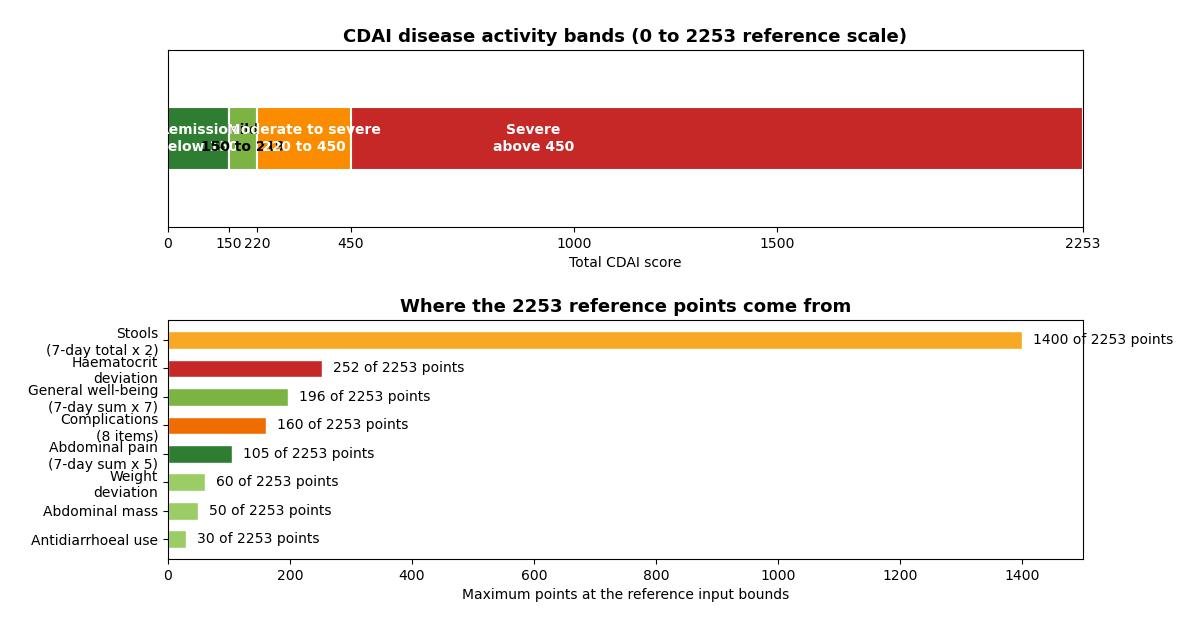
The bands are most useful for tracking change rather than for admiring a single number. In Crohn's disease trials, a fall of 70 to 100 points or more from an earlier score is commonly used as the definition of clinical response, meaning the treatment appears to be working. That is a rule of thumb for describing change, not a promise about any individual's future, and it says nothing about which treatment caused the change. A rising score between visits, on the other hand, suggests worsening activity and deserves a conversation with your clinician, especially if new symptoms such as fever, a new fistula or rapid weight loss have appeared.
Two cautions belong here. First, the same total can describe very different patients: 240 points driven mostly by frequent stools and pain is a different clinical situation from 240 points driven by fistulas, fever and a low haematocrit, even though the number matches. Second, a falling score is good news only if the fall reflects genuine improvement rather than a rosier diary, which is why the same careful 7-day recording matters at every visit.
An honest note: how the diary is handled
This section matters, because not every CDAI calculator handles the 7-day diary the same way, and the differences change the numbers. This calculator implements the original 1976 paper exactly: the diary variables are summed over the full 7 days. The total stool count is multiplied by 2, the sum of the seven daily pain ratings is multiplied by 5, and the sum of the seven daily well-being ratings is multiplied by 7. The published activity bands were calibrated on this scale, so the numbers and the bands belong together.
The widely used MDCalc implementation takes a middle path: it asks for the total number of soft or liquid stools over the past 7 days (multiplied by 2, as in the original), but for abdominal pain and general well-being it uses an average rating per day over the past 7 days (multiplied by 5 and 7). On the same diary, that gives smaller diary-component numbers than the original arithmetic, so its scores sit lower.
Two further differences concern the laboratory variables. In the original paper, the haematocrit and weight deviations are used raw, so a high haematocrit or a weight above standard subtracts points, which is why published CDAI values can fall slightly below zero. This calculator floors both deviations at 0 instead, a common implementation choice, and says so openly: a haematocrit above the reference, or a weight above standard, contributes 0 rather than negative points.
The practical upshot is simple. Use one consistent method to track change over time, and never compare a number from here with a number from a clinic letter, a trial report, or a different website unless you know they were computed the same way. If your clinician quotes a CDAI from your records, ask how it was calculated before setting it beside your own.
Getting the inputs right
A score is only as honest as its inputs, and the CDAI has a few traps for the unwary.
First, keep a real diary. Record stools, pain and well-being each day for seven full days rather than reconstructing the week from memory on day seven; memory smooths out the bad days and the score follows it downhill. Count every liquid or very soft stool, including nighttime ones, and leave out formed stools entirely.
Second, rate each day on its own merits, not the worst day and not the best one. Pain and well-being are subjective by design: the index wants your lived experience across the full week, not a performance. A bad Tuesday and a good Friday both count toward the seven-day totals.
Third, be strict about the complications list. Tick an item only if it was present at some point in the past week, and for fever use a measured temperature above 37.8°C rather than a feeling of feverishness. Each tick is worth 20 points, so casual ticking moves the total fast.
Fourth, the abdominal mass item needs an actual abdominal examination, usually by a clinician. If you are scoring at home and have not been examined, leave it at none rather than guessing; a guessed mass is worse than a missing one.
Fifth, use a recent haematocrit from a blood test taken near the assessment period, and enter it as a percentage. For standard weight, use the expected weight for your height from standard reference tables or your clinician's records; if you do not know it, ask your clinician rather than inventing one, because the weight component is sensitive to the denominator.
Limitations to keep in mind
The CDAI is a strong instrument with known limits, and an honest page should name them.
Pain and well-being are subjective, so two people with identical bowel inflammation can produce different scores, and the same person can score the same inflammation differently on a bad week. The diary smooths this but does not remove it.
The index measures activity, roughly how much is happening right now, not the structural state of the bowel. It says nothing about strictures, fistula anatomy, or mucosal healing seen on endoscopy; those need imaging, endoscopy and stool markers such as faecal calprotectin alongside the score. A low CDAI does not prove the bowel wall is healed.
The abdominal mass item depends on the examiner, and examination findings vary between clinicians. The complications list, while specific, does not cover every extraintestinal problem Crohn's disease can cause.
For day-to-day clinic use, many gastroenterologists prefer the simpler Harvey-Bradshaw Index, published in 1980 as a shorter alternative: five items, scored for the previous day rather than a full week. It is quicker but coarser. Whichever instrument is used, the golden rule from the honest note above still holds: compare like with like, and never mix scores computed by different methods.
Finally, remember what this page is. It is an educational calculator that implements one specified scoring of the CDAI. It does not diagnose Crohn's disease, it does not assess any individual patient, and a low score here is not a clean bill of bowel health. The sections above explain exactly how the number is produced so you can judge it with open eyes.
Medical disclaimer
This calculator is an educational tool. It does not diagnose Crohn's disease, it does not assess any individual patient, and it does not recommend treatment. Crohn's disease is a complex condition, and its management needs a qualified clinician, usually a gastroenterologist, who can examine you, review your history and interpret your tests in context. Never start, stop or change any medication because of a score on this page. If you develop worrying symptoms such as severe abdominal pain, persistent vomiting, a high fever, heavy rectal bleeding, signs of dehydration, or a new painful abdominal swelling, seek urgent medical care.
Key takeaways
- The CDAI combines eight weighted variables, symptoms you record over 7 days, findings on examination, and two numbers derived from blood tests and weight, into a single score that describes how active Crohn's disease is at the time of assessment.
- The standard cutoff is a score below 150, which is described as remission or quiescent disease.
- Count every liquid or very soft stool you pass each day for seven full days, and enter the seven-day total in the calculator.
- Rate each day separately: pain from 0 (none) to 3 (severe), well-being from 0 (well) to 4 (terrible).
Frequently asked questions
What does the CDAI score measure?
The CDAI combines eight weighted variables, symptoms you record over 7 days, findings on examination, and two numbers derived from blood tests and weight, into a single score that describes how active Crohn's disease is at the time of assessment. A higher score means more active disease and a lower score means quieter disease. It is used to track change between visits and as the standard activity measure in Crohn's disease trials. It does not diagnose Crohn's disease and it does not replace clinical judgement.
What CDAI score counts as remission?
The standard cutoff is a score below 150, which is described as remission or quiescent disease. Scores from 150 to 219 indicate mildly active disease, scores from 220 to 450 indicate moderately to severely active disease, and scores above 450 indicate severe disease. These bands are conventions from the trial literature, not treatment rules on their own, and a score should always be read alongside the full clinical picture.
How do I count stools for the 7-day diary?
Count every liquid or very soft stool you pass each day for seven full days, and enter the seven-day total in the calculator. Formed stools do not count. The calculator multiplies your seven-day total by two, exactly as in the original 1976 paper. Be consistent from day to day, because the score is only as honest as the diary behind it.
How do I rate abdominal pain and well-being over the week?
Rate each day separately: pain from 0 (none) to 3 (severe), well-being from 0 (well) to 4 (terrible). Add the seven daily pain ratings (0 to 21) and the seven daily well-being ratings (0 to 28), and enter those two totals. The calculator multiplies the pain total by 5 and the well-being total by 7, exactly as in the original 1976 paper. Because some other websites use daily averages instead of seven-day sums, do not compare a score from this page with one calculated another way unless you know the methods match.
What does a drop of 70 points in my CDAI score mean?
In Crohn's disease trials, a fall of 70 to 100 points or more from an earlier score is commonly used as the definition of clinical response, meaning the treatment appears to be working. It is a rule of thumb for describing change, not a guarantee about your future health, and any change in treatment should be decided with your clinician.
Can I use my CDAI score to change my Crohn's treatment?
No. The CDAI is an educational and tracking aid, not a prescribing guide. Treatment decisions weigh the score alongside endoscopy and imaging results, blood tests, your full history, other conditions, and the benefits and side effects of the drugs themselves. Never start, stop, or change any medication because of a score on this page; only a clinician who knows your case should make those decisions.