Mayo Score Calculator for Ulcerative Colitis
In short: Free Mayo score calculator for ulcerative colitis: full 12-point score with endoscopy or the 9-point partial Mayo, with the honest remission rule built in. Educational tool, not medical advice. Use the calculator above, then read the guide below to interpret your result and its limitations.
Score ulcerative colitis activity with the full 12-point Mayo score or the 9-point partial Mayo. Four clinical domains, each 0 to 3, with the honest remission rule: a total of 2 or less counts as remission only if no individual subscore is above 1.
The calculator
Total Mayo score: Not yet calculated
Activity band: Select one option for each component
Please note: this result is not classed as remission. The remission rule requires both a total of 2 or less and no individual subscore above 1, and one of your subscores is above 1. A clinician should interpret what this means for your care.
Please note: this is an educational aid. It does not diagnose ulcerative colitis and does not advise on treatment. Score honestly, and discuss any result with a clinician who knows your full history.
What the Mayo score measures
Ulcerative colitis is a chronic inflammatory bowel disease in which the lining of the large intestine becomes inflamed and ulcerated, usually starting in the rectum and extending upwards in a continuous pattern. People with the condition live with symptoms such as urgent frequent stools, rectal bleeding, abdominal discomfort and fatigue, and the illness tends to follow a relapsing and remitting course: periods of flare when symptoms are troublesome alternate with periods of quiet when the bowel settles. Because two clinicians can look at the same patient and disagree about how active the disease is, gastroenterology needed a standardised way to grade it.
The Mayo score was introduced to be that measure. Schroeder, Tremaine and Ilstrup described it in a 1987 paper in the New England Journal of Medicine, in a randomised study of coated oral 5-aminosalicylic acid (mesalazine) for mildly to moderately active ulcerative colitis (doi: 10.1056/NEJM198712243172601). It is a composite of four components, each rated from 0 to 3: stool frequency above the person's normal, rectal bleeding, the endoscopic appearance of the bowel lining, and the physician's global assessment. The four subscores are added to give a total from 0 to 12, where a higher total means more active disease. Since its introduction it has become one of the most widely used instruments in ulcerative colitis care and in clinical trials, where it defines who is eligible, what counts as response, and what counts as remission.
The four components of the full Mayo score
Each component is rated on the same 0 to 3 scale, but the anchors for each level are specific to that component. The table below gives the original anchors from Schroeder and colleagues.
| Component | 0 | 1 | 2 | 3 |
|---|---|---|---|---|
| Stool frequency | Normal number of stools | 1 to 2 stools per day more than normal | 3 to 4 stools per day more than normal | 5 or more stools per day more than normal |
| Rectal bleeding | None | Streaks of blood with stool less than half the time | Obvious blood with stool most of the time | Blood alone passed |
| Endoscopic findings | Normal or inactive disease | Mild disease: erythema, decreased vascular pattern, mild friability | Moderate disease: marked erythema, absent vascular pattern, friability, erosions | Severe disease: spontaneous bleeding, ulceration |
| Physician global assessment | Normal | Mild disease | Moderate disease | Severe disease |
A few points about the anchors are worth making explicit. Stool frequency is judged against the person's own normal, not against a population average, because what counts as normal varies. Rectal bleeding is graded by how often blood appears and in what form, from streaks through obvious blood to blood passed alone. The endoscopic component describes what the endoscopist sees, from a normal vascular pattern through progressive loss of that pattern, friability and erosions, to spontaneous bleeding and ulceration. The physician global assessment is the most subjective of the four: it is the clinician's overall judgement of how active the disease is, taking everything into account. It is also the component most often criticised, because two physicians can legitimately assign different global scores to the same patient.
Full Mayo score versus partial Mayo score
The full Mayo score needs an endoscopic examination, usually a flexible sigmoidoscopy, to rate the endoscopic findings component. Endoscopy is invasive, needs preparation, and cannot be repeated at every visit, so a version without it was needed for routine follow-up. The partial Mayo score, proposed by Lewis and colleagues in 2008, drops the endoscopy component and uses only stool frequency, rectal bleeding and the physician global assessment. The total runs from 0 to 9 instead of 0 to 12.
The partial version is not simply the full score minus a part; it has its own commonly applied cutoffs, because removing a component changes the meaning of any given total. The cutoffs most often used are: below 2 for remission, 2 to 4 for mild disease, 5 to 6 for moderate disease, and 7 or more for severe disease. Being honest about provenance matters here: these partial Mayo cutoffs are conventions that grew up in practice and in the research literature, not thresholds fixed by the original 1987 paper, which described only the four components and their anchors. The calculator on this page implements both versions, with a toggle at the top, so you can score whichever version fits the information available.
Understanding the result bands
The commonly applied bands for the full Mayo score are shown in the table below. The remission band carries a condition that deserves attention, and it is explained in its own section next.
| Band | Total score | What it usually means |
|---|---|---|
| Remission | 0 to 2, with no individual subscore above 1 | Minimal or no measurable activity, under both conditions of the remission rule. |
| Mild | 3 to 5 | Active disease, but limited: often increased stool frequency or intermittent bleeding without severe features. |
| Moderate | 6 to 10 | Clearly active disease across several components; the range in which treatment changes are commonly considered. |
| Severe | 11 to 12 | Very active disease, usually with frequent stools, substantial bleeding and severe endoscopic findings. |
| Band (partial Mayo) | Total score | What it usually means |
|---|---|---|
| Remission | 0 to 1 | Minimal or no symptoms and a normal global assessment. |
| Mild | 2 to 4 | Some symptoms or mild global impression, without major bleeding or frequency. |
| Moderate | 5 to 6 | Clearly active symptoms driving the total. |
| Severe | 7 to 9 | Very active symptoms across the three components. |
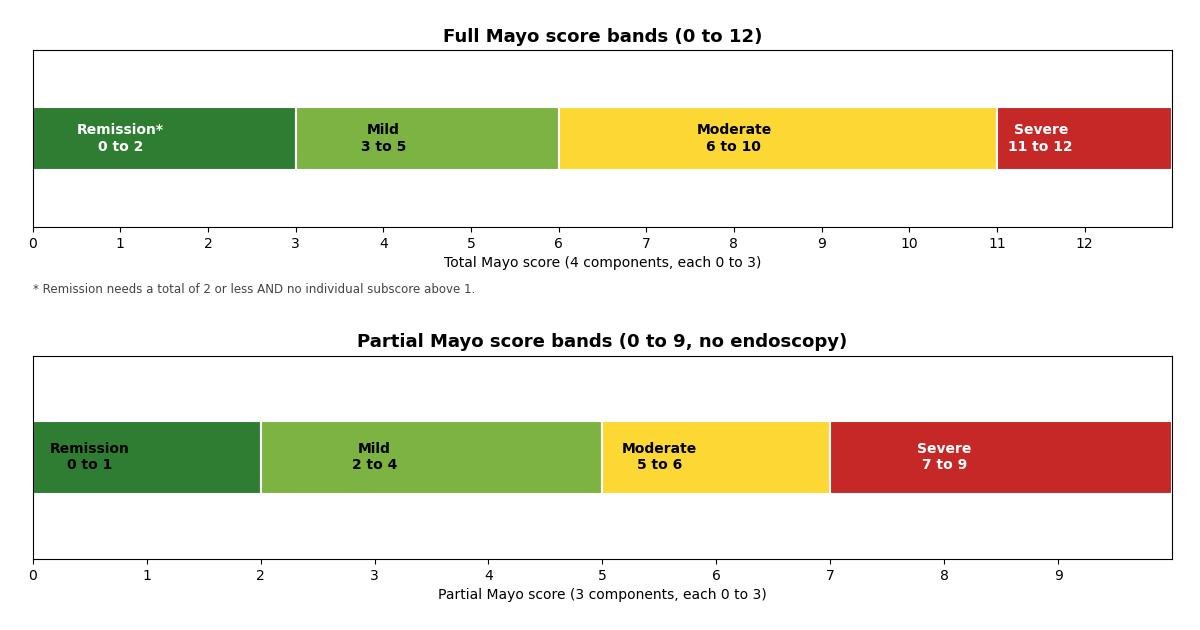
It is worth being honest about what these bands are and are not. They are the cutoffs commonly applied in practice and in ulcerative colitis trials, used to describe how active the disease looks. They are not treatment rules on their own: a score of 6 in a patient who is improving on a new drug means something different from a score of 6 in a patient who is deteriorating, and the same total can be built from very different combinations of components. A score of 8 from frequent stools and intermittent bleeding is a different clinical situation from a score of 8 driven by severe endoscopic ulceration, even though the number is the same. The bands describe the number; the clinician interprets the patient.
Worked examples
A few worked examples show how the arithmetic and the bands fit together.
Example one. A patient reports 1 to 2 stools per day above normal (stool frequency 1), streaks of blood less than half the time (rectal bleeding 1), a normal endoscopy (0), and the physician rates the disease as mild (global 1). The total is 1 plus 1 plus 0 plus 1, which is 3. That sits in the mild band, 3 to 5.
Example two. A patient reports 3 to 4 stools per day above normal (2), obvious blood most of the time (2), moderate endoscopic disease with erosions (2), and a moderate global assessment (2). The total is 2 plus 2 plus 2 plus 2, which is 8. That sits in the moderate band, 6 to 10.
Example three. A patient has normal stool frequency (0), no bleeding (0), inactive disease on endoscopy (0) and a normal global assessment (0). The total is 0. Every subscore is 0, which satisfies the no-subscore-above-1 rule, so this is remission.
Example four uses the partial Mayo. A patient reports 1 to 2 stools above normal (1), streaks of blood less than half the time (1) and a mild global assessment (1), with no recent endoscopy. The total is 3 on the 9-point scale, which sits in the partial Mayo mild band, 2 to 4.
The remission subscore rule
The most misunderstood part of the Mayo score is the remission rule. Remission on the full Mayo score is defined in clinical trials as a total of 2 or less with no individual subscore above 1. Both conditions must hold. This definition is the one used in regulatory trials of ulcerative colitis therapies, and it exists for a clear reason: it stops a single still-active domain from being hidden inside a low total.
Consider a patient with a stool frequency subscore of 2 (3 to 4 extra stools a day) and zeros everywhere else. The total is 2, which is inside the 0 to 2 range. But calling this remission would be misleading, because one domain is plainly active. The rule handles this honestly: a total of 2 with a subscore of 2 is not remission. This calculator flags that situation explicitly instead of quietly labelling it remission. Try it: select full Mayo, set stool frequency to 2, and leave the rest at 0. The result shows a total of 2 with a clear note that the remission rule is not met.
For completeness, trials also define clinical response, which is different from remission. Response is commonly defined as a fall of at least 3 points and at least 30 percent from the baseline total, together with an improvement in the rectal bleeding subscore of at least 1 point or an absolute rectal bleeding subscore of 1 or less. This is the definition used in the infliximab ACT 1 and ACT 2 trials reported by Rutgeerts and colleagues in 2005. Response means meaningful improvement; remission means the disease is essentially quiet under both conditions of the rule.
What the Mayo score cannot do
The Mayo score is a useful instrument with real limits, and an honest page should state them. It does not diagnose ulcerative colitis: the score assumes the diagnosis is already established, and a high total in someone without the disease means nothing about this condition. It does not measure the extent of disease along the colon, only its activity; two patients with the same score can have very different amounts of bowel involved. The physician global assessment is subjective, and studies have shown it is the least reproducible of the four components. The endoscopic subscore needs a trained endoscopist and a recent examination, which is exactly why the partial Mayo exists. The score can also miss activity that is real but invisible to its components, such as microscopic inflammation that persists while symptoms have settled, a situation clinicians sometimes call histological activity despite clinical remission. Finally, no version of the score is a treatment guide. Starting, stopping or changing medication on the strength of a number alone, without a clinician who knows the full picture, would be a misuse of the instrument.
Key takeaways
- The Mayo score measures how active ulcerative colitis is at the time of assessment.
- The full Mayo score has four components and totals 0 to 12, but one component is the endoscopic findings, which requires a sigmoidoscopy or colonoscopy.
- Yes.
- You need an endoscopic examination, usually a flexible sigmoidoscopy rather than a full colonoscopy, to score the endoscopic findings component of the full Mayo score.
Frequently asked questions
What does the Mayo score measure?
The Mayo score measures how active ulcerative colitis is at the time of assessment. It adds four component scores, each rated 0 to 3: stool frequency above normal, rectal bleeding, the endoscopic appearance of the bowel lining, and the physician's global assessment. The total runs from 0 to 12, with a higher total meaning more active disease. It is used to grade severity in a standardised way, to track change between visits, and to define endpoints such as remission and response in clinical trials.
What is the difference between the full Mayo score and the partial Mayo score?
The full Mayo score has four components and totals 0 to 12, but one component is the endoscopic findings, which requires a sigmoidoscopy or colonoscopy. The partial Mayo score drops the endoscopy component and uses only stool frequency, rectal bleeding and the physician's global assessment, giving a total of 0 to 9. The partial version is used when endoscopy is not available or has not been repeated, and it uses its own commonly applied cutoffs: below 2 for remission, 2 to 4 for mild, 5 to 6 for moderate, and 7 or more for severe disease.
Can my total score be 2 and still not count as remission?
Yes. Remission on the full Mayo score requires two things at once: a total of 2 or less, and no individual subscore above 1. A result such as a stool frequency subscore of 2 with everything else 0 gives a total of 2, but it is not classed as remission because one domain is still clearly active. This calculator flags that situation honestly rather than calling it remission, and a clinician should interpret what it means for your care.
Do I need a colonoscopy to calculate the Mayo score?
You need an endoscopic examination, usually a flexible sigmoidoscopy rather than a full colonoscopy, to score the endoscopic findings component of the full Mayo score. If you have not had a recent endoscopy, you can use the partial Mayo score instead, which uses only symptoms and the physician's assessment and needs no procedure. In practice, clinicians often score the partial Mayo at routine visits and reserve the full score, with its endoscopy component, for trial endpoints and key decision points.
Where does the Mayo score come from?
The score was introduced by Schroeder, Tremaine and Ilstrup in a 1987 paper in the New England Journal of Medicine that studied coated oral 5-aminosalicylic acid for mildly to moderately active ulcerative colitis (doi: 10.1056/NEJM198712243172601). The partial Mayo score, which omits endoscopy, was proposed later by Lewis and colleagues in 2008. Both versions are now standard instruments in ulcerative colitis research and care.
Can I use my Mayo score to change my treatment?
No. The Mayo score is an educational and research instrument, not a prescribing guide. Treatment decisions in ulcerative colitis weigh the score alongside your full history, examination, endoscopy and biopsy results, blood tests, other conditions, and the risks and benefits of the available drugs. Only a clinician who knows your case should start, stop, or change any medication. This page does not diagnose ulcerative colitis and does not advise on treatment.
References and further reading
Medical disclaimer
This calculator is an educational aid only. It does not diagnose ulcerative colitis, does not replace clinical judgement, and does not advise on treatment. The Mayo score is one instrument among many that clinicians use, and its result must be interpreted by a qualified clinician in the context of your full history, examination and investigations. If you have symptoms of inflammatory bowel disease, or if your symptoms are worsening, seek medical advice promptly. Never start, stop or change any medication on the basis of a score alone.