CAGE Questionnaire Calculator
In short: Free online CAGE questionnaire calculator. Answer the 4 yes/no questions (Cut down, Annoyed, Guilty, Eye-opener) to get your CAGE score and screening interpretation. Use the calculator above, then read the guide below to interpret your result and its limitations.
Answer the four questions below. Your score updates automatically.
The CAGE questionnaire screens for possible alcohol problems. It does not diagnose alcohol dependence. A score of 2 or more is a positive screen and warrants further assessment by a qualified health professional.
What is the CAGE questionnaire?
The CAGE questionnaire is one of the most widely used brief screening tools for alcohol problems in clinical practice. It consists of just four questions, asked as simple yes-or-no items, and the whole screen takes less than a minute to complete. The name is a mnemonic built from key words in the four questions: Cut down, Annoyed, Guilty, and Eye-opener.
The instrument was introduced by John A. Ewing in a landmark 1984 paper in the Journal of the American Medical Association (JAMA), titled "Detecting alcoholism: the CAGE questionnaire". Ewing proposed it as a practical tool that any clinician could use, in any setting, to detect people who might have alcohol problems and who would benefit from a fuller assessment. More than four decades later, it remains in routine use because of its brevity and its focus on the lifetime pattern of drinking rather than on a single recent episode.
Each of the four questions probes a different behavioural signal. The "cut down" question asks whether the person has ever felt they should reduce their drinking, which taps into their own awareness that drinking may be excessive. The "annoyed" question asks whether other people have irritated them by criticising their drinking, which reflects the social consequences of drinking. The "guilty" question asks about feelings of guilt, which reflects the person's internal appraisal of their drinking behaviour. The "eye-opener" question asks about drinking first thing in the morning to steady nerves or relieve a hangover, which is the item most closely linked to physiological dependence.
Because the questions ask about lifetime experience rather than current drinking, the CAGE screen can detect people whose alcohol problems are in the past as well as those who are drinking problematically now. This is both a strength and a limitation, and it is discussed in more detail below.
How the CAGE is scored
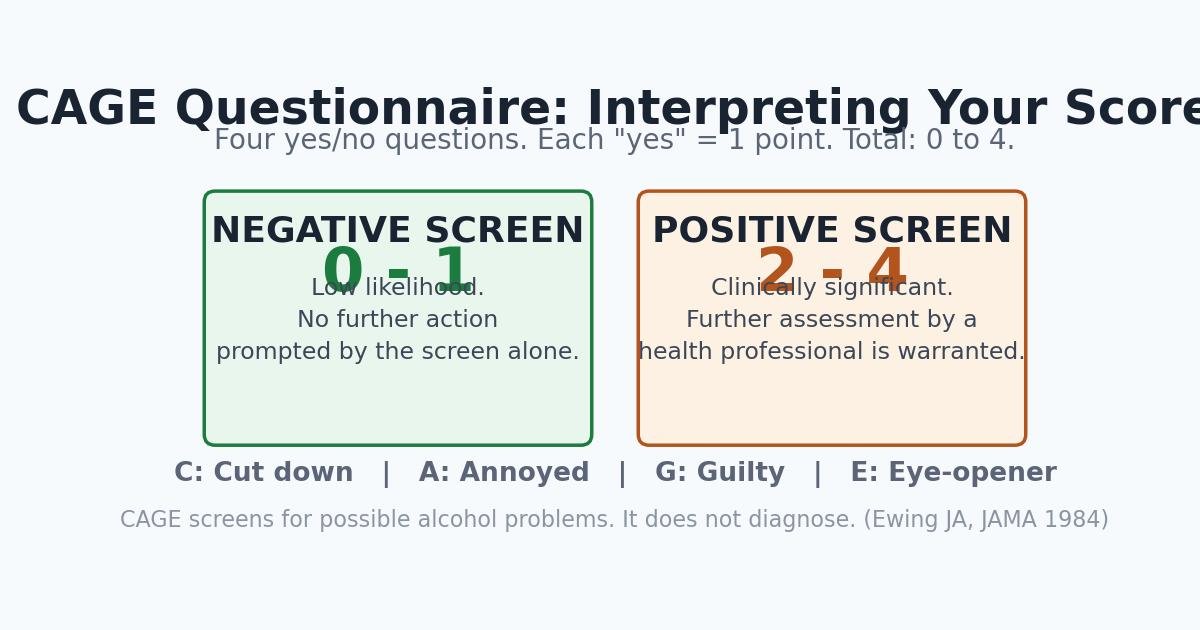
Scoring the CAGE questionnaire could hardly be simpler. Each "yes" answer is worth 1 point and each "no" answer is worth 0 points. The points are added together to give a total score between 0 and 4. The calculator at the top of this page applies exactly this rule: tick "yes" or "no" for each question and your total appears immediately.
Interpretation follows the standard threshold used since Ewing's original paper. A total score of 0 or 1 is a negative screen, meaning the questionnaire does not suggest alcohol problems and no further action is prompted by the screen alone. A total score of 2 or more is a positive screen, meaning the result is clinically significant and further assessment is warranted. The threshold of 2 has been used consistently in the literature and is the cut-off applied by this calculator.
It is worth noting that a single "yes" to the eye-opener question is sometimes treated with extra caution in clinical practice, because morning drinking can signal physical dependence. The formal CAGE scoring rule, however, counts every item equally at 1 point, and this calculator follows that rule exactly.
What your CAGE score means
If your score is 0, you answered "no" to all four questions, and the screen gives no indication of alcohol problems. If your score is 1, the screen is still negative, but it is worth reflecting honestly on which question you answered "yes" to and whether your drinking has changed over time. A negative screen does not guarantee the absence of alcohol-related harm, particularly if drinking is heavy but the person has not yet recognised it as a problem or does not wish to disclose it.
If your score is 2, 3, or 4, the screen is positive. A positive screen does not mean you have alcohol dependence or an alcohol use disorder. It means the pattern of your answers resembles that of people who do have alcohol problems, and that a proper clinical assessment is warranted. Many people with positive screens turn out, after assessment, not to meet the criteria for a diagnosis, while the screen has still served its purpose by starting an honest conversation about drinking.
The appropriate next step after a positive screen is to speak to your GP or another qualified health professional. They can take a fuller history, assess how much and how often you drink, check for physical and psychological effects, and arrange support if it is needed. The calculator result is a starting point for that conversation, not a conclusion.
How accurate is the CAGE questionnaire?
No screening test is perfect, and it is important to interpret the CAGE result with an understanding of its operating characteristics. Across the published literature, the reported sensitivity of the CAGE questionnaire at the standard threshold of 2 generally falls between about 71 percent and 91 percent, and reported specificity generally falls between about 77 percent and 96 percent. In Ewing's original 1984 study, sensitivity was 93 percent and specificity was 76 percent for the detection of alcoholism. These ranges are presented here honestly because performance genuinely varies from study to study and from population to population.
Sensitivity describes how good the test is at picking up people who do have alcohol problems. A sensitivity in the seventies to nineties means the CAGE misses some people with real problems, particularly in populations where drinking problems are uncommon or where people are reluctant to answer honestly. Specificity describes how good the test is at correctly clearing people who do not have problems. Specificity in the high seventies to mid nineties means a positive screen in a person without alcohol problems is possible, especially where alcohol problems are rare.
The accuracy of the CAGE also depends on the setting. It was developed and first tested in hospital and clinic populations, where alcohol problems are relatively common, and it performs best in similar settings. In general population surveys, where most people drink moderately, the proportion of positive screens that turn out to be false positives is higher. Honesty matters too: the questions ask about sensitive personal behaviour, and people who minimise or conceal their drinking will score lower than their true risk would suggest.
The CAGE has known blind spots. It does not measure how much a person drinks, how often they drink, or whether drinking has caused specific harms such as accidents, injuries, or problems at work. It asks about the lifetime pattern, so someone who had a drinking problem years ago but is now abstinent can still score positively. For these reasons, clinicians often use the CAGE as a first step and follow a positive screen with more detailed instruments and a clinical interview.
Why the CAGE screens but does not diagnose
Screening and diagnosis are different tasks, and the CAGE questionnaire is designed only for the first of the two. A screening test is a quick filter that sorts people into those who probably need a closer look and those who probably do not. A diagnosis is a clinical judgement made by a qualified professional after a thorough assessment, taking into account the full history, examination findings, and diagnostic criteria.
The CAGE cannot diagnose alcohol dependence for several reasons. It has only four items, which is far too few to cover the criteria that define alcohol use disorders. It does not ask about quantity or frequency of drinking, withdrawal symptoms, failed attempts to cut down, or the impact of drinking on health, work, and relationships. And its answers depend on self-report, which a clinician must interpret in the context of the whole person.
This distinction matters for how you should respond to your result. A positive screen is a prompt to seek assessment, not a label. A negative screen is reassuring but not absolute proof that drinking is harmless. In both cases, the calculator gives you information to take to a professional, not a verdict about your health.
When to seek help
Consider speaking to your GP or another health professional if any of the following apply to you: your CAGE score is 2 or more; you regularly drink more than you intended to; you have tried to cut down and found it difficult; drinking has affected your health, mood, sleep, work, or relationships; or other people have expressed concern about your drinking. You do not need to wait for a crisis to ask for help, and you do not need a particular score to justify a conversation with your doctor.
Help for alcohol problems is widely available and effective. A GP can carry out a proper assessment, offer brief counselling, and refer you to specialist services where needed. Many countries also run free and confidential alcohol helplines, and your local health authority can direct you to one. If you ever feel unsafe, experience withdrawal symptoms such as shaking, sweating, or seizures when you stop drinking, or have thoughts of harming yourself, seek urgent medical help without delay.
If you are answering these questions about someone else, such as a partner or family member, remember that only they can answer the questions accurately, and that change usually comes from their own recognition of the problem. Raising the subject with care, at a calm moment, and offering to support them in seeking help is usually more effective than confrontation.
Key takeaways
- CAGE is a mnemonic made from the first letters of the four questions: Cut down, Annoyed, Guilty, and Eye-opener.
- Each 'yes' answer scores 1 point and each 'no' scores 0, giving a total from 0 to 4.
- A score of 2 or more means the screen is positive, which indicates a higher likelihood of alcohol problems and that further assessment is warranted.
- No.
Frequently asked questions
What does CAGE stand for?
CAGE is a mnemonic made from the first letters of the four questions: Cut down, Annoyed, Guilty, and Eye-opener. It was introduced by John A. Ewing in 1984 as a brief screening interview for alcohol problems (Ewing JA. JAMA. 1984;252(14):1905-1907).
How is the CAGE questionnaire scored?
Each 'yes' answer scores 1 point and each 'no' scores 0, giving a total from 0 to 4. A score of 0 or 1 is a negative screen, while a score of 2 or more is a positive screen that warrants further assessment by a health professional.
What does a CAGE score of 2 or more mean?
A score of 2 or more means the screen is positive, which indicates a higher likelihood of alcohol problems and that further assessment is warranted. It does not diagnose alcohol dependence on its own. Speak to your GP or another qualified health professional if your score is 2 or higher.
Does the CAGE questionnaire diagnose alcohol dependence?
No. The CAGE questionnaire is a screening tool, not a diagnostic test. It identifies people who should have a fuller clinical assessment. Only a qualified health professional can make a diagnosis after a proper clinical interview.
How accurate is the CAGE questionnaire?
Reported sensitivity ranges from about 71 percent to 91 percent and specificity from about 77 percent to 96 percent across studies. In Ewing's original 1984 study, sensitivity was 93 percent and specificity 76 percent for alcoholism. Performance varies with the population screened, so the screen is a prompt for assessment, not proof of a problem.
Where can I get help with alcohol problems?
If you are worried about your drinking, speak to your GP or local health service. They can arrange a proper assessment and, if needed, refer you to counselling or treatment services. Many countries also have free, confidential alcohol helplines; your local health authority can point you to one.
References
Ewing JA. Detecting alcoholism: the CAGE questionnaire. JAMA. 1984;252(14):1905-1907. doi:10.1001/jama.1984.03350140051031.
Further reading
Explore more screening tools in our psychiatry calculators collection, or browse the full calculator library.