COWS Scale Calculator: Clinical Opiate Withdrawal Scale Scoring
Rate all 11 items with the exact point values from Wesson and Ling (2003) to get the total 0-48 score, the withdrawal severity band, and buprenorphine induction guidance.
In short: Rate all 11 items with the exact point values from Wesson and Ling (2003) to get the total 0-48 score, the withdrawal severity band, and buprenorphine induction guidance. Use the calculator above, then read the guide below to interpret your result and its limitations.
Calculator
For each item, choose the description that best matches the patient. Rate only signs and symptoms judged to be related to opioid withdrawal. Each item carries its own point scale (shown in brackets), exactly as published.
What the COWS is
The Clinical Opiate Withdrawal Scale, usually shortened to COWS, is an 11-item instrument for measuring how severe a patient's opioid withdrawal is at a given moment. It was published in 2003 by D. R. Wesson and Walter Ling in the Journal of Psychoactive Drugs (2003;35(2):253-259). The scale grew out of earlier work on buprenorphine treatment: Wesson and colleagues had first described it in a training manual for buprenorphine treatment in 1999, and the 2003 paper presented it as a quick, clinician-rated alternative to the longer and harder-to-administer withdrawal scales then in use.
The design mixes subjective symptoms and objective signs. Six items depend at least partly on what the patient reports: sweating, restlessness, bone or joint aches, runny nose or tearing, GI upset, and anxiety or irritability. Five items are rated purely on what the observer sees or measures: resting pulse rate, pupil size, tremor, yawning, and gooseflesh skin. This blend was deliberate. Purely self-reported scales can be skewed by what the patient wants the score to show, while purely objective scales can miss real distress that has no visible sign yet. The COWS tries to capture both, and the result is a scale that a trained clinician or health worker can complete in about two minutes.
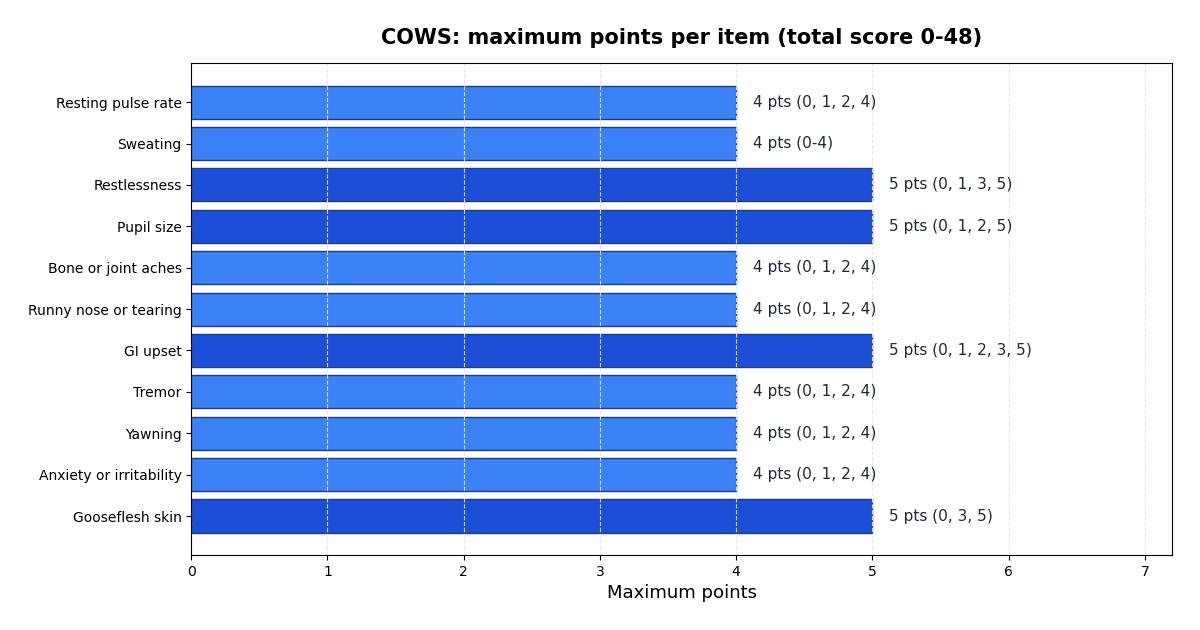
Each item is scored on its own uneven point scale, and the total ranges from 0 to 48. The uneven scales are the feature that transcription errors usually corrupt, so they are worth stating plainly: resting pulse is 0, 1, 2 or 4; sweating is 0 to 4; restlessness is 0, 1, 3 or 5; pupil size is 0, 1, 2 or 5; bone or joint aches are 0, 1, 2 or 4; runny nose or tearing is 0, 1, 2 or 4; GI upset is 0, 1, 2, 3 or 5; tremor is 0, 1, 2 or 4; yawning is 0, 1, 2 or 4; anxiety or irritability is 0, 1, 2 or 4; and gooseflesh skin is 0, 3 or 5. The heaviest weights sit on the most extreme objective signs: pupils so dilated that only the rim of the iris is visible, multiple episodes of vomiting or diarrhea, being unable to sit still for more than a few seconds, and prominent piloerection each earn the top score of 5. The calculator above implements these exact values.
The COWS was built for serial use. Because it takes only two minutes, it can be repeated as withdrawal develops, as treatment is given, or as a check that a patient is genuinely in withdrawal before buprenorphine is started. Wesson and Ling framed it as a tool for differentiating opioid withdrawal from opioid toxicity through repeated measurement: as withdrawal deepens, the score climbs, and as treatment takes effect, it falls.
The 11 items and their exact scores
The table below reproduces the complete scoring grid from the published scale. The shorthand in parentheses shows every point value each item can take; note especially the gaps (there is no 2 or 4 on restlessness, no 1 or 4 on gooseflesh, and no 4 on pupil size or GI upset). These gaps are intentional, not omissions.
| Item | Allowed point values | Maximum |
|---|---|---|
| 1. Resting pulse rate (after 1 min rest) | 0, 1, 2, 4 | 4 |
| 2. Sweating (past 30 min) | 0, 1, 2, 3, 4 | 4 |
| 3. Restlessness (observed) | 0, 1, 3, 5 | 5 |
| 4. Pupil size | 0, 1, 2, 5 | 5 |
| 5. Bone or joint aches | 0, 1, 2, 4 | 4 |
| 6. Runny nose or tearing | 0, 1, 2, 4 | 4 |
| 7. GI upset (last 30 min) | 0, 1, 2, 3, 5 | 5 |
| 8. Tremor (outstretched hands) | 0, 1, 2, 4 | 4 |
| 9. Yawning (observed) | 0, 1, 2, 4 | 4 |
| 10. Anxiety or irritability | 0, 1, 2, 4 | 4 |
| 11. Gooseflesh skin | 0, 3, 5 | 5 |
The individual descriptors matter as much as the numbers. Resting pulse is converted from beats per minute: 80 or below scores 0, 81 to 100 scores 1, 101 to 120 scores 2, and above 120 scores 4. Sweating runs from no report of chills or flushing (0), through subjective chills or flushing (1), flushed or visibly moist face (2), beads of sweat on brow or face (3), to sweat streaming off the face (4). Restlessness goes from able to sit still (0), to reporting difficulty sitting still but managing it (1), to frequent shifting or extraneous limb movements (3), to unable to sit still for more than a few seconds (5). Pupil size goes from pinned or normal for the room light (0), through possibly larger than normal (1), moderately dilated (2), to so dilated that only the rim of the iris is visible (5).
Bone or joint aches carry a special instruction: if the patient already had pain before withdrawal began, only the additional component attributed to opioid withdrawal is scored. The item runs from not present (0), through mild diffuse discomfort (1), patient reports severe diffuse aching of joints or muscles (2), to the patient rubbing joints or muscles and unable to sit still because of the discomfort (4). Runny nose or tearing is scored only when it is not explained by a cold or allergies: not present (0), nasal stuffiness or unusually moist eyes (1), nose running or tearing (2), nose constantly running or tears streaming down the cheeks (4). GI upset over the last 30 minutes runs from no symptoms (0), through stomach cramps (1), nausea or loose stool (2), vomiting or diarrhea (3), to multiple episodes of diarrhea or vomiting (5). Tremor in the outstretched hands runs from none (0), through felt but not seen (1), slight tremor observable (2), to gross tremor or muscle twitching (4). Yawning runs from none (0), through once or twice during the assessment (1), three or more times (2), to several times per minute (4). Anxiety or irritability runs from none (0), through the patient reporting increasing irritability or anxiousness (1), the patient obviously irritable or anxious (2), to the patient so irritable or anxious that participating in the assessment is difficult (4). Gooseflesh skin runs from smooth (0), through piloerection that can be felt or hairs standing up on the arms (3), to prominent piloerection (5).
How to administer the scale
The COWS is administered by a clinician or trained health worker, not as a self-completed questionnaire. The scoring instructions in the published scale carry three rules that keep the score honest. First, for each item the rater circles the number that best describes the patient's signs or symptoms right now. Second, the rating reflects only the apparent relationship to opioid withdrawal. The paper gives the example of a heart rate that is high because the patient was jogging just before the assessment: that elevation is not withdrawal, so it does not add to the score. The same logic applies across items: sweating from a hot room, a runny nose from hay fever, or tremor from caffeine are all excluded. Third, timing windows are built into three items. The resting pulse is measured after the patient has been sitting or lying for one minute, and both the sweating and GI upset items cover the previous 30 minutes.
In practice, the assessment proceeds item by item in a couple of minutes. The observer takes the pulse, notes pupil size, sweating, tremor, yawning, and gooseflesh, watches restlessness during the interview, and asks about bone or joint aches, runny nose or tearing, GI symptoms, and anxiety or irritability. Because several items are observed rather than asked, the scale can be scored even when the patient is a poor historian or is reluctant to describe symptoms, though the subjective items still need the patient's cooperation.
Repeat measurement is where the scale earns its keep. A single COWS total says how severe withdrawal is right now; two or three totals spaced over hours show the trajectory. That trajectory is what treatment decisions rest on: a rising score means withdrawal is deepening, a falling score after medication means the treatment is working, and a flat score in the mild range may mean the patient is stable. The form includes the patient's name, the date and time, and the reason for the assessment, precisely so that serial scores can be filed and compared.
Adding up and interpreting the total
The total is the simple sum of the 11 item scores, from 0 to a maximum of 48. Wesson and Ling define the severity bands as follows:
| Total score | Interpretation |
|---|---|
| 0 | No active withdrawal |
| 1 to 4 | Below the mild band (minimal signs) |
| 5 to 12 | Mild withdrawal |
| 13 to 24 | Moderate withdrawal |
| 25 to 36 | Moderately severe withdrawal |
| 37 to 48 | Severe withdrawal |
Two details deserve emphasis. First, the published bands begin at 5; a score of 0 is explicitly labeled no active withdrawal on the scoring instructions, while scores of 1 to 4 sit below the named mild band. Second, these cutoffs were not derived from a statistical analysis of patient data. As Tompkins and colleagues note in their validation study, the category boundaries reflect the authors' clinical expertise. That does not make them arbitrary, but it does mean the line between, say, 24 and 25 is a clinical judgment rather than a mathematically discovered threshold, and borderline scores should be interpreted in context.
Two short worked examples show the arithmetic in action. Consider a patient with a resting pulse of 96 (1 point), subjective chills (1), reports of difficulty sitting still (1), possibly enlarged pupils (1), mild diffuse aches (1), a stuffy nose (1), stomach cramps (1), no tremor (0), yawning twice (1), reported irritability (1), and smooth skin (0). The sum is 1 + 1 + 1 + 1 + 1 + 1 + 1 + 0 + 1 + 1 + 0 = 9, which sits in the 5 to 12 mild band. Now consider a patient with a pulse of 118 (2), flushed moist face (2), frequent shifting (3), moderately dilated pupils (2), severe diffuse aching (2), a running nose (2), nausea (2), slight observable tremor (2), yawning three times (2), obvious anxiety (2), and prominent piloerection (5). The sum is 2 + 2 + 3 + 2 + 2 + 2 + 2 + 2 + 2 + 2 + 5 = 26, which sits in the 25 to 36 moderately severe band. The calculator above produces the same totals and shows the item-by-item breakdown so every point can be traced.
Using the COWS to time buprenorphine induction
The most consequential clinical use of the COWS is timing the first dose of buprenorphine. Buprenorphine is a partial opioid agonist with very high receptor affinity: if it is given while a full agonist such as heroin or methadone still occupies the mu-opioid receptors, it displaces the full agonist and its weaker intrinsic activity abruptly drops the net opioid effect, precipitating severe withdrawal. This is why induction protocols require the patient to already be in withdrawal before the first dose is given, and why an objective, documented measure of withdrawal matters.
Clinical guidance for buprenorphine induction generally recommends starting when the patient shows at least mild to moderate withdrawal, commonly a COWS score of 12 to 13 or higher, so that enough receptors are unoccupied for the partial agonist to help rather than harm. For short-acting opioids such as heroin, withdrawal signs sufficient for induction commonly emerge 12 to 24 hours after the last dose; long-acting opioids such as methadone take considerably longer, and induction is delayed accordingly. These timing expectations come from induction protocols and treatment guidelines (for example, SAMHSA's Treatment Improvement Protocol 63 on medications for opioid use disorder), not from the COWS paper itself, which is a measurement instrument rather than a treatment protocol.
In the induction workflow, the COWS serves two roles. Before the first dose, one or more scores document that the patient is genuinely in at least mild-to-moderate withdrawal, which is the green light for induction. After the first dose, repeat scores track whether the withdrawal is easing; if the score stays high or climbs, the clinician reassesses rather than simply repeating the dose. The scale's two-minute completion time is what makes this practical at the bedside or in the clinic.
A common error is treating the COWS threshold as a rigid gate. A score of 12 in a patient with clear, worsening signs across repeated measurements is more informative than a single score of 14 taken once. The trend, the time since the last opioid dose, the specific opioid involved, and the patient's history all feed into the induction decision alongside the number.
COWS compared with other withdrawal scales
The COWS is not the only way to measure opioid withdrawal, and knowing the alternatives clarifies what it is for. The Subjective Opiate Withdrawal Scale (SOWS) asks the patient to rate 16 symptoms themselves, which makes it fast but entirely dependent on self-report. The Clinical Institute Narcotic Assessment (CINA) is a longer clinician-rated instrument that includes physiological measures such as blood pressure and a less bounded scoring range, which made it slower and harder to standardize. The Objective Opiate Withdrawal Scale (OOWS) rates 13 observable signs as simply present or absent, which is simple but coarse.
The COWS sits between these: it is clinician-rated like the CINA, but with a fixed 0 to 48 range and a two-minute administration time, and it keeps subjective items that the purely objective scales drop. Tompkins and colleagues validated the COWS against the CINA in 2009 and found strong agreement between the two instruments, which supports the COWS as a practical substitute for the longer scale in routine care. In research and in clinics that need a quick, repeatable, documented withdrawal measure, the COWS has become the standard choice, and it is the scale most induction protocols reference.
Limitations
The COWS has real limitations that users should keep in mind. The severity bands, as noted above, rest on clinical judgment rather than statistical derivation, so borderline scores need context rather than blind trust. Several items are subjective and depend on patient report, which means the score can be influenced by how the patient chooses to describe symptoms. Scoring quality depends on observer training: rating pupil size or distinguishing a 1 from a 2 on sweating takes practice, and untrained raters will disagree.
The scale measures withdrawal severity and nothing else. It does not diagnose opioid use disorder, it does not identify which opioid the patient used, and it does not detect a second problem (an infection, another intoxication, or a psychiatric crisis) that may be driving some of the signs. A high score in a patient who recently used stimulants, for example, needs careful interpretation because several items overlap with stimulant effects.
Finally, the COWS is a clinical instrument for supervised addiction treatment. It is not a self-assessment tool for deciding when to take buprenorphine on one's own. Induction decisions belong with a qualified clinician who can interpret the score alongside the drug history, the timing of the last dose, and the full clinical picture.
Key takeaways
- The Clinical Opiate Withdrawal Scale (COWS) is an 11-item clinician-rated scale published by Wesson and Ling in 2003 for measuring opioid withdrawal severity.
- Each of the 11 items is rated on its own point scale, and the item scores are summed.
- Wesson and Ling define four severity bands: 5 to 12 is mild withdrawal, 13 to 24 is moderate withdrawal, 25 to 36 is moderately severe withdrawal, and above 36 (37 to 48) is severe withdrawal.
- Buprenorphine is a partial opioid agonist that can precipitate severe withdrawal if given while a full agonist still occupies the receptors, so the first dose is timed to when the patient is already in withdrawal.
Frequently asked questions
What is the COWS scale?
The Clinical Opiate Withdrawal Scale is an 11-item clinician-rated scale published by Wesson and Ling in 2003 for measuring opioid withdrawal severity. It combines subjective symptoms (such as anxiety and bone aches) with objective signs (such as pulse, pupil size, sweating, and tremor) into a total score from 0 to 48. It takes about two minutes to complete and is designed for repeated use, so withdrawal can be tracked over time.
How is the COWS scored?
Each of the 11 items is rated on its own point scale and the item scores are summed. The scales are deliberately uneven: most items run 0 to 4, but resting pulse is 0, 1, 2 or 4; restlessness is 0, 1, 3 or 5; pupil size is 0, 1, 2 or 5; GI upset is 0, 1, 2, 3 or 5; and gooseflesh is 0, 3 or 5. The maximum total is 48. Extreme signs such as maximally dilated pupils, repeated vomiting, or prominent gooseflesh carry the heaviest weights.
What do the COWS score bands mean?
Wesson and Ling define four severity bands: 5 to 12 is mild withdrawal, 13 to 24 is moderate withdrawal, 25 to 36 is moderately severe withdrawal, and above 36 (37 to 48) is severe withdrawal. A score of 0 indicates no active withdrawal, and scores of 1 to 4 fall below the mild band. The band cutoffs were set from the authors' clinical experience rather than from a statistical derivation.
How is the COWS used for buprenorphine induction?
Buprenorphine can precipitate severe withdrawal if given while a full opioid agonist still occupies the receptors, so the first dose is timed to when the patient is already in withdrawal. Clinical guidance recommends starting when the patient shows at least mild to moderate withdrawal, commonly a COWS score of 12 to 13 or higher. Serial COWS measurements document that the patient is in withdrawal before induction and track the response afterward.
How long does a COWS assessment take and who performs it?
A trained clinician or health worker can complete the COWS in about two minutes. The resting pulse is measured after the patient has been sitting or lying still for one minute, and the sweating and GI items cover the previous 30 minutes. Only signs and symptoms judged to be related to opioid withdrawal are scored; anything explained by another cause, such as a cold or room temperature, is left out.
What are the limitations of the COWS?
The severity bands were set by clinical judgment rather than statistical analysis, so borderline scores need context. Several items are subjective and depend on patient report, and scoring quality depends on observer training. The scale measures withdrawal severity only: it does not diagnose opioid use disorder, and it does not replace a full clinical assessment. It belongs in supervised addiction treatment, not as a self-assessment tool.
References
- Wesson DR, Ling W. The Clinical Opiate Withdrawal Scale (COWS). J Psychoactive Drugs. 2003;35(2):253-259. doi:10.1080/02791072.2003.10400007. https://doi.org/10.1080/02791072.2003.10400007
- Tompkins DA, Bigelow GE, Harrison JA, Johnson RE, Fudala PJ, Strain EC. Concurrent validation of the Clinical Opiate Withdrawal Scale (COWS) and single-item indices against the Clinical Institute Narcotic Assessment (CINA) opioid withdrawal instrument. Drug Alcohol Depend. 2009;105(1-2):154-159. doi:10.1016/j.drugalcdep.2009.07.001
- Fischer JA, Roche AM, Duraisingam V. Clinical Opiate Withdrawal Scale (COWS): description, strengths and knowledge gaps. National Centre for Education and Training on Addiction (NCETA), Flinders University. 2021.
- Substance Abuse and Mental Health Services Administration. Medications for Opioid Use Disorder. Treatment Improvement Protocol (TIP) Series 63. HHS Publication No. (SMA) 18-5063. Rockville, MD: SAMHSA; 2018.
- American Psychiatric Association
- National Institute of Mental Health
Related calculators: Psychiatry calculators