CIWA-Ar Alcohol Withdrawal Scale Calculator
Score all 10 items of the Clinical Institute Withdrawal Assessment for Alcohol, revised (maximum 67), with the validated anchors and severity bands.
In short: Score all 10 items of the Clinical Institute Withdrawal Assessment for Alcohol, revised (maximum 67), with the validated anchors and severity bands. Use the calculator above, then read the guide below to interpret your result and its limitations.
Score the patient
Rate each item using the anchors below. Items marked Ask are rated from the patient's answers; items marked Observe are rated by direct observation. The total updates automatically. This tool is for clinical training and decision support in monitored settings only.
What the CIWA-Ar is
The Clinical Institute Withdrawal Assessment for Alcohol, revised (CIWA-Ar), is a 10-item clinician-administered scale that quantifies the severity of alcohol withdrawal. It was developed at the Addiction Research Foundation (now the Centre for Addiction and Mental Health) and published in its revised form by Sullivan, Sykora, Schneiderman, Naranjo and Sellers in the British Journal of Addiction in 1989. The revision condensed the longer original Clinical Institute Withdrawal Assessment into a short instrument that keeps strong validity and high inter-rater reliability while remaining practical at the bedside. It is the most commonly used alcohol withdrawal scale in clinical practice today.
Each of the ten items captures a common symptom or sign of alcohol withdrawal: nausea and vomiting, tremor, paroxysmal sweats, anxiety, agitation, tactile disturbances, auditory disturbances, visual disturbances, headache, and orientation with clouding of sensorium. Nine items are scored from 0 to 7; orientation and clouding of sensorium is the single exception, scored from 0 to 4. The total therefore ranges from 0 to a maximum of 67. The full assessment takes about 2 minutes to perform, according to the original validation study, which is what makes it practical for repeated serial scoring during active withdrawal management.
The scale mixes two rating methods. Six items are rated from the patient's own answers to standard questions, such as asking whether the patient feels sick to the stomach or feels nervous. Four items are rated by direct observation: tremor, paroxysmal sweats, agitation, and orientation. This matters for how the tool is used in practice: a rater cannot simply hand the form to a patient and walk away. The clinician must interview the patient and watch them during the assessment, which is one reason the scale performs well when staff are trained and poorly when it is applied mechanically.
The 10 items and how each is scored
The table below summarizes every item, its scoring range, how it is rated, and what it captures. The calculator above uses the full anchor descriptions from the published scale; the table here gives the essential structure so you can see how the total is built.
| Item | Range | How rated | What it captures |
|---|---|---|---|
| Nausea and vomiting | 0-7 | Ask the patient | Gastrointestinal withdrawal symptoms, from no nausea to constant nausea with frequent dry heaves and vomiting |
| Tremor | 0-7 | Observe, arms extended and fingers spread apart | Fine motor tremor, from none to severe tremor even with arms not extended |
| Paroxysmal sweats | 0-7 | Observe | Autonomic sweating, from no visible sweat to drenching sweats |
| Anxiety | 0-7 | Ask the patient | Subjective and observable anxiety, from at ease to states equivalent to acute panic |
| Agitation | 0-7 | Observe | Psychomotor activity, from normal activity to pacing or constantly thrashing about |
| Tactile disturbances | 0-7 | Ask the patient | Itching, pins and needles, burning, numbness, and tactile hallucinations such as feeling bugs on the skin |
| Auditory disturbances | 0-7 | Ask the patient | Heightened sound sensitivity, harshness of sounds, and auditory hallucinations |
| Visual disturbances | 0-7 | Ask the patient | Light sensitivity, altered colour perception, and visual hallucinations |
| Headache, fullness in head | 0-7 | Ask the patient | Head discomfort rated by severity; dizziness or lightheadedness is not rated here |
| Orientation and clouding of sensorium | 0-4 | Observe and test | Cognitive clarity, from fully oriented with intact serial additions to disorientation for place or person |
Two details deserve attention because they are common sources of scoring error. First, the sensory items (tactile, auditory, visual) distinguish between mere sensitivity and true hallucination: mild scores reflect heightened sensitivity or very mild distortions, while scores of 4 and above reflect hallucinations of increasing severity. Second, orientation is the only item with a 0 to 4 range, and it is tested with direct questions such as the day, the place, and serial additions. A patient who cannot do serial additions or is uncertain of the date already scores at least 1 on this item, which is clinically sensible because early clouding of sensorium is an important warning sign.
How to use the calculator
Work through the ten items in order, rating each one before moving on. For the ask-items, pose the standard question and score what the patient reports; for the observe-items, watch the patient during the interview and score what you see. Select the value that best matches the anchors. When a finding falls between two anchors, the intermediate numbers exist for exactly that purpose: a tremor that is clearly present but not moderate, for example, can be scored 2 or 3.
A worked example shows how the total builds up. Consider a patient rated as follows: nausea and vomiting 1 (mild nausea, no vomiting), tremor 4 (moderate with arms extended), paroxysmal sweats 4 (beads of sweat obvious on the forehead), anxiety 4 (moderately anxious), agitation 1 (somewhat more than normal activity), tactile disturbances 0, auditory disturbances 0, visual disturbances 0, headache 2 (mild), and orientation 1 (cannot do serial additions). The sum is 1 + 4 + 4 + 4 + 1 + 0 + 0 + 0 + 2 + 1 = 17. A total of 17 falls in the mild-to-moderate band, so this patient needs active monitoring and, under most symptom-triggered protocols, medication. A second check: the maximum total if every item were at its worst would be 9 items at 7 plus orientation at 4, which is 63 + 4 = 67, confirming the scale maximum.
Because withdrawal evolves over hours, a single score is a snapshot, not a verdict. Serial scoring is the point of the instrument: the same patient scored again in a few hours may move between bands as withdrawal peaks or as treatment takes effect. Record the time of each assessment alongside the score so the trend is visible.
Interpreting the score: the three severity bands
| Total score | Severity | What it means in practice |
|---|---|---|
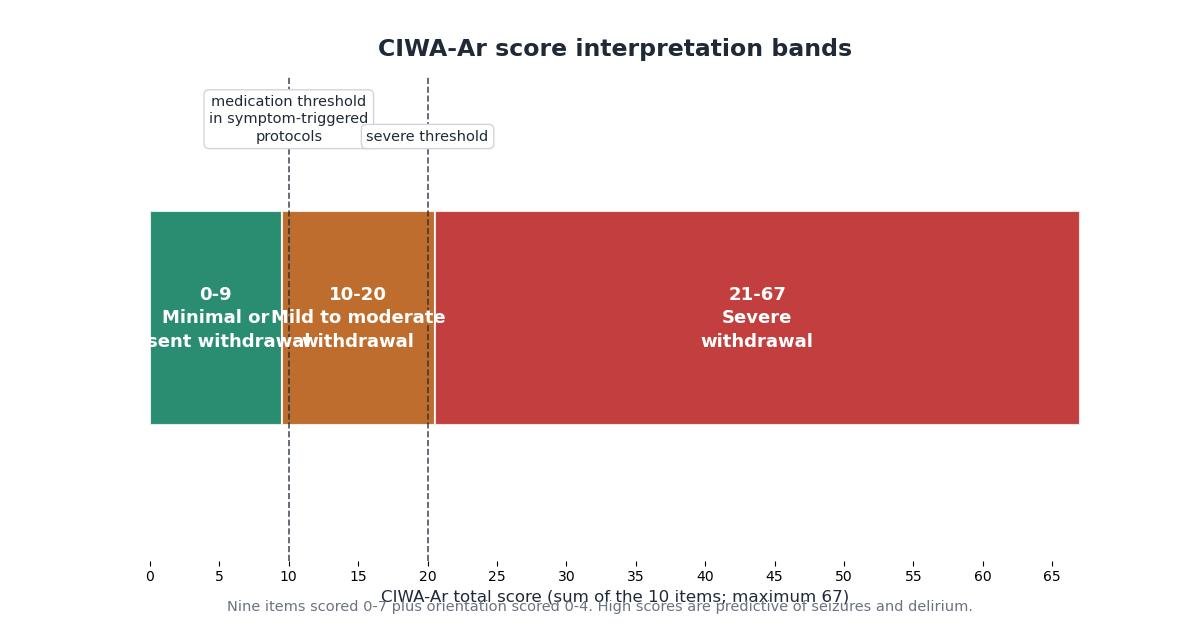
| 0-9 | Minimal or absent withdrawal | Supportive care; not normally requiring additional medication. Monitor about 4 times daily while at risk. |
| 10-20 | Mild to moderate withdrawal | Medication is usually required under symptom-triggered protocols. Monitor every 1 to 4 hours. |
| 21-67 | Severe withdrawal | Urgent, aggressive treatment and close monitoring every 1 to 2 hours. High scores predict seizures and delirium. |
These bands follow the conventions used in widely adopted clinical guidelines: scores below 10 indicate minimal withdrawal not normally requiring additional medication, 10 to 20 indicate moderate withdrawal, and scores above 20 indicate severe withdrawal, with monitoring frequency increasing from about four times daily to every 1 to 2 hours as severity rises. The monitoring cadences above come from the Queensland alcohol withdrawal management guideline, and the interpretation table matches the Flinders University screening resource, which cites the Sullivan 1989 validation study.
A note on competing conventions: some protocols and studies draw the lines slightly differently. One ICU study categorized scores as 8 or below mild, 9 to 19 moderate, and 20 or above severe; an ASAM-derived guideline described scores below 8 to 10 as minimal to mild, 8 to 15 as moderate, and 15 or more as severe. The calculator uses the 0-9 / 10-20 / above-20 banding because it is the most widely taught in bedside protocols, but the exact cutoff that triggers a medication dose is set by the local protocol, not by the scale itself. Always follow the protocol in use where the patient is being treated.
Symptom-triggered treatment: how the score guides benzodiazepine dosing
The main clinical purpose of the CIWA-Ar is to guide symptom-triggered treatment of alcohol withdrawal, usually with benzodiazepines such as diazepam or lorazepam, given in monitored settings. In a symptom-triggered protocol, the patient is scored at regular intervals and receives a dose of medication when the score reaches the protocol's threshold, rather than receiving fixed scheduled doses regardless of symptoms. A commonly used threshold in hospital protocols is a score of 10 or more: the Norfolk and Norwich NHS trust guideline for acute alcohol withdrawal, for example, directs that patients scoring 10 or more on the CIWA-Ar receive a dose of withdrawal medication, are rescored one hour later, and have the protocol discontinued after scoring below 10 for 24 hours.
The evidence behind this approach comes from a randomized, double-blind trial published in the Journal of the American Medical Association in 1994 by Saitz and colleagues, which compared CIWA-guided symptom-triggered therapy with fixed-schedule dosing and found that symptom-triggered treatment resulted in decreased treatment duration and lower total benzodiazepine use. Later evidence reviews, including the American Society of Addiction Medicine working group's meta-analysis published in JAMA in 1997, support benzodiazepines as the pharmacologic mainstay of alcohol withdrawal management. The practical payoff of scoring is visible at both ends of the severity range: patients with genuinely mild withdrawal avoid over-sedation from scheduled doses they do not need, while patients with severe withdrawal are not under-treated because the rising score forces repeated dosing.
Medication choice and dosing schedules remain clinician decisions within the local protocol. Diazepam's long half-life provides a smooth self-tapering effect that many protocols prefer, while lorazepam is often chosen when hepatic function is impaired because it is metabolized outside the liver's oxidative pathways. These are general pharmacologic principles that guide, but do not replace, the treating clinician's judgment for the individual patient.
What the CIWA-Ar cannot do: limitations
The scale has real and well-documented limits. First, it requires a patient who can communicate. Six items depend on the patient's answers, so the instrument cannot be used reliably in patients who are intubated, deeply sedated, delirious to the point of incoherence, or otherwise unable to respond. In intensive care, studies have documented that nurses appropriately decline to score CIWA-Ar in patients who cannot answer its questions, and alternative approaches such as sedation and agitation scales are used instead.
Second, the scale measures withdrawal severity, not the diagnosis of alcohol dependence and not the whole patient. It does not capture vital-sign instability, electrolyte disturbances, concurrent intoxication or other drug withdrawal, or the medical comorbidities that make withdrawal dangerous. A patient can have a modest CIWA-Ar score and still be seriously ill, and studies have reported complications in a small proportion of patients with low scores who were left untreated. The score is one input to clinical judgment, never a substitute for it.
Third, the instrument is only as good as its administration. Research on real-world use has found frequent protocol errors, including scoring by untrained staff and applying the scale to patients for whom it was never validated. A widely cited Mayo Clinic Proceedings study from 2008 documented inappropriate use of symptom-triggered therapy in a general hospital, and later reviews have described misunderstandings and misuse of CIWA protocols as a persistent problem. Training and periodic competency checks for the staff who score the scale are part of using it safely.
Why this scale belongs in monitored settings
Alcohol withdrawal is one of the few withdrawal syndromes that can be directly life-threatening. While most patients experience mild symptoms that resolve with supportive care, a minority progress to seizures or delirium tremens, which carries real mortality without treatment. High CIWA-Ar scores are predictive of these complications: early work by Naranjo and colleagues (1983) and Young and colleagues (1987) showed that high scores predicted the development of seizures and delirium. That predictive value is exactly why severe-band scores trigger urgent, aggressive management rather than watchful waiting.
This is also why the CIWA-Ar is a clinical instrument used in monitored settings, not a self-assessment tool for home use. Scoring oneself or a family member at home cannot substitute for medical evaluation, because the scale cannot detect the complications it predicts and because treatment decisions involve medications that require supervision. Anyone experiencing or witnessing signs of alcohol withdrawal should seek medical care promptly rather than attempting to manage it with an online score.
Key takeaways
- CIWA-Ar stands for the Clinical Institute Withdrawal Assessment for Alcohol, revised.
- The maximum CIWA-Ar score is 67.
- In the banding used on this page, scores of 0 to 9 indicate minimal or absent withdrawal, 10 to 20 indicate mild to moderate withdrawal, and scores above 20 indicate severe withdrawal.
- The CIWA-Ar takes about 2 minutes to perform, according to the original validation study by Sullivan and colleagues (1989).
Frequently asked questions
What does CIWA-Ar stand for?
CIWA-Ar stands for the Clinical Institute Withdrawal Assessment for Alcohol, revised. It is a 10-item clinician-administered scale developed to quantify the severity of alcohol withdrawal. The revised version was published by Sullivan, Sykora, Schneiderman, Naranjo and Sellers in the British Journal of Addiction in 1989 and is the most commonly used alcohol withdrawal scale in clinical practice.
What is the maximum possible CIWA-Ar score?
The maximum CIWA-Ar score is 67. Nine of the ten items are scored from 0 to 7 and one item, orientation and clouding of sensorium, is scored from 0 to 4. Adding the nine 0 to 7 items (63 points) to the 0 to 4 orientation item gives a maximum total of 67.
What CIWA-Ar score counts as severe withdrawal?
In the banding used on this page, scores of 0 to 9 indicate minimal or absent withdrawal, 10 to 20 indicate mild to moderate withdrawal, and scores above 20 indicate severe withdrawal. Severe scores call for close monitoring, typically every 1 to 2 hours, and prompt treatment, since high scores are also predictive of seizures and delirium. Note that some protocols use slightly different cutoffs, for example treating 20 and above as severe, so always follow your local protocol.
How long does the CIWA-Ar take to complete?
The CIWA-Ar takes about 2 minutes to perform, according to the original validation study by Sullivan and colleagues (1989). Its brevity is one reason it is practical for repeated serial assessments, which are usually done every 1 to 4 hours during active withdrawal management depending on the score.
Who can be assessed with the CIWA-Ar?
The CIWA-Ar is designed for patients who are physically dependent on alcohol and at risk of withdrawal, and it requires the patient to communicate: six items are rated from the patient's answers and four (tremor, paroxysmal sweats, agitation, and orientation) are rated by observation. It cannot be used reliably in patients who cannot respond to questions, such as intubated or deeply sedated ICU patients, where alternative sedation and agitation scales are used instead.
Does a high CIWA-Ar score mean the patient will develop delirium tremens?
Not necessarily. A high CIWA-Ar score indicates severe withdrawal right now and is predictive of a higher risk of seizures and delirium, as shown in studies by Naranjo and colleagues (1983) and Young and colleagues (1987), but prediction is not certainty: some patients with low scores still develop complications if left untreated. The score should guide timely treatment, not be treated as a guarantee of what will happen.
Sources and further reading
- Sullivan JT, Sykora K, Schneiderman J, Naranjo CA, Sellers EM. Assessment of alcohol withdrawal: the revised Clinical Institute Withdrawal Assessment for Alcohol scale (CIWA-Ar). British Journal of Addiction. 1989;84(11):1353-1357. The primary validation study: 10 items, maximum score 67, about 2 minutes to administer.
- Saitz R, Mayo-Smith MF, Roberts MS, Redmond HA, Bernard DR, Calkins DR. Individualized treatment for alcohol withdrawal: a randomized double-blind controlled trial. JAMA. 1994;272(7):519-523. Symptom-triggered (CIWA-guided) therapy reduced treatment duration and total benzodiazepine use compared with fixed-schedule dosing.
- Mayo-Smith MF. Pharmacological management of alcohol withdrawal: a meta-analysis and evidence-based practice guideline. American Society of Addiction Medicine Working Group on Pharmacological Management of Alcohol Withdrawal. JAMA. 1997;278(2):144-151.
- Queensland Health, Insight. Alcohol Withdrawal Management guideline: CIWA-Ar monitoring cadence (mild below 10 monitored about 4 times daily; moderate 10 to 20 monitored every 1 to 4 hours; severe above 20 monitored every 1 to 2 hours).
- Flinders University, AOD Screening. Clinical Institute Withdrawal Assessment for Alcohol Revised (CIWA-Ar): score interpretation table (0-9 mild, not normally requiring additional medication; 10-20 moderate; 20 and above severe), citing Sullivan et al. 1989.
- Norfolk and Norwich University Hospitals NHS Foundation Trust. Trust Guidelines for the Management of Acute Alcohol Withdrawal: symptom-triggered protocol with a treatment threshold at CIWA-Ar 10 or more and discontinuation after scoring below 10 for 24 hours.
- Naranjo CA et al. (1983) and Young GP et al. (1987), as summarized in ASAM guidance: high CIWA-Ar scores are predictive of the development of seizures and delirium.
- Hecksel KA, Bostwick JM, Jaeger TM, Cha SS. Inappropriate use of the symptom-triggered therapy for alcohol withdrawal in the general hospital. Mayo Clinic Proceedings. 2008;83:274-279. Documents real-world misuse of CIWA-based protocols.
- Clinical Institute Withdrawal Assessment for Alcohol, revised (CIWA-Ar) scoring form, Queensland Health. Item anchors and standard questions reproduced on this page follow this form of the published scale.