Alcohol Use Disorders Identification Test (AUDIT)
In short: AUDIT alcohol screening calculator: answer 10 WHO questions to get a score from 0 to 40 with Zone I-IV interpretation. Educational screening tool only, not a diagnosis. Use the calculator above, then read the guide below to interpret your result and its limitations.
A 10-item WHO screening questionnaire about alcohol use. Answer each question honestly; the total score ranges from 0 to 40 and places you in one of four zones, each with a recommended level of intervention.
The AUDIT identifies patterns of risky or harmful drinking. It cannot diagnose an alcohol use disorder. Only a qualified clinician can do that after a proper assessment. If you are worried about your drinking, talk to your doctor or a local addiction service. If you are in crisis, contact your local emergency number.
Scoring
| Question | Response | Points |
|---|---|---|
| 1, 3 to 8 | Never | 0 |
| 1, 3 to 8 | Monthly or less | 1 |
| 1, 3 to 8 | 2 to 4 times a month | 2 |
| 1, 3 to 8 | 2 to 3 times a week | 3 |
| 1, 3 to 8 | 4 or more times a week | 4 |
| 2 | 1 or 2 drinks / 3 or 4 / 5 or 6 / 7 to 9 / 10 or more | 0 / 1 / 2 / 3 / 4 |
| 9, 10 | No | 0 |
| 9, 10 | Yes, but not in the past year | 2 |
| 9, 10 | Yes, during the past year | 4 |
Add the points for all ten questions. The total ranges from 0 to 40.
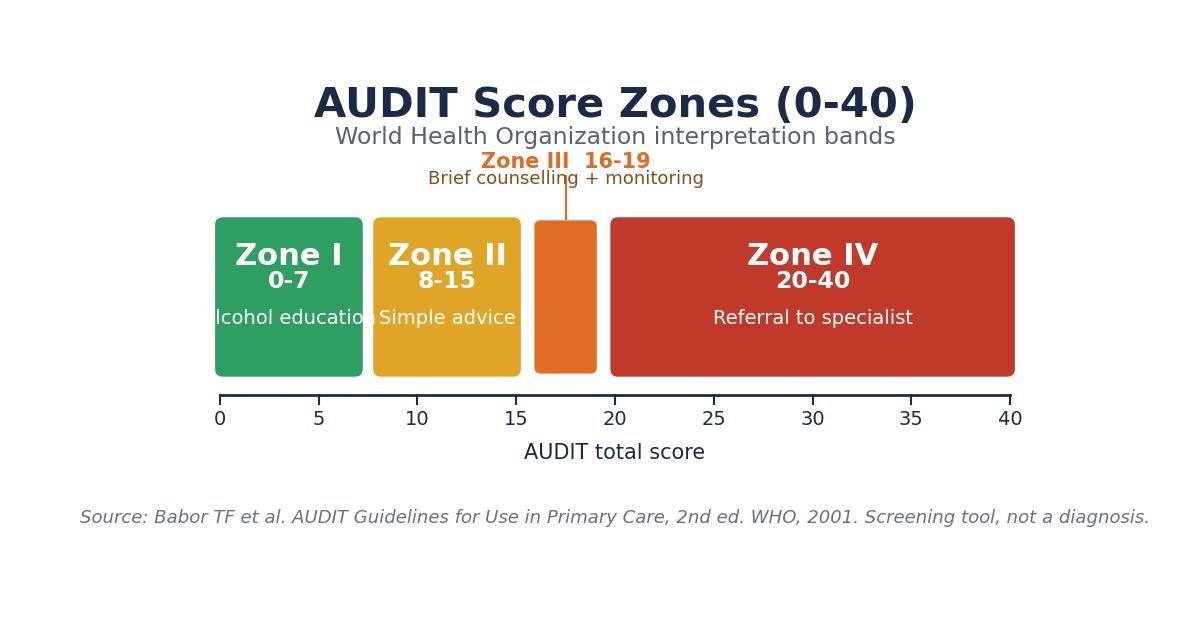
WHO interpretation zones
| Score | Zone | Recommended intervention |
|---|---|---|
| 0 to 7 | Zone I | Alcohol education. Advise continued low-risk drinking. |
| 8 to 15 | Zone II | Simple advice. Advise cutting down. |
| 16 to 19 | Zone III | Brief counselling and continuing monitoring. |
| 20 to 40 | Zone IV | Referral to a specialist for diagnostic evaluation and treatment. |
References
- Babor TF, Higgins-Biddle JC, Saunders JB, Monteiro MG. The Alcohol Use Disorders Identification Test: Guidelines for Use in Primary Care. 2nd edition. Geneva: World Health Organization; 2001. WHO/MSD/MSB/01.6a. WHO publication
- Saunders JB, Aasland OG, Babor TF, de la Fuente JR, Grant M. Development of the Alcohol Use Disorders Identification Test (AUDIT): WHO Collaborative Project on Early Detection of Persons with Harmful Alcohol Consumption, Part II. Addiction. 1993;88(6):791-804. DOI 10.1111/j.1360-0443.1993.tb02093.x
- National Institute of Mental Health
- WHO: Mental Health
About the AUDIT
The Alcohol Use Disorders Identification Test, universally known as the AUDIT, is a 10-item screening questionnaire developed by the World Health Organization in the 1980s and published in its definitive form in 1993. It was created because primary care doctors were missing risky drinking: most consultations left no room for a long assessment, and there was no short, validated tool that worked across countries. The WHO team designed the AUDIT to be completed in a few minutes, either self-administered or given by a health worker, and to do two jobs at once. Measure how much alcohol a person consumes and pick up early signs of dependence and alcohol-related harm.
The instrument grew out of a multinational WHO collaborative project. The original validation study by Saunders and colleagues appeared in the journal Addiction in 1993, and the full guidelines manual (Babor, Higgins-Biddle, Saunders and Monteiro) was published by the WHO in 2001, with the zone-based intervention framework that is still used today. Because it was designed internationally from the start, the AUDIT has been translated and validated in many languages and settings, from general practice to emergency departments, and it remains the most widely used alcohol screening instrument in the world.
How the scoring works
Each of the ten questions is scored from 0 to 4, so the total ranges from 0 to 40. The questions fall into three conceptual groups. Questions 1 to 3 measure alcohol consumption: how often you drink, how much you drink on a typical drinking day, and how often you drink heavily (six or more drinks at once). Questions 4 to 6 look for dependence symptoms: loss of control over drinking, failure to meet normal expectations because of drinking, and needing a morning drink to get going. Questions 7 to 10 capture alcohol-related problems: guilt, blackouts, injuries to yourself or others, and concern expressed by family, friends, or health professionals.
Scoring has one quirk worth knowing. Questions 1 to 8 use a standard frequency or quantity scale worth 0, 1, 2, 3 or 4 points. Questions 9 and 10 skip the middle values: “No” scores 0, “Yes, but not in the past year” scores 2, and “Yes, during the past year” scores 4. The weighting is deliberate. An injury or someone else’s concern about your drinking is a strong signal, and it stays partly relevant even if it happened longer ago.
What your zone means
Zone I (0 to 7): alcohol education. Drinking at this level is generally considered low risk. The WHO recommendation is simple education. Making sure the person understands what low-risk drinking looks like and keeping an eye on things at future check-ups. It is not a licence to increase consumption.
Zone II (8 to 15): simple advice. This range suggests hazardous or harmful drinking. The recommended response is brief, clear advice to cut down, usually delivered in a few minutes during a routine visit, often with an information leaflet. Many people in this range reduce their drinking with nothing more than a direct conversation with a clinician.
Zone III (16 to 19): brief counselling and continuing monitoring. Scores here suggest drinking that is likely causing problems or developing toward dependence. The WHO manual recommends structured brief counselling sessions and follow-up visits to monitor progress.
Zone IV (20 and above): referral to specialist. This zone signals a high probability of alcohol dependence. The recommendation is referral to a specialist for a full diagnostic evaluation and treatment planning, which may include pharmacological treatment and specialist counselling.
These zones describe the recommended level of intervention, not a diagnosis. A person in Zone II is not “alcoholic” and a person in Zone IV still needs a proper clinical assessment before any diagnosis is made.
What counts as a standard drink
Question 2 asks how many drinks you have on a typical drinking day, and it only works if everyone means the same thing by “a drink.” The WHO AUDIT manual uses a reference standard drink of about 10 grams of pure alcohol. In practice, national definitions differ: the United Kingdom counts one unit as 8 grams, while the United States defines a standard drink as 14 grams. A large glass of wine, a strong beer, or a generous spirit measure can each contain two or more “drinks” by these definitions.
Before answering, it is worth doing a rough conversion for your own country’s measure and the drinks you actually pour. Under-counting is the most common scoring error. People answer “3 or 4” for two pints of strong beer, when by gram content it is closer to “5 or 6.” Bottle labels in many countries now state the alcohol content in grams or units, which makes the count easier.
AUDIT versus AUDIT-C
The AUDIT-C is a shortened version that uses only the first three questions. The consumption items. Scored from 0 to 12. Clinics use it as a rapid first filter: if the AUDIT-C score is above the local threshold, the remaining seven questions are administered to complete the full AUDIT. The trade-off is that consumption alone says nothing about dependence symptoms or harm, which is where the clinical picture actually comes from. Use the full AUDIT whenever the situation allows; reserve the AUDIT-C for settings where time is genuinely limited.
Who should use the AUDIT
The AUDIT was designed for adults in primary care, and that remains its core setting: routine health checks, new-patient assessments, and follow-up after an intervention. It is also used in emergency departments, occupational health, antenatal care, and research studies as a standardised screening measure. Because it covers the past year, it captures drinking patterns rather than a single snapshot, which makes it useful for tracking change over time. Repeating the questionnaire after counselling gives both patient and clinician an objective measure of progress.
It is not designed for self-diagnosis, though the questions are the same ones a clinician would ask. An online score can tell you whether a conversation with your doctor is warranted and roughly how urgent it is; it cannot tell you whether you have an alcohol use disorder. Answer the questions honestly. The tool is only as good as its input. And take a score that surprises you as a prompt to discuss it with a professional rather than as a verdict.
Limitations to keep in mind
- The AUDIT depends entirely on self-report. People often under-report how much they drink, whether from embarrassment, memory gaps, or not recognising how much is in each drink, so scores can underestimate the true level of risk.
- It is a screening instrument, not a diagnostic one. A high score means assessment is needed; the diagnosis of an alcohol use disorder requires a clinical interview.
- The zone thresholds are population-level guides. Individual circumstances. Pregnancy, liver disease, medication interactions, driving, mental health conditions. Can make even low consumption risky, and a clinician should weigh these factors.
- Questions 9 and 10 ask about lifetime events with a “past year” distinction, which relies on recall. Older injuries may be remembered selectively, in either direction.
- The standard drink reference varies by country, so cross-country comparisons need care, and question 2 should be answered using the measure that applies to your own drinks.
Key takeaways
- The WHO manual places scores of 20 or above in Zone IV, for which it recommends referral to a specialist for diagnostic evaluation and treatment.
- No.
- There is no fixed schedule.
- The WHO AUDIT manual uses a standard drink of about 10 grams of pure alcohol as its reference.
Frequently asked questions
What score on the AUDIT means you should see a doctor?
The WHO manual places scores of 20 or above in Zone IV, for which it recommends referral to a specialist for diagnostic evaluation and treatment. Scores of 16 to 19 (Zone III) warrant brief counselling and continued monitoring by a health professional, and scores of 8 to 15 (Zone II) warrant simple advice to cut down. The AUDIT is a screening tool, not a diagnosis: a clinician must confirm any diagnosis.
Is the AUDIT a diagnosis of alcoholism?
No. The AUDIT is a screening instrument. It identifies patterns of risky or harmful drinking and suggests what level of intervention is appropriate, but only a qualified clinician can diagnose an alcohol use disorder after a proper clinical assessment.
How often should the AUDIT be repeated?
There is no fixed schedule. Repeating it makes sense when drinking patterns change, after an intervention or counselling so progress can be measured, or at routine health checks if alcohol use is a concern.
What is a standard drink in the AUDIT?
The WHO AUDIT manual uses a standard drink of about 10 grams of pure alcohol as its reference. National definitions vary: for example, the United Kingdom counts 8 grams (one unit) and the United States counts 14 grams. Because drink sizes and alcohol strengths differ, it helps to count drinks using your own country’s definition when answering question 2.
Can people under-report their drinking on the AUDIT?
Yes. Self-report questionnaires depend on honest answers, and people often under-report how much they drink. Clinicians therefore interpret AUDIT scores alongside other signs, and the test is sometimes combined with biological markers or collateral history for a fuller picture.
What is the difference between AUDIT and AUDIT-C?
The AUDIT-C uses only the first three questions of the full AUDIT, covering consumption alone, and is scored from 0 to 12 as a rapid screening step. A positive AUDIT-C is usually followed by the remaining seven questions, because the full AUDIT adds information about dependence symptoms and alcohol-related harm.
This calculator is for educational and informational purposes only. It is not a substitute for professional medical advice, diagnosis, or treatment. An AUDIT score is a screening aid, not a diagnosis; only a qualified clinician can diagnose an alcohol use disorder. Never disregard professional advice because of something you read here. If you are worried about your drinking, talk to your doctor or a local addiction service; if you are in crisis, contact your local emergency number.