DAST-10 Drug Abuse Screening Test
Answer the 10 yes/no questions about your drug use over the past 12 months. Your score is calculated instantly from 0 to 10, with the standard five interpretation bands used since Skinner (1982).
In short: Answer the 10 yes/no questions about your drug use over the past 12 months. Your score is calculated instantly from 0 to 10, with the standard five interpretation bands used since Skinner (1982). Use the calculator above, then read the guide below to interpret your result and its limitations.
Instructions: The following questions concern information about your possible involvement with drugs over the past 12 months. "Drug abuse" here means the use of drugs other than those required for medical reasons. Answer every question with Yes or No.
What is the DAST-10?
The Drug Abuse Screening Test, 10-item version (DAST-10), is a brief self-report questionnaire that screens for problems related to drug use. It was developed by Harvey A. Skinner and published in 1982 in the journal Addictive Behaviors. The DAST-10 is the shortened, ten-question version of Skinner's original Drug Abuse Screening Test, designed for quick screening in clinics, research studies, and community settings where a full assessment is not practical.
Each of the ten questions asks about drug-related experiences or behaviors over the past 12 months. "Drugs" here means drugs used for non-medical reasons, including prescription medicines taken in excess of medical directions and illegal drugs. Alcohol is not covered by this test. The questions are answered with a simple Yes or No. Nine of the ten questions score one point for a Yes answer. Question 3, which asks whether you are always able to stop using drugs when you want to, is reverse-scored per the standard DAST-10 guide: a No answer contributes one point, and a Yes answer contributes none (the standard instruction is to answer Yes to this question if you never use drugs). The total score ranges from 0 to 10.
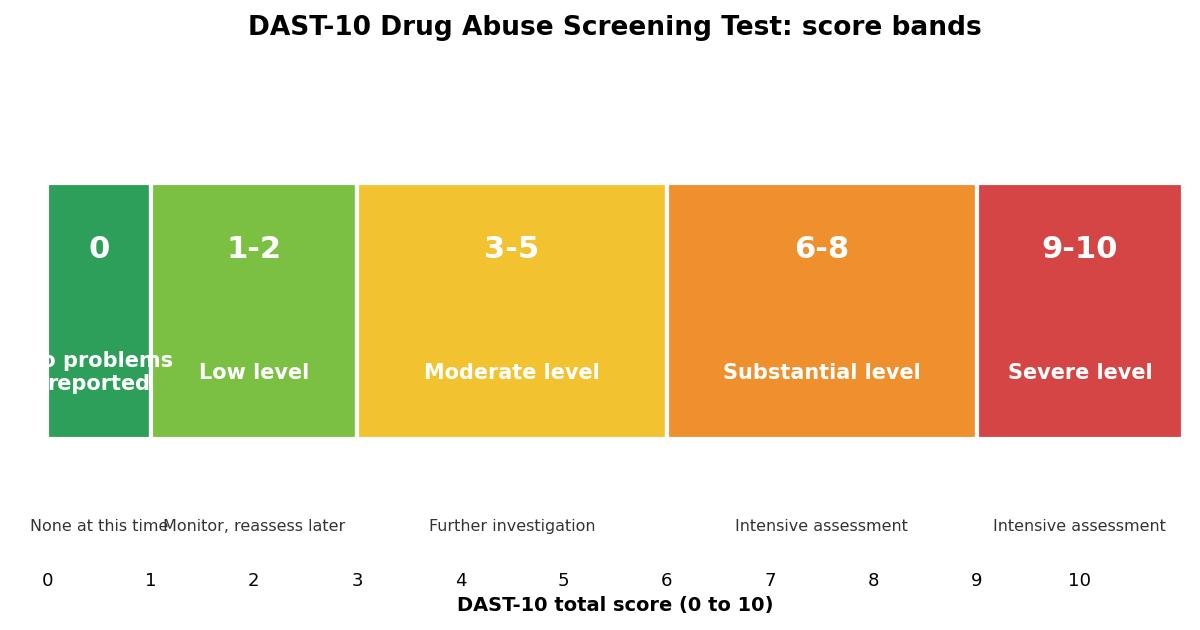
The total score places you in one of five bands: no problems reported (0), low level (1 to 2), moderate level (3 to 5), substantial level (6 to 8), or severe level (9 to 10). Each band comes with a suggested action, ranging from no action at this time for a score of 0, through monitoring and further investigation in the middle bands, to intensive assessment in the two highest bands.
A screening tool, not a diagnosis
It is important to understand exactly what the DAST-10 can and cannot tell you. It is a screening instrument. A screening test sorts people into groups that are more or less likely to need a fuller assessment; it does not diagnose a condition. A score in a higher band means that drug-related problems are likely enough to justify further investigation by a professional. It does not by itself mean that you have a substance use disorder, and a score of 0 does not guarantee that no problem exists.
A diagnosis of a substance use disorder can only be made by a qualified clinician after a face-to-face evaluation. The clinician takes a history, considers medical and medication-related causes, rules out other explanations, and applies formal diagnostic criteria. If your DAST-10 score concerns you, treat it as a reason to have that conversation, not as the final word.
The ten questions, explained
The ten questions were chosen to cover different dimensions of drug-related problems. Understanding what each one asks can help you answer more accurately.
Question 1 asks whether you have used drugs other than those required for medical reasons. This is the gateway question: if you have not used any non-medical drugs in the past 12 months, most of the remaining questions will naturally be answered No.
Question 2 asks whether you abuse more than one drug at a time. Using several drugs together (polydrug use) is associated with greater risk and more complicated patterns of use than single-drug use.
Question 3 asks whether you are always able to stop using drugs when you want to. Loss of control over use is a central feature of problematic drug involvement. If you never use drugs, the standard instruction is to answer Yes to this question. Note that, unlike the other nine questions, this one is reverse-scored: a No answer adds one point to your total, because it indicates loss of control.
Question 4 asks about blackouts or flashbacks as a result of drug use. These are signs that drug use is affecting brain function in ways that carry real safety risks, such as injury or dangerous behavior during periods of impaired awareness.
Question 5 asks whether you ever feel bad or guilty about your drug use. Feelings of guilt or remorse often reflect a growing awareness that use is causing harm, and they are a common prompt for people to seek help. If you never use drugs, answer No.
Question 6 asks whether your spouse or parents ever complain about your involvement with drugs. Complaints from close family members are an external signal that use is visible enough to affect the people around you.
Question 7 asks whether you have neglected your family because of your use of drugs. This question looks at functional impact: drug use that interferes with family responsibilities is a marker of more serious involvement.
Question 8 asks whether you have engaged in illegal activities in order to obtain drugs. Resorting to illegal behavior to get drugs indicates that obtaining and using drugs has become a high priority, which is characteristic of more severe patterns.
Question 9 asks about withdrawal symptoms, such as feeling sick when you stopped taking drugs. Physical withdrawal is a sign of physiological dependence and is an important clinical flag that a professional assessment is needed.
Question 10 asks about medical problems as a result of drug use, giving examples such as memory loss, hepatitis, convulsions, and bleeding. Drug use can damage many body systems, and medical complications are a strong reason to seek care promptly.
How the scoring works
Scoring is deliberately simple. Each question answered Yes contributes one point, and each question answered No contributes zero. Adding the points gives a total between 0 and 10. The total is then interpreted using the five bands published with the instrument:
| Total score | Degree of problems related to drug abuse | Suggested action |
|---|---|---|
| 0 | No problems reported | None at this time |
| 1 to 2 | Low level | Monitor, reassess at a later date |
| 3 to 5 | Moderate level | Further investigation |
| 6 to 8 | Substantial level | Intensive assessment |
| 9 to 10 | Severe level | Intensive assessment |
Notice that the boundary between bands matters more than the exact number. A score of 2 falls in the low level band while a score of 3 moves into the moderate band with its suggestion of further investigation. Likewise, a score of 5 is still moderate, but a score of 6 enters the substantial band where intensive assessment is suggested. The calculator above applies these cutoffs exactly.
What your result means
Score 0, no problems reported. None of the ten problem indicators were present over the past 12 months. The suggested action is none at this time. If your circumstances change, you can retake the screening.
Scores 1 to 2, low level. A small number of indicators were present. The suggested action is to monitor the situation and reassess at a later date. This band is a good moment for honest reflection about whether use is trending upward, and for noting what might change that picture.
Scores 3 to 5, moderate level. Several indicators were present, enough that the instrument suggests further investigation. This does not mean you have a disorder, but it does mean a conversation with a healthcare professional is warranted. Many people find this band a useful early-warning signal: problems are visible but may still be easier to address than they would be later.
Scores 6 to 8, substantial level. Many indicators were present, and the suggested action is intensive assessment. At this level, a professional evaluation is strongly advisable. A clinician can assess the pattern of use, check for medical complications and withdrawal risk, and discuss treatment options.
Scores 9 to 10, severe level. Nearly all indicators were present, and intensive assessment is likewise suggested. If you score in this band, please arrange a professional assessment promptly. You do not need to wait for a crisis to ask for help.
Limitations of the DAST-10
Like every brief screening tool, the DAST-10 has limits worth knowing. First, it depends on self-report, so its accuracy depends on the honesty of the answers. People commonly under-report drug use because of embarrassment, stigma, or worry about consequences. An honest result is more useful than a reassuring one.
Second, the questions ask about the past 12 months, and memory over that span is imperfect. Recent events may be over-weighted and earlier events forgotten. Third, the test does not cover alcohol, so a person with a significant alcohol problem but no drug use would score 0. Alcohol deserves its own screening with a dedicated instrument.
Fourth, the DAST-10 measures the number of problem indicators, not the severity of dependence on its own, and it does not distinguish between different drugs or patterns of use. Two people with the same score can have very different clinical pictures. Finally, the instrument was developed decades ago, and while it remains widely used in research and clinical practice, it should always be interpreted alongside a clinical interview rather than in isolation.
What to do next
If your score falls in the moderate, substantial, or severe band, the most useful next step is a professional assessment. Bring your result to your doctor, a counselor, or a local addiction or mental health service, and ask for a fuller evaluation. You can also note which questions you answered Yes to, since that pattern helps a clinician understand your situation more quickly.
If your score is low but you are still worried about your drug use or someone else's, you do not need a high score to ask for advice. Screening cutoffs are guides, not gates. And if you or someone else is in immediate danger, for example from an overdose, severe withdrawal, or a medical emergency, seek urgent medical help or contact your local emergency number right away.
Source
This calculator implements the 10-item Drug Abuse Screening Test as described in: Skinner HA. The Drug Abuse Screening Test. Addictive Behaviors. 1982;7(4):363-371. The score bands and suggested actions follow the standard DAST-10 scoring guide published with the instrument (0: no problems reported, none at this time; 1 to 2: low level, monitor and reassess later; 3 to 5: moderate level, further investigation; 6 to 8: substantial level, intensive assessment; 9 to 10: severe level, intensive assessment).
Key takeaways
- No.
- In the standard DAST-10 interpretation, a score of 9 to 10 falls in the severe level band and a score of 6 to 8 falls in the substantial level band.
- No.
- As honestly as you can.
Frequently asked questions
Does the DAST-10 diagnose drug addiction?
No. The DAST-10 is a screening instrument, not a diagnostic test. A higher score suggests that drug-related problems are likely and that a fuller clinical assessment would be worthwhile, but a diagnosis of a substance use disorder can only be made by a qualified clinician after a face-to-face evaluation.
What DAST-10 score is considered severe?
In the standard DAST-10 interpretation, a score of 9 to 10 falls in the severe level band and a score of 6 to 8 falls in the substantial level band. Both bands carry the same suggested action: intensive assessment by a qualified professional. Scores of 3 to 5 indicate a moderate level with a suggestion of further investigation, and scores of 1 to 2 indicate a low level with a suggestion to monitor and reassess later.
Does the DAST-10 cover alcohol use?
No. The DAST-10 asks about drugs other than those required for medical reasons, and it does not cover alcohol. Alcohol use is screened with separate instruments, the best known being the AUDIT (Alcohol Use Disorders Identification Test). If you want a picture of both, take each screening separately and discuss both results with a clinician.
How honestly should I answer the DAST-10 questions?
As honestly as you can. The DAST-10 is a self-report questionnaire, so its result is only as accurate as the answers you give. There are no right or wrong answers and the score is for your own understanding and for discussion with a professional. Under-reporting drug use is common because of embarrassment or worry about consequences, but an honest result is far more useful for getting the right help.
Can I fill in the DAST-10 on behalf of someone else?
The DAST-10 is designed as a self-report instrument, so it works best when the person themselves answers the questions about their own drug use over the past 12 months. You can read the questions aloud to someone and record their answers, but the answers should reflect their own experience, not your impression of their use. Clinicians sometimes use the result together with information from family members, but the questionnaire itself is meant to be self-completed.
What should I do if my DAST-10 score is high?
Treat the score as a prompt to talk to a professional, not as a verdict. Bring your result to your doctor, a counselor, or a local addiction or mental health service and ask for a fuller assessment. You do not need to wait until things get worse: scores in the moderate band already carry a suggestion of further investigation. If you or someone else is in immediate danger, seek urgent medical help or contact your local emergency number.