What the K10 Psychological Distress Scale measures
Psychological distress is a broad term for the unpleasant feelings and emotions that affect how a person functions day to day. The Kessler Psychological Distress Scale, usually called the K10, is a 10-question self-report measure designed to capture that general distress rather than to pick out one specific disorder. It asks about the frequency of symptoms associated with both anxiety and depression, such as nervousness, restlessness, hopelessness, sadness and worthlessness, over the previous 30 days. Because it measures distress in general rather than one diagnosis, researchers call it a measure of "non-specific" psychological distress.
The scale was developed by Ronald Kessler and colleagues at Harvard University and published in Psychological Medicine in 2002, in a paper titled "Short screening scales to monitor population prevalences and trends in non-specific psychological distress". The paper grew out of work for the World Health Organization's Composite International Diagnostic Interview, where there was a need for a very short instrument that could be used in large national surveys. The authors started with a large pool of candidate questions about distress symptoms, tested them against detailed diagnostic interviews in the United States National Comorbidity Survey, and selected the 10 items that best identified people with a serious mental illness, judged by how well each item discriminated between cases and non-cases.
The K10 has since become one of the most used mental health measures in the world. It is part of Australia's national mental health survey program and is used in routine clinical practice in several countries, including in primary care, psychology services and crisis lines, where it helps clinicians decide who needs a fuller assessment and track whether distress is improving over time.
How K10 scoring works
Each of the 10 questions offers the same five response options: "None of the time", "A little of the time", "Some of the time", "Most of the time" and "All of the time". These are scored 1 through 5, and the total is simply the sum of all 10 answers. The lowest possible score is therefore 10 (answering "None of the time" to every question) and the highest is 50 (answering "All of the time" to every question). A higher total always means greater psychological distress. The calculation above follows exactly this published scoring rule, and every question must be answered for the total to be valid.
The 30-day timeframe matters. Unlike some questionnaires that ask about the last two weeks, the K10 asks about the last 30 days, which smooths out brief bad days and captures a more representative picture of how someone has been doing over the past month. When you retake the scale later, the new 30-day window will overlap partly with the old one, which is worth keeping in mind if you are tracking change over time.
Interpreting your K10 score: the severity bands
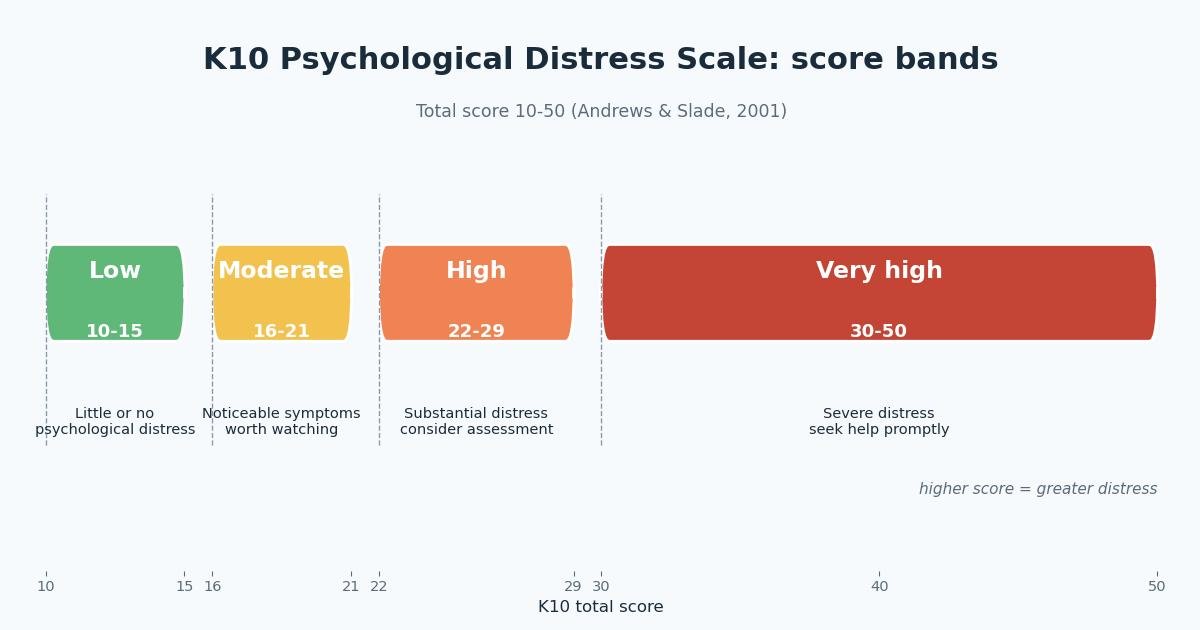
The most widely used interpretation bands were proposed by Gavin Andrews and Tim Slade in 2001, based on Australian population data, and are reproduced in clinical guidelines worldwide. They divide the 10 to 50 range into four levels:
| K10 total score | Level of psychological distress |
|---|---|
| 10 to 15 | Low distress |
| 16 to 21 | Moderate distress |
| 22 to 29 | High distress |
| 30 to 50 | Very high distress |
Low distress (10 to 15)
A score in this range suggests little or no psychological distress over the last month. This is where the majority of the general population scores. A low score does not guarantee that everything is fine, but it does indicate that symptoms of anxiety and depression have been rare or absent. If you feel well and your score is here, the result simply confirms what you already feel. People in this range generally do not need further mental health assessment unless they have specific concerns.
Moderate distress (16 to 21)
A moderate score indicates a noticeable level of distress. You may have been experiencing symptoms such as nervousness, low mood or restlessness a good deal of the time over the past month. At this level, many people benefit from paying attention to the basics that protect mental health: regular sleep, physical activity, social contact and keeping alcohol use low. If the symptoms persist, recur, or are getting in the way of work, study or relationships, it is sensible to discuss them with your GP.
High distress (22 to 29)
A high score indicates substantial psychological distress. People scoring in this range are considerably more likely than the average person to be experiencing an anxiety or depressive disorder, and further assessment is generally recommended. This is a good time to book an appointment with your GP or another qualified health professional, who can explore what is going on, rule out physical causes, and discuss treatment options. Effective help exists, and earlier treatment usually works better.
Very high distress (30 to 50)
A score of 30 or above indicates very high psychological distress and, in the original validation research, this range showed high specificity for serious mental illness. If your score falls here, please do not try to manage this alone: contact your GP, a mental health service, or a crisis line promptly. You do not need to wait for a scheduled appointment if you are struggling. In many countries, crisis lines operate around the clock, and emergency departments can help when distress becomes urgent.
How accurate is the K10?
The K10 was developed with unusual rigour for a 10-item questionnaire. In the original development study, each candidate item was tested against diagnoses made by the World Health Organization's Composite International Diagnostic Interview, a full structured diagnostic interview. The final 10 items were the ones that best identified people with a current serious mental illness, defined by a DSM diagnosis plus substantial functional impairment. In the development samples, the scale discriminated cases from non-cases well, and a cutoff in the high-20s to 30 range gave high specificity for serious mental illness, meaning that most people scoring that high genuinely had significant problems.
Since 2002 the scale has been validated repeatedly in different countries and populations. It is used in Australia's National Survey of Mental Health and Wellbeing, in the United States National Health Interview Survey (where a 6-item version, the K6, is fielded), and in many clinical and research settings around the world. Studies have found good internal consistency and a structure consistent with measuring one general dimension of distress. Like every self-report scale, the K10 depends on honest answers and on the respondent's willingness to report symptoms. Cultural differences in how people describe distress can also affect scores, which is one reason the result should be discussed with a clinician rather than read as a verdict.
K10 versus other mental health questionnaires
The K10 sits alongside several other brief mental health measures, and it helps to know what each one is for. The PHQ-9 focuses specifically on depressive symptoms over the last two weeks, and the GAD-7 focuses specifically on anxiety symptoms over the same period. The K10 is broader: it samples from both the anxiety and depression symptom pools and asks about the last 30 days, making it a measure of overall distress rather than of one disorder. This is why it is favoured in population surveys, where researchers want one number that summarises mental health burden across a whole population.
The K6 is the shorter sibling of the K10, made up of 6 of the same items, and is used in the United States as a screener for serious mental illness with a cutoff of 13 out of 24. The K10's longer item set gives it a wider scoring range and more detail, which is useful in clinical settings where gradations of distress matter for monitoring treatment.
When to seek help based on your result
Screening tools exist to guide action, not to label people. As a rough guide: a low score with no concerns needs no action. A moderate score that persists for several weeks, or that is clearly affecting your life, is worth raising with your GP. A high or very high score is a prompt to seek professional assessment without delay. Whatever your score, some situations always warrant prompt help: thoughts of harming yourself, a plan to act on those thoughts, inability to carry out daily activities, or distress that feels unbearable. If any of these apply, contact your local emergency number or a crisis service immediately rather than waiting to see whether the score changes.
Retaking the K10 to track change over time
Because every question asks about the previous 30 days, the K10 works well as a repeated measure. Clinicians often ask patients to complete it at each visit so that changes in the total score can be tracked across treatment. A falling score suggests distress is easing; a rising score suggests it is worsening. For fair comparisons, answer under similar conditions each time, for example at a similar time of day and in a similar setting, and give each question the same honest consideration. Discuss any meaningful change with your clinician rather than interpreting it on your own, since a change of a few points can reflect normal fluctuation rather than a real trend.
Limitations of the K10
No screening tool is perfect, and the K10 has known limits. First, it measures distress in general and does not distinguish between anxiety, depression, stress from life circumstances, or distress caused by physical illness, so a high score does not point to any particular condition. Second, it relies entirely on self-report: people sometimes understate symptoms out of stigma or embarrassment, or overstate them when they are having a particularly bad day. Third, the standard bands come from Australian population norms and may fit other populations less well, although the scale has performed well in many countries. Fourth, the K10 does not ask about positive mental health, functioning at work or in relationships, or about symptoms of conditions outside the anxiety and depression spectrum, such as psychosis or mania. Finally, and most importantly, it is a screening instrument: it can suggest that further assessment is warranted, but it cannot diagnose anyone with anything.
How this online test scores your answers
The test above implements the published K10 scoring rule exactly: each answer is converted to a number from 1 ("None of the time") to 5 ("All of the time"), the ten numbers are added together, and the total is placed in the Andrews and Slade (2001) bands. All calculation happens in your own browser; your answers are not sent anywhere or stored. The scoring logic has been tested against every band boundary (scores of 10, 15, 16, 21, 22, 29, 30 and 50 all land in the correct band) and against missing or invalid inputs, which are rejected with a clear message.
Key takeaways
- The K10 measures non-specific psychological distress over the previous 30 days.
- No.
- The widely used bands, published by Andrews and Slade (2001), are: 10 to 15 low distress, 16 to 21 moderate distress, 22 to 29 high distress, and 30 to 50 very high distress.
- The K10 was developed by Kessler and colleagues and published in Psychological Medicine in 2002.
Frequently asked questions
What does the K10 measure?
The K10 measures non-specific psychological distress over the previous 30 days. Its 10 items cover symptoms of anxiety and depression, including feeling tired for no reason, nervous, restless, hopeless, depressed, sad and worthless. Each item is scored from 1 (none of the time) to 5 (all of the time), giving a total score from 10 to 50. Higher scores indicate greater distress.
Is the K10 a diagnosis of a mental health condition?
No. The K10 is a screening instrument, not a diagnostic tool. It identifies the level of psychological distress and signals who may need further assessment for anxiety or depressive disorders. Only a qualified health professional, using a clinical interview and diagnostic criteria, can diagnose a mental health condition.
What do the K10 score bands mean?
The widely used bands, published by Andrews and Slade (2001), are: 10 to 15 low distress, 16 to 21 moderate distress, 22 to 29 high distress, and 30 to 50 very high distress. Scores in the high or very high range suggest that a person should consider talking to a GP or mental health professional about their symptoms.
How accurate is the K10?
The K10 was developed by Kessler and colleagues and published in Psychological Medicine in 2002. It has been extensively validated in population surveys and clinical settings. Research shows it discriminates well between people with and without serious mental illness: in the original development work, a cutoff around 30 showed high specificity for serious mental illness, and the scale is widely used in national health surveys, including Australia's National Survey of Mental Health and Wellbeing.
Can I retake the K10 to track my mental health over time?
Yes. Because the K10 always asks about the previous 30 days, it works well as a repeated measure. Clinicians often use it to monitor changes in distress across treatment. For fair comparisons, answer under similar conditions each time and discuss any change with your clinician rather than interpreting it alone.
What should I do if my K10 score is high or very high?
A high or very high score means it is sensible to speak with a qualified health professional, such as your GP, who can assess you properly and discuss support options. Effective treatments exist for anxiety and depression, including talking therapies and medication. If you ever feel you might act on thoughts of harming yourself, seek urgent help immediately through your local emergency number or crisis service.
References
- Kessler RC, Andrews G, Colpe LJ, et al. Short screening scales to monitor population prevalences and trends in non-specific psychological distress. Psychological Medicine. 2002;32(6):959-976.
- Andrews G, Slade T. Interpreting scores on the Kessler Psychological Distress Scale (K10). Australian and New Zealand Journal of Psychiatry. 2001;35(4):494-497.
- Australian Government Department of Health. K10 scoring and interpretation. National Comorbidity Guidelines. Available at: comorbidityguidelines.org.au.
- National Institute of Mental Health
- WHO: Mental Health