What the ASRS v1.1 is
The Adult ADHD Self-Report Scale (ASRS) version 1.1 is an 18-item symptom checklist created by the World Health Organization together with a research team led by Professor Ronald Kessler of Harvard Medical School. It was published in the journal Psychological Medicine in 2005 (Kessler RC et al., "The World Health Organization Adult ADHD Self-Report Scale (ASRS): a short screening scale for use in the general population", Psychological Medicine, 35(2):245-256, DOI: 10.1017/S0033291704002892). The instrument was designed as a screening aid: a short, self-administered questionnaire that can identify adults in the general population whose symptom pattern suggests they may have attention deficit hyperactivity disorder and who would therefore benefit from a full clinical evaluation.
ADHD is usually thought of as a childhood condition, but research published over the last three decades has established that a substantial proportion of children with ADHD continue to experience impairing symptoms as adults, and that ADHD can also be recognised for the first time in adulthood. Adult ADHD is frequently under-recognised because its presentation differs from the hyperactive child stereotype: adults more often describe chronic disorganisation, missed deadlines, losing items, restless minds, and difficulty completing tasks, and these features overlap with symptoms of anxiety, depression, sleep disorders, and thyroid dysfunction. A validated screening instrument like the ASRS helps separate cases that deserve a proper clinical workup from patterns that are less suggestive of ADHD.
The ASRS is built on the symptom criteria developed for the WHO Composite International Diagnostic Interview, a standardised instrument used in psychiatric epidemiology worldwide. Because it derives from an internationally field-tested interview, the ASRS asks about symptom domains that clinicians recognise across diagnostic systems, which is one reason it has become one of the most widely used adult ADHD screeners in both research studies and primary-care settings.
Why this page uses the 6-item Part A
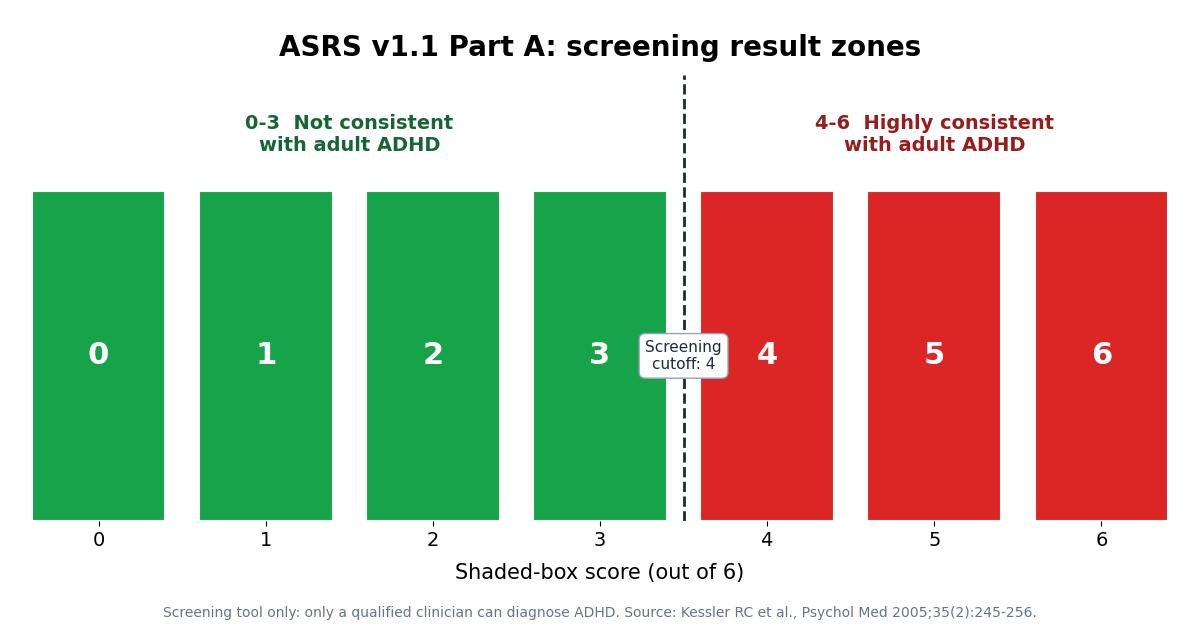
The full ASRS contains 18 items, but the authors' own development research showed that a subset of 6 items carried most of the instrument's ability to discriminate adults with ADHD from those without. These 6 items form Part A of the scale, and the published scoring guidance presents Part A as the screening portion: a person with 4 or more of the 6 responses falling in the shaded boxes is considered to have symptoms "highly consistent with ADHD in adults" and is advised to seek a clinical evaluation. Part B, the remaining 12 items, is intended for use in clinical settings to gather a fuller symptom picture, typically after a positive Part A screen or as part of an assessment already underway. This page therefore implements Part A only, exactly as the instrument's developers recommend for screening, and tells you clearly where the 12-item Part B sits in the process.
The 6 questions explained
The six Part A questions cover the symptom domains that proved most predictive in the development study. They ask about: trouble wrapping up the final details of a project once the challenging parts are done; difficulty getting things in order when a task requires organisation; problems remembering appointments or obligations; avoiding or delaying getting started on tasks that require a lot of thought; fidgeting or squirming when required to sit for a long time; and feeling overly active and compelled to do things, as if driven by a motor. Each question is answered on the same five-point frequency scale: Never, Rarely, Sometimes, Often, or Very often. The questions ask about the last six months, which keeps the responses focused on a current, persistent pattern rather than a single bad week.
How the shaded-box scoring works
The ASRS does not simply add up points. Instead, each question has a "shaded box" threshold, and a symptom counts toward the total only when the chosen frequency reaches that threshold. For questions 1, 2, and 3, the shaded box covers Sometimes, Often, and Very often. For questions 4, 5, and 6, the shaded box covers only Often and Very often, which is a deliberately stricter bar. The screen is considered positive when 4 or more of the 6 responses land in the shaded boxes.
The thresholds are not symmetric across questions for a reason. Items 4, 5, and 6 describe experiences, such as fidgeting or feeling driven, that are common at moderate levels in the general population, so the developers set a higher frequency bar before they count. Items 1, 2, and 3 describe more specific functional difficulties, such as failing to finish the final details of projects or chronically disorganised workflows, for which the Sometimes level already marks an unusual pattern. This calculator applies these exact per-question thresholds automatically, and the results panel shows you, question by question, which of your answers fell in the shaded boxes, so the scoring is fully transparent.
An important consequence of this design: the same frequency answer can mean different things on different questions. "Sometimes" counts toward the score on question 1 but not on question 4. That is by design, and it is the reason paper versions of the ASRS print the scoring boxes in grey, which is also where the instrument's common name, shaded-box scoring, comes from.
What your score means
A score of 4 or more shaded responses means your reported symptom pattern is highly consistent with adult ADHD, and the instrument's guidance recommends that you discuss a full clinical evaluation with a health professional. A score below 4 means your symptoms are not consistent with adult ADHD according to this screener. Crucially, a negative screen does not rule ADHD out. No screening instrument is perfect: brief screeners can miss cases, especially in people whose primary symptoms are inattentive rather than hyperactive, and the ASRS was validated as a screening aid, not a substitute for clinical judgement.
It is also worth remembering that ADHD-like symptoms have many causes. Chronic poor sleep, untreated anxiety or depression, thyroid problems, some medications, substance use, and high sustained stress can all produce inattention, restlessness, and disorganisation that look very much like ADHD on a questionnaire. A clinician's job during the follow-up evaluation is precisely to sort this out, usually through a structured interview, a review of your developmental and educational history, information from people who know you well, and sometimes cognitive or psychological testing.
Limitations of the ASRS
Every screening instrument has limits, and it is worth understanding them before drawing conclusions from a score. First, the ASRS relies entirely on self-report, which means it inherits all the biases of self-perception: people may over-report during a stressful period or under-report symptoms they have learned to compensate for. Second, it is a point-in-time measure of the last six months and cannot establish the childhood onset and persistence that diagnostic criteria require. Third, cultural and linguistic factors can influence how people interpret frequency words like "Often" or how comfortable they are reporting difficulties, which is one reason clinician-administered follow-up matters.
Finally, an online implementation is an educational tool, not a clinical encounter. It cannot observe behaviour, ask follow-up questions, or weigh collateral information, all of which a clinician uses. Treat your result as a structured starting point for a conversation with a professional, not as an answer in itself. If your results concern you, print or save your answers and bring them to an appointment; many clinicians find a completed ASRS a useful piece of the assessment file.
What happens after a positive screen
If your score is 4 or higher and your symptoms are affecting your work, study, or relationships, a reasonable next step is an appointment with your primary-care clinician or a psychiatrist, ideally someone with experience in adult ADHD. Bring your ASRS responses and, if possible, examples of how the symptoms affect daily life, school or work records from earlier years, and, with permission, observations from a partner, family member, or close friend. A full evaluation typically covers current symptoms, childhood history, medical causes that could explain the symptoms, and coexisting conditions such as anxiety, depression, or sleep disorders, which are common alongside adult ADHD and influence treatment choices.
If your score is below 4 but you remain concerned, the same advice applies: a screener is not the last word. Clinicians diagnose based on the full picture, and if impairment persists it deserves investigation regardless of any single score. Whatever your result, persistent problems with attention and organisation are worth taking seriously, because the effective treatments and coping strategies for ADHD and its mimics differ, and getting the right explanation is what opens the right help.