What is the GAD-7?
The Generalised Anxiety Disorder 7-item scale, usually shortened to GAD-7, is a brief self-administered questionnaire that screens for symptoms of generalised anxiety disorder. It asks about seven common anxiety symptoms and how often each one has bothered you over the previous two weeks. Because it takes only a minute or two to complete, it has become one of the standard brief anxiety measures used in primary care clinics, mental health services, and research studies around the world.
The scale was developed by Robert L. Spitzer, Kurt Kroenke, Janet B. W. Williams and Bernd Löwe, and published in the Archives of Internal Medicine in 2006. The authors designed it as a practical tool for busy clinical settings: short enough to complete in a waiting room, yet structured enough to give a meaningful severity score. Each of the seven items reflects a core feature of generalised anxiety as described in psychiatric diagnostic criteria, translated into plain language that patients can answer without medical knowledge.
Unlike a casual online quiz, the GAD-7 is a standardised instrument. The wording of the questions, the four response options, the two-week time frame, and the scoring bands are all fixed by the original publication. That standardisation is what makes scores comparable: a score of 12 obtained in a clinic in London means the same thing as a score of 12 obtained at home in Lahore, provided the questionnaire was completed honestly and in the same way.
How the scoring works
Each of the seven items is scored on a four-point scale: 0 for “Not at all”, 1 for “Several days”, 2 for “More than half the days”, and 3 for “Nearly every day”. Your total score is simply the sum of the seven item scores, which gives a range from 0 to 21. There is no weighting and no complicated formula: every symptom counts equally toward the total.
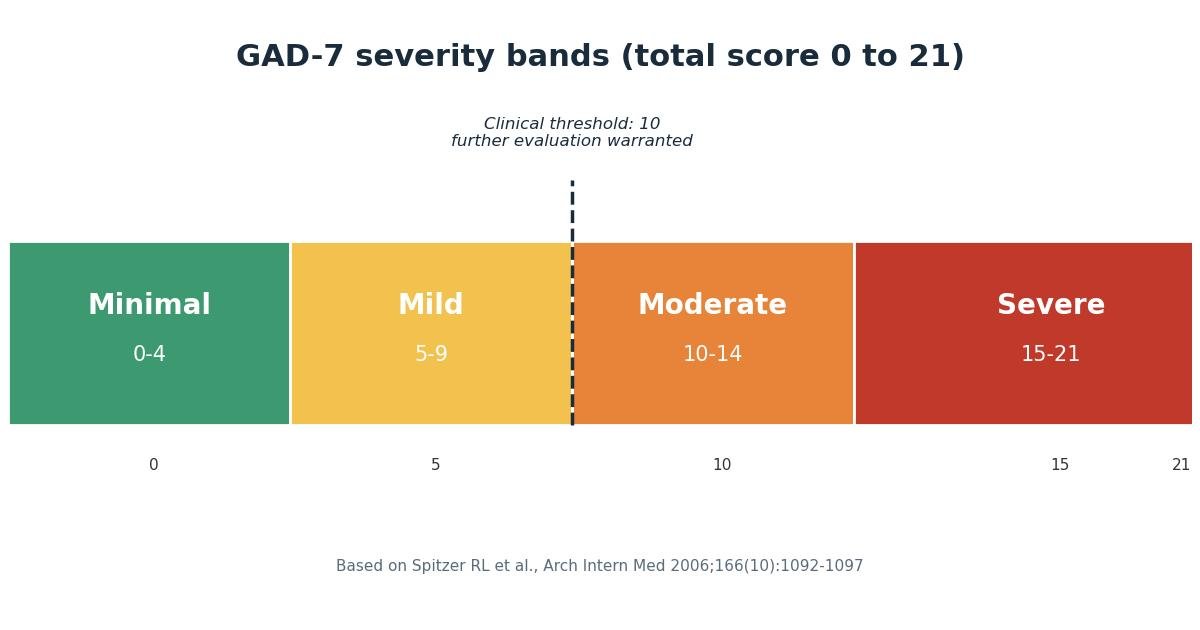
The total score falls into one of four severity bands defined in the original study: 0 to 4 indicates minimal anxiety, 5 to 9 indicates mild anxiety, 10 to 14 indicates moderate anxiety, and 15 to 21 indicates severe anxiety. A score of 10 or above is the commonly used clinical threshold, meaning that further evaluation by a qualified professional is warranted. Our calculator above applies exactly these rules, so the result you receive matches the scoring of the published instrument.
It is worth noting what the score does not do. It does not count how many disorders you have, it does not measure how long you have been anxious, and it does not by itself diagnose generalised anxiety disorder. It is a snapshot of symptom severity over a two-week window, and its proper use is as a starting point for a clinical conversation.
Understanding the four severity bands
Minimal anxiety (0 to 4)
Scores in this range suggest that anxiety symptoms are absent or only occasional. Most people will score in this band during calm periods of life, and a low score here is reassuring. It does not guarantee the absence of an anxiety problem, because some people under-report their symptoms or because anxiety can fluctuate, but it generally means that no action is needed beyond the usual attention to sleep, exercise, and stress management that supports mental health for everyone.
Mild anxiety (5 to 9)
Mild scores indicate that anxiety symptoms are present but relatively contained. Many people in this band notice worry or tension on some days without it seriously disrupting work, relationships, or sleep. For mild anxiety, self-help strategies are often a reasonable first step: regular physical activity, consistent sleep, limiting caffeine and alcohol, and simple stress management techniques. If symptoms persist for months or begin to interfere with daily life, it is still worth discussing them with a clinician, since mild symptoms can sometimes be the early stage of a developing anxiety disorder.
Moderate anxiety (10 to 14)
A score in the moderate range crosses the commonly used clinical threshold of 10, which means further professional evaluation is recommended. At this level, anxiety is typically noticeable on most days and is likely to be affecting concentration, sleep, or daily functioning to some degree. This is the band where a conversation with a GP or mental health professional becomes genuinely useful: they can assess whether the pattern fits generalised anxiety disorder or another condition, and discuss treatment options. Effective treatments exist, and moderate anxiety responds well to them.
Severe anxiety (15 to 21)
Severe scores indicate frequent, intense anxiety symptoms across most or all of the seven items. People scoring in this range often experience persistent worry that is difficult to control, along with physical symptoms such as restlessness, muscle tension, or trouble relaxing nearly every day. A severe score is a clear prompt to seek professional help promptly rather than waiting to see whether things improve on their own. If anxiety ever comes with thoughts of harming yourself, seek urgent help immediately through your local emergency number or crisis service.
What does a score of 10 or above mean?
The threshold of 10 is the most widely used cutoff on the GAD-7. In the original validation study, the authors examined how well different cutoffs identified patients who, on fuller assessment, had generalised anxiety disorder. A score of 10 or above was adopted as the point at which further evaluation is warranted, and it has since become the standard threshold in clinical guidelines and research protocols.
Crossing this threshold does not mean you have generalised anxiety disorder. Screening cutoffs are deliberately set to catch most people who might need help, which means some people above the cutoff will turn out not to have the disorder when assessed in detail. Think of it as a smoke alarm: it tells you that something deserves a closer look, not that the house is on fire. The next step is a proper clinical assessment, which considers the full picture, including how long symptoms have lasted, how much they impair your life, and whether medical causes have been ruled out.
Limitations of the GAD-7
Every measurement tool has limits, and the GAD-7 is no exception. First, it is a screening instrument, not a diagnostic one. Generalised anxiety disorder has formal diagnostic criteria involving symptom duration, the degree of impairment, and the exclusion of other causes, and none of that can be established by a seven-question form.
Second, it relies entirely on self-report. Answers can be shaded by mood on the day, by how carefully the questions are read, or by reluctance to admit to certain symptoms. Physical health problems, such as thyroid disorders or heart rhythm disturbances, and substances, including caffeine, alcohol, and some medications, can produce symptoms that look like anxiety on a questionnaire. A clinician sorts these possibilities out; the GAD-7 cannot.
Third, the two-week window is both a strength and a limitation. It makes the scale sensitive to recent change, which is useful for tracking treatment, but it also means a single stressful fortnight, such as exam season or a family crisis, can push a score up without reflecting a longer-term disorder. Finally, the scale was developed and validated mainly in adult primary care populations, so extra caution is needed when interpreting scores for adolescents or in cultural contexts very different from those of the original studies.
The GAD-7 in clinics and research
In primary care, the GAD-7 is often used alongside its sister scale, the PHQ-9, which screens for depression. Anxiety and depression frequently occur together, and administering both gives a fuller picture of a patient’s mental state in under five minutes. Many clinics repeat both scales at each visit, using the scores to track whether treatment is working.
There is also a shorter two-item version, the GAD-2, which uses just the first two questions of the GAD-7 (nervousness and uncontrollable worry) as an ultra-brief screen. A common workflow is to start with the GAD-2 and, if it suggests possible anxiety, follow up with the full GAD-7 for a more detailed severity score. In research, the GAD-7 is used as a standard outcome measure in trials of treatments for anxiety, which is why keeping the wording and scoring identical to the original matters so much.
Using the GAD-7 to track change over time
Because the GAD-7 always asks about the previous two weeks, it functions well as a repeated measure. If you are receiving treatment for anxiety, your clinician may ask you to complete it regularly so that progress can be followed numerically rather than by impression alone. A falling total over successive completions generally suggests improvement, while a rising total may signal that the current approach needs review.
For fair comparisons, try to answer under similar conditions each time: the same quiet setting, the same honest first instinct, and with the same understanding of the response options. Small shifts of a point or two can reflect normal week-to-week variation rather than real change, so focus on the overall trend across several completions. Most importantly, discuss the pattern with your clinician rather than adjusting any treatment yourself on the basis of a score.
When to seek professional help
Consider speaking with your GP or another qualified health professional if your score is 10 or above, if anxiety is interfering with your work, studies, relationships, or sleep, or if you find yourself avoiding situations because of worry. You do not need to wait until symptoms feel severe: clinicians would much rather see someone early, when anxiety is easier to treat, than late.
Effective treatments for anxiety are well established. Talking therapies, particularly cognitive behavioural therapy, help many people, and several medications can reduce anxiety symptoms when appropriate. Often the two are combined. What matters most is taking the first step of raising the topic with a professional who can guide you to the right option. If you ever feel you might act on thoughts of harming yourself, treat it as an emergency and seek urgent help immediately.
Tips for answering accurately
Keep the two-week time frame firmly in mind: the questions ask about recent experience, not about how you are in general or how you were years ago. Go with your first instinct rather than analysing each question at length, and answer for yourself, not for how you think you should feel. There are no trick questions and no “better” answers. The value of the GAD-7 comes entirely from honest answers, so a quickly and truthfully completed scale is far more useful than a carefully optimised one.
Key takeaways
- The GAD-7 measures the severity of generalised anxiety disorder symptoms over the previous 2 weeks.
- No.
- A score of 10 or above is the commonly used clinical threshold on the GAD-7.
- The GAD-7 was developed and validated by Spitzer, Kroenke, Williams and Lowe in a study of patients in primary care settings, published in the Archives of Internal Medicine in 2006.
Frequently asked questions
What does the GAD-7 measure?
The GAD-7 measures the severity of generalised anxiety disorder symptoms over the previous 2 weeks. Its 7 items cover nervousness, uncontrollable worrying, excessive worry about different things, trouble relaxing, restlessness, irritability, and fear that something awful might happen. Each item is scored 0 to 3, giving a total from 0 to 21. Higher scores indicate more severe anxiety symptoms.
Is the GAD-7 a diagnosis of anxiety disorder?
No. The GAD-7 is a screening instrument, not a diagnostic tool. It identifies people whose symptom pattern and severity suggest that a fuller clinical assessment is warranted. Only a qualified health professional, using a clinical interview and diagnostic criteria, can diagnose generalised anxiety disorder or any other condition.
What does a GAD-7 score of 10 or above mean?
A score of 10 or above is the commonly used clinical threshold on the GAD-7. It indicates moderate to severe anxiety symptoms and suggests that further evaluation by a clinician is warranted. In the original validation study by Spitzer and colleagues, this cutoff was used to flag patients in primary care who should be assessed further for generalised anxiety disorder.
How accurate is the GAD-7?
The GAD-7 was developed and validated by Spitzer, Kroenke, Williams and Lowe in a study of patients in primary care settings, published in the Archives of Internal Medicine in 2006. It is now one of the most widely used brief anxiety measures in clinical practice and research. Like all self-report scales, its result depends on honest answers about the last 2 weeks and should be interpreted alongside a clinical conversation, not in isolation.
Can I retake the GAD-7 to track my anxiety over time?
Yes. Because the GAD-7 always asks about the previous 2 weeks, it works well as a repeated measure. Many clinicians ask patients to complete it at each visit so that changes in the total score can be tracked across treatment. For a fair comparison, answer under similar conditions each time and discuss any change, up or down, with your clinician rather than interpreting it alone.
What should I do if my GAD-7 score is high?
A moderate or severe score means it is sensible to speak with a qualified health professional, such as your GP, who can assess you properly and discuss options. Effective treatments for anxiety exist, including talking therapies and medication. If you ever feel you might act on thoughts of harming yourself, seek urgent help immediately through your local emergency number or crisis service.
References
Spitzer RL, Kroenke K, Williams JBW, Löwe B. A brief measure for assessing generalized anxiety disorder: the GAD-7. Arch Intern Med. 2006;166(10):1092-1097. This is the original publication defining the seven items, the 0 to 3 response scale, the 0 to 21 total score, the severity bands (0-4 minimal, 5-9 mild, 10-14 moderate, 15-21 severe), and the clinical threshold of 10.