EPDS Postnatal Test: Edinburgh Postnatal Depression Scale
Answer the 10 questions about how you have felt over the past 7 days. Your score is calculated instantly using the original Cox, Holden and Sagovsky scoring, with plain-language interpretation and a safety check on question 10.
In short: Answer the 10 questions about how you have felt over the past 7 days. Your score is calculated instantly using the original Cox, Holden and Sagovsky scoring, with plain-language interpretation and a safety check on question 10. Use the calculator above, then read the guide below to interpret your result and its limitations.
What the EPDS is
The Edinburgh Postnatal Depression Scale, usually shortened to EPDS, is the most widely used screening questionnaire for depression around the time of childbirth. It was developed by John Cox, Jeni Holden and Ruth Sagovsky and published in the British Journal of Psychiatry in 1987 (Cox JL, Holden JM, Sagovsky R. Detection of postnatal depression: development of the 10-item Edinburgh Postnatal Depression Scale. Br J Psychiatry. 1987;150:782-786). Since then it has been translated into dozens of languages, validated in many countries, and adopted by midwives, health visitors, GPs and researchers across the world as the standard way to open a conversation about a new mother's mood.
The reason a special scale was needed is that ordinary depression questionnaires do not work well in the weeks after giving birth. Standard scales ask about tiredness, broken sleep, appetite changes and loss of energy, yet almost every new mother experiences those things for purely physical reasons: night feeds, recovery from delivery, hormonal shifts and the sheer demands of caring for a newborn. A questionnaire that counts those normal postpartum experiences as symptoms will overestimate depression and may miss the women who are truly struggling. Cox and colleagues therefore built the EPDS around emotional and psychological symptoms instead: the ability to laugh and look forward to things, guilt, anxiety, panic, feeling overwhelmed, sadness, tearfulness and thoughts of self-harm. Physical complaints are deliberately left out, so the score reflects mood rather than the normal exhaustion of new motherhood.
The scale is designed to be completed by the mother herself, takes only a few minutes, and asks about the past seven days. Its brevity is one reason it has survived for nearly four decades in busy clinics: it can be handed out at a postnatal check, completed in a waiting room, or filled in online at home, and it gives the clinician an immediate, structured starting point for a sensitive conversation.
How the questionnaire works
The calculator above contains the full ten-item EPDS. Each question asks about how you have felt over the past seven days, not just today, and offers four response options scored from 0 to 3. For three of the items (questions 1, 2 and 4), the options run from the healthiest answer scoring 0 to the most distressed answer scoring 3. For the other seven items (questions 3 and 5 through 10), the order is reversed: the most distressed answer comes first and scores 3, while the healthiest answer comes last and scores 0. The total is the sum of all ten item scores and ranges from 0 to 30.
The reverse scoring catches many people out when they try to check the arithmetic by hand. If you simply add up the positions of your ticks, you will get the wrong total, because a tick in the first column means 3 points on a reverse-scored item but 0 points on a directly scored one. The calculator above applies the published scoring key automatically, so each answer is converted to its correct value before the total is summed. You do not need to think about which items are reversed while answering; just choose the response that best describes how you have felt.
Answer the questions honestly and on your own behalf, thinking about most of the time over the past week rather than a single bad day. There are no trick questions and no right answers beyond the truthful ones. If someone is helping you read the questions, for example because of poor eyesight or difficulty with English, the answers should still reflect your own feelings, not their impression of how you seem.
How the scoring works and what your score means
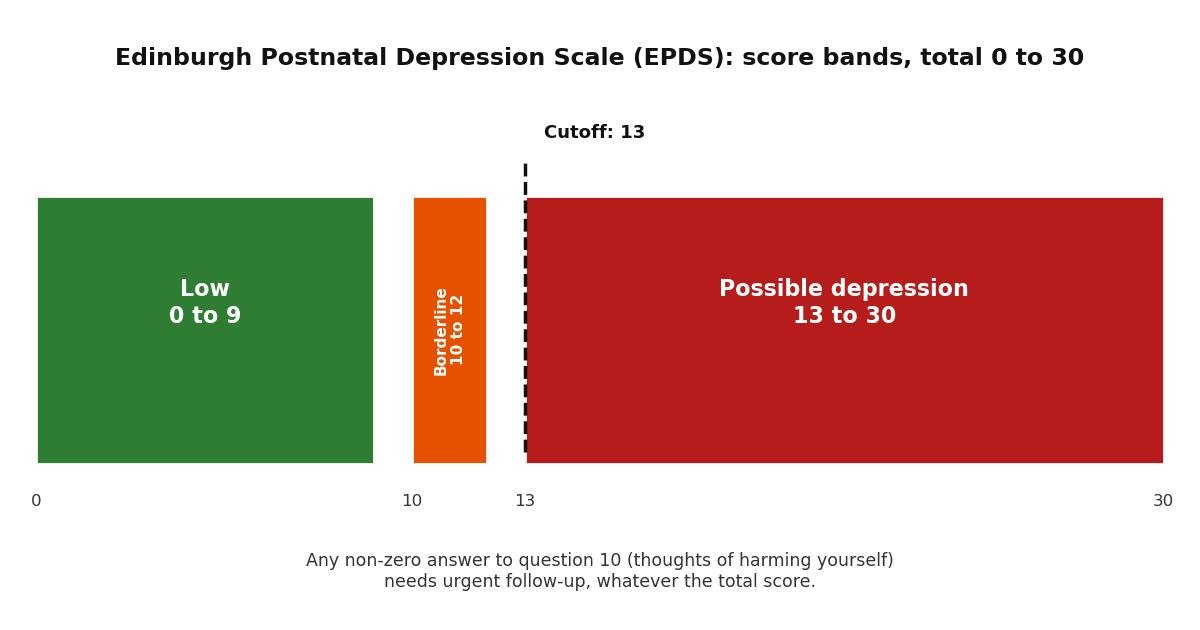
In the original validation study, Cox and colleagues suggested a score of 13 or higher as the threshold indicating likely depression. Scores of 10 to 12 fall in a borderline range: not high enough to meet the original threshold, but high enough to deserve attention, a repeat of the scale after a week or two, and a mention at your next contact with a midwife, GP or health visitor. Scores below 10 fall in the low range. The calculator above follows these bands: 0 to 9 is low, 10 to 12 is borderline, and 13 to 30 indicates possible depression.
Some clinics and guidelines use a slightly lower threshold, such as 10, to make sure fewer cases are missed, because the cost of missing postnatal depression is high. Cutoffs are therefore a clinical judgment rather than a law of nature, and different services may apply them slightly differently. What does not vary is the principle: higher scores mean more depressive symptoms and a greater need for follow-up, and the exact number matters less than what you do with the result.
One rule overrides the total score entirely. Question 10 asks whether the thought of harming yourself has occurred to you. Any answer other than Never to this question is a signal for urgent follow-up, whatever the total. The calculator shows a separate urgent warning in that case, because self-harm thoughts need a prompt, compassionate response on their own, not only as part of a high score.
Understanding your result in context
A low score is reassuring but not a guarantee. The EPDS asks about the past seven days, so it captures a snapshot; mood in the postnatal period can shift quickly as sleep patterns, feeding difficulties, illness or relationship strains come and go. If your score is low today but you feel yourself sliding in the coming weeks, repeat the scale or talk to your midwife or GP. Keeping a note of your scores over time makes it easier to spot a trend.
A borderline score means you are experiencing enough symptoms to take seriously without yet crossing the threshold for likely depression. This is the range where context matters most. A difficult birth, a baby who does not sleep, lack of practical support, financial pressure or conflict at home can all push a score into this range, and addressing those pressures can bring it back down. It is also the range where repeating the scale is most informative: a score that stays borderline or climbs over two weeks is more concerning than one that settles.
A score of 13 or above means the pattern of your answers looks like depression and you should arrange a professional assessment. This does not mean you have been diagnosed; it means a clinician needs to look closer. Bring the score, and if possible your individual answers, to the appointment. Clinicians find it genuinely useful to see which items scored highest, because the pattern guides the conversation: prominent anxiety items suggest a different emphasis than prominent guilt or tearfulness items.
Whatever your score, remember what the number cannot tell you. It cannot identify the cause of your symptoms. A high score could reflect clinical depression, but it could also reflect severe sleep deprivation, an unsupportive or abusive home situation, thyroid problems after delivery, or the normal emotional turbulence of the first weeks. The questionnaire cannot distinguish between these, which is why a score is always the beginning of a conversation with a clinician rather than the end of one.
The self-harm question and when to get urgent help
Question 10 exists because thoughts of harming yourself can occur in postnatal depression and must never be missed. Researchers deliberately placed it last, so that a mother who is already finding the questions difficult is not confronted with it first, but its position does not reduce its importance. If you answered Sometimes, Hardly ever or Yes, quite often, please treat this as urgent: contact your midwife, GP, or local crisis line now, or ask someone you trust to stay with you while you seek help.
It is common to feel frightened or ashamed about these thoughts, and common to worry that admitting them will lead to your baby being taken away. In reality, health professionals hear this disclosure regularly and their first response is to support you, not to punish you. Thoughts of self-harm in the postnatal period are a symptom that responds to treatment, and asking for help is the single most protective step you can take for yourself and your baby. You do not need to wait for a high total score, for a convenient appointment time, or for things to get worse before you reach out.
Using the EPDS during pregnancy
Although the scale was developed for the postnatal period, it is widely used during pregnancy as well, when it is sometimes called the antenatal EPDS. This matters because depression does not wait for the birth: many women who experience postnatal depression were already depressed during pregnancy, and the antenatal period is an important window for identifying them. The questions work the same way in pregnancy, and the scoring and cutoffs are interpreted in the same way.
Depression in pregnancy carries its own risks. It is associated with poorer self-care, reduced attendance at antenatal appointments, and greater difficulties bonding with the baby after birth, and it responds to the same range of treatments used postnatally, adapted for pregnancy. If you are pregnant and your score is elevated, tell your midwife or obstetric team. Support put in place during pregnancy, whether that is talking therapy, practical help, or medication where appropriate, can change the trajectory for both mother and baby.
Some services now use the EPDS routinely at booking or later antenatal visits, alongside questions about anxiety and previous mental health history. If you are offered it, take it as a sign of good care rather than a judgment: screening is how services make sure support reaches the women who need it.
What postnatal depression can look like
Postnatal depression does not always look the way people expect. Sadness and tearfulness are common, but so are irritability, rage that feels out of proportion, numbness or emptiness, and a sense of going through the motions of baby care without feeling anything. Many mothers describe guilt as the dominant emotion: guilt about not enjoying the baby, about not coping as well as other mothers seem to, about resenting the baby or about feeling like a failure. Anxiety is frequently part of the picture too, sometimes focused on the baby's health or safety in ways that feel intrusive and hard to switch off.
It can also show up in the body and in behavior: difficulty concentrating, indecisiveness about small things, withdrawing from friends and family, loss of appetite or comfort eating, and a sense of dread about the day ahead that starts the night before. Some mothers find bonding difficult and feel frightened to admit it; difficulty bonding is a recognized feature of postnatal depression and it usually improves as the depression lifts, which is one more reason to seek help early rather than waiting for feelings to arrive on their own.
It helps to distinguish this from the baby blues, the tearfulness and mood swings that affect many mothers in the first days after birth as hormones shift. The baby blues typically peak around day three to five and fade within two weeks. Postnatal depression lasts longer, feels heavier, and interferes with daily functioning. If low mood persists beyond the first two weeks or is getting worse rather than better, that is the point to complete the EPDS and talk to a professional.
Limitations of the EPDS
The EPDS is a screening instrument, not a diagnostic tool. Screening tools are designed to catch as many true cases as possible, which means they also flag some people who turn out not to be depressed. A positive screen is a signal to look closer, never a diagnosis on its own. Only a clinician who takes a full history, reviews physical health and medications, and applies diagnostic criteria can determine whether someone has depression, an anxiety disorder, severe sleep deprivation, or something else entirely.
The scale has specific blind spots worth knowing. Because it excludes physical symptoms by design, it can underplay depression that presents mainly through bodily complaints, though that pattern is uncommon. Because it asks about the past seven days, a single bad week can inflate the score; repeating the scale after symptoms have had time to settle gives a truer picture. The wording of some items translates unevenly across languages and cultures: concepts like blaming yourself or feeling that things are getting on top of you may carry different weight in different communities, and while many translated versions have been validated, not every language has a validated version.
The scale is also self-report, which means it depends on honesty and insight. Some mothers minimize their symptoms because they fear judgment or intervention, and the EPDS cannot detect that. If your score feels wrong to you, either too high or too low, trust your instinct and discuss it with your clinician anyway. And the EPDS screens for depression, not for other postnatal mental health conditions: postpartum psychosis, for example, is a rare emergency with very different symptoms such as confusion, hallucinations or delusions, and it needs immediate medical attention regardless of any questionnaire score.
What to do after you get your score
If your score is low, treat the questionnaire as a baseline and keep living your life. Stay connected with people who support you, accept practical help when it is offered, sleep when the baby sleeps if you possibly can, and be alert to changes. Repeating the scale in a few weeks, or sooner if circumstances change, gives you an early warning system.
If your score is borderline, take it as a prompt to act early rather than a reason to worry. Talk honestly with your partner, a family member or a friend about how you have been feeling. Look at the practical pressures in your life and see which can be eased: extra hands with night feeds, help with housework, or simply permission to rest. Mention the score to your midwife, GP or health visitor so it is on record, and repeat the scale in one to two weeks to see which direction things are moving.
If your score is 13 or above, book an appointment with your GP, midwife or health visitor and bring the score with you. Effective treatments exist and they work: talking therapies adapted for the postnatal period, structured support, and medication where appropriate and compatible with breastfeeding. Treatment decisions in the postnatal period always weigh benefits against considerations around breastfeeding and infant care, and your clinician will talk these through with you. Postnatal depression is one of the most treatable conditions in medicine, and most mothers recover fully.
Partners and family members have a role too. If someone you love has taken the EPDS and scored highly, the most helpful response is to take the result seriously without catastrophizing: help them book the appointment, offer to go with them, and take on practical tasks so they can rest and attend treatment. Avoid framing it as a personal failing or suggesting they should simply be grateful for a healthy baby; depression does not respond to gratitude, it responds to treatment and support.
Key takeaways
- No.
- In the original validation study by Cox, Holden and Sagovsky (1987), a score of 13 or higher was suggested as the threshold indicating likely depression.
- Seven of the ten items (questions 3 and 5 to 10) are worded negatively, for example blaming yourself, feeling panicky, or feeling sad.
- Yes.
Frequently asked questions
Is the EPDS a diagnosis of postnatal depression?
No. The Edinburgh Postnatal Depression Scale is a screening instrument, not a diagnostic test. It identifies mothers whose symptoms make depression likely and who would benefit from a fuller clinical assessment. A diagnosis requires a face-to-face evaluation by a qualified clinician, who will take a history, consider medical and medication causes, and apply diagnostic criteria.
What score on the EPDS means I might have postnatal depression?
In the original validation study by Cox, Holden and Sagovsky (1987), a score of 13 or higher was suggested as the threshold indicating likely depression. Scores of 10 to 12 fall in a borderline range that also deserves attention and often a repeat of the scale. Some clinical settings use a slightly lower threshold to catch more cases, so always follow your own clinician's guidance.
Why are some EPDS questions scored in reverse?
Seven of the ten items (questions 3 and 5 to 10) are worded negatively, for example blaming yourself, feeling panicky, or feeling sad. On these items the most distressed answer carries the highest score, so the option order is reversed compared with the positively worded items (questions 1, 2 and 4). Mixing positive and negative wording reduces the tendency to tick the same column all the way down without reading, and the calculator applies the published scoring key automatically.
Can I use the EPDS during pregnancy?
Yes. Although the scale was developed for the postnatal period, it is widely used to screen for depression during pregnancy as well, when it is sometimes called the antenatal EPDS. Depression during pregnancy is common and treatable, and identifying it early allows support to be put in place before and after the birth. The scoring and interpretation are the same.
What should I do if I answer anything other than Never to question 10?
Any answer other than Never to question 10, which asks about thoughts of harming yourself, should be treated as a signal for urgent follow-up, whatever your total score. Contact your midwife, GP, or local crisis line promptly, or ask someone you trust to stay with you while you seek help. You do not need to wait for a high total score to ask for help with these thoughts.
How often should I repeat the EPDS?
The EPDS asks about the past seven days, so it reflects a snapshot of how you have been feeling recently. If your score is in the borderline range, repeating the scale after one to two weeks can show whether symptoms are settling or building. Health visitors and midwives often repeat it at routine postnatal contacts. A rising score over time is more concerning than a single borderline result, so keeping your earlier scores to compare is useful.
References and further reading
Sources
- Cox JL, Holden JM, Sagovsky R. Detection of postnatal depression: development of the 10-item Edinburgh Postnatal Depression Scale. British Journal of Psychiatry. 1987;150:782-786.
- Page reviewed for medical accuracy by Dr. Taimoor Asghar, physician and community medicine researcher.