What is the MDQ?
The Mood Disorder Questionnaire, usually shortened to MDQ, is a brief self-report screening questionnaire for bipolar spectrum disorder. It was developed by Robert M. A. Hirschfeld, Janet B. W. Williams, Robert L. Spitzer and colleagues, and published in the American Journal of Psychiatry in 2000. The team created it because bipolar spectrum disorders, which include bipolar I, bipolar II and related conditions, frequently go unrecognised, undiagnosed and untreated. Their aim was a short instrument that could be used in busy clinical settings, especially primary care and general psychiatric clinics, to flag people who might warrant a fuller assessment for bipolar disorder.
The questionnaire focuses on the lifetime history of manic or hypomanic symptoms, the “up” periods that distinguish bipolar disorders from unipolar depression. It asks whether there has ever been a period of time when you were not your usual self, followed by 13 yes or no questions about characteristic experiences: feeling unusually hyper or self-confident, needing much less sleep without missing it, talking faster, racing thoughts, distractibility, high energy, increased activity and sociability, heightened interest in sex, behaviour others might see as excessive or risky, spending sprees, and irritability. These items reflect the DSM-IV criteria for manic and hypomanic episodes, translated into plain language that patients can answer without medical knowledge.
Unlike a casual online quiz, the MDQ is a standardised instrument. The wording of the questions, the two follow-up questions, and the scoring rule are all fixed by the original publication. That standardisation is what makes results comparable: the same answers mean the same thing whether the questionnaire is completed in a clinic or at home, provided it is completed honestly and in the same way. It takes about five minutes to complete, which is why it has been widely adopted in research studies and clinical practice.
The three parts of the questionnaire
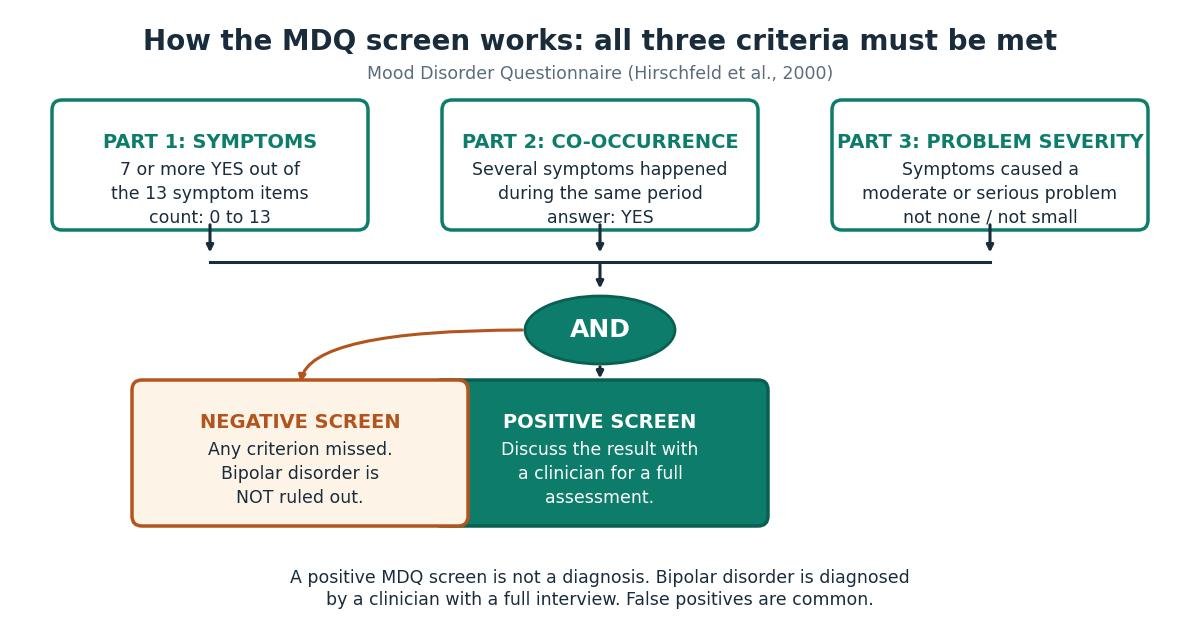
Part 1 contains the 13 symptom items. Each “yes” counts as one point, so the symptom count ranges from 0 to 13. A high count alone is not enough for a positive screen, which is one of the features that separates the MDQ from simpler symptom checklists.
Part 2 is a single yes or no question: if you checked yes to more than one item, have several of these ever happened during the same period of time? This captures clustering, which is clinically essential. Mania and hypomania are defined by symptoms that occur together as an episode, not by isolated experiences scattered across a lifetime. A person who once felt unusually energetic, once spent too much money, and once slept very little, all years apart, has not had a manic episode in the clinical sense.
Part 3 asks how much of a problem any of these caused you, giving examples such as being unable to work, having family, money or legal troubles, or getting into arguments or fights. The four response options are no problem, small problem, moderate problem and serious problem. Only the top two, moderate or serious, count toward a positive screen. This requirement reflects the clinical reality that bipolar disorder is defined by episodes that impair functioning or are noticeable to others, not merely by unusual but harmless high spirits.
How the positive screen works
A positive MDQ screen requires all three conditions to be satisfied at the same time: a symptom count of 7 or more out of 13, a yes answer to the co-occurrence question, and a problem severity rating of moderate or serious. If any one of the three is missing, the screen is negative. Our calculator above applies exactly these rules, so the result you receive matches the scoring of the published instrument.
This strictness is deliberate. Each additional condition trades a little sensitivity for more specificity, which matters because false positive screens are common with bipolar screening instruments. A symptom count of 7 on its own would flag a great many people whose experiences were scattered, mild, or explained by something else. Requiring the symptoms to have clustered in time and to have caused real problems filters out much of that noise. The original authors chose this combination because it gave the best balance of sensitivity and specificity in their validation study.
It is worth noting what the screen does not do. It does not distinguish bipolar I from bipolar II, it does not count how many episodes you have had, and it does not by itself diagnose any condition. It is a triage signal: positive means the pattern deserves a proper clinical look, and negative means the full pattern was not detected this time.
What a positive screen means
A positive screen means your answers match the full pattern the MDQ was designed to detect: at least seven lifetime manic or hypomanic symptoms, clustered in time, that caused moderate or serious problems. It is worth taking seriously, and it is worth discussing with a clinician. It is not, however, a diagnosis of bipolar disorder, and it should never be treated as one.
To understand why, consider the numbers from the original validation study. In a sample of 198 patients attending five outpatient clinics that primarily treat mood disorders, the MDQ cutoff of 7 or more yielded a sensitivity of 0.73 and a specificity of 0.90 when compared with a blinded telephone diagnostic interview using the bipolar module of the Structured Clinical Interview for DSM-IV. A specificity of 0.90 means that about one in ten people without bipolar disorder in that clinical sample still screened positive. In the general population, where bipolar disorder is much less common, the proportion of positive screens that turn out to be false positives is higher still.
A clinician confirming a positive screen will do things no questionnaire can: take a detailed history of distinct mood episodes, ask about family history of mood disorders, review medications and substances that can mimic mania, rule out medical causes such as thyroid disease, and often follow the picture over time before settling on a diagnosis. Bring your MDQ answers to that appointment; they give the clinician a structured starting point for the conversation.
What a negative screen means
A negative screen means the MDQ did not detect the full three-part pattern this time. That is reassuring, but it does not rule bipolar disorder out. No screening instrument catches every case, and the MDQ is known to be less sensitive to bipolar II and milder presentations than to classic bipolar I with full manic episodes. In a UK validation study of 127 outpatients, the instrument detected bipolar I with a sensitivity of 0.83 but bipolar II with a sensitivity of only 0.67 using the standard scoring.
A negative screen can also reflect the strictness of the three-part rule working as designed. Six symptoms with co-occurrence and moderate problems still counts as negative, as does a count of nine without co-occurrence. If your mood symptoms are significant, persistent, or worrying to you or those around you, a negative MDQ result should not stop you from seeking advice. Tell the clinician about your concerns regardless of what this or any other questionnaire says.
Why false positives are common
Bipolar screening instruments produce more false positives than many people expect, and there are several good reasons. First, many MDQ symptoms also occur in other conditions and in ordinary life. High energy, reduced need for sleep, talkativeness, distractibility and irritability can accompany attention deficit hyperactivity disorder, anxiety, substance use, thyroid problems, sleep deprivation, and periods of ordinary stress or enthusiasm. A questionnaire counts the symptom; only a clinician can judge its context.
Second, the severity question requires honest self-assessment of impairment, which is genuinely difficult. Some people minimise real problems, while others rate ordinary friction as serious. Third, screening tools are deliberately tuned to over-flag rather than miss cases: in screening, a false alarm that leads to a conversation is considered less costly than a missed case that never gets assessed.
Finally, the mathematics of screening work against certainty. The lifetime prevalence of bipolar I disorder is approximately 1%, and estimates for the broader bipolar spectrum run around 3 to 6.5%. When a condition is this uncommon, even a test with good specificity will produce many false positives relative to true positives if it is applied broadly. This is why a positive MDQ screen is the beginning of an assessment, not the end of one.
How accurate is the MDQ?
The original validation study by Hirschfeld and colleagues remains the reference point. A total of 198 patients attending five outpatient clinics that primarily treat patients with mood disorders completed the questionnaire, and a research professional blind to the results conducted a telephone research diagnostic interview using the bipolar module of the Structured Clinical Interview for DSM-IV. A screening score of 7 or more items yielded good sensitivity (0.73) and very good specificity (0.90), and the authors concluded that the MDQ is a useful screening instrument for bipolar spectrum disorder in a psychiatric outpatient population.
Later studies found broadly similar but variable performance depending on the setting and population. A UK validation study of 127 sequential outpatients of a specialist affective disorders service reported an overall sensitivity of 0.76 and specificity of 0.86, with good internal consistency (Cronbach’s alpha of 0.91 for the symptom items). The Italian version showed adequate internal consistency (Cronbach’s alpha of 0.79) and test-retest reliability (kappa of 0.64). A review of validation studies summarised sensitivity ranging from 0.60 to 0.71 and specificity from 0.77 to 0.97 across settings, confirming that performance is solid but not uniform.
Some researchers have experimented with modified scoring, for example lowering the symptom threshold or dropping the impairment question, to improve detection of bipolar II disorder. These variants trade specificity for sensitivity and are research proposals, not the standard. Our calculator uses the original, standard three-part scoring exactly as published.
Who should consider taking the MDQ?
The MDQ was designed for clinical populations and primary care: people being treated for depression in whom an underlying bipolar component might be missed, people with recurrent mood swings, and people whose family members have bipolar disorder and who recognise similar patterns in themselves. It is validated primarily in adults, so extra caution is needed when interpreting it for adolescents. If you have never had mood symptoms and are simply curious, the questionnaire will most likely return a negative screen, but it cannot certify that you will never develop a mood disorder.
One group deserves special mention: people currently being treated for unipolar depression. Bipolar spectrum disorders frequently go unrecognised in this group because the depressive episodes bring people to care while the hypomanic periods do not. A positive MDQ screen in someone with recurrent depression is exactly the situation the instrument was built for, and it is worth raising with the treating clinician, since the treatment approach can differ.
The MDQ compared with other bipolar screens
The MDQ is not the only brief bipolar screen. The Hypomania Checklist, usually in its 32-item form (HCL-32), asks about behaviours and feelings during a period of being in a “high” mood, with a standard cutoff of 14 or more endorsed items. Unlike the MDQ, it does not require co-occurrence or functional impairment for its standard scoring. The Bipolar Spectrum Diagnostic Scale (BSDS) takes a different approach again, presenting paragraph descriptions of the bipolar experience. Researchers have compared these instruments head to head in depressed primary care patients and sometimes combined them to improve detection.
The practical difference is emphasis. The MDQ is the shortest of the three to complete and the strictest in its positive-screen rule, because it demands symptoms, clustering and impairment together. The HCL-32 casts a wider net and is more sensitive to milder hypomanic features but produces more false positives. None of them diagnoses bipolar disorder; each is a different way of deciding who deserves a full clinical assessment.
After a positive screen: what happens next
If your screen is positive, the next step is a conversation with your GP or a mental health professional, not self-diagnosis and not self-treatment. Bring your answers, including which items you endorsed and how you rated the problem severity. The clinician will want to know about distinct periods of elevated or irritable mood, how long they lasted, what others noticed, any family history of mood disorders or suicide, current medications and substances, and medical history.
Do not start, stop or change any medication on the basis of a screening result. Antidepressants prescribed for unipolar depression are sometimes reconsidered when bipolarity is suspected, but that is a decision for a clinician with the full picture, not for a questionnaire result. Diagnosis of bipolar disorder often takes time and may require observing the pattern across months; a single appointment sometimes ends with “let us watch this” rather than a label, and that is good practice, not evasion.
Tips for answering accurately
Keep the lifetime frame in mind: the questions ask whether there has ever been such a period, not how you feel this week. The key phrase is “not your usual self”; answer for times when you were clearly different from your baseline, as you or others would describe it. Go with your first instinct rather than analysing each question at length, and be as honest as you can about the problem severity question, which is often the hardest to judge. If you are unsure about an item, answer based on your clearest memory rather than guessing. There are no trick questions and no better answers; the value of the MDQ comes entirely from honest answers.
When to seek help urgently
Regardless of your MDQ result, seek urgent help if you ever feel you might act on thoughts of harming yourself or someone else, if you are in crisis, or if someone you trust is worried about your immediate safety. Contact your local emergency number or crisis service without delay. A screening questionnaire is never a substitute for urgent care, and you do not need a positive screen or any particular score to deserve help in a crisis.
Key takeaways
- The Mood Disorder Questionnaire measures the lifetime history of manic or hypomanic symptoms, the 'up' periods that characterise bipolar spectrum disorders.
- No.
- All three MDQ criteria must be met at the same time: (1) a symptom count of 7 or more out of the 13 items, (2) a yes answer to the question about whether several symptoms happened during the same period of time, and (3) a problem severity rating of 'moderate problem' or 'serious problem'.
- In the original validation study of 198 patients at five outpatient clinics, a score of 7 or more yielded a sensitivity of 0.73 and a specificity of 0.90 against a structured clinical interview.
Frequently asked questions
What does the MDQ measure?
The Mood Disorder Questionnaire measures the lifetime history of manic or hypomanic symptoms, the “up” periods that characterise bipolar spectrum disorders. Its 13 yes/no items cover experiences such as feeling unusually hyper or self-confident, needing much less sleep, talking faster, racing thoughts, distractibility, high energy, increased activity and sociability, heightened interest in sex, risky or excessive behaviour, spending sprees, and irritability. Two further questions ask whether the symptoms clustered in the same period and how much of a problem they caused.
Is the MDQ a diagnosis of bipolar disorder?
No. The MDQ is a screening instrument, not a diagnostic tool. It flags people whose symptom pattern suggests that a fuller clinical assessment for bipolar disorder is warranted. Bipolar disorder can only be diagnosed by a qualified clinician through a full interview, history, and often follow-up over time. False positive screens are common, so a positive result must never be treated as a diagnosis.
What counts as a positive MDQ screen?
All three MDQ criteria must be met at the same time: (1) a symptom count of 7 or more out of the 13 items, (2) a yes answer to the question about whether several symptoms happened during the same period of time, and (3) a problem severity rating of “moderate problem” or “serious problem”. If any one of these three is missing, the screen is negative. This three-part rule comes from the original validation study by Hirschfeld and colleagues.
How accurate is the MDQ?
In the original validation study of 198 patients at five outpatient clinics, a score of 7 or more yielded a sensitivity of 0.73 and a specificity of 0.90 against a structured clinical interview. Later studies found broadly similar but variable performance; a UK study of 127 patients reported sensitivity of 0.76 and specificity of 0.86, with better detection of bipolar I than bipolar II. Accuracy depends on the population tested and on honest answers.
Can the MDQ give a wrong result?
Yes, in both directions. False positives are common: symptoms such as high energy, reduced need for sleep, talkativeness, and irritability also occur in other conditions and in ordinary life, and screening tools are deliberately tuned to over-flag rather than miss cases. False negatives also happen, especially for bipolar II and milder presentations, which the MDQ detects less reliably. A negative screen therefore does not rule bipolar disorder out.
What should I do with my MDQ result?
If your screen is positive, discuss the result with your GP or a mental health professional and bring your answers so they can be reviewed properly. Do not start, stop, or change any medication on the basis of a screen. If your screen is negative but your mood symptoms concern you, still seek advice: a clinician can assess what the questionnaire cannot. If you ever feel you might act on thoughts of harming yourself, seek urgent help immediately through your local emergency number or crisis service.
References
Hirschfeld RMW, Williams JBW, Spitzer RL, et al. Development and validation of a screening instrument for bipolar spectrum disorder: the Mood Disorder Questionnaire. Am J Psychiatry. 2000;157(11):1873-1875. This is the original publication defining the 13 symptom items, the co-occurrence and problem severity questions, the three-part positive screen rule (7 or more symptoms, co-occurrence, moderate or serious problem), and the validation results (198 patients at five outpatient clinics; sensitivity 0.73, specificity 0.90 against the bipolar module of the Structured Clinical Interview for DSM-IV).
Twiss J, Jones S, Anderson I. Validation of the Mood Disorder Questionnaire for screening for bipolar disorder in a UK sample. J Affect Disord. 2008;110(1-2):180-184. Validation in 127 outpatients of a UK specialist affective disorders service: overall sensitivity 0.76, specificity 0.86, higher sensitivity for bipolar I (0.83) than bipolar II (0.67), and good internal consistency (Cronbach’s alpha 0.91).
Zimmerman M, Galione JN. Screening for bipolar disorder: confusion between case-finding and screening. Psychopathology. 2014;83(5):259-266. Review noting that the MDQ authors recommended the cutoff of 7 co-occurring symptoms causing moderate or serious problems because it yielded the best combination of sensitivity (73%) and specificity (90%).
Carta MG, Hardoy MC, Cadeddu M, et al. The accuracy of the Italian version of the Mood Disorder Questionnaire (MDQ) for the screening of bipolar disorders. Clin Pract Epidemiol Ment Health. 2006;2:5. Validation of the Italian MDQ reporting adequate internal consistency (Cronbach’s alpha 0.79) and test-retest reliability (kappa 0.64).