WHO-5 Well-Being Test
In short: Take the WHO-5 Well-Being Index: 5 questions about the last 2 weeks, scored 0 to 100. Learn what your score means, why a score of 50 or below suggests poor well-being, and when a change of 10 points or more is clinically significant. Use the calculator above, then read the guide below to interpret your result and its limitations.
Instructions: For each statement, choose the answer that best describes how you have been feeling over the last 2 weeks.
1. I have felt cheerful and in good spirits.
2. I have felt calm and relaxed.
3. I have felt active and vigorous.
4. I woke up feeling fresh and rested.
5. My daily life has been filled with things that interest me.
What the WHO-5 Well-Being Index is
The WHO-5 Well-Being Index is a short, generic questionnaire developed by the World Health Organization to measure subjective well-being. It contains only five statements, all positively worded, and asks you to rate each one for the last 2 weeks on a scale from 0 (at no time) to 5 (all of the time). The five statements cover feeling cheerful and in good spirits, feeling calm and relaxed, feeling active and vigorous, waking up feeling fresh and rested, and having a daily life filled with things that interest you. Because every question is phrased positively, the questionnaire is quick to complete and tends to feel less intrusive than instruments that ask directly about symptoms such as sadness or hopelessness.
The instrument has been studied extensively. A systematic review by Topp, Ostergaard, Sondergaard and Bech, published in Psychotherapy and Psychosomatics in 2015, examined the literature on the WHO-5 and concluded that it is a valid screening tool for depression in clinical practice. Its brevity is a deliberate design choice: a busy general practitioner can hand it out, score it in under a minute, and use the result as the starting point for a deeper conversation. It has been translated into many languages and used in general practice, psychiatry, primary care research, and population studies, which means a score obtained today can be compared with results from very different settings.
It helps to understand what the WHO-5 is not. It is not a diagnostic questionnaire for depression, and it is not a symptom checklist. It measures the positive side of mental health: cheerfulness, calm, energy, restfulness, and interest. That choice reflects an important idea in public health, namely that health is more than the absence of disease. Two people can both be free of any diagnosable disorder and still report very different levels of well-being, and the WHO-5 is designed to capture exactly that difference.
How the 0 to 100 percentage score works
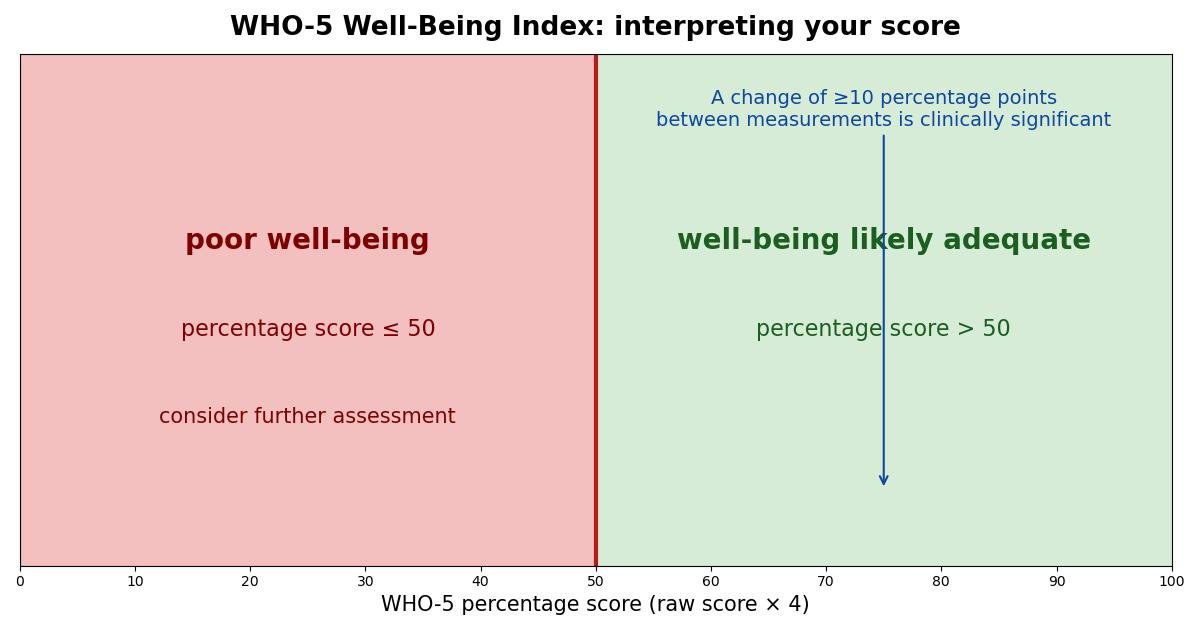
Scoring the WHO-5 takes three steps. First, add the five answers together. Each answer runs from 0 to 5, so the raw total runs from 0 to 25. Second, multiply that raw total by 4. This gives the percentage score, which runs from 0 to 100. Third, interpret the result: a percentage score of 50 or below suggests poor well-being and warrants further assessment, and a change of 10 points or more between two measurements is considered clinically significant.
The multiplication by 4 is a scoring convention, not a calculation that discovers anything new. A raw total of 13 becomes a percentage score of 52; a raw total of 12 becomes 48. The underlying information is identical in both forms. The reason the instrument's scoring instructions specify the multiplication is practical: most people, and most clinicians, find a 0 to 100 scale easier to read at a glance than a 0 to 25 scale. A score of 48 is immediately understood as sitting just below the halfway mark, whereas a raw score of 12 needs an extra mental step to place. It also makes change over time easier to discuss: saying a patient moved from 48 to 60 communicates progress more plainly than saying they moved from 12 to 15.
Calling it a percentage score does not mean it is a percentage of anything absolute. It is not 52 percent of your maximum possible happiness, and it does not mean you are experiencing 52 percent of the well-being a person could have. It is simply the raw score rescaled onto a 0 to 100 range. This matters because people sometimes treat the number as a precise physical measurement, like blood pressure. It is not. It is a summary of five subjective ratings, and its value lies in the thresholds and the changes attached to it, not in the decimal places.
Two numbers on this page deserve emphasis because they are the ones clinicians actually use. The first is 50: scores at or below this level suggest poor well-being and warrant further assessment. Note the direction of the comparison. A score of exactly 50 falls in the group that warrants further assessment, because the convention is 50 or below, not below 50. The second number is 10: a difference of 10 percentage points or more between two measurements, for example from 48 to 58, or from 64 down to 52, is regarded as clinically significant. A change of 9 points does not meet that threshold. These are the two fixed reference points in the instrument's interpretation, and every result page on this site is built around them.
What a low score means, and what it does not mean
A percentage score of 50 or below suggests poor well-being over the last 2 weeks and warrants further assessment. The word suggests is doing important work in that sentence. A low score is a signal, not a verdict. In screening studies reviewed by Topp and colleagues in 2015, low WHO-5 scores tracked closely with depression, which is why clinicians treat the threshold as a flag that deserves follow-up. But many things besides depression can lower a score: a bad fortnight at work, a period of poor sleep, grief, a physical illness, or simply an unusually honest answer to the question about waking up feeling fresh and rested.
The WHO-5 is used as a depression screening adjunct. An adjunct, in clinical language, is something used alongside the main tools rather than as the main tool itself. A general practitioner might ask a patient to complete the WHO-5 while waiting, see a score of 44, and use that as the opening for a conversation about mood, sleep, and stress. What follows might be a dedicated depression questionnaire, such as the PHQ-9, a clinical interview, or simply a plan to check in again in a few weeks. The WHO-5 opens the door; it does not walk through it on its own.
It is worth stating plainly what a low score does not mean. It does not mean you have depression. It does not mean you need medication. It does not mean anything is wrong with you in a permanent or defining sense. Well-being moves up and down over weeks, and a single measurement is a snapshot of one fortnight, not a portrait of your life. If your score is low and it worries you, the correct response is a conversation with a clinician who can look at the broader picture, not a diagnosis you give yourself from a web page.
Limitations you should know about
No questionnaire captures everything, and the WHO-5 has well-known limitations. The most important is built into its design: because it measures positive well-being, it is not the same thing as the absence of illness. A person can score 80 and still meet the criteria for an anxiety disorder, just as a person can be free of any disorder and score 40 during a difficult month. Well-being and illness are related, but they are not two ends of a single line. The WHO-5 measures one dimension; a full clinical picture needs others.
All five items are positively worded, which creates a second limitation. People tend to agree with positively phrased statements more readily than with negative ones, a tendency researchers call acquiescence bias. This can push scores upward slightly, especially in people who want to present themselves well. The questionnaire asks about the last 2 weeks, so it also depends on memory, and memory of mood is notoriously selective: a bad last few days can colour the whole fortnight, and a good weekend can do the opposite.
A third limitation is the ceiling effect. In healthy populations, many people answer most or all of the time to every item and land at or near 100. That is fine for screening, but it means the instrument cannot register improvement in people who start at the top. If you scored 100 in March and 100 again in June, the questionnaire cannot tell you whether your well-being stayed the same or improved further; there is nowhere higher to go. For this reason, the WHO-5 is most informative in the middle and lower ranges of the scale, where there is room for scores to move.
Finally, response styles differ across cultures and individuals. Some cultures encourage modest, measured answers, while others reward enthusiastic ones. Some people read more than half of the time as a high bar and others as a low one. The numbers 50 and 10 are fixed reference points, but the ratings behind them pass through personal and cultural filters. This does not make the score meaningless; it means a score is most useful when compared with the same person's earlier scores rather than with population averages from a different context.
What to do after a low score
If your percentage score is 50 or below, consider it a prompt rather than a sentence. The instrument's own interpretation says such a score warrants further assessment, and that assessment is a conversation, not a verdict. A sensible next step is to discuss the result with your general practitioner or another clinician, bringing the context the questionnaire cannot see: what has been happening in your life over the last 2 weeks, how you are sleeping, and whether low mood is a new pattern or a familiar one.
A clinician who sees a low WHO-5 score will typically do three things. First, they will ask about your history and current circumstances, because context turns a number into a story. Second, they may use a dedicated depression screening tool, such as the PHQ-9, which asks directly about the diagnostic symptoms of depression. Third, they will agree a plan with you, which might be watchful waiting with a repeat WHO-5 in a few weeks, a referral, a change in lifestyle factors such as sleep and exercise, or treatment if the fuller picture supports it. None of these steps follows automatically from the score alone.
There is one situation in which you should not wait for an appointment. If you are having thoughts of harming yourself, or you feel you may act on them, seek help immediately: contact your local emergency number, a crisis helpline, or go to your nearest emergency department. A questionnaire cannot assess risk, and a low well-being score combined with thoughts of self-harm needs an urgent human response, not a retake in a fortnight.
Tracking your well-being over time
The WHO-5 becomes more valuable when it is used repeatedly. A single score tells you where you stand this fortnight; a series of scores tells you where you are heading. This is where the second of the instrument's two key numbers comes in: a change of 10 percentage points or more between measurements is considered clinically significant. If your score moves from 44 to 56 after starting a new routine, that 12-point gain is large enough to count as a real change rather than day-to-day noise. If it moves from 44 to 50, the 6-point shift falls below the threshold and is better read as roughly flat, even though the number went up.
To make comparisons meaningful, retake the questionnaire under similar conditions. The items ask about the last 2 weeks, so spacing measurements about a month apart gives each one a fresh window. Answering at the same time of day, and not in the middle of an unusually good or bad week if you can help it, reduces the wobble that has nothing to do with your underlying well-being. Keep a simple record: the date, the five answers or at least the percentage score, and a line about what was happening in your life. The numbers are the skeleton; the context is what makes them interpretable months later.
Pay attention to direction as well as size. A 10-point fall, say from 64 to 54, is clinically significant in the downward direction and deserves the same attention as an equivalent rise. It does not diagnose anything, but it is the instrument's way of telling you that something has shifted enough to be worth understanding. Conversely, a flat series of scores around the same level, even if that level is below 50, tells a different story from a falling one: persistence rather than decline. Both patterns are useful information to bring to a clinician.
Finally, remember what the score cannot do. It cannot tell you why your well-being changed, only that it did. The questionnaire has no items about work, relationships, health, or sleep, so the explanation always comes from your own reflection. Use the WHO-5 as a thermometer: it tells you the temperature, and it is up to you, with the help of a clinician if needed, to find out what is causing the fever or the chill.
Key takeaways
- A WHO-5 percentage score of 40 means your raw total was 10 out of 25, rescaled by multiplying by 4.
- No.
- The five items each score 0 to 5, giving a raw total of 0 to 25.
- The WHO-5 asks about the last 2 weeks, so retaking it every 2 to 4 weeks gives a meaningful trend.