What is the PCL-5?
The PTSD Checklist for DSM-5, usually shortened to PCL-5, is a 20-item self-report questionnaire that assesses the presence and severity of post-traumatic stress disorder symptoms. It was developed by Weathers, Litz, Keane, Palmieri, Marx and Schnurr and published by the National Center for PTSD in 2013. Its purpose was straightforward: the previous version, the PTSD Checklist for DSM-IV, no longer matched the diagnostic criteria after the fifth edition of the Diagnostic and Statistical Manual of Mental Disorders reorganised PTSD into four symptom clusters, so the checklist had to be rebuilt to match.
Each of the 20 items corresponds directly to one of the 20 PTSD symptoms described in DSM-5. The person completing it rates how much they have been bothered by each symptom over the past month, and the answers are used in three ways: to screen for PTSD, to support a provisional PTSD diagnosis, and to monitor symptom change during and after treatment. Because it is self-administered and takes only 5 to 10 minutes, it is widely used in clinics, research studies, and by people who want a structured way to understand their own symptoms.
The measure comes in three formats: a version without a Criterion A section, a version with an extended Criterion A assessment, and a version combined with the Life Events Checklist for DSM-5 (LEC-5) and an extended Criterion A assessment. The version on this page is the standard 20-item symptom checklist: it asks about your reactions to the stressful experience without the separate trauma-history preamble. The scale is in the public domain, published by the National Center for PTSD, and may be used without permission.
How the PCL-5 is scored
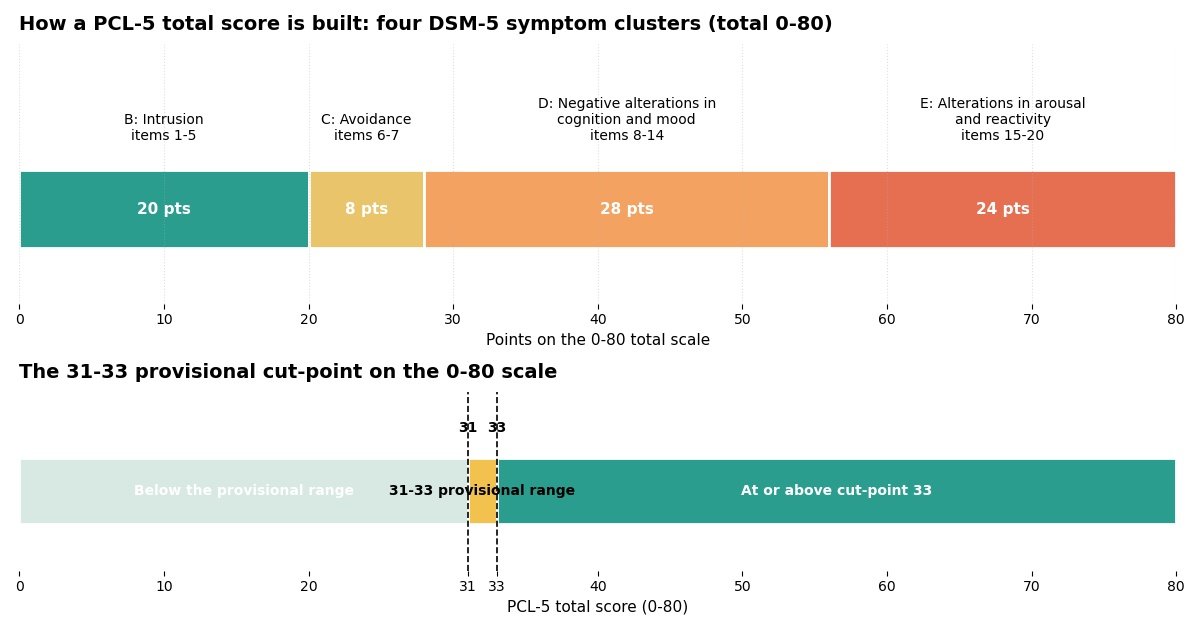
Every item is scored on a five-point scale: 0 for "Not at all", 1 for "A little bit", 2 for "Moderately", 3 for "Quite a bit", and 4 for "Extremely". Your total severity score is simply the sum of all 20 item scores, which gives a range from 0 to 80. There is no weighting and no complicated formula: every symptom counts equally toward the total. Our calculator above applies exactly these rules, so the result you receive matches the scoring of the published instrument.
The National Center for PTSD describes three main ways of using the score. The first is the total severity score itself, which quantifies how bothered you have been overall. The second is a cut-point on that total, with scores of 31 to 33 indicating probable PTSD. The third is the set of DSM-5 symptom cluster severity scores, obtained by summing the items within each cluster, plus a provisional diagnosis method that counts how many items in each cluster reach a rating of 2 or higher. This page gives you all three: the total, the cut-point interpretation, and the cluster breakdown with the provisional rule check.
One thing worth stating plainly is what the official guidance does not provide. The National Center for PTSD has not published official severity ranges for the PCL-5, so any website that labels fixed bands such as "mild", "moderate" or "severe" with specific PCL-5 numbers is adding its own invention. The established interpretations are the 31-33 cut-point range, the cluster scores, and the provisional diagnostic rule described below. This calculator sticks to those three and does not invent severity bands.
The four DSM-5 symptom clusters
DSM-5 groups PTSD symptoms into four clusters, and the PCL-5 maps its items onto them in fixed positions. Each cluster can be scored separately, which helps show which symptom domains are most prominent for a given person. The clusters and their items are:
| Cluster | Items | Score range | What it covers |
|---|---|---|---|
| B: Intrusion | 1 to 5 | 0 to 20 | Re-experiencing the trauma: intrusive memories, disturbing dreams, flashbacks, and emotional or physical reactions to reminders. |
| C: Avoidance | 6 to 7 | 0 to 8 | Avoidance of trauma-related thoughts, feelings, and external reminders such as people, places, or situations. |
| D: Negative alterations in cognition and mood | 8 to 14 | 0 to 28 | Negative beliefs, distorted blame, persistent negative emotions, loss of interest, detachment, and inability to feel positive emotions. |
| E: Alterations in arousal and reactivity | 15 to 20 | 0 to 24 | Irritability, reckless behaviour, hypervigilance, exaggerated startle response, concentration problems, and sleep disturbance. |
Cluster subscores are useful beyond screening. A high arousal and reactivity score with a low avoidance score looks very different in practice from the reverse pattern, and treatment can be shaped accordingly. Tracking the four clusters separately over time can also reveal which symptom domains are responding to treatment and which are not, even when the total score is moving slowly.
What the 31-33 cut-point means
Initial research suggests that a PCL-5 cut-point score between 31 and 33 is indicative of probable PTSD across samples, and the developers of the measure suggest 33 as the commonly used cut-point. In other words, a total of 33 or above is the standard threshold at which a fuller clinical evaluation for PTSD is recommended.
This range comes from validation studies that compared PCL-5 scores against the gold-standard structured interview, the Clinician-Administered PTSD Scale for DSM-5 (CAPS-5). In a study by Bovin and colleagues, cutoffs of 31 to 33 showed the best diagnostic utility for predicting CAPS-5 diagnoses, with no difference between the three scores: sensitivity of 0.88, specificity of 0.69, and overall efficiency of 0.80. A separate English and French validation study by Ashbaugh and colleagues found that a score of 31 in the English sample and 32 in the French sample best categorised participants as having or not having probable PTSD.
The National Center for PTSD also notes that the population and the purpose of screening may warrant different cutoffs. A lower cut-point should be considered when screening or when it is desirable to maximise detection of possible cases, because catching more potential cases matters most. A higher cut-point should be considered when attempting to make a provisional diagnosis or to minimise false positives, because being wrong in that direction is more costly. This page presents the result as a range for that reason: a score of 32 sits inside the provisional range even though it is just below the commonly used cut-point of 33.
Whatever your total, the meaning of crossing the threshold is the same: probable PTSD that warrants professional evaluation, not confirmed PTSD. Screening cutoffs are deliberately set to catch most people who might need help, which means some people above the cutoff will turn out not to have PTSD when assessed in detail, and some below it may still be struggling. The score is a flag, not a verdict.
The provisional DSM-5 diagnosis rule
Alongside the total-score cut-point, the National Center for PTSD describes a second way to reach a provisional PTSD diagnosis. Each item rated as 2 (Moderately) or higher is treated as an endorsed symptom, and then the DSM-5 diagnostic rule is applied: at least 1 intrusion item (questions 1 to 5), at least 1 avoidance item (questions 6 to 7), at least 2 negative cognition and mood items (questions 8 to 14), and at least 2 arousal and reactivity items (questions 15 to 20).
Why two methods? Because they answer slightly different questions. The cut-point method asks how severe the overall burden is. The cluster rule asks whether the pattern of symptoms matches the DSM-5 structure of PTSD. A person can have a high total but fail the cluster rule, for example if all their symptoms sit in only two of the four clusters, and that mismatch is itself clinically informative. When Bovin and colleagues applied this rule to the PCL-5, they found good agreement with CAPS-5 diagnoses: sensitivity of 0.81, specificity of 0.71, and overall efficiency of 0.78.
Our calculator runs both checks automatically and shows the endorsed symptom count in each cluster, so you can see exactly which part of the rule is or is not met. Meeting the cluster rule supports a provisional PTSD diagnosis for screening purposes. As with the cut-point, it is an approximation: confirming the diagnosis still requires a structured clinical interview conducted by a qualified professional.
Measuring change over time
One of the most valuable uses of the PCL-5 is as a repeated measure during treatment. Because it always asks about the past month, it can be administered at intake, regularly during treatment, and at discharge to document whether symptoms are genuinely improving.
The National Center for PTSD gives practical guidance for interpreting change. Evidence for the PCL for DSM-IV suggests that a 5 to 10 point change represents reliable change, meaning change not due to chance, and that a 10 to 20 point change represents clinically significant change. The Center therefore recommends using 5 points as a minimum threshold for determining whether a person has responded to treatment and 10 points as a minimum threshold for determining whether the improvement is clinically meaningful. It adds an honest caveat: change scores for the PCL-5 are still being determined, and the recommendation is to follow the DSM-IV guidance until new information is available, since the two measures are expected to behave in a similar range.
For fair comparisons between your own completions, answer under similar conditions each time: the same quiet setting, the same understanding of the response options, and the same "stressful experience" in mind. Small shifts of a point or two can reflect normal month-to-month variation rather than real change, so focus on the overall trend across several completions and on the cluster subscores, which show whether the domains you care about are the ones moving. Most importantly, discuss the pattern with your clinician rather than adjusting anything yourself on the basis of a score.
What the PCL-5 does not tell you
The single most important limitation is also the one the National Center for PTSD states most clearly: the PCL-5 should not be used as a stand-alone diagnostic tool. A formal PTSD diagnosis requires more than symptom counts. It requires a qualifying trauma exposure, symptoms lasting beyond a month, clinically significant distress or impairment, and the exclusion of other causes such as substance use, medication effects, or bereavement. None of that can be established by a 20-question form.
Second, it relies entirely on self-report. Answers can be shaded by mood on the day, by how carefully the questions are read, or by reluctance to admit to certain symptoms. Trauma symptoms also overlap with other conditions: poor concentration and sleep disturbance appear in depression and anxiety too, and negative beliefs about oneself occur across several disorders. A clinician sorts these possibilities out; the checklist cannot.
Third, this page uses the standard symptom-checklist format without the separate trauma-history (Criterion A) section, so it assumes you are answering with a genuinely stressful or traumatic experience in mind. If your worst "stressful experience" does not meet the clinical definition of trauma exposure, the score still reflects real distress worth discussing with a professional, but the PTSD framework fits less directly. Finally, the one-month window is a snapshot: a single very difficult month, such as the aftermath of an accident or a bereavement, can push the score up without reflecting a longer-term disorder.
When to seek professional help
Consider speaking with your GP or another qualified health professional if your total is at or above the 31-33 range, if your symptom pattern meets the provisional cluster rule, if symptoms have persisted beyond a month, or if they are interfering with your work, studies, relationships, or sleep. You do not need to wait until things feel severe: clinicians would much rather see someone early, when trauma symptoms are easier to treat, than late.
Effective, evidence-based treatments for PTSD exist, including trauma-focused talking therapies, and many people recover substantially with proper care. What matters most is taking the first step of raising the topic with a professional who can assess you properly and guide you to the right support. If you ever feel you might act on thoughts of harming yourself, treat it as an emergency and seek urgent help immediately through your local emergency number or crisis service.
Tips for answering accurately
Keep the one-month time frame firmly in mind: the questions ask about recent experience, not about how you are in general or how you were years ago. Answer with the same stressful experience in mind for all 20 items, ideally the most distressing one you have been through. Go with your first instinct rather than analysing each question at length, and answer for yourself, not for how you think you should feel. There are no trick questions and no "better" answers. The value of the PCL-5 comes entirely from honest answers, so a quickly and truthfully completed checklist is far more useful than a carefully optimised one.
Key takeaways
- The PCL-5 measures the presence and severity of the 20 post-traumatic stress disorder symptoms defined in DSM-5.
- No.
- Research suggests a cut-point of 31 to 33 indicates probable PTSD across samples, and the measure's developers suggest 33 as the commonly used cut-point.
- The provisional DSM-5 method treats any item rated 2 (Moderately) or higher as an endorsed symptom, then requires a specific pattern: at least 1 intrusion item (questions 1-5), at least 1 avoidance item (questions 6-7), at least 2 negative cognition and mood items (questions 8-14), and at least 2 arousal and reactivity items (questions 15-20).
Frequently asked questions
What does the PCL-5 measure?
The PCL-5 measures the presence and severity of the 20 post-traumatic stress disorder symptoms defined in DSM-5. Its 20 items cover the four DSM-5 symptom clusters: intrusion (items 1-5), avoidance (items 6-7), negative alterations in cognition and mood (items 8-14), and alterations in arousal and reactivity (items 15-20). Each item is rated 0 to 4 for the past month, giving a total severity score from 0 to 80. It is used to screen for PTSD, support a provisional PTSD diagnosis, and monitor symptom change over time.
Is a high PCL-5 score a PTSD diagnosis?
No. The PCL-5 is a screening instrument, not a diagnostic test. A score at or above the cut-point, or a cluster-rule pattern, only indicates probable PTSD and the need for a fuller clinical evaluation. A formal diagnosis of PTSD requires a clinical interview by a qualified professional covering the qualifying trauma exposure, symptom duration, functional impairment, and the exclusion of other causes. The National Center for PTSD states explicitly that the PCL-5 should not be used as a stand-alone diagnostic tool.
What does a PCL-5 score of 31 to 33 mean?
Research suggests a cut-point of 31 to 33 indicates probable PTSD across samples, and the measure's developers suggest 33 as the commonly used cut-point. In a study comparing the PCL-5 against the gold-standard Clinician-Administered PTSD Scale (CAPS-5), cutoffs of 31-33 showed sensitivity of 0.88, specificity of 0.69, and overall efficiency of 0.80. A score in this range means further clinical evaluation is recommended, not that PTSD is confirmed. Lower cutoffs may be chosen when screening to maximise detection; higher cutoffs when a provisional diagnosis is being made and false positives should be minimised.
What is the provisional DSM-5 cluster rule on the PCL-5?
The provisional DSM-5 method treats any item rated 2 (Moderately) or higher as an endorsed symptom, then requires a specific pattern: at least 1 intrusion item (questions 1-5), at least 1 avoidance item (questions 6-7), at least 2 negative cognition and mood items (questions 8-14), and at least 2 arousal and reactivity items (questions 15-20). Meeting this pattern supports a provisional PTSD diagnosis for screening purposes. Like the total-score cut-point, it is an approximation and does not replace a structured clinical interview.
Can the PCL-5 be used to track treatment progress?
Yes. The PCL-5 is widely used to monitor PTSD symptoms during and after treatment. Following National Center for PTSD guidance, a change of at least 5 points is treated as reliable change (not due to measurement error), and a change of at least 10 points as clinically meaningful improvement. Because definitive PCL-5 change benchmarks are still being studied, the Center recommends using these thresholds, originally derived for the DSM-IV version, until new information is available. Retake the checklist under similar conditions and discuss changes with your clinician.
Who developed the PCL-5?
The PCL-5 was developed by Weathers, Litz, Keane, Palmieri, Marx and Schnurr and published by the National Center for PTSD in 2013 as an update of the PTSD Checklist for DSM-IV, revised to match the 20 PTSD symptoms of DSM-5. It is in the public domain and available from the National Center for PTSD. The full citation is: Weathers FW, Litz BT, Keane TM, Palmieri PA, Marx BP, Schnurr PP. The PTSD Checklist for DSM-5 (PCL-5). National Center for PTSD, 2013.
References
Weathers FW, Litz BT, Keane TM, Palmieri PA, Marx BP, Schnurr PP. The PTSD Checklist for DSM-5 (PCL-5). National Center for PTSD, 2013. This is the primary citation defining the 20 items, the 0 to 4 response scale, the past-month time frame, and the 0 to 80 total score.
VA National Center for PTSD. Using the PTSD Checklist for DSM-5 (PCL-5). Fact sheet, 2017. The official scoring and interpretation guidance: the 31 to 33 cut-point range, the provisional DSM-5 cluster rule (at least 1 intrusion, 1 avoidance, 2 cognition and mood, and 2 arousal items rated 2 or higher), and the guidance that a 5-point change represents reliable change and a 10-point change represents clinically meaningful improvement.
Bovin MJ, Marx BP, Weathers FW, Gallagher MW, Sloan DM, Schnurr PP. Psychometric properties of the PTSD Checklist for Diagnostic and Statistical Manual of Mental Disorders-Fifth Edition (PCL-5) in veterans. Psychological Assessment. 2016. Reported cutoffs of 31-33 as showing the best diagnostic utility against the CAPS-5 (sensitivity 0.88, specificity 0.69, overall efficiency 0.80) and good agreement for the provisional cluster rule (sensitivity 0.81, specificity 0.71, overall efficiency 0.78).
Blevins CA, Weathers FW, Davis MT, Witte TK, Domino JL. The Posttraumatic Stress Disorder Checklist for DSM-5 (PCL-5): Development and initial psychometric evaluation. Journal of Anxiety Disorders. 2015. Initial development and psychometric evaluation of the PCL-5.
Ashbaugh AR, Houle-Johnson S, Herbert C, El-Hage W, Brunet A. Psychometric validation of the English and French versions of the Posttraumatic Stress Disorder Checklist for DSM-5 (PCL-5). PLoS ONE. 2016. Found optimal cutoffs of 31 (English sample) and 32 (French sample) for categorising probable PTSD.