What is the PHQ-9?
The Patient Health Questionnaire-9, usually shortened to PHQ-9, is a nine-item questionnaire that measures the severity of depressive symptoms. It was developed by Robert L. Spitzer, Kurt Kroenke, and Janet B. W. Williams, and published in 2001 in the Journal of General Internal Medicine. The instrument grew out of the PRIME-MD, a clinician-administered interview for detecting mental disorders in primary care; the PHQ-9 is the self-report depression module of that system, designed so that patients can complete it on their own in a few minutes.
Each of the nine questions matches one of the nine diagnostic criteria for a major depressive episode in the DSM-IV, the edition of the psychiatric diagnostic manual current at the time. The person completing it rates how often they have been bothered by each symptom over the last two weeks: not at all (0 points), several days (1 point), more than half the days (2 points), or nearly every day (3 points). The nine item scores are added together to give a total between 0 and 27.
The original validation study tested the PHQ-9 in 6,000 patients attending eight primary care clinics and seven obstetrics and gynecology clinics. The total score tracked closely with diagnoses of major depression made by independent mental health professionals, and the instrument proved useful both for screening and for grading how severe a person's depression was. Since then it has become one of the most widely used depression measures in primary care and in research, valued because it is brief, free to use, and easy to score.
Understanding your score: the five severity bands
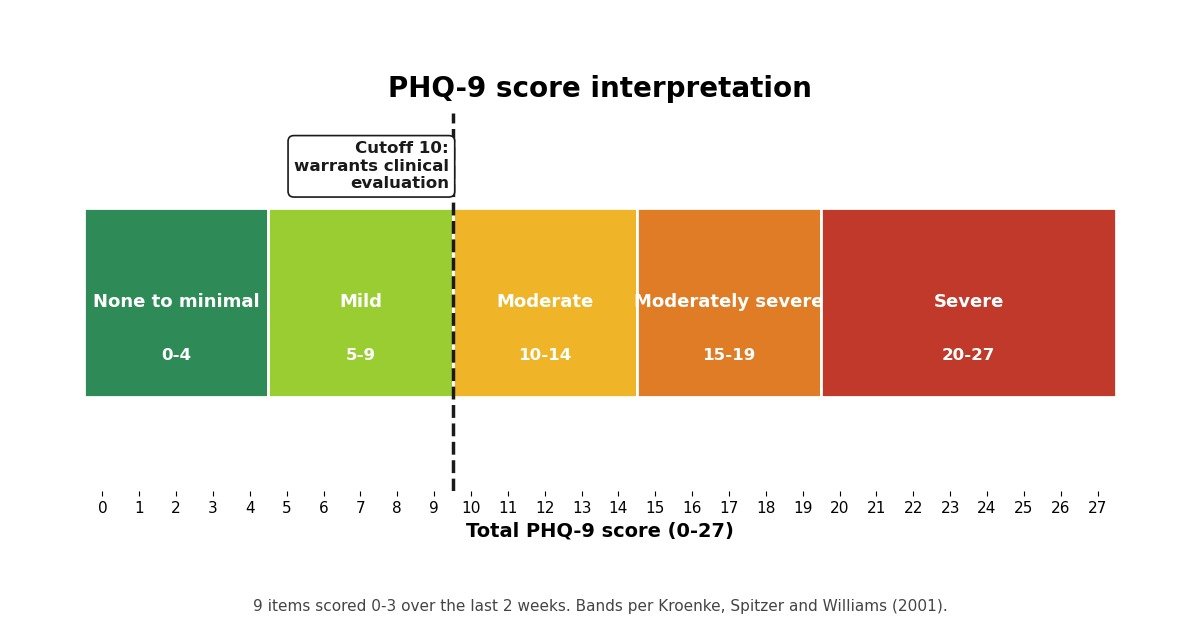
The authors proposed cut points at 5, 10, 15, and 20, dividing the 0 to 27 scale into five severity bands. Here is what each band means in plain language.
0 to 4, none to minimal. You reported few or no depressive symptoms over the last two weeks. Most people in this range are not experiencing depression, and no specific action is usually needed beyond the habits that support general wellbeing: regular sleep, physical activity, and staying connected to other people.
5 to 9, mild. You reported some depressive symptoms, but at a low level. At this level the original paper suggested watchful waiting: keeping an eye on how you feel and repeating the PHQ-9 at a follow-up visit to see whether the score is changing. If the symptoms are new, distressing, or getting worse, it is still worth mentioning them to your doctor.
10 to 14, moderate. Your symptoms are at a level where clinicians usually consider a treatment plan. In the original study this meant counseling, scheduled follow-up, and possibly medication, decided together with a clinician based on your history and preferences.
15 to 19, moderately severe. Symptoms at this level usually warrant active treatment, most often medication, psychotherapy, or both. A clinician will want to see you to work out the best plan and to monitor how you respond.
20 to 27, severe. Scores in this range indicate a high burden of symptoms. The original paper recommended immediate initiation of treatment and expedited referral to a mental health specialist. If you score in this range, please arrange to speak with a clinician promptly rather than waiting.
These band descriptions and the suggested responses come from the original validation study. They are guides for clinicians, not instructions for self-treatment: the right course of action always depends on your full clinical picture, which a questionnaire alone cannot capture.
The cutoff of 10: how clinicians use it
In everyday clinical practice, a score of 10 or above is the most commonly used threshold for deciding that a fuller evaluation for depression is warranted. In the 2001 validation study, this cutoff identified major depression with a sensitivity of about 88 percent and a specificity of about 88 percent.
Those two numbers are worth unpacking. A sensitivity of 88 percent means that out of every 100 people who truly had major depression, about 88 scored 10 or higher; the remaining 12 were missed by the screen. A specificity of 88 percent means that out of every 100 people who did not have major depression, about 88 scored below 10; the remaining 12 were false alarms.
No screening test is perfect, and the PHQ-9 is no exception. A score of 10 or more does not prove that someone has depression, and a score below 10 does not prove that they do not. What the cutoff does is sort people efficiently: those at or above it are the ones a clinician should assess more closely, while those below it are less likely, though not guaranteed, to need that assessment. That is why guidelines treat the PHQ-9 as the start of a clinical conversation, never as its conclusion.
What a high score does and does not mean
A high PHQ-9 score means that you reported a substantial burden of depressive symptoms over the last two weeks, and that a professional evaluation is advisable. It does not mean that you have been diagnosed with depression. A diagnosis of major depressive disorder requires a clinical interview in which a trained professional confirms the pattern, duration, and impact of your symptoms, and rules out other explanations.
Under the DSM framework on which the PHQ-9 is based, a diagnosis requires five or more of the nine symptoms, including either depressed mood or loss of interest or pleasure, present for at least two weeks and representing a change from how the person usually functions. The symptoms must cause significant distress or interfere with daily life, and they must not be better explained by a medical condition, a medication, or substance use. A questionnaire cannot establish any of that on its own; only a clinician talking with you can.
The reverse is equally important. A low score does not guarantee that you are free of depression. The PHQ-9 captures the last two weeks only, so it can miss a depressive episode that is just beginning or one that has recently lifted. Some people also under-report their symptoms because of stigma or because they have grown used to feeling low. If you are struggling despite a low score, that struggle is still real, and it is still worth raising with a clinician. Trust how you feel, not only what a number says.
Limitations of the PHQ-9
The PHQ-9 is a strong instrument, but it has real limits that anyone interpreting a score should understand.
First, several of its items ask about physical symptoms: sleep problems, fatigue, appetite changes, and trouble concentrating. These symptoms overlap with many medical conditions, including thyroid disorders, anemia, sleep apnea, chronic pain, and the side effects of common medications. A person with an untreated thyroid problem can score highly on the PHQ-9 without being depressed, which is one reason a clinician will often check for medical causes before settling on a diagnosis.
Second, the way people describe emotional distress varies across cultures. In some cultural contexts, depression is expressed more through physical complaints than through statements about mood, which can shift scores in ways the instrument was not designed for. Translations of the PHQ-9 exist in many languages, but a score should always be interpreted with the person's cultural background in mind.
Third, the PHQ-9 is a self-report measure, and self-reports can be biased in both directions. Some people minimize their symptoms because of stigma or because they do not want to worry others; some overstate them when they are seeking help or completing the form on a particularly bad day. The score reflects a snapshot, not the whole person.
Fourth, the instrument assumes the reader understands each item as written, so literacy, language fluency, and cognitive difficulties can all affect the result.
Finally, the PHQ-9 cannot measure suicide risk on its own. Question 9 asks about thoughts of being better off dead or of hurting yourself, and any score above zero on that item should lead to a timely conversation with a clinician, but a full assessment of risk requires a professional. A zero on question 9, likewise, does not by itself guarantee safety.
What to do after getting your result
If your score is in the mild range or above, the most useful next step is to share the result with a clinician, such as your primary care doctor. Bring the completed questionnaire or simply note your total score and which items you rated highest; clinicians find it helpful to know exactly which symptoms are bothering you most, because treatment can then be targeted.
The PHQ-9 is also widely used as a monitoring tool. Because it takes only a few minutes, clinicians often ask patients to repeat it at follow-up visits to track whether symptoms are improving, staying the same, or worsening during treatment. If you retake it yourself, try to answer about the same two-week window honestly each time, and remember that small shifts of a point or two from one sitting to the next are normal noise rather than meaningful change.
While you arrange professional input, the general habits that support mental health still matter: keeping a regular sleep schedule, getting daylight and movement during the day, limiting alcohol, and staying in contact with people you trust. These habits are supportive, not treatment; they do not replace professional care when your score suggests you need it.
If you scored above zero on question 9, which asks about thoughts of death or self-harm, please do not wait for a routine appointment. Contact your doctor promptly, call a crisis helpline, or go to your nearest emergency department if you feel you might act on these thoughts. Reaching out is a sign of taking the result seriously, and help is available.
PHQ-9 vs PHQ-2: which should you use?
The PHQ-2 is the PHQ-9's shorter sibling. It consists of just the first two PHQ-9 items: little interest or pleasure in doing things, and feeling down, depressed, or hopeless. It was introduced as an ultra-brief screener for settings where even a nine-item questionnaire takes too long, such as a hurried primary care visit; its validity as a two-item depression screener was reported by Kroenke, Spitzer, and Williams in 2003.
The trade-off is straightforward. The PHQ-2 takes under a minute and is good at flagging people who might be depressed, but it cannot grade severity and it cannot track change over time with any precision. Standard practice is therefore to follow a positive PHQ-2 with the full PHQ-9, which adds the remaining seven items and produces the 0 to 27 score that clinicians use to plan and monitor treatment.
For self-assessment at home, where time is not a constraint, the full PHQ-9 is the better choice: it gives you the severity band and the item-level detail that make a follow-up conversation with a clinician far more productive.
How this calculator scores your answers
This calculator follows the published PHQ-9 scoring exactly. Each of the nine questions is scored 0 for not at all, 1 for several days, 2 for more than half the days, and 3 for nearly every day, referring to the last two weeks. The nine scores are added to a total between 0 and 27, which is then placed in one of the five severity bands: 0 to 4 none to minimal, 5 to 9 mild, 10 to 14 moderate, 15 to 19 moderately severe, and 20 to 27 severe.
Two additional flags are built in. If your total reaches 10 or more, the result notes that this is the published cutoff at which a clinical evaluation is recommended. If you score above zero on question 9, about thoughts of death or self-harm, the result displays a prominent safety message urging you to contact a clinician, a crisis line, or emergency services promptly. The scoring logic is deterministic and contains no external code.
Key takeaways
- A score of 10 or higher is the commonly used threshold suggesting that a clinical evaluation for depression is warranted.
- No.
- Question 9 asks about thoughts of being better off dead or of hurting yourself.
- Clinicians often repeat the PHQ-9 at follow-up visits to monitor whether symptoms are improving during treatment.
Frequently asked questions
What PHQ-9 score means I might have depression?
A score of 10 or higher is the commonly used threshold suggesting that a clinical evaluation for depression is warranted. In the original 2001 validation study this cutoff identified major depression with about 88 percent sensitivity and 88 percent specificity. It is a screening signal, not a diagnosis.
Is the PHQ-9 a diagnosis of depression?
No. The PHQ-9 is a screening and severity-grading instrument. A diagnosis of major depressive disorder requires a clinical interview in which a professional confirms the symptom pattern, its duration of at least two weeks, its impact on daily life, and the absence of better medical or substance-related explanations.
What should I do if I scored above zero on question 9?
Question 9 asks about thoughts of being better off dead or of hurting yourself. Any score above zero deserves a prompt conversation with a clinician. If you feel you might act on these thoughts, contact your local emergency number or a crisis helpline immediately, or go to your nearest emergency department.
How often should I retake the PHQ-9?
Clinicians often repeat the PHQ-9 at follow-up visits to monitor whether symptoms are improving during treatment. If you retake it yourself, answer honestly about the last two weeks each time and do not over-interpret shifts of a point or two, which are normal variation.
How do doctors use the PHQ-9 in practice?
Doctors use it to screen for depression in primary care, to grade severity into the five bands, to guide treatment planning, and to monitor response to treatment over time. Because it is brief and self-administered, it fits easily into routine visits.
What are the limitations of the PHQ-9?
Its physical-symptom items overlap with medical conditions such as thyroid disorders and sleep apnea; cultural differences affect how distress is reported; self-reports can be biased; and the total score cannot assess suicide risk on its own. A clinician interprets the score in the context of a full evaluation.
References and further reading
Source. Kroenke K, Spitzer RL, Williams JBW. The PHQ-9: validity of a brief depression severity measure. Journal of General Internal Medicine. 2001;16(9):611-613. doi:10.1046/j.1525-1497.2001.016009611.x