Caprini VTE Risk Calculator for Surgical Patients
In short: Free Caprini VTE risk calculator: the 2005 Caprini risk assessment model for venous thromboembolism in surgical patients, with weighted risk factors, the four risk bands, and commonly recommended prophylaxis guidance. Educational tool, not medical advice. Use the calculator above, then read the guide below to interpret your result and its limitations.
Score venous thromboembolism risk with the Caprini risk assessment model (Caprini 2005): weighted risk factors worth 1, 2, 3 or 5 points, summed to a total that maps to four bands - very low, low, moderate, or high - with commonly recommended prophylaxis guidance per band.
The calculator
Tick every risk factor that applies. Select exactly one age bracket. The total updates automatically.
Total Caprini score: 0
Risk band: Very low
Please note: this estimates clotting risk only and says nothing about bleeding risk. Prophylaxis decisions must balance both. This is an educational aid, not a prescribing guide: follow local protocol and clinician judgment.
What the Caprini score measures
Venous thromboembolism, usually shortened to VTE, is an umbrella term for two related conditions: deep vein thrombosis (DVT), a blood clot that forms in a deep vein, most often in the leg, and pulmonary embolism (PE), a clot that breaks off and travels to the lungs. PE can be fatal, which is why preventing VTE is one of the central patient-safety tasks in surgical care. The risk is not abstract: surgery itself provokes all three elements of Virchow's triad, the classic description of what makes blood clot inside vessels. Tissue injury from the operation activates the clotting cascade, immobility and bed rest let blood pool in the legs (venous stasis), and the inflammatory response to trauma tilts the blood toward clotting (hypercoagulability). Add a patient's own risk factors, such as older age, cancer, a previous clot, or an inherited clotting tendency, and the hazard can become substantial.
The problem is that risk varies enormously between patients having the same operation. A young, fit patient having a short procedure may have a tiny chance of VTE, while an older patient with cancer, a previous clot and prolonged immobility may have a very high chance. Giving everyone strong blood-thinning drugs would prevent some clots but cause bleeding in others; giving nobody anything would avoid bleeding but leave high-risk patients exposed. The Caprini risk assessment model was designed to resolve this dilemma in a standardised way. It lists the risk factors that matter, assigns each a weight, and converts the sum into one of four risk bands. Each band then maps to a commonly recommended intensity of VTE prophylaxis, ranging from early ambulation alone at the lowest band to combined drug and mechanical prevention at the highest.
The model is named for Joseph Caprini, the vascular surgeon who developed it, and the weighted version used on this page was published in 2005 in the journal Disease-a-Month (Caprini JA. Thrombosis risk assessment as a guide to quality patient care. Dis Mon. 2005;51(2-3):70-78). It is now one of the most widely used VTE risk tools in surgical care worldwide, and it has been validated in large surgical populations, as described in the references at the bottom of this page.
How the model is built
The Caprini model is an additive weighted checklist. There are four tiers of risk factors. One-point factors are relatively modest contributors on their own: things like being aged 41 to 60, having a BMI above 25, or having minor surgery planned. Two-point factors carry more weight: age 61 to 74, major open or laparoscopic surgery lasting over 45 minutes, and malignancy. Three-point factors are strong: age 75 or older, a personal or family history of DVT or PE, and inherited or acquired thrombophilia such as Factor V Leiden. Five-point factors are the strongest single contributors: a stroke in the past month, elective hip or knee replacement, a recent hip, pelvis or leg fracture, and acute spinal cord injury with paralysis. Every factor that applies to the patient scores its full points, and the total is simply the sum.
There is one important structural rule: the age brackets are mutually exclusive. A 65-year-old patient scores 2 points for age, not 2 points plus 1 point for being over 41. The calculator enforces this by asking for exactly one age bracket, and the scoring logic counts only the single selected bracket. Everything else in the checklist is cumulative: a patient can score 2 points for malignancy, 2 for major open surgery and 1 for a BMI above 25, and all of them count. The model's strength is exactly this accumulation: no single moderate factor is alarming on its own, but five of them together move the patient into a high-risk band where stronger prophylaxis is commonly recommended.
The risk factors by weight
The full checklist below follows the published 2005 model. The calculator at the top of the page uses these same items and weights.
| Points | Risk factors |
|---|---|
| 1 point | Age 41 to 60; minor surgery planned; BMI above 25 kg/m2; swollen legs (current); varicose veins; pregnancy or postpartum (under 1 month); history of unexplained or recurrent spontaneous abortion; oral contraceptives or hormone replacement therapy; sepsis (under 1 month); serious lung disease including pneumonia (under 1 month); abnormal pulmonary function (COPD); acute myocardial infarction; congestive heart failure (under 1 month); history of inflammatory bowel disease; medical patient currently at bed rest. |
| 2 points | Age 61 to 74; arthroscopic surgery; major open surgery (over 45 minutes); laparoscopic surgery (over 45 minutes); malignancy (present or previous); patient confined to bed over 72 hours; immobilizing plaster cast (under 1 month); central venous access. |
| 3 points | Age 75 or older; history of DVT or PE; family history of DVT or PE; Factor V Leiden; prothrombin 20210A mutation; lupus anticoagulant; anticardiolipin antibodies; elevated serum homocysteine; heparin-induced thrombocytopenia; other congenital or acquired thrombophilia. |
| 5 points | Stroke (under 1 month); elective hip or knee arthroplasty; hip, pelvis or leg fracture (under 1 month); acute spinal cord injury with paralysis (under 1 month). |
A few of these deserve a word of explanation. The 1-point list is the longest because it captures common, individually modest risks: being slightly overweight, taking combined oral contraceptives, or having a recent bout of sepsis each add a little, and the model assumes several of them together matter. "Medical patient currently at bed rest" is the model's concession that the checklist is used beyond the operating theatre: a patient admitted with a medical illness who is confined to bed still scores. The 2-point tier captures the core surgical risks: long operations, malignancy (cancer is strongly prothrombotic), and prolonged immobility or a cast. The 3-point tier is dominated by the patient's own thrombotic history and inherited or acquired clotting tendencies: a previous DVT or PE is one of the strongest predictors of a future one. The 5-point tier lists catastrophes that each justify maximum prophylaxis on their own: a recent stroke, a hip or knee replacement, a broken hip or pelvis, or a paralysing spinal cord injury. Notice that a single 5-point factor already reaches the high-risk band, since that band starts at 5.
Understanding the result bands
The totals map to four bands. The band thresholds are the ones commonly cited for the Caprini model: 0 points is very low risk, 1 to 2 is low risk, 3 to 4 is moderate risk, and 5 or more is high risk. The table below adds the approximate VTE rates observed in validation studies for each band. These rates are approximate and illustrative: they come from studies of particular surgical populations and vary between patient groups, procedures and centres. They are shown here to give a sense of scale, not as a personal prediction.
| Band | Total score | Approximate VTE rate (illustrative) | What it usually means |
|---|---|---|---|
| Very low | 0 | Around 0.5% | No scored risk factors. Early ambulation is usually sufficient; routine prophylaxis is not commonly recommended. |
| Low | 1 to 2 | Around 1.5% | One or two modest factors. Mechanical prophylaxis is commonly recommended. |
| Moderate | 3 to 4 | Around 3% | Several factors stacking up. Pharmacologic prophylaxis is commonly recommended. |
| High | 5 or more | Around 6% | Strong factors present, or many moderate ones. Combined pharmacologic and mechanical prophylaxis is commonly recommended. |
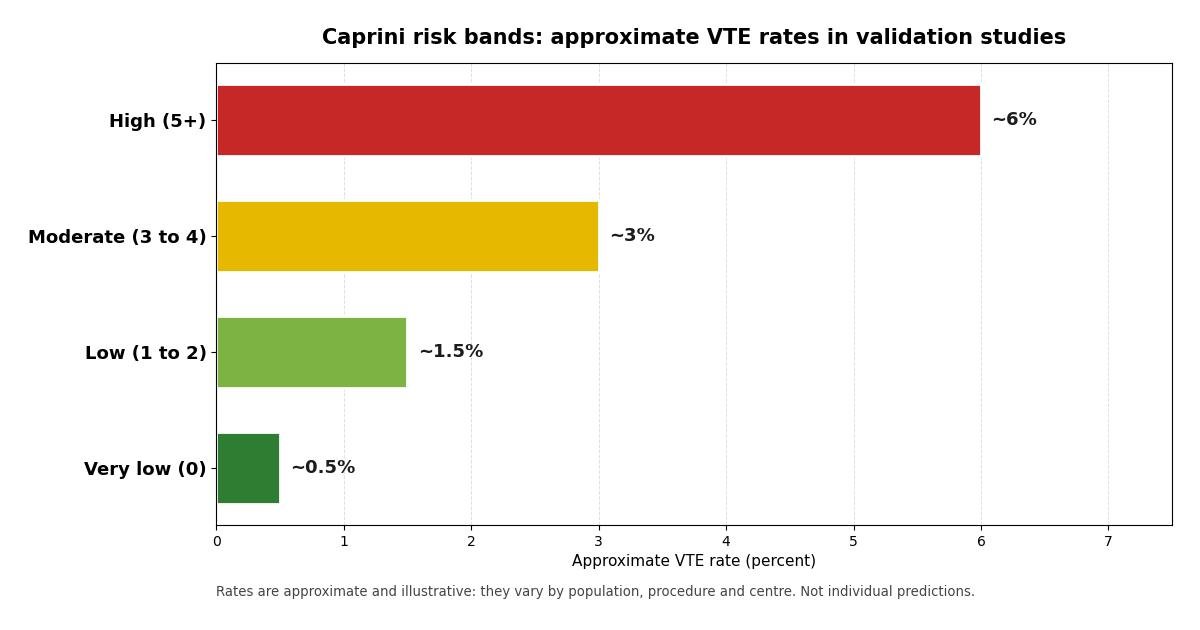
It is worth being explicit about where these rates come from, because the honesty of the number matters. The bands and the approximate rates trace to validation work in large surgical cohorts. Bahl and colleagues applied the Caprini model retrospectively to more than 11,000 general, vascular and urological surgery patients and found that observed VTE rates rose across the bands, reaching roughly 6% in the highest band (Annals of Surgery, 2010). Pannucci and colleagues validated the model in outpatient surgical patients with similar findings (Annals of Surgery, 2012). The 0.5%, 1.5%, 3% and 6% figures often quoted for the bands are consistent with these studies, and this page presents them as approximate for that reason. A different population, for example patients having major cancer surgery or joint replacement, will have different absolute rates, which is why the bands are best used to compare patients and to choose the intensity of prophylaxis rather than to quote an exact personal probability.
Worked examples
Two worked examples show how the arithmetic works in practice.
Example one. A 52-year-old woman with a BMI of 29 is scheduled for a minor excisional procedure. She takes combined oral contraceptives and has varicose veins. Her age bracket scores 1, the minor surgery scores 1, the BMI above 25 scores 1, the hormones score 1, and the varicose veins score 1. The total is 1 plus 1 plus 1 plus 1 plus 1, which is 5. That sits in the high-risk band, 5 or more. This surprises some people, because every factor is modest, but that is exactly the point of the model: five modest factors together carry real weight.
Example two. A 68-year-old man with colon cancer is scheduled for a major open colectomy expected to last three hours, and he has a central venous catheter. His age bracket scores 2, the malignancy scores 2, the major open surgery scores 2, and the central venous access scores 2. The total is 2 plus 2 plus 2 plus 2, which is 8, in the high-risk band. In practice this patient would almost certainly receive combined pharmacologic and mechanical prophylaxis unless bleeding risk forbade it.
Example three shows the age rule. A 78-year-old patient having arthroscopic surgery scores 3 for age (75 or older), not 3 plus 2 for also being over 61. The arthroscopy adds 2, for a total of 5, which is the high-risk band. If the same patient were 65 instead, the age bracket would score 2 and the total would be 4, the moderate band.
Prophylaxis guidance per band
The point of the score is to guide prevention, so it helps to say what each band usually calls for. The guidance below is what is commonly recommended in the VTE thromboprophylaxis literature, including the American College of Chest Physicians guidelines (Gould MK et al., Chest. 2008). It is framed as convention, not prescription, and every decision must be tempered by the patient's bleeding risk, the operation, and local protocol.
Very low risk, 0 points: no routine pharmacologic or mechanical prophylaxis is commonly recommended. Early and frequent ambulation is usually considered sufficient. Low risk, 1 to 2 points: mechanical prophylaxis is commonly recommended, preferably intermittent pneumatic compression (IPC), the sleeves that inflate and deflate around the calves to keep blood moving. Moderate risk, 3 to 4 points: pharmacologic prophylaxis is commonly recommended, using low molecular weight heparin (LMWH), low dose unfractionated heparin (LDUH), or fondaparinux, sometimes with mechanical prophylaxis added. High risk, 5 or more points: combined pharmacologic and mechanical prophylaxis is commonly recommended, and for the highest-risk operations, namely major orthopaedic surgery, hip fracture surgery, and cancer surgery, extended-duration pharmacologic prophylaxis after discharge is commonly recommended.
Mechanical prophylaxis and pharmacologic prophylaxis work differently, and it helps to know both. Mechanical methods reduce stasis: IPC sleeves, graduated compression stockings, and early ambulation all keep venous blood moving in the legs. Pharmacologic methods reduce hypercoagulability: heparins and fondaparinux damp down the clotting cascade. Combining them addresses two arms of Virchow's triad at once, which is why the high-risk band calls for both. The third arm, vessel injury, is inherent to the surgery itself and cannot be prevented directly.
What the score cannot do
The Caprini model is a useful instrument with real limits, and an honest page should state them. The most important limit is that it scores clotting risk only. It says nothing about bleeding risk, and every prophylaxis decision must weigh both. A patient with a Caprini total of 9 who is actively bleeding, or who has just had neurosurgery, cannot simply be given heparin on the strength of the score: the bleeding risk must be assessed separately, with its own tools and clinical judgment, and the decision will often be to use mechanical prophylaxis only, or to delay pharmacologic prophylaxis. Using this calculator without a separate bleeding assessment would be a misuse of the instrument.
The model also has validation boundaries. It was developed and validated in surgical populations, and it performs best where it has been studied: general, vascular, urological, plastic and orthopaedic surgery. Applying it to populations where it has not been validated, such as obstetric patients or critically ill medical patients, is more uncertain, and the band rates quoted here come from surgical cohorts. The model does not capture every risk factor either: it has no item for how long the immobility will last beyond the 72-hour item, no item for travel history, and it cannot weigh factors the checklist does not list. Finally, the total is only as good as the checklist behind it: a missed factor, such as an unasked family history of clots, moves the patient to a lower band than they deserve. The score standardises judgment; it does not replace it.
Key takeaways
- The Caprini score estimates how likely a surgical patient is to develop venous thromboembolism (VTE), meaning deep vein thrombosis (DVT), a clot in a deep vein, or pulmonary embolism (PE), a clot that travels to the lungs.
- Each risk factor present scores its assigned points, and the total is the sum.
- The commonly used bands are: 0 points is very low risk, with approximate VTE rates around 0.5%; 1 to 2 points is low risk, around 1.5%; 3 to 4 points is moderate risk, around 3%; and 5 or more points is high risk, around 6%.
- As commonly recommended in the thromboprophylaxis literature: very low risk (0 points) usually needs no routine pharmacologic or mechanical prophylaxis beyond early ambulation; low risk (1 to 2 points) usually calls for mechanical prophylaxis, preferably intermittent pneumatic compression; moderate risk (3 to 4 points) usually calls for pharmacologic prophylaxis with low molecular weight heparin, low dose unfractionated heparin, or fondaparinux; high risk (5 or more points) usually calls for combined pharmacologic and mechanical prophylaxis, with extended-duration pharmacologic prophylaxis after major orthopaedic, hip fracture, or cancer surgery.
Frequently asked questions
What does the Caprini score measure?
The Caprini score estimates how likely a surgical patient is to develop venous thromboembolism (VTE), meaning deep vein thrombosis (DVT), a clot in a deep vein, or pulmonary embolism (PE), a clot that travels to the lungs. It works from a checklist of weighted risk factors, each worth 1, 2, 3 or 5 points. The points are added to a total, and the total maps to one of four bands: very low, low, moderate, or high risk. The bands guide commonly recommended VTE prophylaxis, from early ambulation alone at the lowest band up to combined pharmacologic and mechanical prophylaxis at the highest.
How is the Caprini total score calculated?
Each risk factor present scores its assigned points, and the total is the sum. One-point factors include age 41 to 60, BMI above 25, minor surgery planned, and hormone use; two-point factors include age 61 to 74, major open or laparoscopic surgery over 45 minutes, and malignancy; three-point factors include age 75 or older, a history or family history of DVT or PE, and inherited or acquired thrombophilia; five-point factors include recent stroke, elective hip or knee replacement, recent hip, pelvis or leg fracture, and acute spinal cord injury with paralysis. Only one age bracket is counted: a patient aged 65 scores 2 points for age, not 2 plus 1.
What do the four Caprini risk bands mean?
The commonly used bands are: 0 points is very low risk, with approximate VTE rates around 0.5%; 1 to 2 points is low risk, around 1.5%; 3 to 4 points is moderate risk, around 3%; and 5 or more points is high risk, around 6%. These rates are approximate and illustrative: they come from validation studies in surgical populations and vary between patient groups, procedures and centres. The bands are most useful for comparing patients and for choosing the intensity of prophylaxis, not for predicting an exact individual probability.
What VTE prevention is usually recommended for each Caprini band?
As commonly recommended in the thromboprophylaxis literature: very low risk (0 points) usually needs no routine pharmacologic or mechanical prophylaxis beyond early ambulation; low risk (1 to 2 points) usually calls for mechanical prophylaxis, preferably intermittent pneumatic compression; moderate risk (3 to 4 points) usually calls for pharmacologic prophylaxis with low molecular weight heparin, low dose unfractionated heparin, or fondaparinux; high risk (5 or more points) usually calls for combined pharmacologic and mechanical prophylaxis, with extended-duration pharmacologic prophylaxis after major orthopaedic, hip fracture, or cancer surgery. These are conventions, not prescriptions: bleeding risk, local protocol and clinician judgment always apply.
Where does the Caprini model come from, and is it validated?
The model was developed by Joseph Caprini and published in its current weighted form in 2005 in the journal Disease-a-Month (Dis Mon. 2005;51(2-3):70-78). It has since been validated in large surgical populations: Bahl and colleagues studied more than 11,000 general, vascular and urological surgery patients (Annals of Surgery, 2010), and Pannucci and colleagues validated it in outpatient surgical patients (Annals of Surgery, 2012). Validation showed that higher scores track with higher observed VTE rates across the bands, which is why the model is one of the most widely used VTE risk tools in surgical care.
Can I use my Caprini score to decide on blood thinners myself?
No. The Caprini score estimates clotting risk only; it says nothing about bleeding risk, which is the other half of every prophylaxis decision. Drugs used for VTE prevention can cause serious bleeding, so the choice between mechanical and pharmacologic prophylaxis must be made by a clinician who knows the patient, the operation, the anaesthesia plan, and any bleeding history. This calculator is an educational aid: it does not diagnose, it does not advise on treatment, and no medication decision should follow from its result without a clinician.
References and further reading
Medical disclaimer
This calculator is an educational aid only. It does not diagnose venous thromboembolism, does not assess bleeding risk, does not replace clinical judgement, and does not advise on treatment or prophylaxis. The Caprini score estimates clotting risk; every prophylaxis decision must also weigh bleeding risk, the planned operation, anaesthesia, and the patient's full history. If you have symptoms of a blood clot, such as leg swelling or pain, sudden breathlessness, or chest pain, seek medical advice promptly. Never start, stop or change any medication on the basis of a score alone.