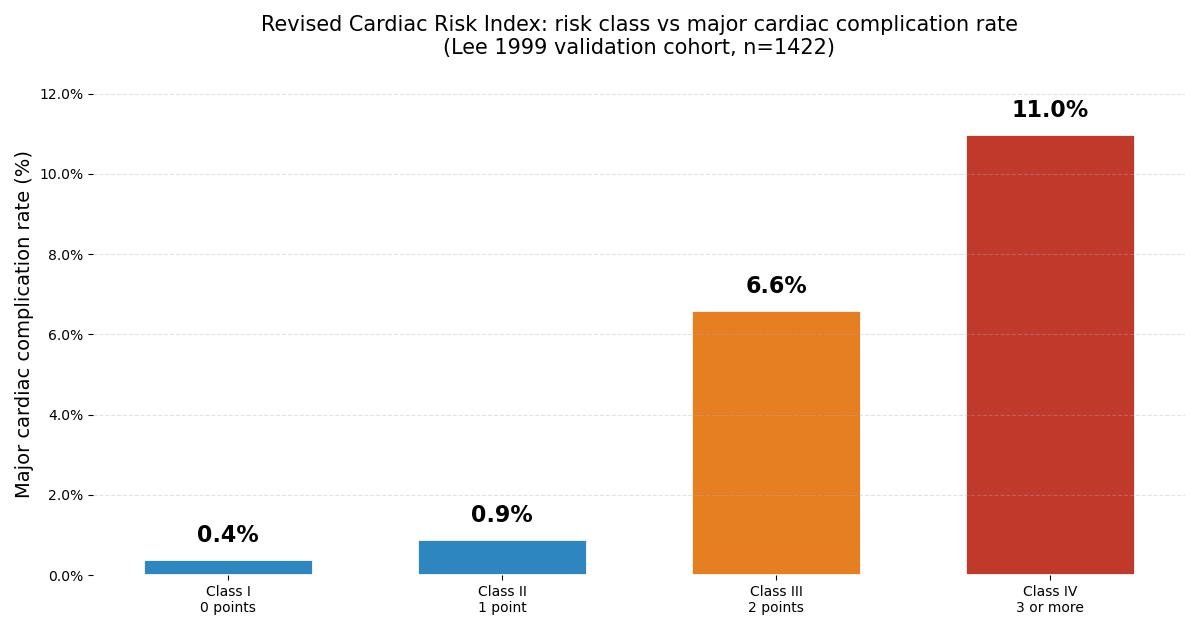
The Lee 1999 Revised Cardiac Risk Index: six perioperative risk factors, one point each, mapping to Class I 0.4%, Class II 0.9%, Class III 6.6%, and Class IV 11.0% rates of major cardiac complications after elective major noncardiac surgery in patients aged 50 or older.
In short: The Lee 1999 Revised Cardiac Risk Index: six perioperative risk factors, one point each, mapping to Class I 0.4%, Class II 0.9%, Class III 6.6%, and Class IV 11.0% rates of major cardiac complications after elective major noncardiac surgery in patients aged 50 or older. Use the calculator above, then read the guide below to interpret your result and its limitations.
Medically reviewed on 5 October 2026 by Dr. Taimoor Asghar.
Answer each factor as yes or no from the preoperative history and the most recent creatinine. For serum creatinine, type the value and choose the unit; the calculator applies the Lee 1999 threshold of above 2.0 mg/dL (176.8 micromol/L) for you. All six answers are required before the score is computed. This is an informational estimate, not a clinical decision.
RCRI calculator table
Item
Value
What the Revised Cardiac Risk Index is
The Revised Cardiac Risk Index, usually called the RCRI or the Lee index, is a simple preoperative scoring system that estimates the chance of a major cardiac complication around the time of noncardiac surgery. It was developed by Lee, Marcantonio, Mangione, Goldman and colleagues and published in Circulation in 1999. The investigators studied 4,315 patients aged 50 years or older undergoing elective major noncardiac procedures at a tertiary care teaching hospital, Brigham and Women's Hospital in Boston. They split the cohort into a 2,893-patient derivation group, in which the index was built, and a 1,422-patient validation group, in which it was prospectively tested.
The appeal of the index is its simplicity. Six binary risk factors are each worth one point, and the total score of 0 to 6 places the patient into one of four risk classes. No calculator weighting, no interaction terms, and no laboratory panel beyond a routine creatinine is needed. Every input comes from information already available in the standard preoperative history and basic blood work, which is why the RCRI remains one of the most widely used perioperative risk tools more than two decades after publication, and why major perioperative guidelines recommend some validated risk tool of this kind as the first step of preoperative cardiac evaluation.
It is important to understand what the percentages attached to the classes represent. The composite endpoint used in Lee 1999 was myocardial infarction, pulmonary edema, ventricular fibrillation, primary cardiac arrest, or complete heart block during the perioperative period. The event rates are therefore rates of that specific composite outcome, in that specific population, with that era's methods of detection. They are not rates of death, and they are not transferable without thought to populations that differ in age mix, comorbidity burden, or monitoring intensity.
The six RCRI risk factors
Each of the following counts as exactly one point when present. In the original logistic regression model the adjusted odds ratios for these factors ranged from about 1.9 to 3.0, so the authors assigned them equal weight, which is what makes the index so easy to apply at the bedside.
1. High-risk surgery
The original definition covers intraperitoneal, intrathoracic, or suprainguinal vascular surgery. These operations involve large fluid shifts, significant blood loss potential, and sustained sympathetic stress, all of which raise myocardial oxygen demand. A laparoscopic intraperitoneal procedure counts in the original definition, since the index predates the widespread adoption of minimally invasive techniques; clinicians applying it today usually judge whether the planned operation matches the spirit of major open intraperitoneal or intrathoracic surgery.
2. History of ischemic heart disease
This factor is present with a prior myocardial infarction, a positive exercise (stress) test, Q waves on the electrocardiogram, prior coronary revascularization by percutaneous coronary intervention or coronary artery bypass grafting, or current use of nitrate therapy. Note that it is a history of ischemic disease that counts, not merely risk factors such as hypertension or hyperlipidemia, and not stable angina without one of the listed criteria.
3. History of congestive heart failure
This factor is present with a history of congestive heart failure, pulmonary edema, or an S3 gallop on physical examination. The full original definition also included paroxysmal nocturnal dyspnea and a chest radiograph showing pulmonary vascular redistribution. Heart failure is one of the strongest perioperative predictors in later analyses as well, so a careful history here matters more than for any other factor.
4. History of cerebrovascular disease
A prior transient ischemic attack or stroke counts. Cerebrovascular disease marks diffuse atherosclerotic burden and shared risk pathways with coronary disease, and it independently predicted complications in the Lee cohort.
5. Diabetes mellitus treated with insulin
Only diabetes treated with insulin counts, not diabetes controlled by diet or oral agents alone. The distinction matters because insulin therapy in the Lee cohort marked more advanced disease with greater vascular involvement. A patient with type 2 diabetes on metformin alone does not receive this point.
Renal insufficiency marked by a creatinine strictly above 2.0 mg/dL counts as one point. The threshold is strict: a value of exactly 2.0 does not count. Later work has suggested that an estimated glomerular filtration rate below 30 mL/min may predict complications better than this creatinine cutoff, but the cutoff as published is what the index uses, and the calculator above applies it exactly, converting micromol/L values at 88.4 per mg/dL.
How the score is read: the four risk classes
The total number of points determines the risk class. The event rates most commonly quoted come from the 1,422-patient prospective validation cohort:
How the score is read: the four risk classes table
Points
Risk class
Major cardiac complication rate (validation cohort)
0
Class I
0.4% (2 of 488 patients)
1
Class II
0.9% (5 of 567 patients)
2
Class III
6.6% (17 of 258 patients)
3 or more
Class IV
11.0% (12 of 109 patients)
RCRI risk class versus major cardiac complication rate in the Lee 1999 validation cohort (n = 1,422).
The jump between Class II and Class III is the most striking feature of the index: adding a second risk factor takes the estimated complication rate from under 1% to about 6.6%. That step change is why many clinicians treat a score of 2 or more as the threshold for additional preoperative cardiac evaluation. A frequently repeated error in secondary sources is to attribute the 0.4, 0.9, 6.6, and 11.0 percent figures to the derivation cohort; in the 2,893-patient derivation group the corresponding rates were 0.5%, 1.3%, 4%, and 9%.
Worked example
Consider a 68-year-old man scheduled for an open intraperitoneal bowel resection. His history includes a myocardial infarction three years ago and type 2 diabetes treated with insulin. His most recent creatinine is 2.4 mg/dL. He has no history of heart failure or cerebrovascular disease.
Scoring: high-risk surgery 1 point, ischemic heart disease 1 point, insulin-treated diabetes 1 point, creatinine above 2.0 mg/dL 1 point, heart failure 0, cerebrovascular disease 0. The total is 4 points, which is 3 or more, so the patient falls in Class IV with an estimated major cardiac complication rate of 11.0% by the validation cohort figures. You can check this by entering the same answers in the calculator above.
Using the RCRI in preoperative assessment
Perioperative guidelines use the RCRI as the opening move of a stepwise evaluation, not as a final answer. The 2014 ACC/AHA perioperative guideline, and the updated 2024 AHA/ACC guideline, recommend identifying patients at low risk (generally under 1%) of perioperative major adverse cardiac events who can proceed to surgery without further cardiac testing, and pairing a clinical risk score with functional capacity assessment and selective biomarker testing for the rest. In practice, Class I patients usually proceed directly, Class II patients merit a check of functional capacity, and Class III and IV patients are the ones for whom clinicians typically consider measuring BNP or NT-proBNP, obtaining troponin surveillance around surgery, or requesting cardiology input when the result would change management.
Two practical cautions belong here. First, the score does not capture functional capacity, which independently predicts outcomes; a patient who cannot climb a flight of stairs carries risk the index does not see. Second, the index does not adjust for surgical urgency. The Lee cohort was entirely elective, and emergency cases carry higher risk than the score predicts, which is why the calculator is scoped to elective major noncardiac surgery and must not be applied to emergency procedures.
Scope of this calculator: elective major noncardiac surgery in patients aged 50 or older, matching the Lee 1999 study population. It is not validated for emergency surgery, for patients under 50, or for cardiac surgery.
Validation, limits, and what the index cannot do
The RCRI has been externally validated many times, which is a genuine strength. Discrimination in the original validation cohort was good, with an area under the ROC curve around 0.81. But validation has also mapped its limits honestly, and those limits should shape how the result is used.
Devereaux and colleagues, in a 2005 review of perioperative cardiac risk (Canadian Medical Association Journal), re-examined the original Lee cohort using a tighter composite endpoint of myocardial infarction, cardiac arrest, and cardiac death, excluding pulmonary edema and complete heart block. With that endpoint, 59 of 4,315 patients had an event, and the class-specific rates were 0.4% (95% CI 0.1 to 0.8), 1.0% (0.5 to 1.4), 2.4% (1.3 to 3.5), and 5.4% (2.8 to 7.9). The lesson is that the percentages move with the endpoint definition: an index validated against one composite should not be quoted as if it predicts a different one.
A large prospective external validation by Roshanov, Sessler, Chow, Devereaux and colleagues, a secondary analysis of 35,815 patients aged 45 or older undergoing elective inpatient noncardiac surgery at 28 centers in 14 countries, used systematic troponin monitoring. When myocardial injury after noncardiac surgery (MINS) was included in the composite outcome, 30-day cardiac event rates across RCRI classes I through IV were 8.2%, 15.4%, 26.7%, and 40.1%; excluding MINS, they were 1.6%, 4.0%, 7.9%, and 12.9%. One in twelve patients with no RCRI risk factors had a cardiac complication, which is why the authors concluded that the RCRI alone is not sufficient to guide postoperative cardiac monitoring without systematic troponin testing. Contemporary high-sensitivity troponin surveillance will therefore tend to find higher event rates than Lee's 1999 cohort, where such monitoring did not exist.
A single-center prospective re-evaluation in 9,519 consecutive elective surgical patients, published in the Canadian Journal of Anesthesia in 2013, found class rates of 0.5%, 2.6%, 7.2%, and 14.4%, somewhat higher than the original, and reported that insulin therapy and the creatinine cutoff added little predictive value in that population while a GFR below 30 mL/min predicted better. Performance is also notably weaker in vascular surgery, where discrimination drops to an AUC near 0.64 and dedicated vascular risk tools may perform better. Finally, the derivation population came from a single tertiary academic center in the open-surgery era, with surgery requiring at least a two-day hospital stay; generalizing to community hospitals, ambulatory procedures, or predominantly laparoscopic practice requires judgment.
What the RCRI does not do: it does not predict death specifically, it does not account for emergency or urgent surgery, it ignores functional capacity and cardiac biomarkers, it was not derived in patients under 50, and it cannot tell you whether surgery should happen. It quantifies one specific risk so that the care team can plan around it.
Key takeaways
The six factors, each worth one point, are: high-risk surgery (intraperitoneal, intrathoracic, or suprainguinal vascular); history of ischemic heart disease (prior myocardial infarction, positive exercise test, Q waves on the ECG, prior coronary revascularization, or current nitrate therapy); history of congestive heart failure; history of cerebrovascular disease (transient ischemic attack or stroke); diabetes mellitus treated with insulin; and preoperative serum creatinine above 2.0 mg/dL (176.8 micromol/L).
In the 1,422-patient prospective validation cohort of Lee et al.
No.
Modern studies often use high-sensitivity troponin monitoring, which detects myocardial injury after noncardiac surgery (MINS) that routine testing in 1999 would have missed.
Frequently asked questions
What are the six risk factors in the Revised Cardiac Risk Index?
The six factors, each worth one point, are: high-risk surgery (intraperitoneal, intrathoracic, or suprainguinal vascular); history of ischemic heart disease (prior myocardial infarction, positive exercise test, Q waves on the ECG, prior coronary revascularization, or current nitrate therapy); history of congestive heart failure; history of cerebrovascular disease (transient ischemic attack or stroke); diabetes mellitus treated with insulin; and preoperative serum creatinine above 2.0 mg/dL (176.8 micromol/L).
What do the RCRI risk classes mean in percentage terms?
In the 1,422-patient prospective validation cohort of Lee et al. (Circulation 1999), the rates of major cardiac complications were: Class I (0 points) 0.4%, Class II (1 point) 0.9%, Class III (2 points) 6.6%, and Class IV (3 or more points) 11.0%. The composite endpoint was myocardial infarction, pulmonary edema, ventricular fibrillation, primary cardiac arrest, or complete heart block.
Was the RCRI validated in emergency surgery?
No. Lee et al. studied stable patients aged 50 or older undergoing elective (non-urgent) major noncardiac surgery. Emergency surgery carries additional risk that the index does not capture, so the RCRI is not validated for emergency procedures and should not be used to estimate risk for them.
Why do some modern studies report higher complication rates than Lee 1999?
Modern studies often use high-sensitivity troponin monitoring, which detects myocardial injury after noncardiac surgery (MINS) that routine testing in 1999 would have missed. A large prospective external validation by Roshanov, Sessler, Chow, Devereaux and colleagues found 30-day cardiac event rates of 8.2%, 15.4%, 26.7%, and 40.1% across RCRI classes I through IV when MINS was included in the composite outcome, and 1.6%, 4.0%, 7.9%, and 12.9% when it was excluded. Broader endpoints and sicker populations also raise observed rates.
What is the difference between the derivation and validation cohort results in Lee 1999?
In the 2,893-patient derivation cohort, major cardiac complication rates for 0, 1, 2, and 3 or more risk factors were 0.5%, 1.3%, 4%, and 9%. In the separate 1,422-patient prospective validation cohort, the rates were 0.4%, 0.9%, 6.6%, and 11.0%. The figures most commonly quoted (0.4, 0.9, 6.6, 11.0) are the validation cohort rates, not the derivation cohort rates.
Does a high RCRI score mean surgery should be cancelled?
No. The RCRI is a risk communication and triage tool, not a gate that approves or blocks surgery. A score of 2 or more generally identifies patients who merit closer preoperative evaluation, for example assessment of functional capacity, measurement of cardiac biomarkers such as BNP or troponin, or cardiology input when the result would change management. The decision to proceed balances surgical urgency and benefit against cardiac risk in discussion with the patient and the care team.
Sources
Lee TH, Marcantonio ER, Mangione CM, et al. Derivation and prospective validation of a simple index for prediction of cardiac risk of major noncardiac surgery. Circulation. 1999;100(10):1043-1049. doi:10.1161/01.CIR.100.10.1043
Devereaux PJ, Goldman L, Cook DJ, et al. Perioperative cardiac events in patients undergoing noncardiac surgery: a review of the magnitude of the problem, the pathophysiology of the events and methods to estimate and communicate risk. CMAJ. 2005;173(6):627-634. (Re-analysis of the original Lee cohort with a composite of myocardial infarction, cardiac arrest, and cardiac death: 59 of 4,315 events; class rates 0.4%, 1.0%, 2.4%, 5.4% with 95% confidence intervals.)
Roshanov PS, Sessler DI, Chow CK, Devereaux PJ, et al. Using the Revised Cardiac Risk Index to predict major postoperative events for people with kidney failure: an external validation and update. (Secondary analysis of a prospective cohort of 35,815 patients aged 45 or older undergoing elective inpatient noncardiac surgery at 28 centers in 14 countries.)
Ford MK, et al. The Revised Cardiac Risk Index in the new millennium: a single-centre prospective cohort re-evaluation of the original variables in 9,519 consecutive elective surgical patients. Can J Anaesth. 2013. (Class rates 0.5%, 2.6%, 7.2%, 14.4%; GFR below 30 mL/min outperformed the creatinine cutoff.)
Pre-operative risk prediction editorial, J Am Coll Cardiol. 2019. https://www.jacc.org/doi/10.1016/j.jacc.2019.04.024 (RCRI scope: age 50 or older, surgery requiring at least 2 days of hospital stay, open surgical techniques; moderate discrimination with AUC about 0.78 to 0.81; poor discrimination in vascular surgery.)
Medical disclaimer
This calculator is an educational tool only and does not provide medical advice. The Revised Cardiac Risk Index estimates the probability of a specific composite of major cardiac complications in a defined study population; it does not predict individual outcomes and does not replace clinical judgment. Perioperative decisions must be made by qualified clinicians in discussion with the patient, taking into account surgical urgency, functional capacity, biomarkers, and the full clinical picture. If you are a patient, discuss your surgical risk with your surgeon, anesthesiologist, or primary care clinician. In an emergency, seek immediate medical care.