Why blood clot risk matters in surgery
Blood clots that form in the deep veins, most often in the legs, are called deep vein thrombosis (DVT). When part of such a clot breaks off and travels to the lungs, it causes a pulmonary embolism (PE), which can be fatal within minutes. Together, DVT and PE are known as venous thromboembolism (VTE), and VTE remains one of the most common preventable causes of death in hospitalized surgical patients.
Surgery creates a perfect storm for clotting. The classic Virchow triad describes the three ingredients: sluggish blood flow from immobility and anesthesia, injury to blood vessel walls from the operation itself, and a blood chemistry that is more prone to clotting after tissue trauma. Add advanced age, cancer, or an inherited clotting tendency, and the risk climbs further. Many postoperative clots are silent at first, which is why prevention, rather than waiting for symptoms, is the cornerstone of care.
The difficulty is that the medicines used to prevent clots, mainly heparins, also increase the risk of bleeding, which after surgery can be dangerous in its own right. Giving every surgical patient full anticoagulation would prevent some clots but cause too many bleeds; giving nobody prophylaxis would avoid bleeds but allow preventable clots and deaths. The rational answer is risk stratification: estimate each patient's clotting risk, weigh it against their bleeding risk, and match the intensity of prevention to the patient. The Caprini score is the most widely used tool for the clotting-risk half of that equation.
How the Caprini model was developed and validated
The Caprini risk assessment model was developed by Dr. Joseph A. Caprini, a vascular surgeon and researcher specializing in thrombosis, in the early 1990s. The original version contained about 20 risk factors and was validated in general surgical cohorts. Over the following two decades the model was expanded and refined, and the current widely used form is the 2013 version of the score card, which lists 40 risk factors weighted by their apparent contribution to VTE risk.
The model gained its central place in practice when Gould and colleagues adapted it into the American College of Chest Physicians (ACCP) evidence-based guidelines for prevention of VTE in nonorthopedic surgical patients (Chest, 2012). Those guidelines tie each Caprini risk category to a specific prophylaxis recommendation with graded strength of evidence, which is why the score card pairs the checklist with a treatment table. Since then the Caprini model has become the most extensively validated tool for estimating perioperative VTE risk, studied across general, vascular, plastic, gynecologic, urologic, and bariatric surgery populations, as well as in hospitalized medical patients. A recent comprehensive review of VTE risk assessment models describes it as the most extensively validated perioperative VTE tool available, while noting that its strongest predictive performance remains in surgical settings.
Validation studies have consistently shown a steep gradient of observed VTE rates across the score categories, which is the property that makes the model clinically useful: patients in the highest category develop clots many times more often than patients in the lowest, so the score genuinely separates patients who need intensive prevention from those who do not.
How the score works: four weight tiers
The Caprini checklist assigns each risk factor a weight of 1, 2, 3, or 5 points, reflecting how strongly that factor is associated with postoperative clotting in the underlying evidence. The total score is the simple sum of all applicable weights.
One-point factors are common and individually modest contributors: age 41 to 60 years, minor surgery, BMI above 25 kg/m2, swollen legs, varicose veins, pregnancy or the postpartum period, a history of unexplained or recurrent spontaneous abortion, oral contraceptives or hormone replacement therapy, sepsis within the past month, serious lung disease including pneumonia within the past month, abnormal pulmonary function, acute myocardial infarction, congestive heart failure within the past month, a history of inflammatory bowel disease, and being a medical patient currently at bed rest. A patient can accumulate several of these, and they add up.
Two-point factors carry more weight: age 61 to 74 years, arthroscopic surgery, major open surgery lasting more than 45 minutes, laparoscopic surgery lasting more than 45 minutes, malignancy (current or past), confinement to bed for more than 72 hours, an immobilizing plaster cast, and central venous access. Note that the type and duration of surgery itself contributes points, because longer, bigger operations injure more tissue and immobilize the patient longer.
Three-point factors mark substantially elevated risk: age 75 years or older, a personal history of VTE, a family history of VTE, and the inherited or acquired thrombophilias, namely Factor V Leiden, the prothrombin 20210A mutation, lupus anticoagulant, anticardiolipin antibodies, elevated serum homocysteine, heparin-induced thrombocytopenia, and other congenital or acquired thrombophilias. A prior clot is one of the strongest predictors of a future clot, which is why it sits in this tier.
Five-point factors are the highest-weight items, reserved for conditions with dramatic short-term clotting risk: stroke within the past month, elective major lower extremity arthroplasty (hip or knee replacement), hip, pelvis, or leg fracture within the past month, and acute spinal cord injury with paralysis within the past month. These are the patients for whom aggressive prevention is least controversial.
Age and BMI deserve special mention. Age is handled in three bands because clotting risk rises in steps rather than smoothly: 41 to 60 years earns 1 point, 61 to 74 earns 2, and 75 or older earns 3. Only one age band applies. BMI above 25 kg/m2 earns 1 point; this calculator computes BMI automatically when you enter height and weight, so you do not need to calculate it yourself. The threshold is strictly above 25: a BMI of exactly 25 does not earn the point.
Understanding your result: the four risk categories
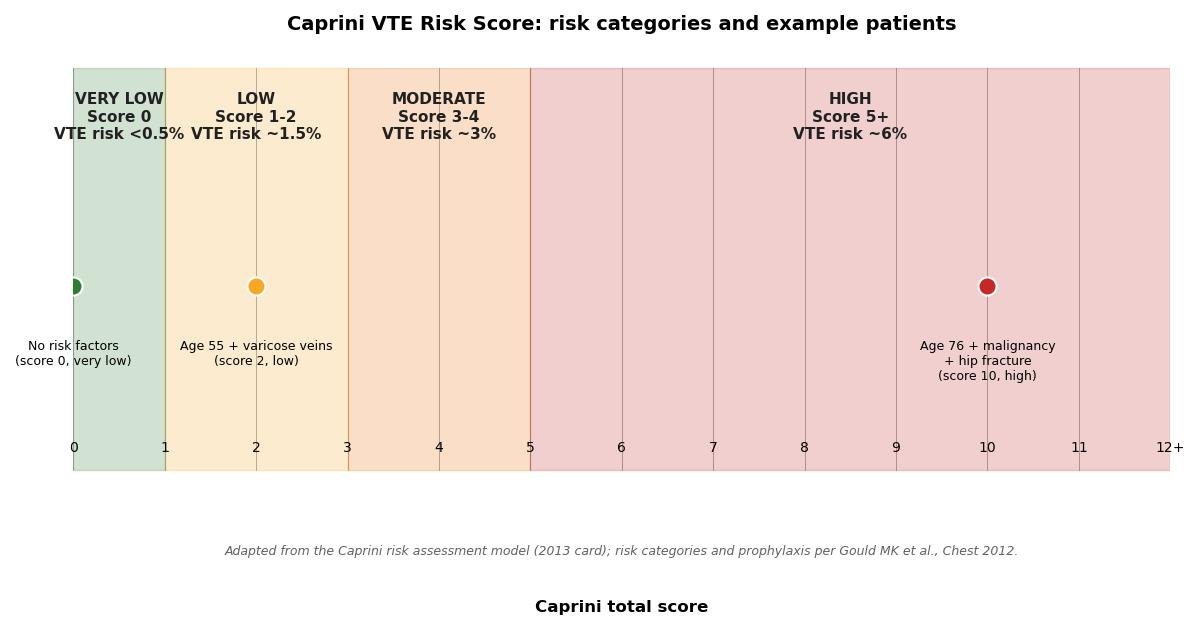
The total score maps to four risk categories. A score of 0 is very low risk, with an estimated VTE incidence below 0.5 percent. A score of 1 to 2 is low risk, around 1.5 percent. A score of 3 to 4 is moderate risk, around 3 percent. A score of 5 or more is high risk, around 6 percent. Some clinicians and researchers further stratify the high-risk group, noting that risk keeps climbing with very high scores, for example above 8 or 9, but the standard clinical cutoffs are the four categories above.
It is important to understand what these percentages mean. They are group incidences observed in validation studies, not personal guarantees: a patient with a score of 6 does not have exactly a 6 percent chance of a clot, but belongs to a group in which roughly 6 in 100 patients developed VTE. The value of the score is comparative and action-oriented: it tells the surgical team which prevention intensity is warranted, not a precise individual probability.
The score is also a snapshot. Risk factors can appear or resolve: a patient who develops pneumonia, becomes immobilized, or undergoes a second operation should be reassessed, because the score, and the appropriate prophylaxis, may change.
What prevention each category calls for
The prophylaxis recommendations paired with the Caprini categories come from the ACCP guideline adaptation by Gould and colleagues, and they apply to general and abdominal-pelvic nonorthopedic surgical patients, including gastrointestinal, urological, gynecologic, bariatric, vascular, and plastic and reconstructive surgery. They are framed as guidance with graded recommendations, and the final decision always rests with the treating team, balancing clot risk against bleeding risk.
For very low risk (score 0), the recommendation is early ambulation alone, with no specific pharmacologic or mechanical prophylaxis. For low risk (scores 1 to 2), mechanical prophylaxis is recommended, preferably with intermittent pneumatic compression, the inflatable sleeves that rhythmically squeeze the calves to keep blood moving. For moderate risk (scores 3 to 4), the options are pharmacologic prophylaxis with low-molecular-weight heparin or low-dose unfractionated heparin, or mechanical prophylaxis with intermittent pneumatic compression.
For high risk (score 5 or more), combined prophylaxis is recommended: a heparin-based medicine plus mechanical prophylaxis with elastic stockings or intermittent pneumatic compression. For patients undergoing abdominal or pelvic surgery for cancer, extended-duration prophylaxis with low-molecular-weight heparin for 4 weeks after discharge is recommended. When heparins are contraindicated, the alternatives are fondaparinux or low-dose aspirin (160 mg), mechanical prophylaxis preferably with intermittent pneumatic compression, or both.
Bleeding risk is the essential counterweight. Patients at high risk of major bleeding, or in whom the consequences of bleeding would be severe (for example neurosurgery or spinal procedures), should receive mechanical prophylaxis with intermittent pneumatic compression until the bleeding risk diminishes, after which pharmacologic prophylaxis can be started. The Caprini score does not measure bleeding risk, so a separate bleeding assessment is mandatory before any anticoagulant is prescribed. Dosing, timing, and duration of any medicine are clinical decisions for the surgical team, not something this calculator prescribes.
Limitations to keep in mind
First, the model was developed and most strongly validated in surgical patients; its performance in medical inpatients, outpatients, and special populations such as pregnant patients outside the perioperative context or children is less certain, and dedicated tools exist for some of those groups.
Second, the score can overestimate risk in low-risk populations. Because the checklist is long, many patients accumulate a few 1-point factors and land in the low or moderate categories, and critics have noted that indiscriminate application can drive prophylaxis use beyond what the evidence supports. The score should inform, not dictate, and procedure-specific guidance takes precedence where it exists: orthopedic joint replacement, for example, has its own dedicated prophylaxis protocols.
Third, the checklist cannot capture everything. The severity of individual factors varies (a small varicose vein is not the same as extensive venous disease), interactions between factors are not modeled, and the score says nothing about bleeding risk, renal function, or drug interactions that shape the actual prophylaxis choice.
Finally, the score is only as good as its inputs. A rushed or incomplete history underestimates risk, while ticking uncertain items overestimates it. When in doubt, the surgical and anesthesia teams should verify the risk factors directly with the patient.
Key takeaways
- The Caprini score estimates the risk of venous thromboembolism (deep vein thrombosis and pulmonary embolism) in surgical patients.
- Each risk factor is assigned a weight of 1, 2, 3, or 5 points based on the strength of its association with clotting.
- A score of 0 is very low risk (estimated VTE incidence below 0.5%), 1-2 is low risk (about 1.5%), 3-4 is moderate risk (about 3%), and 5 or more is high risk (about 6%).
- Per the ACCP guideline adaptation of the model: very low risk needs early ambulation only; low risk needs mechanical prophylaxis, preferably intermittent pneumatic compression; moderate risk needs pharmacologic prophylaxis (LMWH or low-dose unfractionated heparin) or mechanical prophylaxis; high risk needs combined pharmacologic and mechanical prophylaxis, with extended-duration LMWH after discharge for abdominal or pelvic cancer surgery.
Frequently asked questions
What is the Caprini score used for?
The Caprini score estimates the risk of venous thromboembolism (deep vein thrombosis and pulmonary embolism) in surgical patients. The total score places the patient into a risk category (very low, low, moderate, or high) that guides how intensive blood clot prevention should be.
How is the Caprini score calculated?
Each risk factor is assigned a weight of 1, 2, 3, or 5 points based on the strength of its association with clotting. Age contributes 1 point (41-60 years), 2 points (61-74), or 3 points (75 or older); BMI above 25 contributes 1 point; and factors such as prior VTE, thrombophilia, stroke, or major joint replacement contribute 3 or 5 points. The points are summed for a total score.
What do the Caprini risk categories mean?
A score of 0 is very low risk (estimated VTE incidence below 0.5%), 1-2 is low risk (about 1.5%), 3-4 is moderate risk (about 3%), and 5 or more is high risk (about 6%). These percentages are group incidences from validation studies, not personal guarantees.
What prophylaxis does each Caprini category need?
Per the ACCP guideline adaptation of the model: very low risk needs early ambulation only; low risk needs mechanical prophylaxis, preferably intermittent pneumatic compression; moderate risk needs pharmacologic prophylaxis (LMWH or low-dose unfractionated heparin) or mechanical prophylaxis; high risk needs combined pharmacologic and mechanical prophylaxis, with extended-duration LMWH after discharge for abdominal or pelvic cancer surgery.
Does the Caprini score replace clinical judgment about bleeding risk?
No. The score estimates clotting risk only. Bleeding risk must be assessed separately: patients at high bleeding risk or with severe consequences of bleeding should receive mechanical prophylaxis with intermittent pneumatic compression until the bleeding risk diminishes, before pharmacologic prophylaxis is started.
Can the Caprini score be used in non-surgical patients?
The model was developed and most extensively validated in surgical patients, and the guideline-based prophylaxis recommendations apply to general and abdominal-pelvic nonorthopedic surgical patients. Its accuracy in medical inpatients and other populations is less well established.
Sources and further reading
- Gould MK, Garcia DA, Wren SM, et al. Prevention of VTE in nonorthopedic surgical patients: Antithrombotic Therapy and Prevention of Thrombosis, 9th ed: American College of Chest Physicians Evidence-Based Clinical Practice Guidelines. Chest. 2012;141(2 Suppl):e227S-e277S. PubMed 22315263
- Caprini risk assessment model score card (2013 version), adapted from Gould MK, et al. Score card reference
- Queensland Health. Caprini score: prediction score for risk of VTE, with prophylaxis recommendations. PDF
- Comprehensive review of VTE risk assessment models for hospitalized medical patients: development, validation, and limitations of the Caprini RAM. PMC review
Related calculators
Planning perioperative care? Also see our Apfel PONV risk score calculator and browse all surgery and perioperative calculators.