What are postoperative pulmonary complications?
Postoperative pulmonary complications, usually abbreviated PPCs, are breathing-related problems that develop after surgery. The ARISCAT investigators defined them as a composite of seven events: respiratory infection, respiratory failure, bronchospasm, atelectasis (partial collapse of lung tissue), pleural effusion (fluid around the lung), pneumothorax (air around the lung), and aspiration pneumonitis (lung inflammation caused by inhaled stomach contents). These complications matter far beyond a few extra days in hospital. In the original ARISCAT development sample, one in five patients who developed a pulmonary complication died, which shows why identifying at-risk patients before the operation is clinically important.
PPCs arise from a combination of patient vulnerability and surgical insult. General anesthesia reduces the functional residual capacity of the lungs, impairs mucociliary clearance, and blunts the cough reflex. Surgical pain then discourages deep breathing and coughing, especially after incisions near the diaphragm. Add prolonged immobility, and secretions pool in the airways, small airways collapse, and infection or respiratory failure can follow. Because these mechanisms are partly predictable, preoperative risk stratification is one of the most useful things a surgical team can do.
Why stratify pulmonary risk before surgery?
Not every patient needs the same intensity of perioperative respiratory care. Lung expansion techniques such as incentive spirometry, continuous positive airway pressure, deep-breathing exercises, and early mobilization all reduce PPCs, but applying maximal prevention to every surgical patient wastes resources and attention. A validated risk score lets the team concentrate preventive effort where it changes outcomes: high-risk patients can be optimized before elective surgery, watched more closely afterwards, and given analgesia plans that specifically protect the ability to breathe deeply and cough.
Risk stratification also improves the consent conversation. A patient facing upper abdominal surgery who learns that their personal risk profile places them in the high-risk category can make a better-informed decision and can participate actively in prevention, for example by practicing incentive spirometry before admission and planning for early mobilization.
The ARISCAT study: how the score was developed
ARISCAT stands for Assess Respiratory Risk in Surgical Patients in Catalonia. The score was developed by Canet and colleagues and published in Anesthesiology in 2010. The investigators enrolled a prospective multicenter cohort of 2,464 patients undergoing a broad range of surgical procedures with general, neuraxial, or regional anesthesia across hospitals in Catalonia, Spain. The outcome was the composite of postoperative pulmonary complications described above, assessed during the hospital stay.
From dozens of candidate variables, multivariable logistic regression identified seven independent predictors of PPCs. Each predictor was assigned a weighted point value proportional to its regression coefficient, so that the score reflects the relative strength of each risk factor rather than treating them equally. The resulting index was then tested in a separate validation cohort, where it showed good discrimination with an area under the receiver operating characteristic curve of 0.8. Subsequent independent validations have supported the score's transportability: a Spanish external validation reported an area under the curve of 0.8 with sensitivity of about 69% and specificity of about 75% at a cutoff of 26 points, and a Danish national cohort restricted to emergency abdominal surgery reported an area under the curve of 0.83.
The seven risk factors, explained
1. Age. Patients aged 51 to 80 receive 3 points and those over 80 receive 16 points. Aging reduces chest wall compliance, respiratory muscle strength, and the ventilatory response to hypoxia and hypercapnia, all of which make postoperative atelectasis and infection more likely. The steep jump from 3 to 16 points reflects how sharply risk rises in the very elderly.
2. Preoperative oxygen saturation. A room-air SpO2 of 91 to 95% scores 8 points; 90% or lower scores 24 points, making it the single heaviest-weighted factor in the index. Low resting saturation signals limited respiratory reserve: the patient is already closer to the steep part of the oxygen dissociation curve, so any postoperative insult such as atelectasis or hypoventilation is more likely to cause clinically important hypoxemia.
3. Respiratory infection in the last month (17 points). A recent chest infection leaves airways inflamed, hyperreactive, and colonized. Anesthesia and intubation on top of recovering airways markedly increase the risk of bronchospasm, atelectasis, and postoperative pneumonia. This is one of the most actionable factors: elective surgery is often postponed until the infection has fully resolved.
4. Preoperative anemia, haemoglobin below 10 g/dL (11 points). Anemia reduces the oxygen-carrying capacity of blood, so any postoperative drop in arterial oxygen content is less well tolerated. It also frequently marks chronic disease, poor nutrition, or ongoing blood loss, each of which independently worsens surgical outcomes. Correcting anemia before elective surgery lowers this component of risk.
5. Surgical incision. Upper abdominal incisions score 15 points and intrathoracic incisions 23 points, while peripheral incisions score zero. Incisions near the diaphragm cause the most diaphragmatic dysfunction and the most pain-limited breathing. This is why laparoscopic approaches, which avoid large upper abdominal wounds, are associated with fewer pulmonary complications.
6. Duration of surgery. Procedures lasting more than 2 hours up to 3 hours score 16 points; longer than 3 hours scores 23 points. Longer operations mean longer exposure to anesthesia-induced atelectasis, more fluid shifts, greater inflammatory response, and often more complex or extensive surgery.
7. Emergency surgery (8 points). Emergency procedures carry extra risk because there is no time for optimization: the patient may not be fasted, may have a full stomach (aspiration risk), and often presents with acute illness, pain, or physiological derangement that cannot be corrected preoperatively.
How the score is calculated and interpreted
| Risk factor | Category | Points |
|---|---|---|
| Age | 50 years or younger | 0 |
| 51 to 80 years | 3 | |
| Over 80 years | 16 | |
| Preoperative SpO2 (room air) | 96% or higher | 0 |
| 91 to 95% | 8 | |
| 90% or lower | 24 | |
| Respiratory infection, last month | Yes | 17 |
| Preoperative anemia (Hb below 10 g/dL) | Yes | 11 |
| Surgical incision | Peripheral | 0 |
| Upper abdominal | 15 | |
| Intrathoracic | 23 | |
| Duration of surgery | 2 hours or less | 0 |
| More than 2 hours up to 3 hours | 16 | |
| More than 3 hours | 23 | |
| Emergency surgery | Yes | 8 |
The points are added to give a total between 0 and 122. Three risk classes are defined:
- Low risk: below 26 points. About 1.6% of patients in the original cohort developed a pulmonary complication.
- Intermediate risk: 26 to 44 points. About 13.3% developed a complication.
- High risk: 45 points or more. About 42.1% developed a complication.
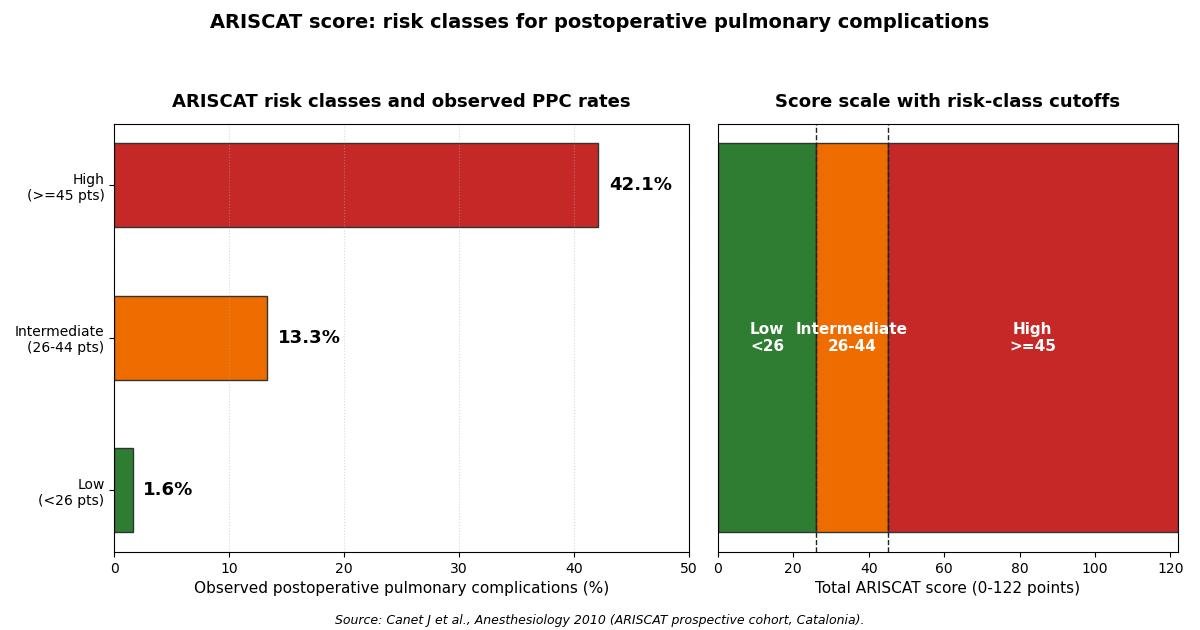
It is important to read these percentages correctly. They are the observed complication rates in the study population for each class, not a personal probability for the patient in front of you. A high-risk classification means the patient resembles a group in which roughly two in five developed a complication, which is a strong signal to intensify prevention, not a prediction of inevitability.
Worked examples
Example 1: low risk. A 45-year-old woman (0 points) with SpO2 98% (0), no recent infection (0), no anemia (0), undergoing peripheral surgery (0) lasting 1 hour (0) as an elective case (0). Total: 0 points, low risk, expected complication rate around 1.6%.
Example 2: near the boundary. A 65-year-old man (3 points) with SpO2 94% (8 points) and haemoglobin 9.2 g/dL (11 points), undergoing upper abdominal surgery (15 points) expected to last 2.5 hours (16 points), elective (0), no recent infection (0). Total: 3 + 8 + 11 + 15 + 16 = 53 points, high risk. If the same patient had no anemia, the total would be 42 points, which falls in the intermediate class (26 to 44). This shows how a single factor, here the anemia, can move a patient across a class boundary, which is exactly why correcting modifiable factors before elective surgery matters.
Example 3: high risk. An 82-year-old man (16 points) with SpO2 89% (24 points) and a chest infection three weeks ago (17 points), undergoing emergency (8 points) upper abdominal surgery (15 points) expected to last over 3 hours (23 points), with haemoglobin 11.5 g/dL (0). Total: 16 + 24 + 17 + 8 + 15 + 23 = 103 points, high risk, expected rate around 42.1%.
How clinicians use the result
For low-risk patients, standard perioperative care with routine monitoring and early mobilization is appropriate. For intermediate-risk patients, teams commonly add enhanced respiratory monitoring, structured lung expansion therapy such as incentive spirometry or CPAP, and analgesia plans designed to preserve deep breathing and effective coughing. For high-risk patients, the emphasis shifts to preoperative optimization wherever the surgery is elective: treat respiratory infections and allow full recovery, correct anemia, consider less invasive surgical approaches, and plan postoperative care in a setting with close respiratory surveillance.
The score also supports shared decision making. Explaining that a patient's profile places them in the high-risk group, with the observed rate of about 42%, helps patients understand why the team recommends specific preventive measures and why postoperative vigilance matters. Related perioperative tools on this site include the Apfel score for postoperative nausea and vomiting, the STOP-Bang questionnaire for sleep apnea screening, and the SpO2/FiO2 ratio calculator for assessing hypoxemia severity.
Limitations of the ARISCAT score
Every prediction model has boundaries, and ARISCAT is no exception. First, it was developed in one region of Spain, so its performance in very different populations, health systems, or surgical case mixes may vary, although the Danish and Spanish external validations are reassuring. Second, the observed rates are group averages from a cohort studied before modern enhanced recovery pathways were widespread; contemporary complication rates with aggressive prevention may be lower. Third, the score was developed in adults undergoing a mix of procedures and should not be applied uncritically to children or to highly specialized populations such as lung transplant recipients. Fourth, like all risk scores, it describes groups, not individuals: two patients with the same score can have very different outcomes. Finally, the score does not replace clinical judgment. A low score in a frail patient with severe cardiac disease does not mean the operation is low risk overall; it means the pulmonary component of risk is estimated to be low.
Key takeaways
- The ARISCAT score predicts the risk of postoperative pulmonary complications (PPCs) such as atelectasis, pneumonia, respiratory failure, bronchospasm, pleural effusion, pneumothorax, and aspiration pneumonitis in adults undergoing surgery with general, neuraxial, or regional anesthesia.
- The seven independent predictors are: age (51-80 years scores 3 points, over 80 scores 16), preoperative oxygen saturation (91-95% scores 8, 90% or less scores 24), respiratory infection in the previous month (17 points), preoperative anemia with haemoglobin below 10 g/dL (11 points), surgical incision (upper abdominal 15, intrathoracic 23), duration of surgery (2-3 hours 16, more than 3 hours 23), and emergency surgery (8 points).
- A total below 26 points is low risk, with about 1.6% of patients developing a postoperative pulmonary complication in the original cohort.
- No.
Frequently asked questions
What is the ARISCAT score used for?
The ARISCAT score predicts the risk of postoperative pulmonary complications (PPCs) such as atelectasis, pneumonia, respiratory failure, bronchospasm, pleural effusion, pneumothorax, and aspiration pneumonitis in adults undergoing surgery with general, neuraxial, or regional anesthesia. It is calculated before surgery from seven routinely available patient and procedure variables and assigns the patient to a low, intermediate, or high risk class.
What are the seven ARISCAT risk factors?
The seven independent predictors are: age (51-80 years scores 3 points, over 80 scores 16), preoperative oxygen saturation (91-95% scores 8, 90% or less scores 24), respiratory infection in the previous month (17 points), preoperative anemia with haemoglobin below 10 g/dL (11 points), surgical incision (upper abdominal 15, intrathoracic 23), duration of surgery (2-3 hours 16, more than 3 hours 23), and emergency surgery (8 points). Reference categories score zero.
What do the ARISCAT risk classes mean?
A total below 26 points is low risk, with about 1.6% of patients developing a postoperative pulmonary complication in the original cohort. A total of 26-44 points is intermediate risk (about 13.3%), and 45 points or more is high risk (about 42.1%). These percentages are the observed complication rates in the study population, not a personal guarantee for any individual patient.
Is a high ARISCAT score a guarantee of complications?
No. The percentages describe what happened in the study population: among patients scoring 45 or more, 42.1% developed a pulmonary complication, which also means most did not. The score estimates group-level risk to guide preventive measures and monitoring; it cannot predict any individual patient's outcome with certainty.
Has the ARISCAT score been validated outside the original study?
Yes. Independent external validations include a Spanish cohort with an area under the ROC curve of 0.8, sensitivity of about 69% and specificity of about 75% at a cutoff of 26 points, and a Danish national cohort of emergency abdominal surgery patients with an area under the curve of 0.83. These results support the score's transportability beyond the original Catalan population.
Can the ARISCAT score be lowered before surgery?
Some contributors are modifiable: treating a respiratory infection and correcting anemia before elective surgery, choosing the least invasive feasible incision, and keeping operating time short all reduce the score. Patient factors such as age and emergency status cannot change, but identifying high-risk patients allows targeted prevention such as lung expansion therapy, optimized analgesia, and enhanced postoperative monitoring.
Sources
- Canet J, Gallart L, Gomar C, et al. Prediction of postoperative pulmonary complications in a population-based surgical cohort. Anesthesiology. 2010;113(6):1338-1350. (Original ARISCAT derivation and validation study; seven predictors, point values, and risk classes.)
- ARISCAT risk class complication rates (low below 26 points 1.6%, intermediate 26-44 points 13.3%, high above 44 points 42.1%): PMC7101190.
- Full ARISCAT point table with all seven factors and categories: Journal of the College of Physicians and Surgeons Pakistan.
- ARISCAT development details, external validations (Mazo et al. AUC 0.8, sensitivity 69.31%, specificity 75.25% at cutoff 26; Kokotovic et al. Danish cohort AUC 0.83), and limitations: Revista do Colegio Brasileiro de Cirurgioes review (PDF).
References and further reading
Medical disclaimer. This calculator is an educational tool based on a published clinical prediction rule. It estimates group-level risk and does not diagnose, treat, or replace professional medical judgment. Surgical decisions should always be made with a qualified clinician who knows the full clinical picture. If you are a patient, discuss your individual risk with your surgical and anesthesia team.