Gupta Perioperative Cardiac Risk (MICA) Calculator
In short: Estimate 30-day risk of perioperative myocardial infarction or cardiac arrest with the Gupta MICA calculator: five predictors (age, ASA class, functional status, creatinine, procedure type) from the Circulation 2011 NSQIP model. Use the calculator above, then read the guide below to interpret your result and its limitations.
Estimate the 30-day risk of perioperative myocardial infarction or cardiac arrest (MICA) for an adult undergoing surgery, using the five-predictor logistic model developed by Prateek K. Gupta and colleagues from the American College of Surgeons National Surgical Quality Improvement Program (ACS NSQIP) database and published in Circulation in 2011.
Calculate MICA risk
16 years or older (the model was developed in patients aged 16 and above).
What MICA is
MICA stands for myocardial infarction or cardiac arrest occurring during surgery or within 30 days after it. These are the two most serious perioperative cardiac events, and they are the ones this calculator predicts as a combined outcome. In the Gupta derivation study, 0.65 percent of 211,410 surgical patients developed perioperative MICA, and their 30-day mortality was 61.42 percent, compared with 1.35 percent in patients without MICA. That stark difference is why perioperative cardiac risk assessment is a routine part of preoperative evaluation: identifying high-risk patients allows teams to optimise medical therapy, adjust anaesthetic and monitoring plans, and have an honest informed-consent conversation about risk before an elective operation.
The model uses the NSQIP definitions for both endpoints. Myocardial infarction was defined as new ECG changes of acute ischaemia (ST elevation of at least 1 mm in two or more contiguous leads, new left bundle branch block, or new Q waves in two or more contiguous leads) or a troponin elevation greater than three times the upper limit of normal in the setting of suspected myocardial ischaemia. Cardiac arrest was defined as the absence of cardiac rhythm, or a chaotic rhythm causing loss of consciousness that requires basic or advanced life support. Note that this definition excludes patients whose automatic implantable defibrillators fire without loss of consciousness.
The five predictors and the equation
The Gupta calculator uses just five preoperative variables, selected by stepwise logistic regression from 136 candidate perioperative variables because adding more did not meaningfully improve prediction. The variables are age (continuous, per year), ASA physical status class, functional status, abnormal preoperative creatinine, and type of surgery across 21 categories. The estimated risk is computed from the logistic equation:
x = -5.25 + (0.02 x age) + coefficient(status) + coefficient(ASA) + coefficient(creatinine) + coefficient(procedure)
Estimated MICA risk = ex / (1 + ex) x 100%
The verified coefficients from Table 2 of the original Circulation paper are:
| Predictor | Coefficient |
|---|---|
| Age, per year | +0.02 |
| ASA class I (vs class V) | -5.17 |
| ASA class II | -3.29 |
| ASA class III | -1.92 |
| ASA class IV | -0.95 |
| ASA class V | 0 (reference) |
| Partially dependent functional status | +0.65 |
| Totally dependent functional status | +1.03 |
| Creatinine above 1.5 mg/dL | +0.61 |
| Creatinine not measured | -0.10 |
| Procedure (vs hernia): anorectal | -0.16 |
| Procedure: aortic | +1.60 |
| Procedure: bariatric | -0.25 |
| Procedure: brain | +1.40 |
| Procedure: breast | -1.61 |
| Procedure: cardiac | +1.01 |
| Procedure: ENT / head and neck | +0.71 |
| Procedure: foregut / hepatopancreatobiliary | +1.39 |
| Procedure: gallbladder, appendix, adrenal, spleen | +0.59 |
| Procedure: intestinal | +1.14 |
| Procedure: neck (thyroid/parathyroid) | +0.18 |
| Procedure: obstetric / gynecologic | +0.76 |
| Procedure: orthopedic | +0.80 |
| Procedure: other abdominal | +1.13 |
| Procedure: peripheral vascular | +0.86 |
| Procedure: skin | +0.54 |
| Procedure: spinal | +0.21 |
| Procedure: thoracic | +0.40 |
| Procedure: urology | -0.26 |
| Procedure: vein | -1.09 |
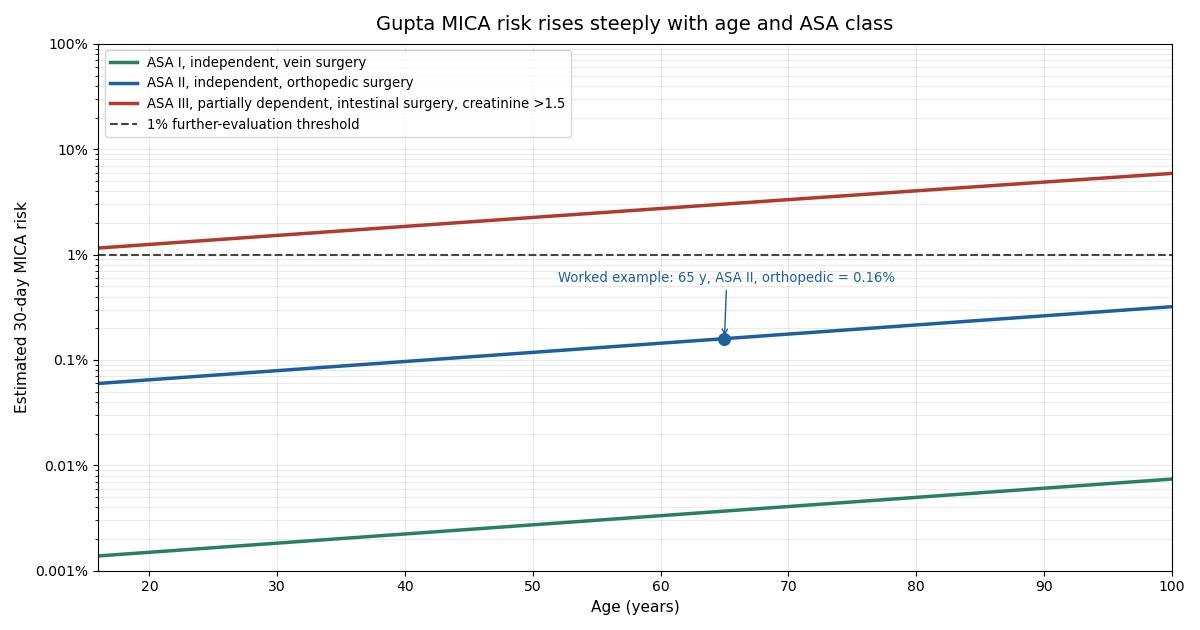
A worked example from the published verification of this model: a 65-year-old independent patient, ASA class II, normal creatinine, undergoing orthopedic surgery. Then x = -5.25 + (65 x 0.02) + 0 + (-3.29) + 0 + 0.80 = -5.25 + 1.30 - 3.29 + 0.80 = -6.44. The estimated risk is e-6.44 / (1 + e-6.44) = 0.16 percent. This calculator reproduces that value exactly.
How the model was developed and validated
The model was derived from the American College of Surgeons 2007 NSQIP Participant Use Data File: 211,410 patients from 183 to 250 participating academic and community US hospitals, with data collected prospectively on 136 perioperative variables. Trauma patients, transplant patients, and patients younger than 16 were excluded. Among them, 1,371 patients (0.65 percent) developed MICA: 154 intraoperative MIs, 357 postoperative MIs, 24 intraoperative cardiac arrests, and 902 postoperative cardiac arrests. Patients with MICA were markedly older than those without (median age 71 versus 56).
The five-variable final model was then validated on the independent 2008 NSQIP data set of 257,385 patients, in which 1,401 (0.54 percent) developed MICA. Discrimination was excellent in both data sets: the C statistic (area under the receiver operating characteristic curve) was 0.884 in the training set and 0.874 in the validation set, and calibration was excellent with no substantial deviation from perfect fit on the observed-versus-expected plots. When the Revised Cardiac Risk Index was applied to the same 2008 data, its C statistic was only 0.747, which is the basis for the claim that the Gupta model discriminates better than the RCRI, particularly in lower-risk patients who make up most elective surgical populations. The study was led by Prateek K. Gupta and colleagues at Creighton University and the University of Nebraska Medical Center, and published in Circulation in 2011 (volume 124, pages 381 to 387).
Understanding your result
The output is a percentage probability of MICA within 30 days of surgery. To put the number in context, the calculator also reports where the risk sits relative to the derivation cohort, using the reported percentile distribution: below 0.05 percent is very low risk (below the 25th percentile); 0.05 to 0.14 percent is low (26th to 50th percentile); 0.14 to 1.47 percent is moderate (51st to 90th percentile); 1.47 to 2.60 percent is high (91st to 95th); 2.60 to 7.69 percent is very high (96th to 97th); and above 7.69 percent is extremely high (above the 97th percentile).
In clinical practice, a predicted risk of 1 percent or higher is commonly used as the threshold at which additional cardiac evaluation may be considered, consistent with the 2014 ACC/AHA perioperative guideline's approach to elevated risk. Patients at or above this level, especially those with poor functional capacity or multiple risk factors, may be candidates for cardiology consultation, preoperative ECG or echocardiography, or stress testing before elective high-risk surgery, depending on the clinical picture and the urgency of the operation. Below 1 percent, patients with at least moderate functional capacity generally do not need additional testing. These are framework-level interpretations: the actual decision always belongs to the surgical and anaesthesia team in the context of the patient's symptoms, the urgency of surgery, and local practice.
The Gupta model versus the Revised Cardiac Risk Index
The Revised Cardiac Risk Index (RCRI), published by Lee and colleagues in 1999, assigns one point each for six binary risk factors (history of ischaemic heart disease, congestive heart failure, cerebrovascular disease, insulin-treated diabetes, creatinine above 2.0 mg/dL, and high-risk surgery) and groups patients into risk classes. The Gupta model takes a different approach: it uses logistic regression on five predictors with statistically derived coefficients, producing a calibrated individual percentage rather than a point score. Two features distinguish it. First, age enters as a continuous variable, so a 50-year-old and an 80-year-old are not lumped together. Second, procedure type enters with 21 distinct coefficients rather than a single high-risk-surgery flag, so aortic surgery (coefficient +1.60) and vein surgery (-1.09) are properly separated. In the NSQIP validation population the Gupta model achieved a C statistic of 0.874 versus 0.747 for the RCRI, meaning it more often ranks patients who develop MICA above those who do not. That said, the RCRI remains useful: it is simpler, requires no calculator, and explicitly includes ischaemic heart disease, heart failure, and diabetes, which the Gupta model captures only indirectly through ASA class and functional status.
Limitations to keep in mind
No risk model captures everything, and this one is no exception. It was derived from US hospital data and has been validated mostly in North American and European cohorts, so calibration in other populations may differ. Emergency surgery was considered during model development but did not enter the final five-variable model, so the score may underestimate risk in true emergencies, where urgency itself is an independent predictor. The model does not include history of coronary artery disease, prior myocardial infarction, heart failure, or current medications as separate predictors, although ASA class and functional status reflect these conditions indirectly. If creatinine has not been measured, the model treats it as a separate category (coefficient -0.10), which is a slightly optimistic assumption; in a patient with known kidney disease, diabetes, hypertension, or heart failure, creatinine should be measured before elective surgery. Finally, patients with active cardiac conditions such as unstable angina, recent myocardial infarction, decompensated heart failure, or significant arrhythmias need specialist evaluation regardless of the calculated score, and the result should never replace clinical assessment.
Key takeaways
- It predicts the probability that an adult patient will develop a perioperative myocardial infarction or cardiac arrest during surgery or within 30 days after it.
- The Gupta model uses five predictors in a logistic equation that produces a calibrated percentage risk, with age entered continuously and 21 procedure-specific coefficients.
- A predicted risk of 1 percent or higher is commonly used as a threshold that may prompt further evaluation, consistent with the 2014 ACC/AHA perioperative guideline framework.
- It can be calculated, but the result should be interpreted cautiously.
Frequently asked questions
What exactly does the Gupta MICA calculator predict?
It predicts the probability that an adult patient will develop a perioperative myocardial infarction or cardiac arrest during surgery or within 30 days after it. The outcome is the composite called MICA: myocardial infarction defined by ECG changes or troponin elevation greater than three times the upper limit of normal with suspected ischaemia, or cardiac arrest requiring life support.
How is the Gupta score different from the RCRI?
The Gupta model uses five predictors in a logistic equation that produces a calibrated percentage risk, with age entered continuously and 21 procedure-specific coefficients. The RCRI uses six binary yes-or-no factors with equal weight. In the NSQIP validation population, the Gupta model discriminated better (C statistic 0.874 versus 0.747 for the RCRI), especially in lower-risk patients.
At what risk level should further cardiac testing be considered?
A predicted risk of 1 percent or higher is commonly used as a threshold that may prompt further evaluation, consistent with the 2014 ACC/AHA perioperative guideline framework. Patients above this level with poor functional capacity or multiple risk factors may be candidates for cardiology referral or stress testing before elective high-risk surgery. The decision always rests with the treating team.
Can this calculator be used before emergency surgery?
It can be calculated, but the result should be interpreted cautiously. Emergency surgery was considered during model development but did not enter the final five-variable model, so actual risk in true emergencies is generally higher than the calculated figure. In emergencies, clinical judgement and immediate anaesthesia assessment take precedence over any risk calculator.
What if the creatinine value is not available?
Select "Not measured". The model includes a separate coefficient for missing creatinine (-0.10), reflecting that unmeasured patients in the derivation cohort tended to be healthier. This is a slightly optimistic assumption, so in patients with known kidney disease, diabetes, hypertension, or heart failure, creatinine should be measured before elective surgery.
Does a low Gupta risk mean surgery is completely safe?
No. A low predicted risk indicates a statistically lower probability of perioperative MICA, but no calculator can guarantee a safe outcome. Patients with active cardiac symptoms such as chest pain, new arrhythmia, or signs of heart failure should be evaluated regardless of the calculated score. The calculator supports, but never replaces, clinical assessment.
Sources
- Gupta PK, Gupta H, Sundaram A, Kaushik M, Fang X, Miller WJ, Esterbrooks DJ, Hunter CB, Pipinos II, Johanning JM, Lynch TG, Forse RA, Mohiuddin SM, Mooss AN. Development and validation of a risk calculator for prediction of cardiac risk after surgery. Circulation. 2011;124(4):381-387. doi:10.1161/CIRCULATIONAHA.110.015701. https://www.ahajournals.org/doi/10.1161/CIRCULATIONAHA.110.015701
- Fleisher LA, Fleischmann KE, Auerbach AD, et al. 2014 ACC/AHA guideline on perioperative cardiovascular evaluation and management of patients undergoing noncardiac surgery. J Am Coll Cardiol. 2014;64(22):e77-e137. https://www.ahajournals.org/doi/10.1161/CIRCULATIONAHA.114.010972
- Lee TH, Marcantonio ER, Mangione CM, et al. Derivation and prospective validation of a simple index for prediction of cardiac risk of major noncardiac surgery. Circulation. 1999;100(10):1043-1049. https://www.ahajournals.org/doi/10.1161/01.cir.100.10.1043