Apfel PONV Risk Score Calculator
In short: Free Apfel PONV risk score calculator: answer the 4 validated risk-factor questions, get your predicted postoperative nausea and vomiting risk (10% to 79%), the risk band, and consensus-guided prophylaxis considerations. Medically reviewed. Use the calculator above, then read the guide below to interpret your result and its limitations.
Answer the four validated risk-factor questions below. The calculator counts how many are present and shows your predicted risk of postoperative nausea and vomiting, your risk band, and the consensus-guided prophylaxis considerations for that band. Risk figures verified against Apfel et al., Anesthesiology 1999 on 2026-10-05. Medically reviewed by Dr. Taimoor Asghar.
The 4 Apfel risk factors
Instructions: Answer yes or no to each question. Each "yes" adds one point, for a total score from 0 to 4. All four questions must be answered before the score can be calculated.
What is postoperative nausea and vomiting?
Postoperative nausea and vomiting, usually shortened to PONV, is one of the most common adverse effects of anesthesia and surgery. In the Apfel derivation study it was defined as at least one episode of nausea, vomiting, or both within the first 24 hours after surgery. Across the general surgical population, roughly 30 percent of patients experience PONV, and in high-risk groups the figure climbs to 70 or 80 percent. Patients consistently rank it among the most distressing parts of the surgical experience, often worse than the pain itself.
PONV is more than an unpleasant memory. Severe or prolonged vomiting raises the risk of aspiration, wound dehiscence, electrolyte disturbance, and bleeding after certain operations, and it is a leading cause of delayed discharge and unplanned hospital admission after day-case surgery. Because effective prevention exists, modern anesthesia practice tries to identify the patients most likely to be affected before the operation starts and to concentrate prophylaxis on them. That is the job the Apfel score was designed to do.
The score was published in 1999 by Christian Apfel and colleagues in the journal Anesthesiology. It grew out of work at two centers, Oulu in Finland with 520 adult patients and Wuerzburg in Germany with 2202 adult patients, all of whom received inhalational general anesthesia without any antiemetic prophylaxis. The researchers first built a statistical model with logistic regression, then asked whether the model could be simplified to a plain count of risk factors without losing its predictive power. It could: the simplified count version discriminated nearly as well as the full model, with areas under the receiver operating characteristic curve of 0.63 to 0.73, and it worked equally well when a score derived at one center was applied to the other center. That simplicity is why the Apfel score, and not the more complex alternatives, became the everyday tool in preoperative clinics and on anesthesia charts worldwide.
The four risk factors
The logistic regression analysis left four independent predictors standing. Each one is worth understanding on its own.
Female sex. Women experience PONV roughly two to three times more often than men, and this is the single most consistent predictor across PONV studies. Hormonal influences are thought to play a role, and the effect is strong enough that sex alone moves a patient one step up the risk curve.
Non-smoker status. Somewhat counterintuitively, it is the non-smokers who are at higher risk. Smokers have a lower incidence of PONV, possibly because chronic tobacco exposure induces the liver enzymes that metabolize anesthetic agents, or because nicotine has mild antiemetic properties. A patient who does not smoke therefore scores one point.
History of PONV or motion sickness. A personal history of nausea or vomiting after a previous anesthetic, or a tendency to motion sickness, marks a patient as individually susceptible. The two histories are combined into one factor: either alone, or both together, adds a single point, because they reflect the same underlying susceptibility of the vomiting center.
Postoperative opioid use. Opioids given for pain relief after surgery are a dose-related driver of PONV. Because the factor is assessed preoperatively, the question is whether opioids are planned as part of the postoperative analgesia. Patients whose pain can be managed without opioids avoid this point entirely, which is one reason opioid-sparing pain strategies are popular in modern anesthesia.
Together these four cover the main domains of PONV risk: who the patient is, how susceptible they are, and what the anesthetic plan involves. Notably absent are factors such as the type or duration of surgery, which did not add independent predictive value once these four were accounted for in the derivation dataset.
How the scoring works
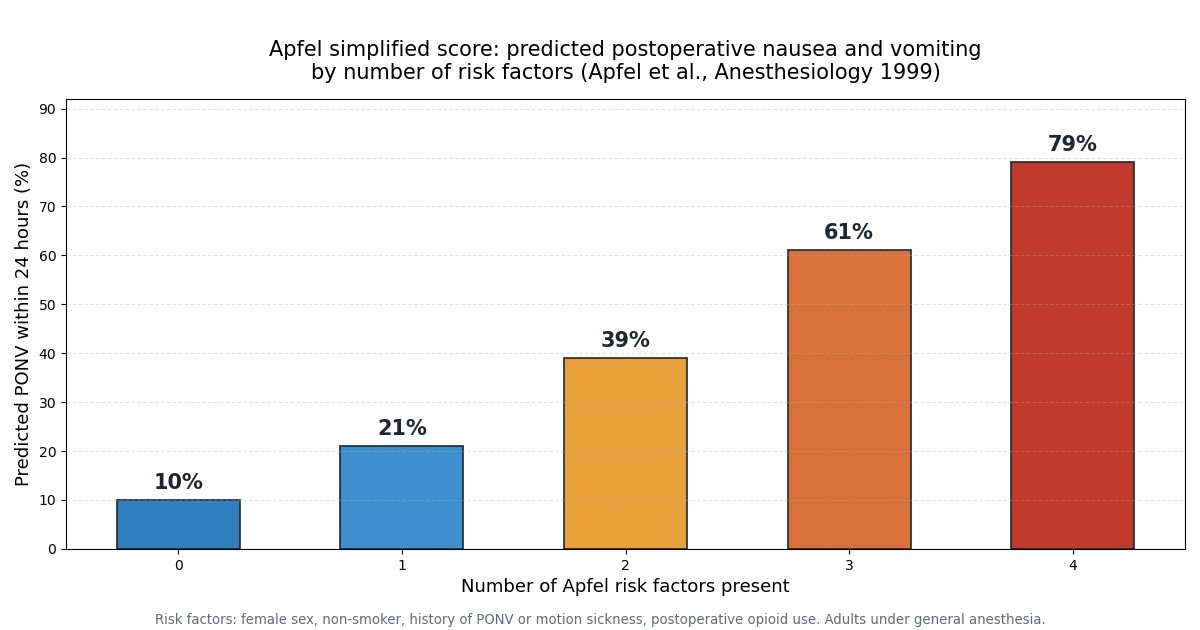
The arithmetic is deliberately trivial: count the number of risk factors present. The total is always a whole number from 0 to 4. That total is then translated into the predicted probability of PONV within 24 hours, using the incidences observed in the original study population:
| Apfel score | Risk factors present | Predicted PONV risk | Risk band |
|---|---|---|---|
| 0 | None | 10% | Low |
| 1 | One | 21% | Moderate |
| 2 | Two | 39% | Moderate |
| 3 | Three | 61% | High |
| 4 | Four | 79% | High |
Each additional factor adds roughly 18 to 22 percentage points of risk, which is why the score is often summarized as "about 20 percent per factor". The Fourth Consensus Guidelines for the Management of Postoperative Nausea and Vomiting (2020) present the same curve rounded to 10, 20, 40, 60 and 80 percent for everyday use; the calculator above keeps the original published values of 10, 21, 39, 61 and 79 percent so the numbers stay traceable to the source study.
One number in the table deserves emphasis: even with zero risk factors, the predicted risk is 10 percent, not zero. No combination of patient characteristics makes PONV impossible, because anesthesia and surgery themselves carry a baseline emetogenic stimulus. That floor is part of why some clinicians consider low-dose prophylaxis even for low-risk patients, though the guidelines do not require it.
It is also worth remembering what the percentages mean. They are group incidences, not personal certainties. A score of 4 means that about 8 out of 10 patients with that profile experienced PONV in the study population, not that any individual patient has an 80 percent "chance" in a deterministic sense. The score ranks patients by risk so that prophylaxis can be allocated sensibly; it does not predict any single patient's outcome.
Prophylaxis strategy by risk band
Scoring risk is only useful if it changes management, and the consensus guidelines are explicit that it should. The core principle is risk-stratified, multimodal prophylaxis: the higher the score, the more antiemetic interventions are combined, and those interventions should come from different drug classes so that several receptor pathways are blocked at once.
For a low-risk patient with a score of 0 (about 10 percent predicted risk), the guidelines generally do not call for routine pharmacologic prophylaxis. The sensible plan is to keep the baseline risk low through the anesthetic technique and to treat PONV promptly if it occurs, using an agent from a different class than any prophylaxis the patient may have received.
For a moderate-risk patient with a score of 1 or 2 (about 21 to 39 percent predicted risk), the guidelines suggest considering one to two prophylactic interventions from different classes. The Fourth Consensus Guidelines go further for this group, recommending that adults with one or more risk factors receive multimodal prophylaxis with at least two antiemetics from different drug classes. Apfel himself recommended prophylactic antiemetics for anyone with two or more risk factors.
For a high-risk patient with a score of 3 or 4 (about 61 to 79 percent predicted risk), the guidelines favor a combination of two to three interventions from different classes. The drug classes with the strongest evidence include serotonin 5-HT3 antagonists, corticosteroids such as dexamethasone, dopamine antagonists, and neurokinin-1 antagonists. The landmark IMPACT trial, which randomized over 4,000 high-risk patients, found that ondansetron, dexamethasone and droperidol each reduced PONV by about 26 percent, that adding a second agent reduced the incidence by a further 26 percent and a third by another 26 percent, and that the effects of the interventions were independent of one another and of the patient's baseline risk. The practical takeaway from IMPACT is that the number of interventions matters more than which specific agents are chosen.
Two cautions frame this guidance. First, it is guidance, not a prescription: the exact regimen must be chosen by the anesthesia team, which weighs the patient's cardiac history, QT interval, diabetes, drug interactions, and other medications before selecting agents and doses. Second, if PONV breaks through despite prophylaxis, the rescue treatment should come from a different drug class than the prophylaxis given within the previous 6 hours; repeating the same agent in that window has been shown to be no better than placebo.
Non-pharmacologic measures that lower baseline risk
Drugs are only half the strategy. The consensus guidelines list several anesthetic choices that reduce the baseline risk of PONV for every patient, regardless of score, and these are worth discussing with the anesthesia team before surgery.
Avoiding nitrous oxide is one of the best-supported measures. Using propofol for both induction and maintenance of anesthesia, known as total intravenous anesthesia, lowers PONV compared with volatile inhaled anesthetics. Minimizing perioperative opioids through multimodal pain relief, for example combining paracetamol, non-steroidal anti-inflammatory drugs and regional nerve blocks, removes the single most modifiable Apfel factor. Adequate intravenous hydration during surgery and supplemental oxygen are also listed among the baseline risk-reduction strategies, and minimizing the reversal agent neostigmine is suggested where feasible.
These measures matter because they shift the whole risk curve downward. A patient with a score of 2 whose anesthetic avoids volatile agents and opioids may experience a risk closer to that of a lower band, whereas the published percentages describe patients who received inhalational anesthesia without prophylaxis. The score tells you where you start; the anesthetic plan influences where you finish.
Limitations of the Apfel score
Every risk score has boundaries, and the Apfel score is no exception. First, it was derived and validated in adult inpatients receiving general anesthesia with inhaled agents. It should not be applied to children, in whom the sex difference in PONV has not been demonstrated before puberty, nor assumed to be accurate for pure regional anesthesia techniques, which generally carry a lower PONV risk.
Second, its discriminating power is modest. An area under the curve of 0.63 to 0.73 means the score separates high-risk from low-risk groups reliably but cannot predict individual outcomes precisely. Two patients with identical scores can have very different experiences, and the score should never be presented as a personal guarantee in either direction.
Third, the percentages describe patients who received no antiemetic prophylaxis and inhalational anesthesia. Modern practice, with routine prophylaxis and total intravenous anesthesia, produces lower absolute risks than the table suggests. The score remains valid for ranking patients and guiding how aggressively to treat, but the raw percentages are best read as "risk without prevention" rather than "risk despite best care".
Fourth, the score defines PONV as nausea or vomiting within the first 24 hours. Nausea and vomiting after discharge, known as post-discharge nausea and vomiting or PDNV, has its own risk score with five predictors, which adds surgery lasting longer than 60 minutes to the four Apfel factors. A low Apfel score does not rule out PDNV.
Finally, the score does not capture everything. Certain operations, such as strabismus surgery, middle ear surgery and laparoscopic procedures, carry extra risk through mechanisms the four factors do not measure, and individual drug sensitivities or a history of severe PONV may justify more aggressive prophylaxis than the score alone would suggest. Clinical judgment always has the last word.
Key takeaways
- Lower is better.
- Approximately, yes.
- No.
- The consensus guidelines favor risk-stratified, multimodal prophylaxis: the higher the score, the more antiemetic interventions are combined from different drug classes.
Frequently asked questions
What is a good score on the Apfel PONV risk score?
Lower is better. A score of 0 means a low predicted risk of about 10%, so routine antiemetic prophylaxis is generally not required. The risk rises to 21% with one factor, 39% with two, 61% with three, and 79% with four (Apfel et al., Anesthesiology 1999). Scores of 3 or 4 are considered high risk and are the group most likely to benefit from combination prophylaxis.
Does each Apfel risk factor really add about 20 percent to the risk?
Approximately, yes. In the original derivation study the observed incidences were 10%, 21%, 39%, 61% and 79% for scores 0 through 4, so each additional factor adds roughly 18 to 22 percentage points. The 2020 consensus guidelines round these to 10%, 20%, 40%, 60% and 80% for simplicity, but the calculator above uses the original published values.
Can the Apfel score be used in children?
No. The score was derived and validated in adult inpatients undergoing general anesthesia, and some predictors do not behave the same way in children. For example, the female sex effect on PONV has not been identified before puberty. Pediatric anesthetists use different risk models, so this calculator should not be applied to children.
What should be done for a high Apfel score of 3 or 4?
The consensus guidelines favor risk-stratified, multimodal prophylaxis: the higher the score, the more antiemetic interventions are combined from different drug classes. For a score of 3 or 4 this usually means a combination of two or three agents, plus baseline risk reduction such as avoiding nitrous oxide and minimizing opioids. The exact regimen is a clinical decision made by the anesthesia team, because it must account for the patient's other conditions and medications.
If I had PONV after a previous operation but have never had motion sickness, does that count?
Yes. History of PONV and history of motion sickness together form a single risk factor in the Apfel score. Either one alone, or both together, adds one point. Having both does not add two points; the factor is either present or absent.
Does the Apfel score apply if I am having spinal or regional anesthesia?
The score was validated in patients receiving general anesthesia with inhaled anesthetics, and its risk percentages describe that population. Regional anesthesia techniques generally carry a lower PONV risk than general anesthesia, so the score will tend to overestimate risk for a pure regional technique. The score is most meaningful for planned general anesthesia in adults.
References
1. Apfel CC, Laara E, Koivuranta M, Greim CA, Roewer N. A simplified risk score for predicting postoperative nausea and vomiting: conclusions from cross-validations between two centers. Anesthesiology. 1999;91(3):693-700. PMID: 10485781. PubMed abstract
2. Gan TJ, Belani KG, Bergese S, Chung F, Diemunsch P, Habib AS, et al. Fourth consensus guidelines for the management of postoperative nausea and vomiting. Anesth Analg. 2020;131(2):411-448. Full guideline text (PDF)
3. Prophylaxis and treatment of postoperative nausea and vomiting. BJA Education. Summary of current guideline recommendations
4. Apfel CC, Korttila K, Abdalla M, et al. A factorial trial of six interventions for the prevention of postoperative nausea and vomiting (IMPACT). Summary of findings. Medscape summary
5. Discussion of SAMBA guideline risk banding and prophylaxis by Apfel score. Medscape
6. How to prevent and manage postoperative nausea and vomiting: practical use of the modified Apfel score. Pharmaceutical Journal