Why the ASA classification exists
The American Society of Anesthesiologists has used a physical status classification for over 80 years. The earliest version dates to 1941, and the system has been refined continuously since then. Its purpose has always been modest and practical: to assess and communicate a patient's pre-anesthesia medical co-morbidities in a standard language that the whole perioperative team understands at a glance.
For decades the six classes existed as one-line definitions only. In 2014 the ASA issued a formal statement that, for the first time, attached approved examples to each class, because studies had shown that concrete examples improve the accuracy of assignments (Abouleish and colleagues reported this in 2015, and Hurwitz and colleagues confirmed in 2017 that adding examples improves correct classifications). The statement was last amended on December 13, 2020, adding pediatric and obstetric examples alongside the adult ones, and it was developed by the ASA Committee on Economics for all patients receiving anesthesia care.
One sentence in the 2020 statement deserves to be underlined, because it is the most common misunderstanding about the system: the classification system alone does not predict perioperative risks, but used with other factors, such as the type of surgery, frailty, and the level of deconditioning, it can be helpful in predicting perioperative risks. The ASA class is a starting point for judgment, not a verdict on it.
The six classes, explained with the official definitions
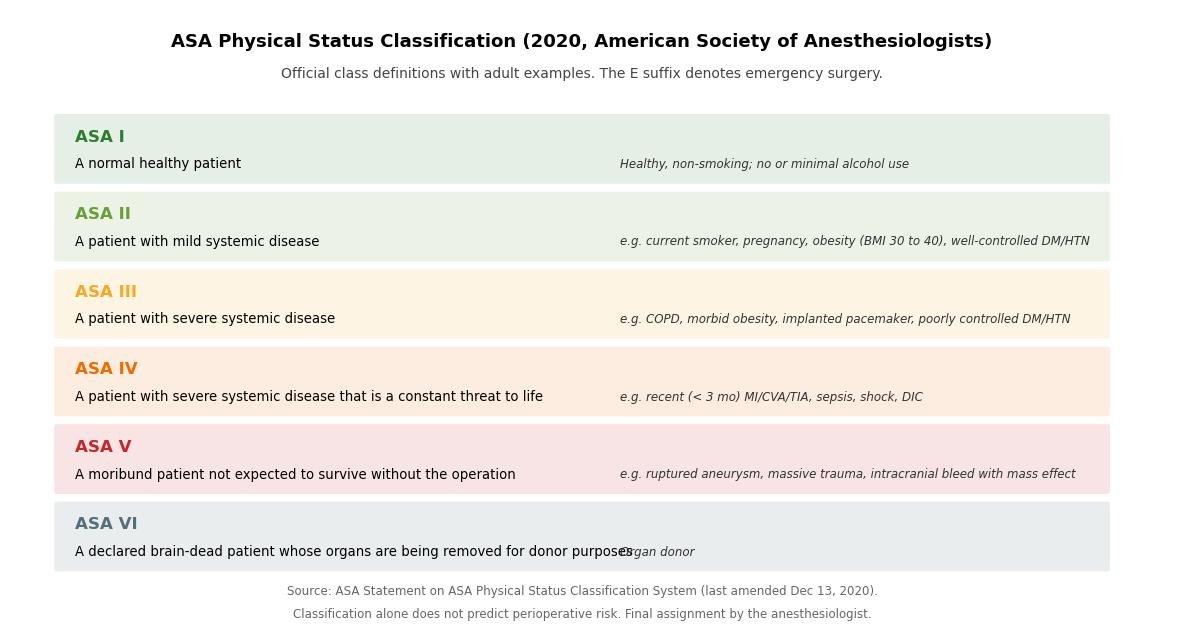
What follows uses the definitions and adult examples exactly as approved in the 2020 ASA statement. The statement calls these guidelines for clinicians rather than rigid definitions, and notes that examples include but are not limited to the listed items.
ASA I: a normal healthy patient
The definition is three words: a normal healthy patient. The adult examples are equally plain: healthy, non-smoking, and no or minimal alcohol use. ASA I is the baseline against which every other class is judged, and it belongs to patients with no acute or chronic disease and no functional limitations.
ASA II: a patient with mild systemic disease
The definition: a patient with mild systemic disease. The approved adult examples describe the flavor precisely: mild diseases only, without substantive functional limitations. The listed examples are a current smoker, a social alcohol drinker, pregnancy, obesity with a body mass index between 30 and 40, well-controlled diabetes or hypertension, and mild lung disease.
Pregnancy deserves a special note, because it surprises people: the ASA statement explicitly says that although pregnancy is not a disease, the parturient's physiologic state is significantly altered compared with when she is not pregnant, hence the assignment of ASA II for a woman with an uncomplicated pregnancy.
ASA III: a patient with severe systemic disease
The definition: a patient with severe systemic disease. The examples pivot on one phrase: substantive functional limitations, and one or more moderate to severe diseases. Approved adult examples include poorly controlled diabetes or hypertension, COPD, morbid obesity (body mass index of 40 or higher), active hepatitis, alcohol dependence or abuse, an implanted pacemaker, a moderate reduction of ejection fraction, end-stage renal disease undergoing regularly scheduled dialysis, and a history more than 3 months old of myocardial infarction, cerebrovascular accident, transient ischemic attack, or coronary artery disease and stents.
ASA IV: a patient with severe systemic disease that is a constant threat to life
The definition: a patient with severe systemic disease that is a constant threat to life. Approved adult examples include a recent event, within 3 months, of myocardial infarction, cerebrovascular accident, transient ischemic attack, or coronary artery disease and stents; ongoing cardiac ischemia or severe valve dysfunction; a severe reduction of ejection fraction; shock; sepsis; disseminated intravascular coagulation (DIC); and acute respiratory distress or end-stage renal disease not undergoing regularly scheduled dialysis.
Notice the deliberate contrasts with ASA III: the same organ systems appear, but the timing or intensity changes. A heart attack more than 3 months ago on a stable patient is ASA III; the same event 6 weeks ago, or ongoing ischemia, is ASA IV. Dialysis on a regular schedule is ASA III; end-stage renal disease without it is ASA IV.
ASA V: a moribund patient who is not expected to survive without the operation
The definition: a moribund patient who is not expected to survive without the operation. Approved adult examples include a ruptured abdominal or thoracic aneurysm, massive trauma, an intracranial bleed with mass effect, and ischemic bowel in the face of significant cardiac pathology or multiple organ or system dysfunction.
ASA V is reserved for patients at the point of death whose only chance of survival runs through the operating room. It is the rarest assignment in elective practice and one of the most consistent predictors of perioperative mortality in outcome registries, though even here the class itself is a description of the patient's state, not a prediction made in isolation.
ASA VI: a declared brain-dead patient whose organs are being removed for donor purposes
The definition is the whole story: a declared brain-dead patient whose organs are being removed for donor purposes. This class exists so that anesthesia care given to organ donors is documented and communicated in the same language as every other case.
The E modifier: what emergency means
The addition of the letter E to any base class denotes emergency surgery. The ASA defines an emergency as existing when delay in treatment of the patient would lead to a significant increase in the threat to life or body part. The suffix can be added to any class: a healthy patient needing an urgent appendectomy is ASA II-E, and a patient with severe systemic disease presenting for an emergency procedure might be ASA IV-E.
The E modifier matters because emergency status is itself a risk factor for perioperative complications, and flagging it alerts the whole team to heightened urgency. In the interactive tool above, ticking the emergency checkbox applies the modifier to whatever class the selected scenario produces.
How the anesthesia team actually uses the ASA class
Once assigned, the ASA class travels with the patient through the perioperative period as a compact summary of their health status. The anesthesia care team uses it to decide the specific anesthesia care plan, the appropriate personnel and setting for intraoperative and postoperative care, and the resources needed to optimize outcomes. A patient classified ASA III or IV will typically prompt more intensive monitoring, a more senior team, and closer postoperative observation than a routine ASA I or II case.
The classification also feeds research and quality improvement. Hospitals and registries use ASA classes for risk adjustment when comparing outcomes, and the 2020 statement explicitly lists data collection, quality metrics, benchmarking, and health services research among the system's applications. Because the language is standard across institutions, an ASA III means roughly the same thing in any hospital that uses the system honestly.
What the classification does not do
Three limitations are worth stating plainly, because they are where misuse happens.
First, the classification alone does not predict perioperative risk. An ASA III patient having a low-risk peripheral procedure under local anesthesia faces a very different risk profile from an ASA III patient having major vascular surgery. The class describes the patient, not the operation, and risk prediction requires combining the class with the type of surgery, frailty, deconditioning, and urgency.
Second, the definitions are deliberately not rigid rules. The ASA calls them guidelines for clinicians and allows institutions to develop their own specific examples to improve communication. Two reasonable anesthesiologists can assign different classes to the same patient, and that disagreement is not necessarily an error: it reflects the judgment the system is designed to structure, not replace.
Third, assignment is the anesthesiologist's responsibility and it is finalized late. The classification may first be considered during the preoperative assessment, but the final assignment is made on the day of anesthesia care by the anesthesiologist after evaluating the patient. A patient's class can legitimately change between the clinic visit and the operating room if their condition changes.
Five judgment calls that change the class
Working through the official examples reveals the lines that matter most in practice.
Pregnancy. An uncomplicated pregnancy is ASA II by explicit statement, even though pregnancy is not a disease. This is one of the few places where the ASA answers the question for you directly.
Smoking versus alcohol dependence. A current smoker with no other disease is ASA II. Alcohol dependence or abuse is ASA III. The distinction is severity and systemic burden, not the habit itself.
The 3-month line. A heart attack, stroke, TIA, or coronary stent more than 3 months ago in a stable patient is ASA III. The same event within the last 3 months, or ongoing cardiac ischemia, is ASA IV. Time since the event is the classifier.
The dialysis schedule. End-stage renal disease on regularly scheduled dialysis is ASA III. The same disease without regularly scheduled dialysis is ASA IV. The schedule is a proxy for how controlled the systemic disease is.
Functional limitation. The single most useful divider between ASA II and ASA III is whether there are substantive functional limitations. Well-controlled hypertension with no symptoms is ASA II; poorly controlled hypertension with limitation of activity is ASA III. When in doubt about II versus III, ask what the patient can still do.
Related calculators
If you are working up a patient for surgery, you may also want the Apfel PONV risk score, which estimates the risk of postoperative nausea and vomiting from four simple risk factors, and the STOP-Bang score, which screens for obstructive sleep apnea, a common and under-recognized perioperative risk.
Key takeaways
- It is a six-class system from the American Society of Anesthesiologists that describes and communicates a patient's pre-anesthesia medical co-morbidities, from ASA I (a normal healthy patient) to ASA VI (a declared brain-dead organ donor).
- The responsible anesthesiologist.
- Yes.
- Not by itself.
Frequently asked questions
What does the ASA physical status classification mean?
It is a six-class system from the American Society of Anesthesiologists that describes and communicates a patient's pre-anesthesia medical co-morbidities, from ASA I (a normal healthy patient) to ASA VI (a declared brain-dead organ donor). Its purpose is assessment and communication of a patient's overall health status before anesthesia care.
Who assigns the ASA class?
The responsible anesthesiologist. The classification may first be considered during the preoperative assessment, but the final assignment is made on the day of anesthesia care after the anesthesiologist evaluates the patient.
Is pregnancy an ASA II?
Yes. The ASA statement notes that although pregnancy is not a disease, the parturient's physiologic state is significantly altered compared with when she is not pregnant, hence the assignment of ASA II for a woman with an uncomplicated pregnancy.
Does the ASA class predict the risk of dying during surgery?
Not by itself. The ASA statement is explicit: the classification system alone does not predict perioperative risks, but used with other factors such as the type of surgery, frailty, and level of deconditioning, it can be helpful in predicting perioperative risks.
What does the E mean in ASA III-E?
The addition of E denotes emergency surgery. An emergency is defined as existing when delay in treatment of the patient would lead to a significant increase in the threat to life or body part. The E suffix can be added to any base class, for example ASA II-E.
Can two anesthesiologists assign different ASA classes to the same patient?
Yes. The ASA describes the system as guidelines for clinicians rather than rigid definitions, so clinical judgment and interpretation play a role. Adding the official examples has been shown to improve correct assignments, and institutions may develop their own specific examples to improve consistency.
References
- American Society of Anesthesiologists. Statement on ASA Physical Status Classification System. Original approval October 15, 2014; last amended December 13, 2020. asahq.org/standards-and-practice-parameters/statement-on-asa-physical-status-classification-system
- American Society of Anesthesiologists. Insurers Set to Ignore Sicker, More Complex Patients Starting July 15. News release, June 2024 (describes the ASA Physical Status system as in use since 1941 and consistently shown to be a predictor of anesthetic risk when used with other factors). asahq.org/about-asa/newsroom/news-releases/2024/06/insurers-set-to-ignore-sicker-more-complex-patients-starting-july-15
- Abouleish AE, et al. ASA provides examples to each ASA physical status class. Cited in the 2020 ASA statement as showing that examples improve assignment. (2015)
- Hurwitz EE, et al. Adding examples to the ASA Physical Status classification improves correct assignment. Cited in the 2020 ASA statement. (2017)
- American Society of Anesthesiologists
- American College of Surgeons