STOP-Bang Questionnaire (OSA Screening) Calculator
In short: Free STOP-Bang questionnaire calculator: answer the 8 validated yes/no items, get your 0-8 score and low, intermediate, or high OSA risk band with the published high-risk refinement, and learn how accurate this screening tool is and what to do next. Use the calculator above, then read the guide below to interpret your result and its limitations.
Answer the 8 validated yes/no items below. The calculator totals your STOP-Bang score from 0 to 8, places it in the low, intermediate, or high risk band, and applies the published high-risk refinement automatically. Items, thresholds, and bands verified against Chung et al., British Journal of Anaesthesia 2012 on 2026-10-05. Medically reviewed by Dr. Taimoor Asghar.
The 8 STOP-Bang items
Instructions: Answer each question yes or no. Each yes counts as 1 point. All 8 items must be answered for a valid score.
What is obstructive sleep apnea?
Obstructive sleep apnea (OSA) is a common sleep-related breathing disorder. During sleep, the muscles of the throat relax more than they should, and the upper airway narrows or closes repeatedly. Each full closure is an apnea; each partial narrowing with a dip in oxygen is a hypopnea. These events fragment sleep, because the brain briefly wakes to reopen the airway, and they cause repeated drops in blood oxygen. A person can have hundreds of these events in a single night and remember nothing about them in the morning. Over time, untreated OSA is linked to high blood pressure, heart disease, stroke, type 2 diabetes, and crashes caused by falling asleep at the wheel or at work.
The standard measure of severity is the apnea-hypopnea index (AHI): the number of apneas and hypopneas per hour of sleep. An AHI of 5 or more is the threshold for OSA, 15 or more marks moderate-to-severe disease, and 30 or more marks severe disease. Population estimates vary, but the validation literature for STOP-Bang describes OSA as affecting 2 to 26 percent of the general population, and large studies such as the Sleep Heart Health Study have found OSA in up to 18 percent of adults, with overt symptomatic disease in about 4 percent of men and 2 percent of women. The gap between how common OSA is and how often it is diagnosed is one of the main reasons screening tools exist: most people with the condition do not know they have it.
What the STOP-Bang questionnaire screens for
The STOP-Bang questionnaire is a simple 8-item screening tool that estimates how likely a person is to have obstructive sleep apnea. It was developed and validated in the surgical population, where unrecognized sleep apnea raises the risk of complications around anesthesia, and it has since been used worldwide in sleep clinics, primary care, occupational health, and preoperative assessment. Completing it takes about a minute, and it needs no equipment and no medical training to score.
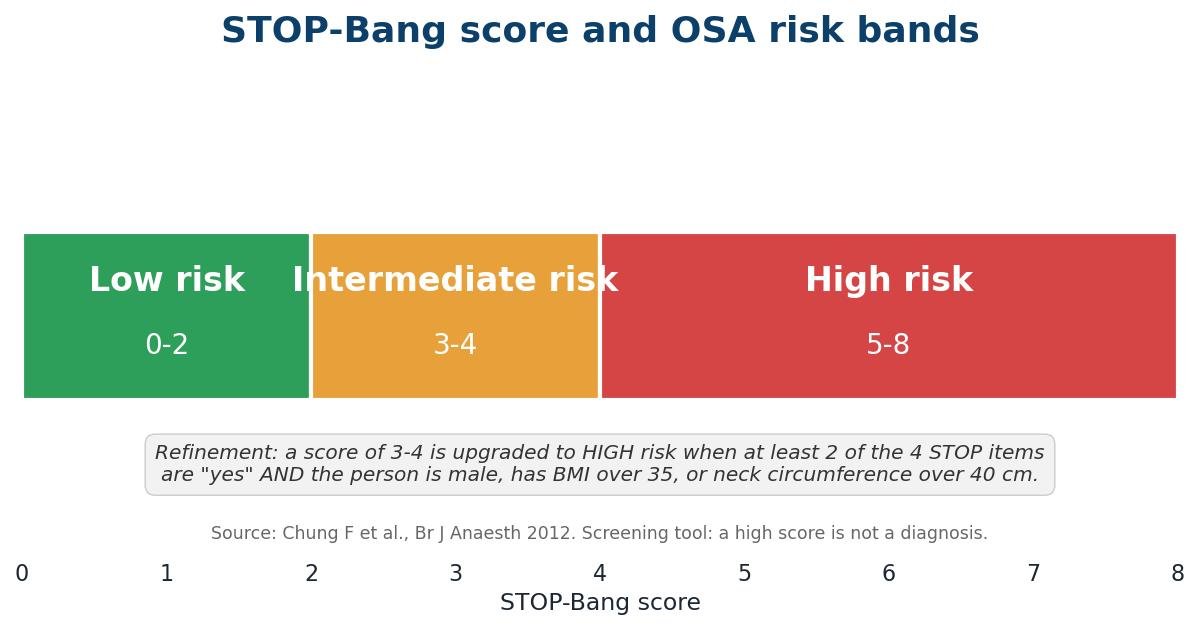
Each of the 8 questions is answered yes or no, and each yes contributes exactly 1 point. The total, from 0 to 8, places the person in a risk band: 0 to 2 is low risk, 3 to 4 is intermediate risk, and 5 to 8 is high risk for moderate-to-severe OSA. There is also a published refinement: someone with a total in the intermediate range who answered yes to at least 2 of the first 4 (STOP) questions, and who is male, has a BMI over 35, or has a neck circumference over 40 cm, is reclassified as high risk. This calculator applies that refinement automatically and tells you when it did.
What the questionnaire screens for is probability, not disease. A high score means sleep apnea is likely enough that formal sleep testing is worth arranging; a low score makes moderate-to-severe apnea unlikely but cannot rule out mild disease. It is a triage instrument: it points clinicians toward who needs the expensive, time-consuming overnight sleep study (polysomnography) and who does not.
The 8 STOP-Bang items and what each one measures
The 8 items were chosen because each one is a known predictor of sleep apnea, and because together they can be remembered as the acronym STOP-Bang. The exact validated wordings are the ones in the questionnaire above; they matter, because changing a question changes the performance of the tool.
S, snoring. "Do you snore loudly (louder than talking or loud enough to be heard through closed doors)?" Snoring is the sound of air forcing its way through a narrowed airway, so loud, habitual snoring is the most visible night-time symptom of OSA.
T, tiredness. "Do you often feel tired, fatigued, or sleepy during the daytime?" Fragmented sleep leaves people unrefreshed despite long nights in bed. If daytime sleepiness is the main symptom, the Epworth Sleepiness Scale calculator measures that separately; tiredness here is one predictor among eight.
O, observed apnea. "Has anyone observed you stop breathing during your sleep?" Witnessed pauses in breathing, sometimes with gasping or choking, are a classic and highly suspicious symptom of OSA, and a bed partner is often the first to notice.
P, blood pressure. "Do you have or are you being treated for high blood pressure?" OSA and hypertension travel together: the repeated oxygen dips and surges of sympathetic activity overnight push blood pressure up, and a large share of people with hard-to-treat hypertension turn out to have undiagnosed apnea.
B, BMI. "Is your BMI more than 35 kg/m2?" Extra weight around the neck and chest narrows the upper airway and reduces the lung volume that holds the airway open during sleep, which is why obesity is the strongest modifiable risk factor for OSA. (BMI is weight in kilograms divided by height in meters squared.)
A, age. "Are you over 50 years old?" The prevalence of sleep apnea rises with age as throat muscle tone falls and fat redistributes.
N, neck circumference. "Is your neck circumference greater than 40 cm?" A thick neck means tissue deposited around the upper airway, which narrows it from the outside. The validated cutoff is 40 cm for everyone; the original paper forms note about 17 inches for men and 16 inches for women as equivalents.
G, gender. "Are you male?" Men develop OSA at higher rates than women, partly because of differences in airway anatomy and fat distribution, so male sex adds one point.
How the scoring works: risk bands and the high-risk refinement
Scoring could not be simpler: count the yes answers. The total is your STOP-Bang score, always a whole number from 0 to 8. The standard interpretation, published by the team that developed the tool, divides the range into three bands:
| STOP-Bang total | Band | What it means |
|---|---|---|
| 0-2 | Low risk | Low probability of moderate-to-severe OSA. Useful mainly for ruling disease out; does not exclude mild apnea. |
| 3-4 | Intermediate risk | The gray zone: probability of OSA climbs through this range. The high-risk refinement below applies here. |
| 5-8 | High risk | High probability of moderate-to-severe OSA. Formal sleep evaluation is warranted. |
In the 2012 validation study of 746 surgical patients, the odds ratios made the gradient explicit. Compared with low scores, the odds of moderate-to-severe OSA were 4.8 at a score of 5, 6.3 at a score of 6, and 6.9 at scores of 7 to 8; the odds of severe OSA were 10.4, 11.6, and 14.9 at the same scores. The predicted probability of moderate-to-severe OSA rose from 0.36 at a score of 3 to 0.60 at scores of 7 to 8.
The high-risk refinement deserves a clear explanation. Suppose a man answers yes to snoring and observed apnea (2 STOP points), plus the male-gender item, for a total of 3. By the plain bands he would land in intermediate risk. But validation work showed that this combination carries a high probability of OSA, so the refined rule reclassifies him: a total of 3 or 4 is upgraded to high risk whenever at least 2 of the first 4 (STOP) answers are yes and at least one of the three strongest demographic predictors, male sex, BMI over 35, or neck circumference over 40 cm, is also yes. Put simply, two suggestive symptoms plus the most OSA-typical body profile is enough to treat the screen as high risk.
One more rule worth stating plainly: the questionnaire is only valid when all 8 items are answered. Skipping the neck-circumference question because you do not own a tape measure does not give you a score out of 7; it gives you an invalid result. This calculator refuses to score until every item has a yes or no, and it tells you by name which items are still blank.
How accurate is the STOP-Bang questionnaire?
The honest headline is that STOP-Bang is built for sensitivity, not specificity. In the original validation against overnight polysomnography, the questionnaire detected 83.6 percent of all OSA (AHI 5 or more), 92.9 percent of moderate-to-severe OSA (AHI 15 or more), and 100 percent of severe OSA (AHI 30 or more). The corresponding negative predictive values, the chance that a negative screen truly means no disease, were 60.8, 90.2, and 100 percent. A later surgical cohort found that a score of 3 or more caught 93 percent of moderate-to-severe and 100 percent of severe OSA, with negative predictive values to match.
The price of that sensitivity is false positives: at the same cutoff of 3, specificity was only 47 percent for moderate and 37 percent for severe OSA, so many people who screen positive turn out not to have apnea on formal testing. That trade-off is deliberate. For a screening tool used before surgery or in a busy clinic, missing severe OSA is far more dangerous than over-referring for a sleep study.
Accuracy also rises steeply with the score itself, which is why the bands matter. In the 2012 validation, the predicted probability of severe OSA was 15 percent at a score of 3, then 25, 35, 45, and 65 percent at scores of 4, 5, 6, and 7 to 8. A systematic review and meta-analysis (Nagappa et al., PLoS ONE 2015) confirmed the questionnaire's role as a screening tool across different populations, while noting the same pattern everywhere: excellent for ruling OSA out and for flagging high-risk patients, modest at pinning the diagnosis down on its own.
Compare that with the alternatives. The Berlin questionnaire is longer and more complex to score. The Epworth Sleepiness Scale measures how sleepy you are, not whether you stop breathing at night, and up to a third of people with confirmed OSA have normal Epworth scores. STOP-Bang's advantage is that it can be completed in about a minute from facts a person already knows, and its disadvantage is exactly what you would expect from a questionnaire: it cannot see your airway.
What to do with your result: screening is not diagnosis
This is the part that matters most. The STOP-Bang questionnaire is a screening instrument: it estimates probability. It cannot diagnose obstructive sleep apnea, and no score on it, high or low, is a diagnosis. The reference standard for diagnosis remains sleep testing: full overnight polysomnography in a sleep laboratory, or a portable (home) sleep study in selected patients. Both were used as the reference in the 2012 validation study, and both measure what the questionnaire cannot: actual apneas, hypopneas, oxygen levels, and sleep stages.
If your score is in the low band, treat the screen as reassuring but not absolute: mild apnea can still be present, and if symptoms such as witnessed apneas or unrefreshing sleep persist, they deserve attention on their own merits. If your score is intermediate, the next step depends on context. Before planned surgery, guidelines treat intermediate scores with caution, and the refined high-risk rule exists precisely to catch people in this band who are likely to have apnea. In everyday life, an intermediate score with symptoms is a good reason to discuss a sleep study with your doctor rather than to wait and see.
If your score is high, arrange a proper sleep evaluation. Bring the score to the appointment, but expect the clinician to take their own history: driving safety, snoring history, blood pressure control, sedating medications, and alcohol use near bedtime all shape what happens next. Effective treatments exist, and they work best when the diagnosis is confirmed properly. Continuous positive airway pressure (CPAP) is the standard treatment for moderate-to-severe OSA; weight loss, positional therapy, and oral appliances have roles in selected patients. None of these should be started on the strength of a questionnaire score alone.
One setting deserves a special note: before anesthesia. Unrecognized OSA raises the risk of airway and breathing complications during and after surgery, which is why STOP-Bang was created for surgical patients in the first place. If you are scheduled for surgery and score high, tell the anesthesia team well in advance so they can plan monitoring and pain control accordingly.
Limitations
No screening tool is perfect, and STOP-Bang's limits are well documented. First, it over-calls: with specificity near 40 percent at the usual cutoff, most positive screens need a sleep study to sort true from false, so a high score is the start of a workup, not its conclusion. Second, it under-detects mild disease: the validation numbers are strongest for moderate-to-severe and severe OSA, and a low score does not exclude mild apnea, which can still matter in people with symptoms or resistant hypertension. Third, it is a snapshot of risk factors, not a measure of sleep: it cannot distinguish OSA from central sleep apnea, hypoventilation syndromes, or the many other things that fragment sleep. Fourth, the demographic items are blunt instruments. A muscular athlete can have a thick neck and a BMI over 35 with no apnea; a slight older woman can have severe apnea with a low score. Finally, the tool was validated mainly in surgical and sleep-clinic populations, where OSA is common, so its positive predictive value is lower in young, lean, asymptomatic people. Clinical judgment, not arithmetic, has the last word.
Tips for an accurate answer
Answer all 8 questions, and answer honestly rather than toward the result you want. For snoring and observed apneas, ask the person who shares your bed or your room; self-reports of snoring are unreliable. For the tiredness question, think about your usual recent weeks, not a single bad night after travel or illness. Measure your neck with a tape at the level of the Adam's apple rather than guessing, and compute your BMI from a recent weight rather than a remembered one. Answer the blood-pressure question as written: yes if you have hypertension, diagnosed or treated. And if you complete the questionnaire for someone else, such as an older parent, answer each item as it applies to them, not to you.
Key takeaways
- No.
- STOP-Bang was developed for surgical patients because unrecognized sleep apnea raises the risk of airway and breathing complications during and after anesthesia.
- Men develop obstructive sleep apnea at higher rates than women, partly because of differences in upper-airway anatomy and fat distribution, so male sex was validated as one of the 8 predictors.
- Yes.
Frequently asked questions
Can the STOP-Bang questionnaire diagnose sleep apnea?
No. STOP-Bang is a screening tool that estimates the probability of obstructive sleep apnea; it cannot diagnose it. The reference standard is sleep testing, either overnight polysomnography in a sleep laboratory or a portable home sleep study, which directly measures apneas, hypopneas, oxygen levels, and sleep stages. A high STOP-Bang score means testing is warranted, and a low score makes significant apnea unlikely but cannot rule out mild disease.
What does a high STOP-Bang score mean before surgery?
STOP-Bang was developed for surgical patients because unrecognized sleep apnea raises the risk of airway and breathing complications during and after anesthesia. If you are scheduled for surgery and score in the high band (or in the intermediate band with the high-risk refinement applied), tell the anesthesia team well in advance so they can plan monitoring, airway management, and pain control accordingly.
Why is being male one of the STOP-Bang questions?
Men develop obstructive sleep apnea at higher rates than women, partly because of differences in upper-airway anatomy and fat distribution, so male sex was validated as one of the 8 predictors. It contributes just 1 point out of 8: women absolutely can have sleep apnea and can reach high scores through the other items, and the questionnaire performs well in both sexes.
Is the 40 cm neck circumference cutoff the same for men and women?
Yes. In the validated scoring, the cutoff is greater than 40 cm for everyone (the original paper forms note about 17 inches for men and 16 inches for women as equivalents). Measure with a tape at the level of the Adam's apple. If your measurement is right at the boundary, treat the result as approximate and discuss it with a clinician rather than rounding yourself into or out of a point.
My STOP-Bang score is 3 or 4. What should I do?
A score of 3 or 4 is the intermediate band: the probability of moderate-to-severe apnea is real but uncertain. First check whether the high-risk refinement applies (2 or more STOP answers plus male sex, BMI over 35, or neck over 40 cm), because that upgrades the screen to high risk. If you have symptoms such as witnessed apneas, loud snoring, or unrefreshing sleep, discuss a sleep study with your doctor. If you are symptom-free, mention the score at your next checkup, and before any planned surgery tell the anesthesia team.
How is STOP-Bang different from the Epworth Sleepiness Scale?
They measure different things. STOP-Bang estimates the probability of obstructive sleep apnea from symptoms plus demographic risk factors, scoring 0 to 8. The Epworth Sleepiness Scale measures your propensity to fall asleep during the day, scoring 0 to 24, and says nothing about whether you stop breathing at night. Up to a third of people with confirmed apnea have normal Epworth scores, which is why the two tools complement rather than replace each other.
Sources
This page's items, thresholds, risk bands, and accuracy figures were verified on 2026-10-05 against the following sources:
- Chung F, Subramanyam R, Liao P, Sasaki E, Shapiro C, Sun Y. High STOP-Bang score indicates a high probability of obstructive sleep apnoea. British Journal of Anaesthesia. 2012;108(5):768-775 (risk bands 0-2 low, 3-4 intermediate, 5-8 high; the high-risk refinement; odds ratios and predicted probabilities per score): doi.org/10.1093/bja/aes022
- Chung F, Yegneswaran B, Liao P, et al. STOP questionnaire: a tool to screen patients for obstructive sleep apnea. Anesthesiology. 2008;108(5):812-821 (the original 8 items, exact wordings, and thresholds BMI over 35, age over 50, neck over 40 cm, male gender; sensitivities 83.6, 92.9, and 100 percent and negative predictive values 60.8, 90.2, and 100 percent at AHI cutoffs 5, 15, and 30).
- Nagappa M, Liao P, Wong J, et al. Validation of the STOP-Bang questionnaire as a screening tool for obstructive sleep apnea among different populations: a systematic review and meta-analysis. PLoS ONE. 2015;10(12):e0143697 (confirmation of the questionnaire's screening role across populations; severe OSA probabilities of 15, 25, 35, 45, and 65 percent at scores of 3, 4, 5, 6, and 7-8).
References and further reading
Medical disclaimer. This calculator is an educational screening tool, not medical advice. The STOP-Bang questionnaire estimates the probability of obstructive sleep apnea; it cannot diagnose sleep apnea or any other condition, and a low score does not exclude mild disease. Do not use it to diagnose, treat, or make decisions about surgery, driving, or any medical condition. Discuss your result with a qualified clinician, and never drive or operate machinery when you feel you might fall asleep.