BODE Index Calculator for COPD
In short: Free BODE index calculator for COPD: BMI, airflow obstruction, dyspnoea and exercise capacity scored 0 to 10, with quartile-based survival estimates from the original cohort. Educational tool, not medical advice. Use the calculator above, then read the guide below to interpret your result and its limitations.
Score the BODE index for chronic obstructive pulmonary disease: body-mass index, airflow obstruction, dyspnoea grade and six-minute walk distance combine to a total of 0 to 10, grouped into quartiles with survival estimates from the original cohort.
The calculator
BODE index: Not yet calculated
Enter all four components and press Calculate.
What the BODE index is
Chronic obstructive pulmonary disease kills more by slow attrition than by sudden catastrophe, which makes prognosis genuinely hard. For decades the field leaned on a single number, the forced expiratory volume in one second, to grade severity and guess at the future. The problem is that FEV1 describes the lungs, not the person. Two patients with identical spirometry can live completely different lives: one still walking the dog, the other housebound and breathless. The BODE index was built to close that gap. Published by Celli, Cote, Marin and colleagues in the New England Journal of Medicine in 2004, it combines four domains into a single 0 to 10 score: Body-mass index, airflow Obstruction, Dyspnoea, and Exercise capacity. In the original study of 625 patients, BODE predicted death better than FEV1 alone, and it has been validated repeatedly since.
The letters are doing real work. Each captures a different way COPD harms people. Body mass reflects the systemic, wasting side of advanced disease. Obstruction captures the lung mechanics. Dyspnoea captures the symptom burden patients actually feel. Exercise capacity captures what the whole system can still do. A score that listens to all four hears the disease more accurately than any one of them alone.
The four components, explained
Body-mass index (0 or 1 point)
BMI above 21 scores 0; 21 or below scores 1. This is the only component capped at 1 point, which reflects its role as a modifier rather than the main driver. Low body mass in COPD is not about vanity metrics: it signals the systemic inflammatory and nutritional toll of severe disease, and it independently predicts mortality. The cutoff is deliberately set at 21, below the usual healthy range boundary, so it flags genuine depletion rather than ordinary thinness.
Airflow obstruction: FEV1 percent of predicted (0 to 3 points)
FEV1 as a percentage of the predicted value for the person's age, sex, height and ethnicity: 65 percent or more scores 0, 50 to 64 scores 1, 36 to 49 scores 2, and 35 or less scores 3. Use post-bronchodilator values from quality spirometry. The predicted value must come from appropriate reference equations for the population; applying the wrong reference set shifts every band and corrupts the score.
Dyspnoea: the mMRC grade (0 to 3 points)
The modified Medical Research Council dyspnoea scale grades breathlessness from 0 to 4 based on what it stops the person doing. Grade 0 means breathless only with strenuous exercise; grade 1, short of breath when hurrying or walking up a slight hill; grade 2, walking slower than people of the same age or stopping for breath at one's own pace; grade 3, stopping after about 100 metres on level ground; grade 4, too breathless to leave the house or breathless when dressing. For BODE, grades 0 and 1 together score 0 points, then each higher grade adds a point: grade 2 scores 1, grade 3 scores 2, grade 4 scores 3. Ask the question exactly as worded; paraphrasing the scale changes the answers.
Exercise capacity: six-minute walk distance (0 to 3 points)
Distance walked in six minutes on a flat 30-metre course: 350 metres or more scores 0, 250 to 349 scores 1, 150 to 249 scores 2, and under 150 scores 3. The test must follow protocol, with standardised encouragement each minute and the patient allowed to rest. Supplemental oxygen, if used, should be noted, because it changes the distance. A walk test done casually down a corridor is not a six-minute walk test, and the points it produces are fiction.
What the total means
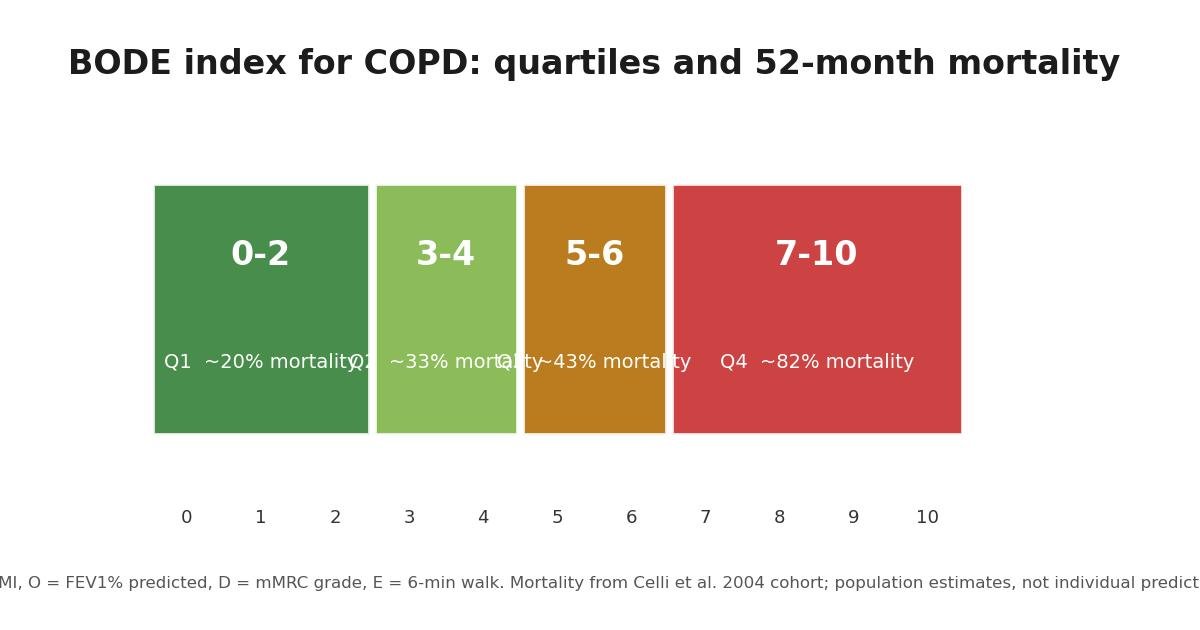
| BODE total | Quartile | Approx. 52-month mortality (original cohort) |
|---|---|---|
| 0 to 2 | Quartile 1 | About 20% |
| 3 to 4 | Quartile 2 | About 33% |
| 5 to 6 | Quartile 3 | About 43% |
| 7 to 10 | Quartile 4 | About 82% |
These survival figures come from the 625 patients Celli and colleagues followed for 52 months. They are the most quoted numbers attached to BODE, and also the most misused. They describe what happened to groups, not what will happen to the person in front of you. A patient in quartile 4 has roughly four chances in five of dying within four years in that cohort's experience, which also means roughly one in five lived. Other cohorts, other eras, other care: the numbers shift. Use quartiles to calibrate the seriousness of the conversation, to prioritise pulmonary rehabilitation, and to open advance care planning at the right time, never to deliver a personal expiry date.
Worked examples
Example 1. A 68-year-old with BMI 24, FEV1 58 percent predicted, mMRC grade 1, and a 380-metre walk. Points: BMI 0, obstruction 1, dyspnoea 0, exercise 0. Total 1, quartile 1. Mild multidimensional disease despite moderate airflow obstruction, which is exactly the kind of nuance BODE adds over FEV1 alone.
Example 2. A 71-year-old with BMI 19, FEV1 32 percent predicted, mMRC grade 3, and a 210-metre walk. Points: BMI 1, obstruction 3, dyspnoea 2, exercise 2. Total 8, quartile 4. The score matches the clinical picture of advanced disease and should prompt rehabilitation referral and a conversation about goals of care.
Example 3. A 64-year-old with BMI 27, FEV1 45 percent predicted, mMRC grade 2, and a 290-metre walk. Points: 0 + 2 + 1 + 1 = 4, quartile 2. Moderate disease; the preserved body mass and reasonable walk distance keep the total down, suggesting rehabilitation could still move the needle.
How BODE is used in practice
A number only matters if it changes what happens next, and BODE earns its place by anchoring three kinds of decisions. The first is pulmonary rehabilitation. Rehab is among the most effective interventions in COPD, improving exercise capacity, breathlessness and quality of life, yet referral rates remain stubbornly low. A BODE in quartile 2 or above is a concrete, defensible trigger to refer: the exercise and dyspnoea components are precisely the domains rehabilitation improves, and re-scoring after a programme gives patient and clinician a shared, honest measure of what was gained.
The second is timing of bigger conversations. Lung transplantation and lung volume reduction are options for a narrow slice of patients, and evaluation takes months; a patient sitting in quartile 3 or 4 deserves to have those doors opened or closed deliberately rather than discovered too late. Similarly, advance care planning lands better when it follows a measured assessment than when it follows a crisis admission. Quoting a quartile is not the point; the point is that the score gives the clinician permission to raise the subject early, when the patient can still shape the plan.
The third use is the humblest and perhaps the most valuable: communication between clinicians. "BODE 6, quartile 3" carries more information in four characters than a paragraph of adjectives. It travels well in referral letters, multidisciplinary meetings and handover notes, and it means the same thing to everyone who reads it. That shared language is what turns a research instrument into a clinical one.
Limitations worth knowing
BODE was derived in COPD and should stay there: it is not validated in asthma, bronchiectasis or interstitial lung disease, however tempting the generalisation. Score it when the patient is stable, not during or just after an exacerbation, when every component is transiently worse. The BMI component behaves oddly at the other end too; severe obesity brings its own risks that BODE does not capture, and the index was not designed for that population. Comorbidities, which kill many COPD patients before their lungs do, sit outside the score entirely. Finally, the survival estimates age: COPD care has improved since 2004, with better exacerbation management and wider rehabilitation, so modern cohorts tend to do somewhat better than the original numbers suggest.
Key takeaways
- The BODE index is a multidimensional scoring system that predicts survival in chronic obstructive pulmonary disease.
- FEV1 alone is an incomplete predictor of what matters to patients with COPD.
- Scores are grouped into quartiles: 0 to 2, 3 to 4, 5 to 6, and 7 to 10.
- The six-minute walk test is done on a flat, straight 30-metre course.