Bicarbonate Deficit Calculator: Sodium Bicarbonate Replacement Estimator
In short: Estimate the bicarbonate deficit in severe metabolic acidosis (0.5 x weight x [target HCO3 - serum HCO3]), the conventional half-dose, and the equivalent volume of 8.4% or 7.5% sodium bicarbonate. Includes when bicarbonate is and is not indicated, cardiac arrest and DKA guidance, and risks. Use the calculator above, then read the guide below to interpret your result and its limitations.
For severe metabolic acidosis. Estimates the bicarbonate deficit, the conventional half-dose, and the equivalent volume of 8.4% or 7.5% sodium bicarbonate, with setting-specific guidance for general critical care, cardiac arrest, and diabetic ketoacidosis.
Calculator
What the bicarbonate deficit means
Metabolic acidosis is a fall in blood pH driven by accumulation of fixed acids or loss of bicarbonate, and the serum bicarbonate concentration is its most visible laboratory marker. A typical adult reference range for serum bicarbonate is about 22-28 mEq/L; in severe metabolic acidosis it can fall into the single digits. When the acidosis is severe enough, clinicians sometimes give intravenous sodium bicarbonate as a temporizing measure, and the bicarbonate deficit is the estimated amount, in milliequivalents, needed to raise the serum bicarbonate from its measured value to a chosen target.
The deficit is an estimate, not a measured quantity. Administered bicarbonate does not stay in the plasma: it distributes through the extracellular fluid and is partly buffered inside cells, so the volume it appears to distribute into, the apparent bicarbonate space, is larger than the plasma volume. Decades of bedside teaching approximate this space as about 50 percent of body weight, which gives the standard formula used by this calculator: deficit (mEq) = 0.5 x weight (kg) x (target HCO3 - serum HCO3). The MSD Manual's treatment formula for severe metabolic acidosis uses the same structure with a 0.4 factor, that is, NaHCO3 required (mEq) = (desired HCO3 - observed HCO3) x 0.4 x body weight (kg), with the desired bicarbonate set from the level needed to reach a pH of 7.10. This calculator offers both, clearly labeled: the standard 0.5 estimate and the low-space 0.4 variant preferred for elderly or volume-depleted patients.
When bicarbonate therapy is indicated, and when it is not
Bicarbonate therapy is one of the more debated interventions in critical care, and the honest summary is that its benefit is narrow and conditional. The indication most experts agree on is severe metabolic acidosis, commonly defined as an arterial pH below about 7.0 to 7.1, where the acidosis itself threatens cardiovascular stability: myocardial contractility falls, vessels respond poorly to catecholamines, and arrhythmia risk rises. The MSD Manual states that despite the controversies, most experts recommend giving bicarbonate IV for severe metabolic acidosis with pH below 7.0, primarily because of concern about worsening cardiovascular instability at lower pH values. Even there, bicarbonate is a bridge, not a cure: it buys time while the underlying cause is treated.
For mild or moderate acidosis, bicarbonate is not indicated. Volume resuscitation restores renal perfusion and endogenous bicarbonate regeneration; insulin stops ketoacid production in DKA; source control and antibiotics address sepsis; dialysis removes the offending toxin or uremic acids. In all of these, the acidosis corrects as the cause resolves, and adding bicarbonate contributes little while adding real risk. That is the central caveat of this entire page: bicarbonate is never a substitute for treating the cause of the acidosis.
Two settings deserve explicit notes because clinicians reach for bicarbonate there and the guidelines say no. In cardiac arrest, the American Heart Association does not recommend routine sodium bicarbonate during resuscitation; the 2020 advanced life support guidelines class it as not recommended for routine use. The exceptions are specific: severe pre-existing metabolic acidosis, life-threatening hyperkalemia, and tricyclic antidepressant overdose. Prolonged downtime alone is not an accepted indication, and the deficit estimator on this page is not a resuscitation dosing tool. In diabetic ketoacidosis, routine bicarbonate is likewise not recommended. The American Diabetes Association reserves it for arterial pH below 6.9, with prompt correction only into the 7.0 to 7.1 range; at pH 7.0 or above, insulin and fluids resolve ketoacidosis on their own, and trials have not shown faster resolution or shorter hospital stays with bicarbonate added. The DKA setting in this calculator therefore shows cautionary guidance rather than an encouragement to dose.
Where the formula comes from
The derivation is simple arithmetic on a physiological approximation. If the apparent bicarbonate space is S liters and the serum bicarbonate must rise by D mEq/L, then S x D milliequivalents of bicarbonate must be added to that space. Setting S to 0.5 liters per kilogram of body weight gives the standard formula. The 0.4 variant in the MSD Manual comes from the same idea with a smaller assumed space, and its worked example is instructive: a 70 kg man with pH 6.92, PCO2 40 mmHg, and HCO3 8 mEq/L needs a target bicarbonate of 0.30 x 40 = 12 mEq/L to reach pH 7.10; the gap of 4 mEq/L times 0.4 times 70 kg gives 112 mEq of bicarbonate, administered over several hours with blood gases rechecked 30 minutes to 1 hour later to allow equilibration with extravascular bicarbonate.
Note what the formula assumes and therefore where it breaks down. It assumes the apparent space is a fixed fraction of weight, but in reality the space expands as acidosis worsens, because more administered bicarbonate is consumed buffering intracellular acid; some protocols therefore use larger factors for profound acidosis. It assumes a stable weight, so it is unreliable in massive fluid shifts, third-spacing, or pregnancy. It assumes the measured bicarbonate reflects the whole space, yet arterial and venous values differ and ongoing acid production keeps moving the target. And it says nothing about ventilation: if the patient cannot blow off the CO2 generated when bicarbonate neutralizes acid, the pH may not improve and intracellular acidosis can paradoxically worsen. These limitations are why the half-dose rule exists.
The half-dose rule and reassessment
Conventional critical care practice is to administer half of the calculated deficit, recheck arterial or venous blood gases after about 30 to 60 minutes, and recalculate from the new bicarbonate level before deciding on any further dose. Three reasons justify this. First, the deficit is an estimate of a moving target: the patient is still generating acid while you infuse, so a full calculated dose is usually wrong by the time it finishes. Second, bicarbonate equilibrates slowly with the extravascular space, so an early repeat gas underestimates the eventual effect and a full upfront dose invites overshoot. Third, overshoot into metabolic alkalosis carries its own harms, including a leftward shift of the oxyhemoglobin dissociation curve that impairs oxygen unloading to tissues, and a fall in ionized calcium that can provoke tetany or seizures. Giving half, waiting for equilibration, and remeasuring converts a rough formula into a safe iterative process. This calculator therefore presents the half-dose as the recommended initial dose and shows the full deficit only as the reference number it was derived from.
Concentrations and how the dose is given
Sodium bicarbonate for injection comes in concentrations that matter for both the maths and the safety. The 8.4% solution contains 1 mEq of bicarbonate per mL, so a standard 50 mL ampule contains 50 mEq. The 7.5% solution contains about 0.89 mEq per mL, because 75 mg per mL divided by the molecular weight of 84 mg per mmol gives 0.89 mmol, and each mmol of sodium bicarbonate yields one mEq of bicarbonate. Dividing the half-dose in mEq by these factors gives the volume to administer, which is exactly what this calculator does.
Bicarbonate is not pushed rapidly. The MSD Manual notes that multiple 50 mL ampules given over a short period can worsen volume overload and cause hyperosmolality, and recommends iso-osmotic admixtures for infusion: 150 mEq of NaHCO3 mixed with 1 liter of sterile water, or 75 mEq mixed with 1 liter of 0.45% saline. In practice the half-dose is typically diluted and infused over one to several hours, with electrolytes and blood gases monitored. Sodium bicarbonate is incompatible in the same line with calcium-containing solutions, because calcium carbonate precipitates, and with many drugs; it should be given through a dedicated line or with verified compatibility.
Risks and adverse effects
Every milliequivalent of sodium bicarbonate carries a milliequivalent of sodium, so the sodium load deserves the first mention. A 175 mEq half-dose delivers 175 mmol of sodium, roughly 4 grams of elemental sodium, and full-deficit dosing in a large patient can deliver far more; in a patient with heart failure, renal failure, or baseline hypernatremia this alone can be dangerous. The accompanying water load matters too: diluents add volume, and concentrated ampules add osmoles, so hyperosmolality and volume overload are real risks of aggressive dosing.
Hypokalemia is the most clinically immediate electrolyte risk. As pH rises, potassium shifts into cells, and insulin, which is often being given simultaneously in DKA, drives potassium down further. Serum potassium must be checked and replaced; giving bicarbonate to a hypokalemic patient without potassium repletion can precipitate dangerous arrhythmias. Overshoot metabolic alkalosis is the reason for the half-dose rule, and severe alkalemia reduces ionized calcium through increased protein binding, which can cause perioral tingling, carpopedal spasm, or seizures, and further depresses cardiac function.
Two more debated harms complete the picture. When bicarbonate neutralizes acid it generates CO2, which crosses cell membranes and the blood-brain barrier far faster than bicarbonate itself; in theory this produces paradoxical intracellular and cerebrospinal fluid acidosis even as the blood pH improves, which is one argument against bicarbonate in DKA, where it has been implicated as a risk factor for cerebral edema in children. In lactic acidosis, some data suggest bicarbonate can stimulate further lactate production and worsen intracellular acidosis. These mechanisms remain contested, but they reinforce the same conclusion: bicarbonate is a conditional, closely monitored intervention for severe acidemia, not a routine corrector of low numbers.
Worked example
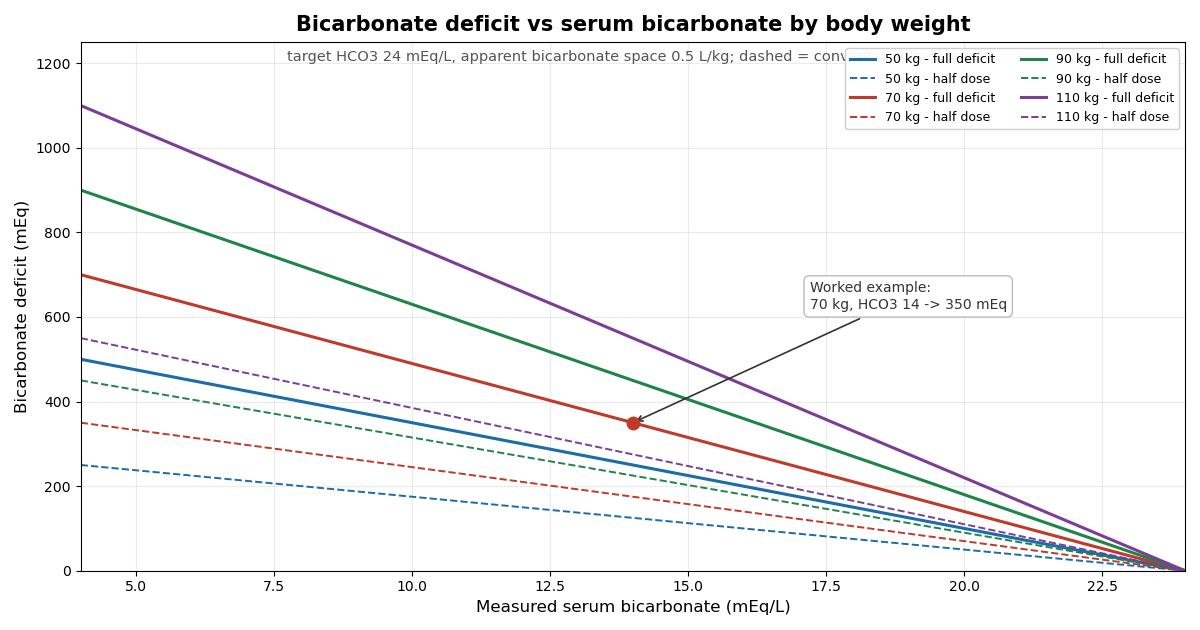
A 70 kg patient has a serum bicarbonate of 14 mEq/L and the target is 24 mEq/L. The standard deficit is 0.5 x 70 x (24 - 14) = 350 mEq. The conventional initial dose is half: 175 mEq. As 8.4% solution at 1 mEq per mL, that is 175 mL, or 175 / 50 = 3.5 ampules of 50 mL. As 7.5% solution at 0.89 mEq per mL, it is 175 / 0.89 = 196.6 mL. The sodium load in the half-dose is 175 mmol. After infusion and a 30 to 60 minute equilibration, a repeat gas gives a new bicarbonate from which the next dose, if any, is recalculated. With the low-space 0.4 variant the same patient has a deficit of 0.4 x 70 x 10 = 280 mEq and a half-dose of 140 mEq.
| Parameter | Standard (0.5) | Low-space (0.4) |
|---|---|---|
| Full deficit, 70 kg, HCO3 14, target 24 | 350 mEq | 280 mEq |
| Conventional initial dose (half) | 175 mEq | 140 mEq |
| Volume of 8.4% NaHCO3 | 175 mL (3.5 ampules) | 140 mL (2.8 ampules) |
| Volume of 7.5% NaHCO3 | 196.6 mL | 157.3 mL |
| Sodium load in the half-dose | 175 mmol Na | 140 mmol Na |
Limitations of this estimator
This calculator implements the standard bedside formula and the conventional half-dose practice; it does not make bicarbonate therapy appropriate. It is an adult estimator: pediatric dosing follows pediatric critical care protocols, not a scaled-down adult formula. It assumes the apparent bicarbonate space is a fixed fraction of weight, which fails in massive volume shifts, severe edema, pregnancy, and end-stage renal disease. It uses a single serum bicarbonate value, but arterial and venous samples differ, and a venous value with poor perfusion can mislead. It cannot account for ongoing acid generation, concurrent therapies such as dialysis or insulin, or the patient's ventilatory capacity to clear the generated CO2. Finally, the setting selector changes guidance, not pharmacology: the decision to give bicarbonate, the infusion rate, the diluent, and the monitoring plan belong to the treating clinician and local protocol. When in doubt, treat the cause first and recheck the gas.
Related calculators
Browse the pulmonology calculators or the full calculator library on Doctor With Data.
Key takeaways
- Bicarbonate is reserved for severe metabolic acidosis, most commonly when arterial pH falls below about 7.0 to 7.1, and only as a temporizing measure while the underlying cause is treated.
- The standard estimate is: bicarbonate deficit (mEq) = 0.5 x body weight (kg) x (target HCO3 - measured HCO3), where both bicarbonate values are in mEq/L.
- Conventional practice is to give half the calculated deficit and then reassess blood gases after 30 to 60 minutes.
- 8.4% sodium bicarbonate contains 1 mEq of bicarbonate per mL, so one 50 mL ampule contains 50 mEq.
Frequently asked questions
When is intravenous sodium bicarbonate actually indicated for metabolic acidosis?
Bicarbonate is reserved for severe metabolic acidosis, most commonly when arterial pH falls below about 7.0 to 7.1, and only as a temporizing measure while the underlying cause is treated. It is not indicated for mild or moderate acidosis, because fluids, insulin, or treatment of the cause usually correct the acid-base disturbance on their own. The MSD Manual notes that despite controversy, most experts give bicarbonate IV for severe metabolic acidosis with pH below 7.0, mainly because of concern about worsening cardiovascular instability at lower pH values.
How is the bicarbonate deficit calculated?
The standard estimate is: bicarbonate deficit (mEq) = 0.5 x body weight (kg) x (target HCO3 - measured HCO3), where both bicarbonate values are in mEq/L. The 0.5 factor is the apparent bicarbonate space, roughly half of body weight, because administered bicarbonate distributes beyond the plasma and is partly buffered intracellularly. A low-space variant uses 0.4 x weight, which matches the MSD Manual treatment formula for raising bicarbonate toward the level needed for a pH of 7.10, and is preferred for elderly or volume-depleted patients.
Why do clinicians give only half the calculated bicarbonate deficit?
Conventional practice is to give half the calculated deficit and then reassess blood gases after 30 to 60 minutes. The formula is only an estimate of a moving target: the patient keeps producing acid, bicarbonate keeps equilibrating with extravascular fluid, and ventilation is still adjusting. Giving the full calculated amount risks overshooting into metabolic alkalosis. The half-dose rule therefore builds in a safety margin, and the dose is recalculated from the new bicarbonate level before any further administration.
How many mEq of bicarbonate are in one ampule of 8.4% sodium bicarbonate?
8.4% sodium bicarbonate contains 1 mEq of bicarbonate per mL, so one 50 mL ampule contains 50 mEq. The 7.5% solution contains about 0.89 mEq per mL (75 mg per mL divided by the molecular weight of 84). These conversions are built into this estimator: divide the half-dose in mEq by 50 to get the number of 50 mL ampules of 8.4% solution.
Should sodium bicarbonate be given during cardiac arrest?
No, not routinely. The American Heart Association does not recommend routine sodium bicarbonate during cardiac arrest (class 3 recommendation in the 2020 advanced life support guidelines). It is considered only for specific situations such as severe pre-existing metabolic acidosis, life-threatening hyperkalemia, or tricyclic antidepressant overdose. The deficit formula on this page is not a resuscitation dosing tool; drug decisions during a code follow the local advanced life support protocol.
Should sodium bicarbonate be given in diabetic ketoacidosis (DKA)?
Routine bicarbonate is not recommended in DKA. The American Diabetes Association reserves it for arterial pH below 6.9, with prompt correction only to the 7.0 to 7.1 range. At pH 7.0 or above, insulin and fluids resolve ketoacidosis without bicarbonate, and studies have not shown faster resolution or shorter hospital stays with bicarbonate. In DKA, bicarbonate adds risks of hypokalemia and, in children, cerebral edema, so potassium must be monitored closely if it is used.
References
- MSD Manual, Professional Edition: Metabolic Acidosis - treatment section. Gives the NaHCO3 dosing formula (desired minus observed HCO3 x 0.4 x body weight), the pH below 7.0 expert consensus, the 50 mEq per 50 mL ampule content, and iso-osmotic admixture recipes. https://msdmanuals.com/professional/nephrology/acid-base-regulation-and-disorders/metabolic-acidosis
- American Heart Association guidance summary: routine use of sodium bicarbonate is not recommended during cardiac arrest (2020 advanced life support guidelines, class 3 recommendation), with exceptions for pre-existing severe metabolic acidosis, hyperkalemia, and tricyclic antidepressant overdose. https://www.thecardiologyadvisor.com/news/aha-issues-updated-guidance-adult-advanced-cardiovascular-life-support/
- American Diabetes Association position on DKA, via Clinician.com review: bicarbonate reserved for serum pH below 6.9 with prompt correction to 7.0-7.1; no outcome benefit shown at higher pH; risks include hypokalemia and cerebral edema. https://www.clinician.com/articles/135938-diabetic-ketoacidosis
- Medscape Critical Care Pearl: Metabolic Acidosis - alternative deficit methods and the typical 10-15 mEq/L partial-correction endpoint used in ICU practice. https://www.medscape.com/viewarticle/808418
- American Thoracic Society
- European Respiratory Society