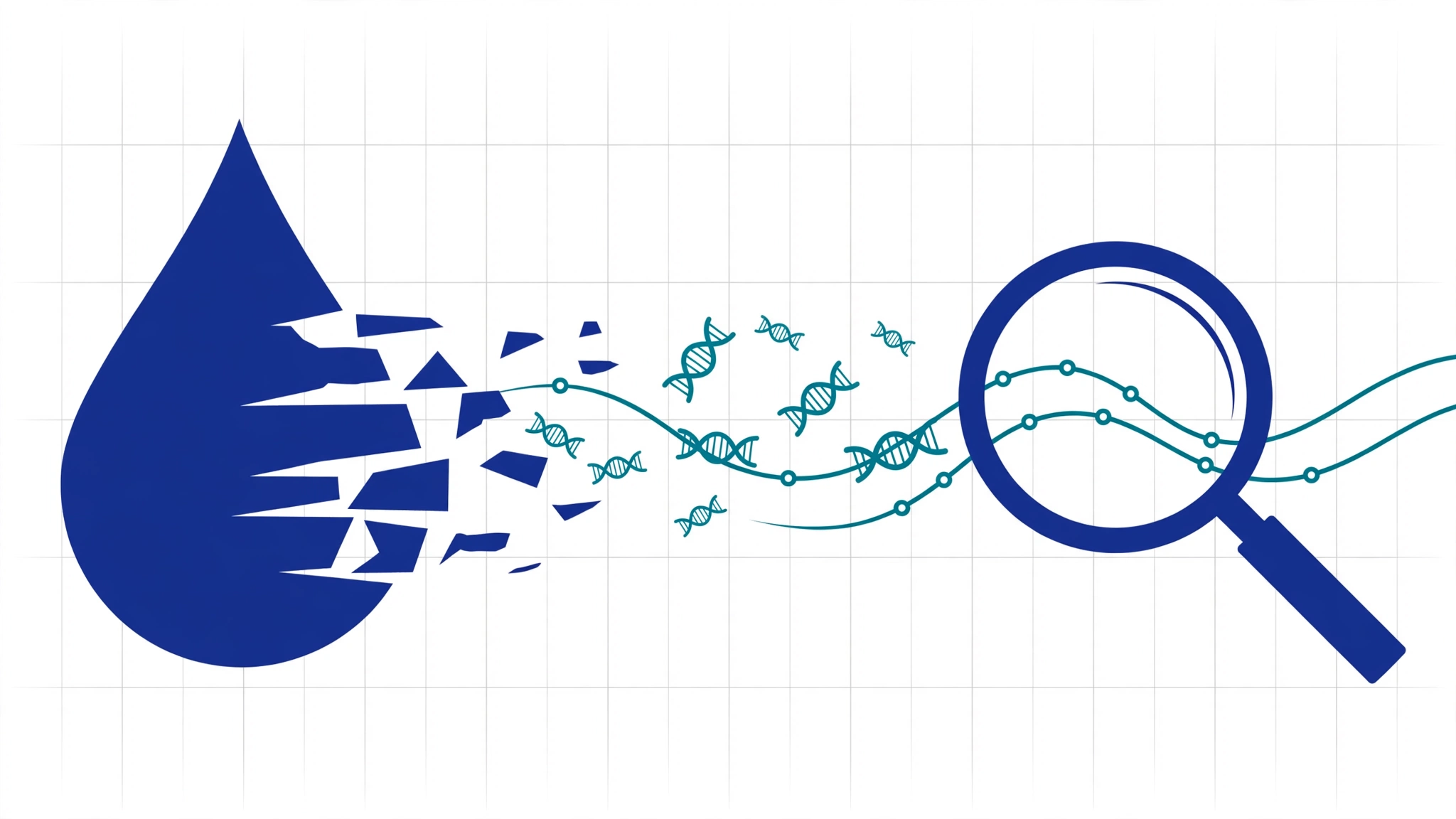
You have probably seen the headline: Guardant Health says its Guardant Reveal blood test has been “validated” for predicting cancer recurrence. The announcement is a company press release, and the word “validated” is doing a lot of heavy lifting. Here is what the study behind it actually shows.
The short version: the Guardant Reveal COSMOS study paper, published 5 October 2026 in Cancer Research Communications, tested the test in 48 patients with surgically removed stage II-III melanoma. It caught 81% of distant recurrences, flagged nobody who stayed cancer-free, and spotted ctDNA a median of 70.5 days before recurrence appeared clinically. A positive blood result four weeks after surgery was linked to roughly a 12-fold higher recurrence risk and more than a 30-fold higher death risk. Real signal – from 48 people.
What COSMOS-MEL01 actually tested
COSMOS stands for COnquer Solid Malignancies by blOod Screening. It is not one study but a prospective programme testing Guardant Reveal across six cancer types. The new paper is the melanoma arm, run at Japanese cancer centres; a colorectal-cancer arm was published separately in 2024.
The design was simple and observational: 48 melanoma patients, 280 blood samples over longitudinal surveillance, asking whether circulating tumour DNA (ctDNA) after surgery predicts recurrence and death. Nobody’s treatment changed because of a test result. Nobody was randomised.
The test itself is “tissue-free” – unlike older ctDNA assays it needs no tumour sample to know what to look for, reading epigenomic patterns instead. Faster results, less logistics. A genuine practical plus, assuming performance holds.
What “validation” means in study-design terms
Validation has layers. This paper clears some, not all.
Analytical validity – does it measure what it claims? Broadly yes. 100% specificity means no recurrence-free patient had a positive post-treatment test; 81% sensitivity means it missed about one in five distant recurrences.
Clinical validity – does the result track outcomes? Yes, strongly. A positive test four weeks post-surgery came with a roughly 12-fold recurrence risk and over 30-fold death risk, with a median 70.5-day warning (up to 273 days in one case).
Clinical utility – does using it improve outcomes? Untested. No one got different treatment based on a result, so there is no evidence that acting on the test extends survival or spares unnecessary therapy. This is the layer that changes guidelines and reimbursement. It is missing.
Then there is the sample size. With 48 patients, “100% specificity” and “30-fold risk” are fragile estimates – a couple of different events could move them. Risk figures from tiny cohorts deserve the same scepticism as any p-value. And you cannot borrow the 342-patient colorectal COSMOS data to cover melanoma. This paper is melanoma evidence only.
What the study cannot prove
- It cannot prove the test works in other cancers. Reveal is marketed for early-stage colorectal, breast and lung cancers too. This paper says nothing about them.
- It cannot prove earlier detection saves lives. Seventy days of warning feels like a win, but if no effective intervention exists in that window, earlier knowledge just lengthens the period of being a patient. Classic lead-time bias – the screening-epidemiology trap every clinician learns and then forgets when the press release lands.
- It cannot rule out spin. Company-sponsored programme, company press release. The paper passed peer review at an AACR journal, which counts – but read the paper, not the headline.
- It did not publish confidence intervals in the release. A 12-fold risk estimate without uncertainty bounds is incomplete information, and with n=48 those bounds are wide.
What a practising doctor should take away before ordering
Treat this as a risk-stratification tool with promising early evidence, not a settled standard of care. A positive ctDNA result four weeks after melanoma surgery marks a very different patient from a negative one – useful for surveillance intensity and trial enrolment. But a negative result is not a guarantee (one in five distant recurrences was missed), and the test should not dictate treatment or replace imaging on this evidence alone.
Honest bottom line: COSMOS-MEL01 is a well-designed small step – prospective, multicentre, clearly reported. That is how test validation should begin. It is not how it ends.
FAQ
Is Guardant Reveal a screening test for healthy people?
No. It detects minimal residual disease in patients who already had cancer removed – not undiagnosed cancer in healthy people. Different test category entirely.
Does a positive result mean the cancer is definitely back?
Not exactly. It means tumour DNA fragments were found in blood, which was strongly associated with later recurrence. In this study no recurrence-free patient tested positive – but 48 patients is a small basis for certainty. A result to discuss with an oncologist, not a verdict.
Can doctors order it for breast or lung cancer?
The test is marketed for those cancers too, but the evidence base differs by indication. This study supports melanoma only.
Disclaimer: this article explains a published research study for educational purposes. It is not medical advice, and it is not a recommendation for or against any test. Decisions about ctDNA testing belong in a conversation between a patient and their oncology team.