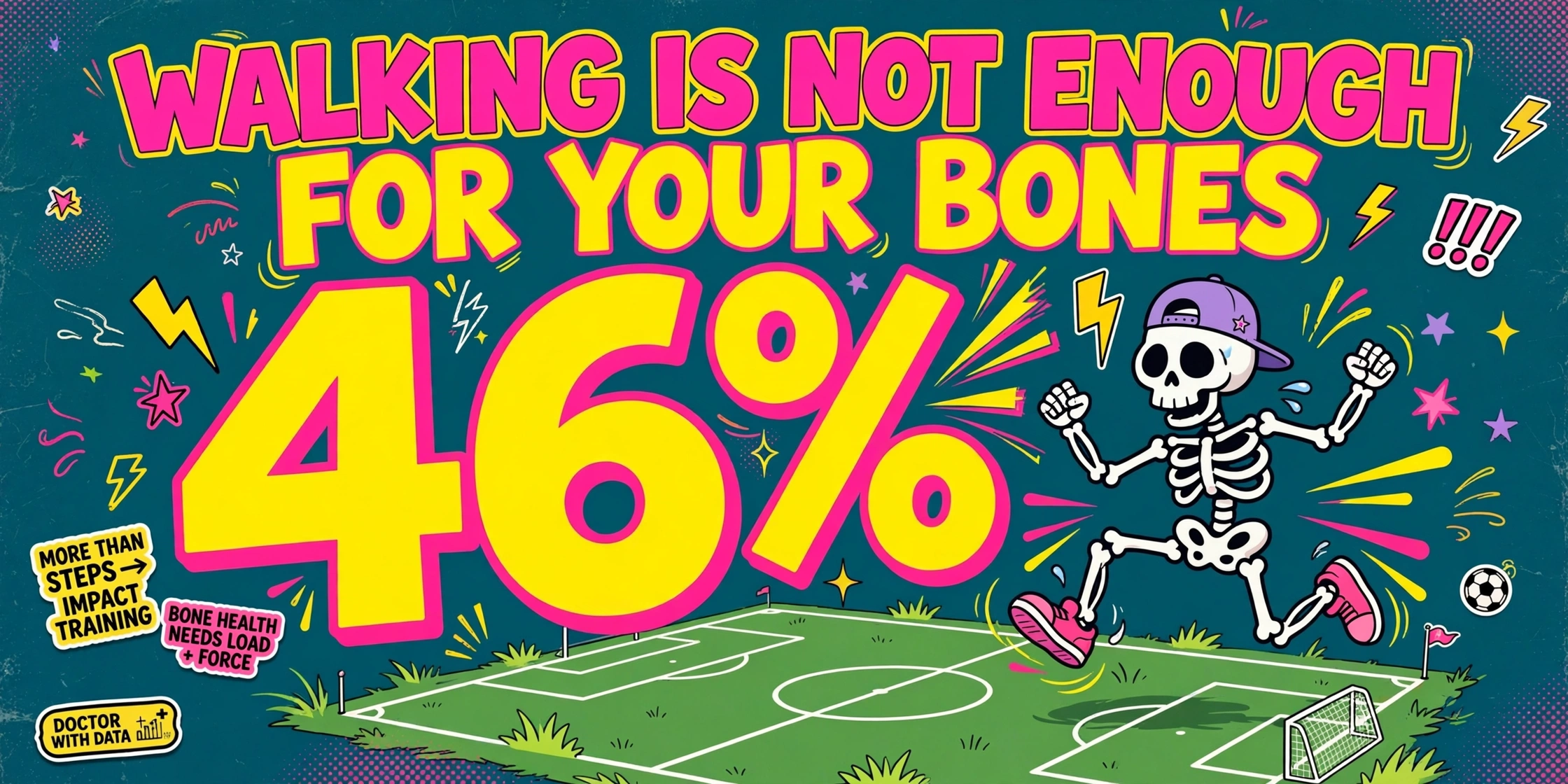
What is the best exercise for bone density? According to a 2026 meta-analysis from Semmelweis University, the answer is neither your daily walk nor the standard gym routine. The researchers pooled 24 clinical trials covering 1,238 healthy adults and found that the activities most effective at stimulating bone formation were high-intensity sports with explosive movements and rapid changes of direction, such as recreational football and handball. These sports were associated with increases of 45% to 46% in blood substances linked to bone formation. In contrast, walking, step aerobics and traditional gym-based resistance exercises were markedly less effective.
If you have spent years believing that a daily walk keeps your skeleton strong, that headline may sting. But the details of the study are more useful than the headline, and they point to a practical change most people can make without giving up the activities they enjoy.
What the researchers actually measured
The study, led by PhD student Viktoria Barna and published in Sports Medicine Open in August 2026 (Barna et al., DOI: 10.1186/s40798-026-00986-2), took an unusual approach. Instead of tracking changes in bone mineral density, which can take months or years to move, the team looked at substances in the blood that show whether the body is actively building new bone tissue.
These bone remodelling biomarkers, including the protein osteocalcin, can reflect the effects of exercise within just a few weeks. That makes them a useful early read on whether a given workout is actually waking the skeleton up, long before a bone density scan would show anything.
The analysis covered 24 trials with 1,238 healthy adult participants in total. What makes it distinctive is that the researchers examined not only the type of exercise, whether endurance, resistance or combined training, but also intensity, frequency and duration. Their stated goal was to determine which forms of exercise stimulate bone metabolism most effectively and which appear to be less beneficial.
One important boundary on what the study can tell us: blood markers of bone formation are an early signal, not a guarantee. The trials did not measure fractures, and they did not track bone mineral density over years. A 46% rise in a bone-formation marker is a strong lead, but it is not the same as proof that playing football cuts your fracture risk. Treat the findings as direction, not as a prescription you would defend against a sceptical rheumatologist.
Why your bones care more about impact than mileage
Bone is living tissue that responds to mechanical strain. When you land from a jump, sprint, stop and turn sharply, the forces travelling through your skeleton tell bone-building cells, osteoblasts, that the structure needs reinforcing. Gentle, repetitive loading does not send the same signal.
This is why the pattern in the meta-analysis makes sense to physiologists. Activities involving explosive movements, rapid changes of direction and turning, exactly the recipe of recreational football and handball, produced the largest increases in bone-formation substances, around 45% to 46%. The skeleton appears to respond to the quality of the impact rather than to how many minutes you exercised.
It is worth noting that the participants in these trials were healthy adults. The findings do not automatically apply to people who already have osteoporosis, joint replacements or significant balance problems, a point we will return to in the safety section.
The surprise: standard gym resistance training fell flat
The finding that caught even the researchers off guard concerned weight training. First author Viktoria Barna described it as the study’s most surprising result: resistance training did not produce a significant effect on markers of bone metabolism, even though several professional guidelines recommend it for maintaining bone health. Likewise, low or moderate intensity endurance exercise, such as walking or jogging, showed no meaningful long-term effect on the same markers.
This does not mean lifting weights is useless. Resistance training protects muscle mass, balance and function, all of which matter enormously for staying independent as you age. Strong muscles also reduce fall risk, and fewer falls mean fewer fractures whatever your bone density. But if your specific goal is to stimulate bone formation, the meta-analysis suggests that standard gym sessions, performed at moderate intensity, may not deliver the mechanical stimulus bones are waiting for.
So should you stop walking?
No, and the researchers are explicit about this. Walking and other lower-intensity activity still carry well-established health benefits. What the study questions is whether walking is sufficient for bone metabolism on its own. Dr Nora Sydo, clinical specialist and co-author, summarised the position: regular physical activity offers many health benefits, yet the findings suggest that low-intensity exercise alone is not sufficient to stimulate bone metabolism. Bones, it seems, need a greater mechanical stimulus.
The practical takeaway is therefore addition, not substitution. Keep the walk, it does more for your heart, weight, mood and sleep than any single other habit, and add a dose of the explosive, multidirectional movement the evidence favours. For most adults, that looks like one or two sessions a week of something bouncy and unpredictable rather than another hour on the treadmill.
Good options that match the study’s recipe:
- Recreational football or handball. The two sports the analysis specifically flagged, with the 45 to 46% marker increases. Many cities have casual over-35 leagues, and both sports mix sprinting, jumping, stopping and turning, the exact stimulus bones respond to.
- Tennis, squash or badminton. Racket sports demand constant bursts of acceleration and sharp direction changes, and they are easy to play socially at any level.
- Dancing. Partner dancing, hip-hop classes or anything with jumps and quick footwork delivers varied, multidirectional loading in a way jogging never will.
- Basketball or netball. Jumping, landing, pivoting and sprinting cover all the bases of the osteogenic recipe.
- Jump-based interval training. If team sports are not your thing, short intervals of box jumps, skipping, hopscotch-style drills or even a few minutes on a trampoline can provide the explosive stimulus. Start small and build up.
A useful rule of thumb from the study: if your exercise could be described as steady and repetitive, it is probably doing less for your bones than something stop-start and multidirectional, however enjoyable the steady option is for everything else.
The safety fine print
The researchers include a clear caution, and it deserves repeating rather than paraphrasing away. High-intensity, explosive exercise is not appropriate to start suddenly or without preparation, particularly for people with cardiovascular, musculoskeletal or metabolic disease, and for people already living with osteoporosis. Anyone in these groups should talk to their GP, treating physician or a sports medicine specialist before adding jumping, sprinting or team sports to their routine, to make sure the activity and its intensity suit their health status.
If you have low bone density, impact exercise needs to be introduced carefully and ideally under professional guidance, because fragile bones do not respond to a sudden mechanical challenge the way healthy ones do. The goal is to challenge the skeleton gradually, not to overwhelm it.
For healthy adults without these conditions, the transition can be gradual too. Start with one weekly session of a stop-start activity, keep your existing routine, and give your tendons and joints a few weeks to adapt before increasing intensity. Bones respond to impact, but tendons respond to patience.
What this means for your week
Putting the evidence together, the bone-building exercise recipe that emerges from the meta-analysis is simple:
- Keep your base of regular activity. Walking, cycling, swimming all still earn their place for heart and general health.
- Add one to two weekly sessions of high-intensity, multidirectional movement: recreational football, handball, tennis, basketball, dancing or jump-based intervals.
- Make sure your existing strength training, if you do any, includes some explosive elements, lighter weights moved quickly, or plyometric movements, rather than only slow, heavy sets.
- Progress gradually, and check with your GP first if you have osteoporosis, heart disease, joint problems or a metabolic condition.
The study’s senior author, Dr Peter Ferdinandy, vice rector for science and innovations at Semmelweis University, said the findings could help improve exercise programmes designed to maintain bone health and prevent osteoporosis. It is easy to see why: the advice it supports is concrete, affordable and, for many people, more fun than the treadmill. Bones do not want more of the same. They want a surprise.
Frequently asked questions
Does walking strengthen bones?
Walking is excellent for overall health, but this meta-analysis found that walking and jogging showed no meaningful long-term effect on blood markers of bone formation. Keep walking for your heart, weight and mood, and add multidirectional, high-intensity activity for your bones.
Is weightlifting good for bone density?
Resistance training builds muscle and protects against falls, both of which reduce fracture risk. But the Semmelweis University meta-analysis found that standard gym-based resistance training did not significantly affect bone metabolism markers, unlike explosive sports such as football and handball.
What exercise builds bone the fastest?
In the 24-trial meta-analysis, recreational football and handball were associated with the largest increases in bone-formation substances, 45% to 46%. The common feature was explosive movement with rapid changes of direction. Racket sports, basketball and jump-based intervals match the same recipe.
Can exercise reverse osteoporosis?
Exercise can support bone health at any age, but the meta-analysis studied healthy adults and measured bone-formation markers, not osteoporosis reversal. If you already have osteoporosis, speak to your GP before starting high-intensity or impact exercise.
How quickly does exercise affect bone formation?
Blood biomarkers of bone formation can reflect the effects of exercise within just a few weeks, much earlier than bone density scans, which typically need months or years to show change.
Sources
- Barna V et al., High-Intensity Training Increases Osteocalcin Levels: A Meta-Analysis of Effects of Exercise on Bone Remodeling Biomarkers, Sports Medicine Open (2026). DOI: 10.1186/s40798-026-00986-2
- Semmelweis University research summary, 4 August 2026 (MedicalXpress report)