CAM-ICU Calculator: Delirium Screening in Intensive Care
In short: Free CAM-ICU calculator: screen for ICU delirium with the four Confusion Assessment Method features, the RASS arousal gate, and the ASE attention test. Educational tool, not medical advice. Use the calculator above, then read the guide below to interpret your result and its limitations.
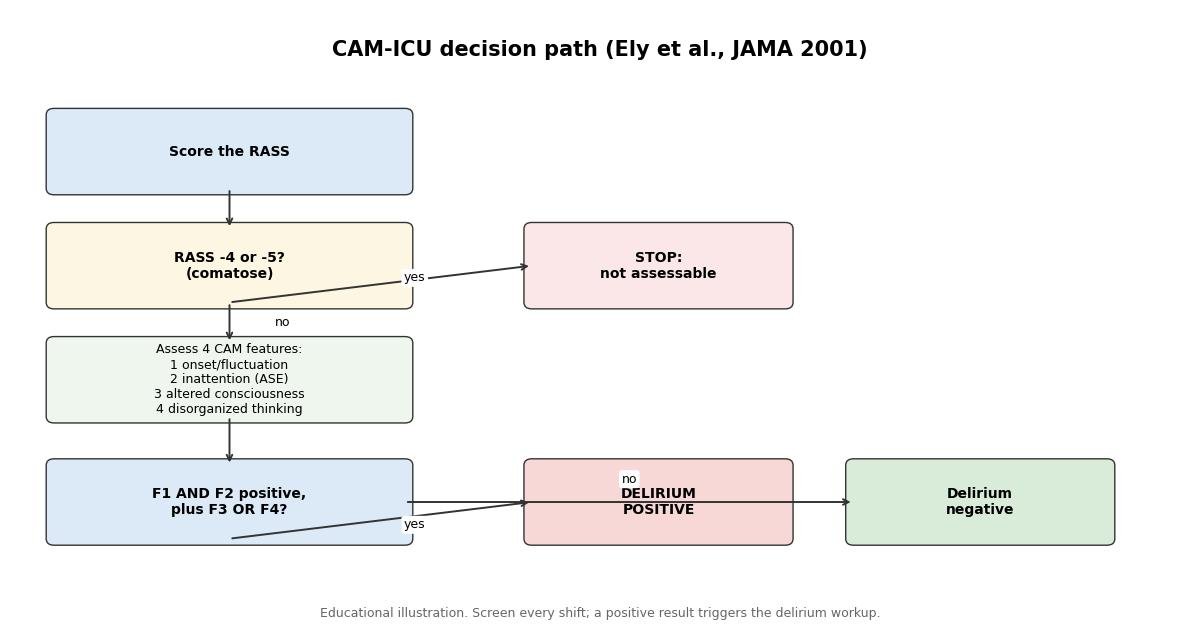
Screen for ICU delirium with the Confusion Assessment Method: the RASS arousal gate, then four features. Delirium is present when features 1 and 2 are positive plus feature 3 or 4.
Select the RASS score and answer the four features to see the result.
What the CAM-ICU is
Delirium affects up to four in five mechanically ventilated ICU patients at some point in their stay, yet without a structured instrument most cases go unrecognised. Hypoactive delirium, the quiet, withdrawn form, is the commonest and the most missed: the patient lies still, makes little eye contact, and is easily mistaken for someone who is simply sedated or "having a quiet day". The Confusion Assessment Method for the Intensive Care Unit was built to fix exactly that blind spot.
Developed by Ely and colleagues and published in JAMA in 2001, the CAM-ICU adapts the Confusion Assessment Method to patients who cannot speak. Where the original CAM asks the patient questions, the CAM-ICU uses non-verbal tasks: squeezing a hand on target letters, nodding at yes/no questions, following simple commands. A trained bedside nurse can complete it in under two minutes, and in the original validation it matched a psychiatrist's DSM-IV diagnosis with sensitivity of 93 to 100 percent and specificity of 89 to 100 percent.
The instrument has four features. Feature 1 is acute onset or fluctuating course: is this different from the patient's baseline, or has behaviour fluctuated over the past 24 hours? Feature 2 is inattention, tested formally. Feature 3 is altered level of consciousness, meaning any RASS other than 0. Feature 4 is disorganized thinking, tested with simple questions and commands. Delirium is present when features 1 and 2 are both positive and either feature 3 or feature 4 is positive. Every other combination is negative.
The RASS gate comes first
Delirium is a disorder of attention and awareness, and you cannot test attention in a patient who cannot be aroused. The CAM-ICU therefore begins with the Richmond Agitation-Sedation Scale. At RASS -4 (deep sedation) or -5 (unarousable), the patient is classed as comatose and the screen stops. There is no point squeezing through the remaining features, and doing so risks labelling deep sedation as delirium.
Assessment proceeds at RASS -3 or lighter. Note what this implies for practice: a unit running deep sedation as routine will find most patients unassessable most of the time, which is itself a reason to favour lighter sedation targets. The gate also explains why the two scales travel together in guidelines and in this calculator's sibling page: the RASS calculator scores arousal, and this page builds on it.
Testing inattention: the ASE
Feature 2, inattention, is the heart of the instrument and the part most often done badly. The Attention Screening Examination has two forms. In the auditory form, the examiner reads the ten-letter sequence S-A-V-E-A-H-A-A-R-T at a steady one letter per second, and the patient squeezes the examiner's hand on every letter A. There are five As in the sequence; more than two errors, misses or false squeezes combined, counts as inattention.
The sequence is deliberately tricky. The As cluster in the middle, so a patient who starts strong and fades, or who squeezes at everything, both fail. That is the point: sustained attention over ten seconds is exactly what delirium destroys first. For patients who cannot follow the auditory task, a picture-recognition version exists: five simple drawings are shown, then ten more, and the patient nods at the ones seen before. The principle is identical.
Feature 4, disorganized thinking, uses four yes/no questions (for example, "Will a stone float on water?", "Are there fish in the sea?", "Does one pound weigh more than two pounds?", "Can you use a hammer to pound a nail?") plus two commands ("Hold up this many fingers", then "Now do the same with the other hand"). More than one error across the set counts as positive. The questions are intentionally simple: a patient who fails them is not merely confused, they have lost the thread of basic reasoning.
What a positive screen means
A positive CAM-ICU is the start of work, not the end of it. Delirium is a symptom, and the screen's job is to trigger the search for causes. The usual suspects in the ICU form a long list: infection and sepsis, hypoxia, hypotension, metabolic derangements (sodium, glucose, urea, liver failure), new medications (benzodiazepines, anticholinergics, opioids, steroids), alcohol or drug withdrawal, pain, urinary retention, constipation, sleep deprivation, and sensory deprivation in patients without their glasses or hearing aids.
Management is cause-directed and non-pharmacological first. The evidence-backed bundle includes regular reorientation (clocks, daylight, familiar voices), sleep hygiene (noise and light reduction at night), early mobilisation, ensuring glasses and hearing aids are in place, adequate pain control, and minimising restraints, catheters, and deliriogenic drugs. Antipsychotics do not treat delirium itself and are reserved, per current guidelines, for severe agitation that threatens the safety of the patient or staff, at the lowest effective dose for the shortest time.
A negative screen is reassuring but not a clean bill of health for the day. Delirium fluctuates over hours, which is why guidelines recommend screening every shift and whenever mental status changes. A patient who is negative in the morning can be floridly delirious by the evening, and the fluctuation itself is one of the diagnostic features.
Delirium versus lookalikes
Three conditions are commonly confused with delirium, and the CAM-ICU's structure helps separate them. Dementia is chronic and stable, without the acute onset or fluctuation of feature 1; a patient with dementia can still develop superimposed delirium, which is why knowing the baseline matters. Depression can mimic hypoactive delirium, but it lacks inattention on formal testing and does not fluctuate hour to hour. And deep sedation, as discussed, is excluded by the RASS gate before the features are even assessed.
Getting this right matters because the treatments differ completely. Dementia needs long-term support, depression needs psychiatric care, oversedation needs the infusions lightened, and delirium needs the precipitant hunt. A screening instrument earns its keep by routing the patient down the right one of these paths.
Worked examples
Example 1. A ventilated patient is RASS -1. Compared with yesterday he is different (feature 1 positive). On the ASE letters he makes 4 errors (feature 2 positive). RASS is not 0 (feature 3 positive). Commands: 0 errors (feature 4 negative). Features 1, 2, and 3 are positive, so the CAM-ICU is positive: delirium.
Example 2. A patient is RASS 0, calm and attentive. No change from baseline (feature 1 negative), 1 error on ASE (feature 2 negative). The screen is negative regardless of the other features, because features 1 and 2 are both required.
Example 3. A patient is RASS -5 after a propofol bolus. The screen stops at the gate: not assessable, classed as coma. The team plans reassessment after the sedation hold.
Preventing delirium: the ABCDEF bundle
Screening finds delirium; prevention stops it starting. The ABCDEF bundle is the evidence-backed package that ICU teams use to do both. Each letter is a daily, coordinated intervention. A is assess, prevent, and manage pain: pain drives agitation, and unrelieved pain is itself a delirium risk, so regular pain assessment with a validated tool comes before any sedation decision. B is both spontaneous awakening trials and spontaneous breathing trials: daily, coordinated pauses in sedation and ventilator support, which shorten ventilation and reduce delirium days.
C is choice of sedation: favouring lighter targets and agents with lower delirium risk, and avoiding benzodiazepines where possible. The evidence here connects directly back to the two calculators on this site: units that hold patients in the RASS -2 to 0 band, and that screen with the CAM-ICU every shift, consistently report less delirium than units running deep sedation without structured screening. D is delirium assessment, prevention, and management: this page's instrument, used routinely, plus the non-pharmacological measures described above. E is early mobility and exercise, even for ventilated patients: sitting on the edge of the bed, standing, walking with support. Immobility feeds delirium, and mobilisation reverses it. F is family engagement and empowerment: familiar voices, orientation, and participation in care, which re-anchor a disoriented patient better than any drug.
The bundle works as a bundle. Studies of partial implementation show partial benefit; the full effect appears when the whole team, nurses, physiotherapists, pharmacists, doctors, and families, delivers all six elements together. For the person using this calculator, the practical takeaway is simple: a positive CAM-ICU should not only trigger the precipitant hunt, it should trigger a review of whether the bundle is actually being delivered to that patient, that day.
Key takeaways
- The Confusion Assessment Method for the Intensive Care Unit is a bedside delirium screening instrument designed for patients who cannot speak, including those on ventilators.
- Delirium can only be assessed in a patient who is arousable.
- Inattention is tested with the Attention Screening Examination.
- A positive screen should trigger the standard delirium workup: look for precipitants such as infection, hypoxia, metabolic derangement, new medications (especially sedatives and anticholinergics), pain, sleep deprivation, and sensory deprivation.