RASS Calculator: Richmond Agitation-Sedation Scale
In short: Free RASS calculator: score agitation and sedation from +4 (combative) to -5 (unarousable) with the published descriptors, the stepwise assessment procedure, and the commonly targeted range. Educational tool, not medical advice. Use the calculator above, then read the guide below to interpret your result and its limitations.
Score agitation and sedation on the ten-point Richmond scale, from +4 (combative) to -5 (unarousable), using the published descriptors and the stepwise assessment procedure.
Select a level above to see the RASS score and interpretation.
What the Richmond Agitation-Sedation Scale is
The Richmond Agitation-Sedation Scale, universally known as the RASS, is the standard instrument for measuring how awake, agitated, or sedated a critically ill patient is. Developed by Sessler and colleagues and published in the American Journal of Respiratory and Critical Care Medicine in 2002, it replaced a patchwork of older sedation scores that were vague, hard to reproduce between observers, or unable to capture agitation and sedation on the same continuum.
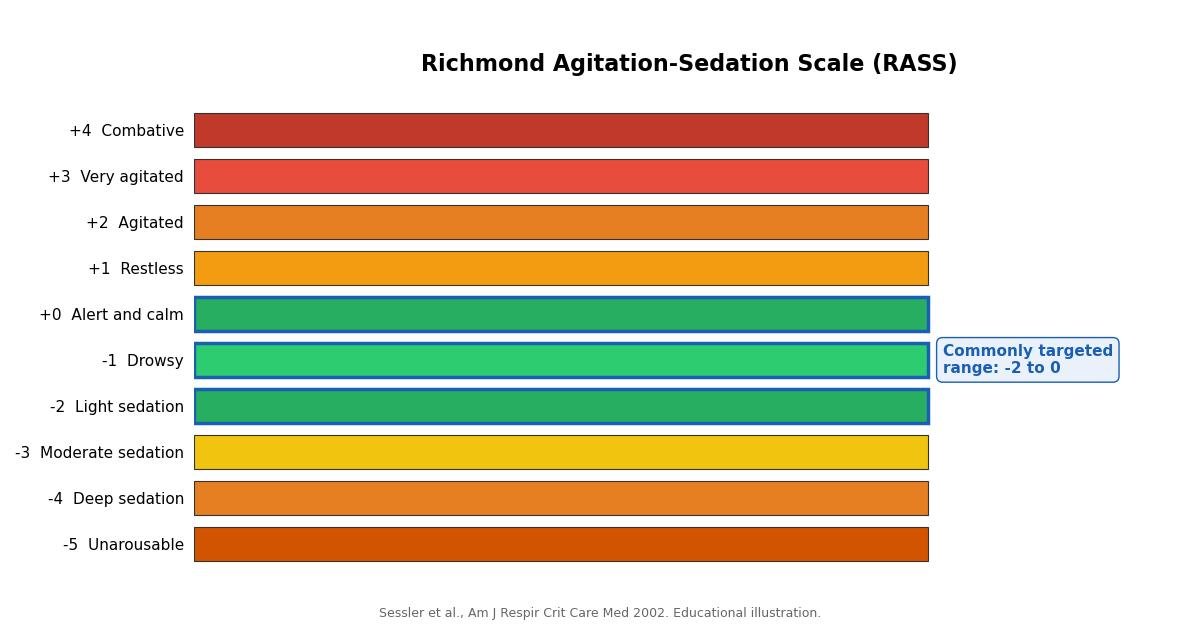
The scale runs from +4 to -5. Positive numbers describe agitation: +4 is combative, +3 very agitated, +2 agitated, +1 restless. Zero means alert and calm. Negative numbers describe deepening sedation: -1 drowsy, -2 lightly sedated, -3 moderately sedated, -4 deeply sedated, -5 unarousable. One number therefore tells the whole team, at a glance, where the patient sits and in which direction they are moving.
That shared language is the point. In an intensive care unit, sedation is titrated continuously against a target, and the target only works if every nurse, doctor, and therapist means the same thing by it. The RASS gives ten clearly described anchor points instead of vague instructions like "keep comfortable". When the chart says RASS -2, everyone knows exactly what was observed.
How the assessment is performed
The RASS is not a questionnaire. It is a brief structured examination, and the order matters. The published procedure runs in three steps, and you stop at the first step that gives you an answer.
Step 1: observe. Watch the patient without touching them. If they are alert and calm, that is 0. If they are restless, anxious, or overtly agitated, score +1 to +4 on observation alone. No stimulation is needed, and none should be given, because stimulating an agitated patient only makes the assessment worse.
Step 2: voice. If the patient is not alert, call their name and ask them to open their eyes and look at you. Sustained eye opening with eye contact lasting ten seconds or more is -1. Brief eye contact lasting less than ten seconds is -2. Any movement or eye opening without eye contact is -3.
Step 3: physical stimulation. If there is no response to voice, shake the shoulder or rub the sternum. Movement or eye opening to physical stimulation is -4. No response to voice or physical stimulation is -5.
The sequence protects the score's meaning. A patient who opens their eyes to voice is -2 or -3, never -4, because -4 explicitly requires no response to voice. Skipping steps, or scoring on a hunch, is how the scale loses its reliability.
The full ten levels
| Score | Level | What you see |
|---|---|---|
| +4 | Combative | Overtly combative, violent, immediate danger to staff. |
| +3 | Very agitated | Pulls or removes tubes or catheters; aggressive. |
| +2 | Agitated | Frequent non-purposeful movement, fights the ventilator. |
| +1 | Restless | Anxious but movements not aggressive or vigorous. |
| 0 | Alert and calm | Spontaneously attentive to surroundings. |
| -1 | Drowsy | Not fully alert, but sustained awakening (eye opening and eye contact) to voice for 10 seconds or more. |
| -2 | Light sedation | Briefly awakens with eye contact to voice, less than 10 seconds. |
| -3 | Moderate sedation | Movement or eye opening to voice, but no eye contact. |
| -4 | Deep sedation | No response to voice, but movement or eye opening to physical stimulation. |
| -5 | Unarousable | No response to voice or physical stimulation. |
What target to aim for
For most mechanically ventilated ICU patients, the commonly targeted range is light sedation: RASS -2 to 0. The reasoning comes from a consistent body of critical care literature associating lighter sedation with shorter time on the ventilator, shorter ICU stays, and less delirium. Modern PADIS guidelines (2018) recommend targeting light sedation as the default, and this calculator flags scores in that range.
Deeper sedation, RASS -3 to -5, is not wrong in itself. It is indicated for specific situations: severe acute respiratory distress syndrome with ventilator dyssynchrony, raised intracranial pressure, status epilepticus, therapeutic hypothermia, or the immediate post-operative period after major surgery. The key point is that deep sedation should be a deliberate choice for a reason, not the accidental result of infusions left running.
Agitation, the positive side of the scale, is never a target. A RASS of +1 or higher should prompt a search for causes: pain, delirium, hypoxia, a blocked endotracheal tube, urinary retention, withdrawal, or fear. Sedating an agitated patient without asking why is one of the classic ICU errors the scale was designed to prevent.
RASS and delirium screening
The RASS does double duty as the gatekeeper for delirium assessment. The Confusion Assessment Method for the ICU (CAM-ICU) can only be performed when the patient is assessable, which means RASS -3 or lighter. At RASS -4 or -5 the patient is classed as comatose, and delirium cannot be assessed until sedation lightens.
This distinction matters because deep sedation and hypoactive delirium look identical from the foot of the bed: a quiet, unresponsive patient. One is a drug effect that lifts when infusions stop; the other is acute brain dysfunction with its own causes and consequences. Scoring the RASS first forces the team to separate the two instead of conflating them.
Worked examples
Example 1. A ventilated patient lies still with eyes closed. Called by name, she opens her eyes, makes eye contact, and holds it while you count to twelve. RASS -1: drowsy, within the target range.
Example 2. A patient repeatedly reaches for his endotracheal tube and has pulled out his nasogastric tube twice. RASS +3: very agitated. The response is not simply more sedation but a search for the cause, starting with pain and delirium.
Example 3. A patient with severe ARDS is on deep sedation for ventilator synchrony. No response to voice; on sternal rub, the eyes open briefly without tracking. RASS -4: deep sedation, appropriate here for the indication, with a daily plan to reassess whether it is still needed.
Limitations
The RASS was validated in critically ill adults, mostly ventilated, and its descriptors assume a patient who could potentially follow commands. It is not validated in children, for whom paediatric sedation scales exist. It does not measure pain, which must be assessed separately, and a calm score does not mean a comfortable patient. Like every bedside scale, it is only as good as the technique: the fixed observation-voice-stimulation sequence is part of the instrument, not optional decoration.
Documenting and trending the RASS
A single RASS score is a snapshot; the trend is the story. Most ICUs record the RASS at least every four hours and with every sedation change, and the resulting curve shows at a glance whether the patient is tracking the target, drifting deeper than intended, or cycling between agitation and oversedation. That cycling pattern, sometimes called the "roller coaster", is itself informative: it often means bolus dosing is chasing agitation rather than a steady infusion holding a target, and it usually resolves when the team switches strategy.
Documentation should capture more than the number. The conditions of the assessment matter: was the score taken during a spontaneous awakening trial, after a bolus, or during routine care? A RASS of -1 during a sedation hold means something different from the same score two hours after a midazolam bolus. Good charting also notes what was done about the score, because a number without a response is just decoration. If the target is -2 to 0 and the patient scores +2, the record should show the cause found and the action taken, not just the digit.
There are settings where the RASS needs adaptation. In patients with neuromuscular blockade, no behavioural scale works at all, since the patient cannot move; depth is then followed with processed EEG or clinical judgement, and the RASS resumes when blockade lifts. In patients with severe brain injury, the motor responses the scale relies on may reflect the injury rather than sedation depth, so the score is interpreted alongside the neurological examination. And in the dying patient receiving palliative sedation, the RASS can still describe the level of consciousness, but the target is comfort as defined by the patient and family, not a number from a guideline.
Finally, the RASS belongs to the bedside nurse more than to any other clinician. Nurses perform the overwhelming majority of assessments, titrate the infusions, and spot the trends first. Units where nurses are empowered to titrate within a prescribed target range consistently achieve lighter sedation and better outcomes than units where every change waits for a doctor's order. The scale works because it gives the person at the bedside a precise, defensible language for what they see.
Key takeaways
- The Richmond Agitation-Sedation Scale measures a patient's level of agitation or sedation on a single ten-point continuum.
- The assessment follows a fixed sequence.
- For most mechanically ventilated ICU patients, guidelines commonly target light sedation, usually a RASS of -2 to 0, because lighter sedation is associated with shorter ventilation times and less delirium in the supporting literature.
- The RASS is the gatekeeper for delirium screening with the CAM-ICU.