qSOFA calculator
Enter the three bedside measurements, then press Calculate qSOFA. Each criterion met scores 1 point; the total ranges from 0 to 3.
qSOFA score: 0 / 3
What is the qSOFA score?
The quick Sequential Organ Failure Assessment, universally shortened to qSOFA, is a three-item bedside score published in 2016 as part of the Third International Consensus Definitions for Sepsis and Septic Shock, known as Sepsis-3. It was created to solve a practical problem. The full Sequential Organ Failure Assessment (SOFA) score covers six organ systems and needs several laboratory tests, which takes time and is not always available at the bedside, especially in a busy emergency department or on a general ward. qSOFA strips the assessment down to three clinical signs that any trained clinician can measure in under a minute: the respiratory rate, the level of consciousness expressed through the Glasgow Coma Scale, and the systolic blood pressure.
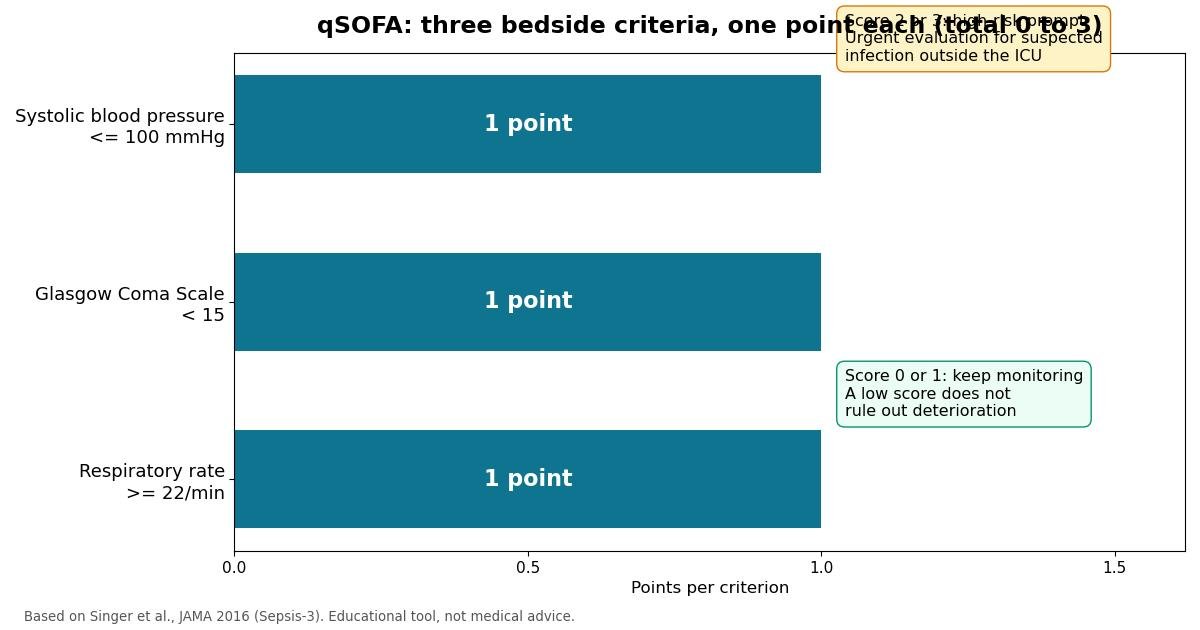
Each abnormal sign earns one point, giving a total from 0 to 3. A total of 2 or more in an adult with suspected infection outside the intensive care unit flags a high risk of a poor outcome, such as a prolonged stay in intensive care or death in hospital. Crucially, qSOFA is a prompt for action, not a diagnosis. It tells the clinician to look harder for organ dysfunction, to consider escalating treatment, and to monitor the patient more closely. It never replaces bedside judgment, and a low score never rules out a deteriorating patient.
The three criteria, one point each
The Sepsis-3 task force selected the three variables through multivariable modelling on large patient cohorts, then simplified the cut points so the tool could be used at the bedside without a computer. Each criterion that is met contributes exactly one point.
Respiratory rate of 22 breaths per minute or more
Fast breathing is often the earliest visible sign that the body is compensating for trouble: the lungs working harder to clear carbon dioxide in metabolic acidosis, to correct low oxygen, or to keep up with the metabolic demands of a serious infection. The validation work found that a rate of 22 per minute or more carried the predictive signal, so a patient breathing at 22 or faster scores 1 point on this criterion.
Altered mentation: Glasgow Coma Scale below 15
A fully alert adult scores 15 on the Glasgow Coma Scale. Any score below 15 means the brain is not functioning normally, whether from poor perfusion, low oxygen, or the systemic effects of infection. The original statistical model used a stricter cut point of 13 or less, but the task force checked and found that simplifying to any score below 15 did not reduce predictive validity, while making the tool far easier to apply. So a GCS of 14 or less scores 1 point.
Systolic blood pressure of 100 mmHg or less
A falling systolic pressure signals that the circulation is failing to keep up with the body's demands, an early step on the road toward shock. A systolic reading of 100 mmHg or less scores 1 point. Add the points from the three criteria to get the total qSOFA score from 0 to 3.
How this calculator works
Enter the respiratory rate in breaths per minute, the Glasgow Coma Scale score from 3 to 15, and the systolic blood pressure in mmHg, then press Calculate qSOFA. The calculator applies the published Sepsis-3 thresholds exactly: 1 point for a respiratory rate of 22 or more, 1 point for a GCS below 15, and 1 point for a systolic pressure of 100 or less. It shows the total from 0 to 3 with a line-by-line breakdown, so you can see precisely which criteria were met, and it flags scores of 2 or more as high risk. Inputs outside plausible ranges are rejected with a clear message rather than silently producing a wrong score. The calculation runs entirely in your browser and nothing is sent to a server. Because the tool is fully deterministic, the same inputs always give the same score, every time.
Interpreting the result
Score 0. None of the three criteria are met. The risk of a poor outcome appears lower at this moment. Continue routine monitoring and repeat the qSOFA if anything about the patient changes. A score of 0 does not guarantee safety, and it does not exclude infection or sepsis.
Score 1. One criterion is met. This calls for watchful care: monitor the patient closely, repeat the qSOFA, look actively for the source of infection, and watch for early signs of organ dysfunction. Many patients who later deteriorate pass through a score of 1 on the way.
Score 2 or 3. This is the high-risk prompt. In the Sepsis-3 validation work, non-ICU patients with suspected infection and a qSOFA of 2 or more had a 3- to 14-fold increase in hospital mortality compared with patients scoring below 2, across deciles of baseline risk. The Sepsis-3 task force advises that such a score should prompt the clinician to investigate further for organ dysfunction, to start or escalate therapy as appropriate, to consider referral to critical care, and to increase the frequency of monitoring. A positive score should also prompt the clinician to consider that an infection may be present even if it was not previously recognized.
Whatever the score, remember what qSOFA is not. It does not diagnose sepsis. The diagnosis of sepsis under Sepsis-3 rests on life-threatening organ dysfunction caused by a dysregulated host response to infection, operationalized as an increase in the SOFA score of 2 points or more. qSOFA is the alarm bell; the full assessment comes after.
qSOFA and the Sepsis-3 definitions
In 2016 the Sepsis-3 task force redefined sepsis as life-threatening organ dysfunction caused by a dysregulated host response to infection. For clinical use, organ dysfunction is represented by an acute increase in the total SOFA score of 2 points or more consequent to the infection, a change associated with an in-hospital mortality greater than 10 percent. The redefinition moved the field away from the older systemic inflammatory response syndrome (SIRS) criteria, which were sensitive but so non-specific that they flagged many patients without sepsis.
qSOFA was born alongside the new definition as a practical companion, not as part of the definition itself. The full SOFA score needs arterial blood gases, platelet counts, bilirubin, creatinine, blood pressure data, and the GCS, so it cannot be completed instantly at the bedside. The task force therefore derived a parsimonious three-variable model that needed no laboratory tests and could be assessed quickly and repeatedly. That model is qSOFA. Its purpose was always narrow: to identify, among adults with suspected infection outside the ICU, those likely to have poor outcomes so that clinicians act sooner.
Where qSOFA belongs: outside the ICU
qSOFA was designed and validated for non-ICU settings: the emergency department, hospital wards, and prehospital care. In the companion validation study by Seymour and colleagues, which analyzed 148,907 encounters with suspected infection, the non-ICU validation cohort of 66,522 encounters showed qSOFA predicting in-hospital mortality with an area under the receiver operating characteristic curve (AUROC) of 0.81 (95 percent confidence interval 0.80 to 0.82), statistically greater than the full SOFA score at 0.79 and the SIRS criteria at 0.76. The model also held up in out-of-hospital, emergency department, and ward settings in external datasets.
Inside the ICU the picture reverses. Among ICU encounters, qSOFA achieved an AUROC of only 0.66 for in-hospital mortality, clearly inferior to the full SOFA score at 0.74, likely because ICU interventions such as vasopressors, sedatives, and mechanical ventilation distort the simple bedside signs. The practical rule is therefore straightforward: use qSOFA as the prompt outside the ICU, and use the full SOFA score for patients already in intensive care.
Limitations you must know
The most important limitation of qSOFA is its low sensitivity as a lone screening test. A systematic review and meta-analysis by Fernando and colleagues, covering 38 studies and 385,333 patients, found that qSOFA detected only 60.8 percent of the patients who died (95 percent confidence interval 51.4 to 69.4), with a specificity of 72.0 percent. In the non-ICU subgroup, where qSOFA is meant to be used, sensitivity was even lower at 51.2 percent. A separate meta-analysis by Song and colleagues reported a pooled sensitivity of 0.51 for qSOFA versus 0.86 for the SIRS criteria. In plain terms, roughly half of the patients who die outside the ICU never reach a qSOFA of 2. A normal score therefore cannot rule out sepsis or a poor outcome, and a patient with fewer than two criteria may still need aggressive treatment.
This evidence base is why the 2021 Surviving Sepsis Campaign guidelines issue a strong recommendation, based on moderate-quality evidence, against using qSOFA on its own as a screening tool for sepsis or septic shock, preferring SIRS, NEWS, or MEWS instead. qSOFA is also a single snapshot in time: vital signs change, so the score should be repeated. The GCS component carries its own practical challenges, because scoring consciousness has inter-observer variation and altered mentation from other causes, such as drugs or stroke, counts the same in the arithmetic while meaning something different clinically. Finally, qSOFA was developed and validated in adults; it is not a paediatric tool.
Worked example
A 68-year-old woman arrives at the emergency department with a suspected urinary tract infection and new confusion. Her respiratory rate is 24 breaths per minute, her Glasgow Coma Scale is 14 because she is disoriented to time, and her systolic blood pressure is 95 mmHg. Step through the criteria: a respiratory rate of 24 is 22 or more, so that is 1 point. A GCS of 14 is below 15, so that is 1 point. A systolic pressure of 95 is 100 or less, so that is 1 point. The total qSOFA is 3. Because she has suspected infection and is outside the ICU, this score is a high-risk prompt: the team should urgently assess for organ dysfunction, start appropriate therapy, and consider critical care input with closer monitoring. Try these same numbers in the calculator above to see the breakdown.
Key takeaways
- qSOFA stands for quick Sequential Organ Failure Assessment.
- A qSOFA score of 2 or 3 is considered high risk.
- No.
- No.
Frequently asked questions
What does qSOFA stand for?
qSOFA stands for quick Sequential Organ Failure Assessment. It is a simplified bedside version of the full SOFA score, introduced with the Sepsis-3 definitions in 2016. It uses three clinical criteria that need no laboratory tests: a respiratory rate of 22 breaths per minute or more, a Glasgow Coma Scale score below 15 (altered mentation), and a systolic blood pressure of 100 mmHg or less.
What counts as a high qSOFA score?
A qSOFA score of 2 or 3 is considered high risk. In adults with suspected infection outside the intensive care unit, meeting two or more criteria was associated with a substantially higher risk of poor outcomes such as prolonged ICU stay or in-hospital death, so it should prompt urgent further evaluation. A score of 0 or 1 is lower risk, but it does not rule out deterioration and the patient still needs monitoring.
Can qSOFA diagnose sepsis?
No. qSOFA is not a diagnostic test for sepsis and it is not part of the Sepsis-3 definition of sepsis. Sepsis is defined as life-threatening organ dysfunction caused by a dysregulated host response to infection, operationalized as an increase in the SOFA score of 2 points or more. qSOFA is only a bedside prompt that identifies patients who need urgent further evaluation.
Should qSOFA be used in the ICU?
No. qSOFA was designed and validated for patients with suspected infection outside the intensive care unit, such as in the emergency department or on hospital wards. Inside the ICU, the full SOFA score predicts in-hospital mortality better, so SOFA is the preferred tool there.
What are the main limitations of qSOFA?
The main limitation is low sensitivity. A large meta-analysis found qSOFA detected only about 61 percent of the patients who died overall, and about 51 percent of those who died outside the ICU, so a normal score cannot rule out a poor outcome. For this reason the 2021 Surviving Sepsis Campaign guidelines recommend against using qSOFA on its own as a screening tool, preferring SIRS, NEWS, or MEWS. qSOFA is also a single snapshot in time and does not replace clinical judgment.
Who can use this qSOFA calculator?
This calculator is an educational tool for clinicians and students who assess adults with suspected infection outside the intensive care unit. It performs the same arithmetic as the published criteria, but it does not give medical advice. Clinical decisions must always rest on the full clinical picture and local protocols, not on a score alone.
References
- Singer M, Deutschman CS, Seymour CW, et al. The Third International Consensus Definitions for Sepsis and Septic Shock (Sepsis-3). JAMA. 2016;315(8):801-810. doi:10.1001/jama.2016.0287
- Seymour CW, Liu VX, Iwashyna TJ, et al. Assessment of Clinical Criteria for Sepsis: For the Third International Consensus Definitions for Sepsis and Septic Shock (Sepsis-3). JAMA. 2016;315(8):762-774. doi:10.1001/jama.2016.0288
- Fernando SM, Tran A, Taljaard M, et al. Prognostic Accuracy of the Quick Sequential Organ Failure Assessment for Mortality in Patients With Suspected Infection: A Systematic Review and Meta-analysis. Ann Intern Med. 2018;168(4):266-275.
- Song JU, Sin CK, Park HK, Lee J. SOFA and qSOFA at admission to the emergency department: diagnostic sensitivity and relation with prognosis in patients with suspected infection. J Intensive Care. 2018;6:28. doi:10.1186/s40560-018-0279-7
- Evans L, Rhodes A, Alhazzani W, et al. Surviving Sepsis Campaign: International Guidelines for Management of Sepsis and Septic Shock 2021. Crit Care Med. 2021;49(11):e1063-e1143.
- Society of Critical Care Medicine
- NICE Guidance
Medical disclaimer
This qSOFA calculator is an educational tool only. It performs the published arithmetic of the Sepsis-3 qSOFA criteria; it does not diagnose sepsis, it does not predict any individual patient's outcome, and it is not a substitute for clinical judgment.
Always interpret the score in the context of the full clinical picture, the patient's history and examination, and your local protocols. If you are worried about a patient, seek senior help and follow your institution's sepsis pathway regardless of the score. If you are a member of the public, this page is not medical advice: contact a clinician or emergency services if you are concerned about infection.