Antidepressant Tapering Calculator: Build a Safe Reduction Schedule
In short: Plan an illustrative antidepressant taper: percentage-based or fixed dose steps, step dates, total taper length, and a discontinuation-syndrome risk note from the drug's half-life. Educational tool; clinician supervision required. Use the calculator above, then read the guide below to interpret your result and its limitations.
Educational planner only. This tool builds an illustrative dose-reduction schedule for stopping an antidepressant gradually. Every taper must be planned and supervised by the clinician who prescribed the medication. Never adjust or stop your antidepressant based on this page alone.
Tapering schedule planner
| Step | Date | Dose (mg) | % of original | Cumulative weeks |
|---|
Rounding rule: doses below 5 mg are shown to the nearest 0.5 mg; doses of 5 mg and above to one decimal place. Each step is computed from the exact formula dose = start x (1 - r)^n and then rounded. This schedule is illustrative only and does not replace clinical advice.
Why stopping an antidepressant needs a plan
Antidepressants are not addictive in the way that alcohol or opioids are, but the body adapts to their presence, and removing them too quickly can trigger antidepressant discontinuation syndrome. The symptoms are unpleasant and sometimes severe: flu-like aching, nausea, dizziness, headache, vivid dreams, insomnia, anxiety, tearfulness, and the brief electric-shock sensations many patients describe as brain zaps. For some people the reaction is strong enough to push them back onto the drug, which can then be mistaken for proof that the medication is still needed, when in fact the underlying condition may have been stable for a long time.
Timing helps separate withdrawal from relapse. Discontinuation symptoms typically begin within days of a dose reduction or missed doses, peak within a week or two, and then resolve gradually in a wave-like pattern, although in a minority of cases they linger for weeks. A return of depression or anxiety, by contrast, tends to build more slowly and mirrors the original illness. Because the two can look alike at first, any symptom diary kept during a taper should record exactly when each change started relative to the last dose reduction.
Older guidelines often advised tapering over 2 to 4 weeks down to the minimum therapeutic dose before stopping. Reviews of the evidence have found that such short tapers offer minimal benefit over abrupt discontinuation and are often poorly tolerated. The direction of modern guidance, including the Maudsley Deprescribing Guidelines published in 2024, is toward slower, individualised tapers that extend over months and continue down to doses far below the usual therapeutic range before the final step to zero.
Hyperbolic tapering: what the science says
The most influential paper on this topic is the 2019 Personal View by Mark Horowitz and David Taylor in The Lancet Psychiatry (volume 6, pages 538 to 546, doi:10.1016/S2215-0366(19)30032-X). They examined positron emission tomography (PET) imaging data on how SSRIs occupy the serotonin transporter in the brain and found that occupancy follows the law of mass action: it rises steeply at low doses and then flattens as it approaches saturation. The practical consequence is that a 10 mg reduction from 20 mg to 10 mg removes far more transporter occupancy than a 10 mg reduction from 60 mg to 50 mg.
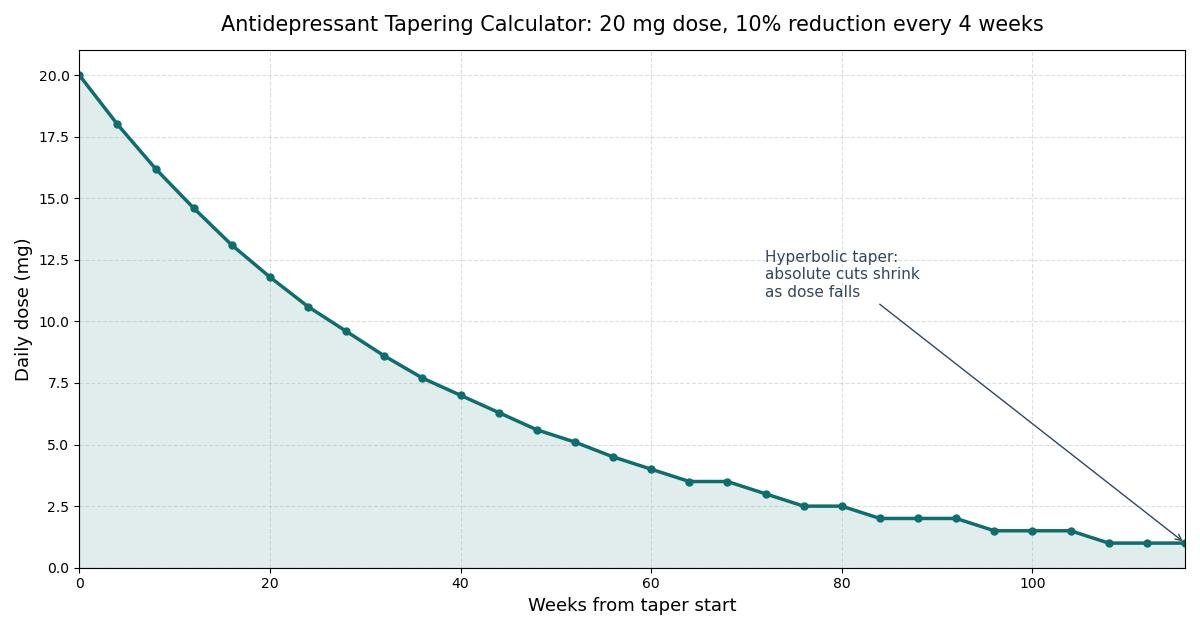
Horowitz and Taylor argued that this pharmacology makes linear, fixed-milligram tapers biologically uneven. Each fixed cut removes a larger share of the drug's effect than the one before it, so the hardest biological step is the last one, exactly where most tapers end. Their proposal was hyperbolic tapering: reduce the dose by a fixed proportion of the most recent dose, commonly around 10 percent, so that each step lowers transporter occupancy by a roughly similar amount from start to finish. This is the same principle long used for benzodiazepine tapers, where doses are reduced exponentially to very small amounts.
Clinical studies point in the same direction. In one paroxetine study summarised in a 2021 Cochrane review, patients who tapered over an average of 38.6 weeks had a 6.1 percent incidence of withdrawal syndrome, compared with 78.2 percent among those who stopped abruptly. Another study found significantly fewer withdrawal symptoms when the taper extended over up to four months rather than days. A Dutch programme using tapering strips that allow reductions to small fractions of the minimum therapeutic dose helped 71 percent of 895 participants, most of whom had previously experienced withdrawal, to discontinue over a median of 56 days. The evidence base is still developing, but the consistent message is that slow, proportional reductions down to very low doses are better tolerated than short linear tapers.
Half-life drives withdrawal risk
How quickly a drug leaves the body is a strong predictor of how rough discontinuation will feel. A short half-life means blood levels plunge between dose reductions, giving the nervous system little time to adapt. A long half-life, especially with an active metabolite that lingers even longer, smooths the descent. The table below lists typical adult elimination half-lives for the antidepressants in this planner, verified against current pharmacology references. Individual values vary with age, liver function, and genetics, so treat these as typical ranges rather than personal predictions.
| Antidepressant | Elimination half-life |
|---|---|
| Fluoxetine | 4 to 6 days (active metabolite norfluoxetine: 7 to 15 days) |
| Sertraline | about 26 hours |
| Paroxetine | about 21 hours |
| Citalopram | about 35 hours |
| Escitalopram | 27 to 32 hours |
| Venlafaxine | about 5 hours (active metabolite O-desmethylvenlafaxine: about 11 hours) |
| Desvenlafaxine | about 11 hours |
| Duloxetine | about 12 hours |
| Bupropion | about 21 hours |
| Mirtazapine | 20 to 40 hours |
| Amitriptyline | 10 to 28 hours |
| Clomipramine | about 32 hours |
| Vortioxetine | about 66 hours |
Two drugs stand out at the extremes, exactly as standard pharmacology teaching describes. Paroxetine (about 21 hours, with nonlinear kinetics that make its half-life shorten further at low doses) and venlafaxine (about 5 hours for the parent drug) are the classic higher-risk drugs for discontinuation syndrome. At the other extreme, fluoxetine is effectively self-tapering: its active metabolite norfluoxetine persists for 7 to 15 days, so plasma levels decline gently even after the last tablet. Everything in between carries a moderate expected risk, and the planner's risk note reflects this three-tier grouping. Half-life is the main driver shown here, but it is not the whole story: paroxetine adds anticholinergic rebound to its short half-life, and individual sensitivity varies widely.
How to use this planner
Choose your antidepressant from the verified half-life list, enter your current daily dose in milligrams, and pick a taper style. Percentage tapering, the default, reduces each step by a fixed proportion of the current dose, for example 10 percent, which follows the hyperbolic principle described above. Fixed-milligram tapering subtracts the same number of milligrams each time; it is simpler to follow with standard tablets but becomes biologically steeper as the dose falls, so clinicians usually reserve it for the higher-dose phase or switch to percentage steps near the end.
Next, set the interval between steps in weeks and a target dose, using 0 for a full stop. Four weeks between steps is a common starting point, and many clinicians lengthen the interval, or add extra small steps, once the dose drops below the minimum therapeutic level, because that is where transporter occupancy changes fastest. The planner builds the schedule from your chosen start date, showing for each step the calendar date, the dose in milligrams, the percentage of the original dose, and the cumulative weeks elapsed. It also reports the total number of steps and the total taper length.
Doses are rounded to amounts that can realistically be measured: below 5 mg the planner rounds to the nearest 0.5 mg, and at 5 mg and above it rounds to one decimal place. Each step is computed from the exact exponential formula, dose = start x (1 - r)^n, and then rounded for display, and the schedule is guaranteed to decrease at every step. The final step always lands exactly on your target dose. Understand clearly what this output is: an illustration of the arithmetic of tapering, not a prescription. Your clinician may adjust every parameter here based on your history, and that judgment overrides anything the planner suggests.
Recognising discontinuation syndrome
Knowing the symptom pattern helps you respond early rather than suffering in confusion. The classic physical symptoms include flu-like aches, nausea or vomiting, dizziness or vertigo, headache, sweating, and sensory disturbances such as tingling, numbness, or electric-shock sensations. Psychological symptoms include anxiety, agitation, tearfulness, irritability, vivid or disturbing dreams, and insomnia. Some people also notice problems with concentration and coordination. Symptoms usually appear within one to four days of a dose reduction, peak within the first one to two weeks, and then fade, though a minority of patients report a protracted course lasting many weeks.
Several features distinguish this syndrome from a relapse of depression or anxiety. Withdrawal starts quickly after a pharmacological change, includes prominent physical and sensory symptoms that were not part of the original illness, and follows the wave pattern described above. Relapse tends to emerge more gradually, recreates the original symptom profile, and does not track dose changes so closely. When in doubt, the safest interpretation is to treat new symptoms as potentially withdrawal-related and contact the prescriber rather than either enduring them silently or restarting the drug independently.
Risk is not distributed evenly. Longer duration of treatment, higher doses, and a history of previous withdrawal episodes all raise the likelihood of symptoms, as does a shorter drug half-life. Anxiety about stopping can amplify the experience, which is one reason a written plan with predictable steps, like the one this planner produces, can itself be therapeutic: it replaces uncertainty with a schedule that both patient and clinician can see.
Making the small steps work in practice
The arithmetic of hyperbolic tapering eventually demands doses that do not exist as manufactured tablets. A 10 percent taper from 20 mg reaches 2 mg after about 22 steps, and no standard tablet comes in that strength. Clinicians bridge this gap in several ways. Some antidepressants, including fluoxetine, sertraline, citalopram, escitalopram, and paroxetine, are available as oral liquids that allow fine dose measurement. Compounding pharmacies can prepare custom capsules or liquids at any strength a prescriber orders. In some countries, tapering strips with pre-measured daily pouches descending in tiny increments are available on prescription.
Tablet splitting is a common workaround but needs care: only split tablets that are scored and immediate-release, never split extended-release or enteric-coated formulations, and confirm with a pharmacist that the specific product can be divided accurately. Opening capsules to count beads is sometimes used for drugs like venlafaxine and duloxetine, but bead counts are imprecise and should only be done under professional guidance. Whatever method is chosen, keep the measurement method consistent from step to step so that each reduction is genuinely proportional.
Two habits make tapers safer. First, keep a short daily log of dose taken, sleep quality, mood, and any physical symptoms, with dates; this is the evidence your clinician needs to distinguish withdrawal from relapse and to decide whether to hold, slow, or continue. Second, agree in advance on a rule for setbacks: a common approach is that if significant symptoms appear, you stay at the current dose until they settle for at least a week, then resume with smaller reductions or longer intervals. Never compensate for a missed reduction by doubling the next cut.
Key takeaways
- No.
- Brain imaging research shows that serotonin transporter occupancy follows the law of mass action: at high doses the transporter is nearly saturated, so cutting 10 mg changes very little, while the same 10 mg cut at a low dose produces a large change in occupancy.
- As a rule, the shorter the half-life, the higher the expected risk of discontinuation syndrome.
- There is no single correct answer, which is why a clinician must individualise the plan.
Frequently asked questions
Is this tapering planner medical advice?
No. This planner is an educational illustration only. It builds a schedule from the numbers you enter, but it does not know your diagnosis, your history, or the reason you are stopping. Every taper must be planned with the clinician who prescribed the antidepressant. Never start, change, or stop an antidepressant because of a number shown on this page.
Why taper by percentage instead of by fixed milligrams?
Brain imaging research shows that serotonin transporter occupancy follows the law of mass action: at high doses the transporter is nearly saturated, so cutting 10 mg changes very little, while the same 10 mg cut at a low dose produces a large change in occupancy. Horowitz and Taylor (Lancet Psychiatry, 2019) argued from this PET data that doses should be reduced hyperbolically, meaning by a percentage of the most recent dose, so that each step lowers the biological effect by a roughly equal amount. Fixed milligram steps do the opposite: they get harsher, in biological terms, as the dose falls. This calculator defaults to 10 percent per step for that reason.
Which antidepressants carry the highest discontinuation risk?
As a rule, the shorter the half-life, the higher the expected risk of discontinuation syndrome. Paroxetine (about 21 hours, with nonlinear kinetics) and venlafaxine (about 5 hours for the parent drug) are the classic higher-risk drugs and are named as such in standard pharmacology references. Fluoxetine sits at the other end: its active metabolite norfluoxetine lingers for 7 to 15 days, so the drug effectively tapers itself and withdrawal is less likely. Drugs in between, such as sertraline, citalopram, escitalopram, duloxetine, mirtazapine, and the tricyclics, carry a moderate expected risk.
How long should a taper take?
There is no single correct answer, which is why a clinician must individualise the plan. Older guidance often suggested 2 to 4 weeks, but studies reviewed by Horowitz and Taylor found that such short tapers show minimal benefit over abrupt discontinuation. In one study, people who tapered paroxetine over an average of about 39 weeks had a 6.1 percent incidence of withdrawal syndrome compared with 78.2 percent after abrupt discontinuation, and another study found significantly fewer symptoms when tapering stretched over up to four months. The steps at the lowest doses usually matter most, so many clinicians make the final phase the slowest part of the schedule.
What should I do if withdrawal symptoms appear during the taper?
Contact your prescribing clinician promptly and do not try to fix the problem by restarting the old dose on your own. Common responses a clinician may choose include holding at the current dose until symptoms settle, slowing the taper, or making the next reduction smaller. Keeping a brief daily symptom diary, noting sleep, mood, dizziness, nausea, and any electric-shock sensations, helps the clinician tell withdrawal apart from a return of the original condition, because withdrawal typically starts within days of a dose change, peaks within a week or two, and then fades in a wave-like pattern.
Can I speed up the taper if I feel fine?
Only with your clinician's agreement. Feeling well at a higher dose does not guarantee the next reduction will be easy, because the biological effect of each step grows as the dose falls. Delayed symptoms can also appear days after a reduction, especially with longer half-life drugs. A common safe approach is to keep the planned interval, confirm you are still symptom-free for the full interval, and let the clinician decide whether the next step can be larger or sooner.
Related tools
If you are reviewing psychiatric medications more broadly, these related planners may help: the benzodiazepine equivalence calculator for comparing doses across sedatives, the serotonin syndrome risk checker when combinations of serotonergic drugs are involved, and the PHQ-9 depression test and GAD-7 anxiety test for tracking symptom severity during and after a taper. Symptom scores taken at each taper step give your clinician objective data alongside your diary.
Medical disclaimer
Important: This calculator is an educational tool only and is not medical advice. The schedules it generates are mathematical illustrations, not prescriptions, and they do not take account of your diagnosis, medical history, other medications, or individual risk factors. Antidepressant tapering must be planned and supervised by a qualified clinician. Never start, adjust, or stop an antidepressant based solely on this page, and never stop abruptly without medical guidance. If you experience severe withdrawal symptoms, thoughts of harming yourself, or a sudden worsening of your condition, seek urgent medical care. If you are in crisis, contact your local emergency number or crisis helpline immediately.