Antipsychotic Dose Equivalence Calculator
In short: Convert antipsychotic doses to chlorpromazine equivalents and between drugs using the Gardner et al. 2010 international consensus ratios. Free calculator with full equivalence table, worked examples and FAQs. Use the calculator above, then read the guide below to interpret your result and its limitations.
Chlorpromazine equivalents (CPZeq) from the Gardner et al. 2010 international consensus. Medically reviewed by Dr. Taimoor Asghar.
Convert an antipsychotic dose
Results use the consensus equivalency ratios versus chlorpromazine published by Gardner et al. 2010. They are approximations for switching and research comparisons, not prescriptions.
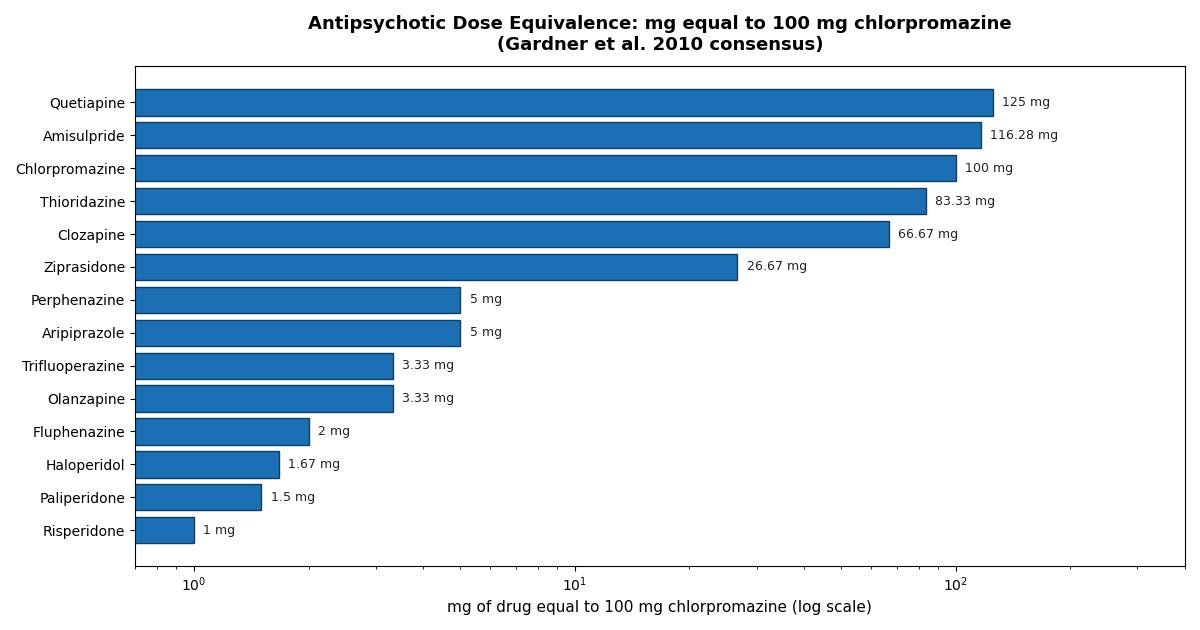
Equivalence chart
What chlorpromazine equivalents are and why clinicians use them
Antipsychotic drugs differ enormously in potency. A typical daily dose can be as small as 1 mg of risperidone or as large as 750 mg of quetiapine, yet both can represent a similar intensity of treatment. To compare doses across drugs, psychiatry has long used the chlorpromazine equivalent: the number of milligrams of chlorpromazine (one of the oldest antipsychotics) considered roughly equal in antipsychotic effect to a given dose of another drug.
Chlorpromazine equivalents serve three practical purposes. First, they guide switching: when a patient moves from one antipsychotic to another, the prescriber estimates a dose of the new drug with comparable effect instead of guessing from the very different milligram numbers. Second, they let researchers add up exposure when patients take more than one antipsychotic, so total dose can be reported on a single scale. Third, they give a rough sense of whether a dose is low, medium or high relative to the usual range for that drug.
The catch is that no equivalence table is exact. Equivalents are population averages, and individual patients differ in metabolism, age, organ function, smoking status and sensitivity to side effects. Treat every number on this page as a starting estimate that a clinician then adjusts, never as a precise personal conversion.
How to use this calculator
Select the drug the dose is currently expressed in, enter the daily dose in milligrams, and select the drug you want to convert to. The calculator shows two things: the chlorpromazine equivalent of the entered dose, and the equivalent daily dose of the target drug. Below the result you also get the entered dose expressed in every drug in the table, so you can compare at a glance.
The arithmetic is simple and fully deterministic. Each drug carries its consensus equivalency ratio versus chlorpromazine from Gardner et al. 2010. The chlorpromazine equivalent equals dose multiplied by that ratio, and the target dose equals the chlorpromazine equivalent divided by the target drug's ratio. Results are rounded to two decimals where that is sensible.
The Gardner 2010 international consensus behind the numbers
All conversion factors in this calculator come from one source: Gardner DM, Murphy AL, O'Donnell H, Centorrino F and Baldessarini RJ, "International consensus study of antipsychotic dosing," The American Journal of Psychiatry 2010;167(6):686-693. You can read the paper via its DOI link in the references. In that study, 43 clinical and research experts from 18 countries took part in a two-stage Delphi survey and produced consensus median equivalent doses for 36 oral antipsychotics, using olanzapine 20 mg per day as the reference treatment and chlorpromazine as the historical reference.
The paper reports an "equivalency ratio versus chlorpromazine" for each drug, which is the figure this calculator uses directly. For example, haloperidol's ratio is 60, meaning 1 mg of haloperidol counts as 60 mg of chlorpromazine, while quetiapine's ratio is 0.80, meaning 1 mg of quetiapine counts as 0.8 mg of chlorpromazine. The consensus equivalent of olanzapine 20 mg per day was chlorpromazine 600 mg per day, so a drug dose equal to 100 mg of chlorpromazine is 100 divided by its ratio: haloperidol 1.67 mg, risperidone 1 mg, olanzapine 3.33 mg, quetiapine 125 mg, aripiprazole 5 mg, ziprasidone 26.67 mg, clozapine 66.67 mg, amisulpride 116.28 mg, paliperidone 1.5 mg, fluphenazine 2 mg, perphenazine 5 mg, thioridazine 83.33 mg and trifluoperazine 3.33 mg.
The experts also rated their confidence in each estimate. Confidence was high for haloperidol, risperidone, quetiapine and clozapine, moderate for the rest of the drugs in this calculator, and the estimates rested on 19 to 43 respondents per drug. One drug you will not find here is lurasidone: it was not included in the Gardner 2010 consensus at all, so rather than guess a value, this calculator leaves it out. The paper also published consensus target dose ranges, for instance haloperidol 5 to 10 mg per day, risperidone 4 to 6 mg per day, olanzapine 10 to 20 mg per day, quetiapine 400 to 800 mg per day, aripiprazole 15 to 30 mg per day, ziprasidone 120 to 160 mg per day, clozapine 200 to 500 mg per day, amisulpride 400 to 800 mg per day, paliperidone 6 to 9 mg per day and chlorpromazine 300 to 600 mg per day.
Worked examples
Example 1. A patient takes haloperidol 4 mg per day. The chlorpromazine equivalent is 4 times 60 = 240 mg. As olanzapine that is 240 divided by 30 = 8 mg per day.
Example 2. A patient takes olanzapine 10 mg per day. The chlorpromazine equivalent is 10 times 30 = 300 mg. As quetiapine that is 300 divided by 0.80 = 375 mg per day.
Example 3. A patient takes quetiapine 300 mg per day. The chlorpromazine equivalent is 300 times 0.80 = 240 mg. As risperidone that is 240 divided by 100 = 2.4 mg per day.
Example 4. A patient takes aripiprazole 15 mg per day. The chlorpromazine equivalent is 15 times 20 = 300 mg, which is simply 300 mg of chlorpromazine itself.
Full equivalence table (Gardner et al. 2010)
The table shows, for each drug, the consensus median equivalent dose in mg per day (versus olanzapine 20 mg per day), the dose in mg equal to 100 mg of chlorpromazine, and the experts' confidence rating. Confidence H means high, M means moderate.
| Drug | Consensus equivalent dose (mg/day) | mg equal to 100 mg chlorpromazine | Expert confidence |
|---|---|---|---|
| Chlorpromazine | 600 | 100 | M |
| Haloperidol | 10 | 1.67 | H |
| Risperidone | 6 | 1 | H |
| Olanzapine | 20 | 3.33 | Reference |
| Quetiapine | 750 | 125 | H |
| Aripiprazole | 30 | 5 | M |
| Ziprasidone | 160 | 26.67 | M |
| Clozapine | 400 | 66.67 | H |
| Amisulpride | 700 | 116.28 | M |
| Paliperidone | 9 | 1.5 | M |
| Fluphenazine | 12 | 2 | M |
| Perphenazine | 30 | 5 | M |
| Thioridazine | 500 | 83.33 | M |
| Trifluoperazine | 20 | 3.33 | M |
Source: Gardner et al. 2010, Table 1. Consensus medians versus olanzapine 20 mg/day; "mg equal to 100 mg chlorpromazine" = 100 divided by the published equivalency ratio versus chlorpromazine.
Why different sources quote different equivalents
If you compare equivalence tables you will find they disagree, sometimes substantially, and that is expected because they are built with different methods. Woods (2003) derived equivalents from the minimum effective doses seen in fixed-dose placebo-controlled trials, giving 2 mg of risperidone, 5 mg of olanzapine, 75 mg of quetiapine, 60 mg of ziprasidone and 7.5 mg of aripiprazole per 100 mg of chlorpromazine. Leucht and colleagues (2016) used the WHO defined daily dose method, which keys equivalents to average maintenance doses rather than expert judgement. Older tables often trace back to Davis (1974) and to formulary maximum doses.
Gardner et al. 2010 is different again: it asked experienced clinicians and researchers what doses they consider clinically equivalent in practice. That makes it a consensus of real-world prescribing rather than a trial statistic, but it also means the numbers reflect opinion, with the confidence ratings and respondent counts shown above telling you how firm each estimate is. This calculator uses the Gardner 2010 ratios throughout and names the source for every number, so you always know exactly which method stands behind a result.
Important limitations when switching antipsychotics
Equivalents are population-average approximations for switching and research, not exact for individuals. Two patients on the same dose can have very different blood levels and responses because of metabolism, body weight, age, smoking, liver and kidney function, and interacting medicines. The Gardner authors themselves found 17 patient and treatment characteristics, including age and hepatic or renal impairment, that call for dosing modifications.
Switching also involves more than arithmetic. Stopping one drug and starting another usually needs a cross-titration schedule to avoid rebound psychosis, withdrawal symptoms such as nausea and insomnia, and cholinergic rebound. Clozapine needs extra caution because abrupt discontinuation carries particular risks and restarting requires its own titration with blood monitoring. None of that is captured by an equivalence number.
For all these reasons, any switch must be planned and supervised by the prescribing clinician, who will treat the calculator's figure as a starting estimate and adjust it to the patient's history and circumstances. Patients should never adjust or stop antipsychotic medication on the basis of this page.
Key takeaways
- A chlorpromazine equivalent is a standard way to express the dose of any antipsychotic as the number of milligrams of chlorpromazine thought to be roughly equal in antipsychotic effect.
- Every conversion factor here comes from Gardner DM, Murphy AL, O'Donnell H, Centorrino F and Baldessarini RJ, International consensus study of antipsychotic dosing, The American Journal of Psychiatry 2010;167(6):686-693, https://doi.org/10.1176/appi.ajp.2009.09060802.
- Each drug has a consensus equivalency ratio versus chlorpromazine from Gardner et al.
- Equivalent doses depend on the method used.
Frequently asked questions
What is a chlorpromazine equivalent dose?
A chlorpromazine equivalent is a standard way to express the dose of any antipsychotic as the number of milligrams of chlorpromazine thought to be roughly equal in antipsychotic effect. Because antipsychotics come in very different potencies, for example 2 mg of fluphenazine versus 500 mg of thioridazine, equivalents let clinicians and researchers compare total antipsychotic exposure across drugs on one scale.
Which study do the numbers in this calculator come from?
Every conversion factor here comes from Gardner DM, Murphy AL, O'Donnell H, Centorrino F and Baldessarini RJ, International consensus study of antipsychotic dosing, The American Journal of Psychiatry 2010;167(6):686-693, https://doi.org/10.1176/appi.ajp.2009.09060802. In that two-stage Delphi study, 43 clinical and research experts from 18 countries gave consensus median equivalent doses for oral antipsychotics, using olanzapine 20 mg per day as the reference and chlorpromazine as the historical anchor.
How is the conversion calculated?
Each drug has a consensus equivalency ratio versus chlorpromazine from Gardner et al. 2010. The chlorpromazine equivalent of a dose is dose in mg multiplied by that ratio. To convert between two drugs, the calculator first converts the starting dose to chlorpromazine equivalents and then divides by the target drug's ratio. For example, haloperidol has a ratio of 60, so 4 mg of haloperidol equals 240 mg of chlorpromazine, which equals 8 mg of olanzapine (ratio 30).
Why do other sources list different equivalent doses?
Equivalent doses depend on the method used. Woods (2003) estimated equivalents from minimum effective doses in fixed-dose trials, giving for example risperidone 2 mg, olanzapine 5 mg, quetiapine 75 mg, ziprasidone 60 mg and aripiprazole 7.5 mg per 100 mg of chlorpromazine. The WHO defined daily dose method and formulary maximum-dose methods give yet other figures. Gardner et al. 2010 instead asked international experts for clinically equivalent doses, so its ratios reflect real-world prescribing consensus rather than trial doses. No single table is exact, which is why this calculator names its source for every number.
Can I use this calculator to switch my own medication?
No. These equivalents are population-average approximations, not exact for any individual, and switching antipsychotics involves cross-titration schedules, rebound and withdrawal risks, and monitoring for relapse and side effects. Any switch must be planned and supervised by the prescribing clinician, who will adjust the calculated figure to the patient's history, age, organ function and co-medications.
Do these equivalents apply to injections, children, or older adults?
No. The Gardner 2010 consensus covered oral antipsychotics for a defined adult reference case, a moderately symptomatic adult man with schizophrenia and at least two years of prior treatment, and the authors found 17 patient and treatment characteristics, including age and hepatic or renal function, that call for dosing modifications. Long-acting injections, children, older adults and medically complex patients need separate clinical judgement, not this table.
Related calculators
If you work with psychotropic medicines you may also need our benzodiazepine equivalence calculator, the serotonin syndrome risk checker, the PHQ-9 depression test and the GAD-7 anxiety test.
Reference
Gardner DM, Murphy AL, O'Donnell H, Centorrino F, Baldessarini RJ. International consensus study of antipsychotic dosing. The American Journal of Psychiatry. 2010;167(6):686-693. https://doi.org/10.1176/appi.ajp.2009.09060802