What this MME calculator does
MME stands for morphine milligram equivalents: a standardised unit that expresses any opioid dose as the number of milligrams of oral morphine it is roughly equivalent to. A patient taking 20 mg of oxycodone twice a day, for example, takes 40 mg of oxycodone per day; multiplied by the oxycodone factor of 1.5, that is 60 MME per day. When a patient takes more than one opioid, each drug is converted separately and the results are added together to give the total daily MME. This MME calculator performs exactly that arithmetic: it takes one or more opioids with their total daily doses, applies the CDC conversion factors, and reports the per-opioid MME and the combined total.
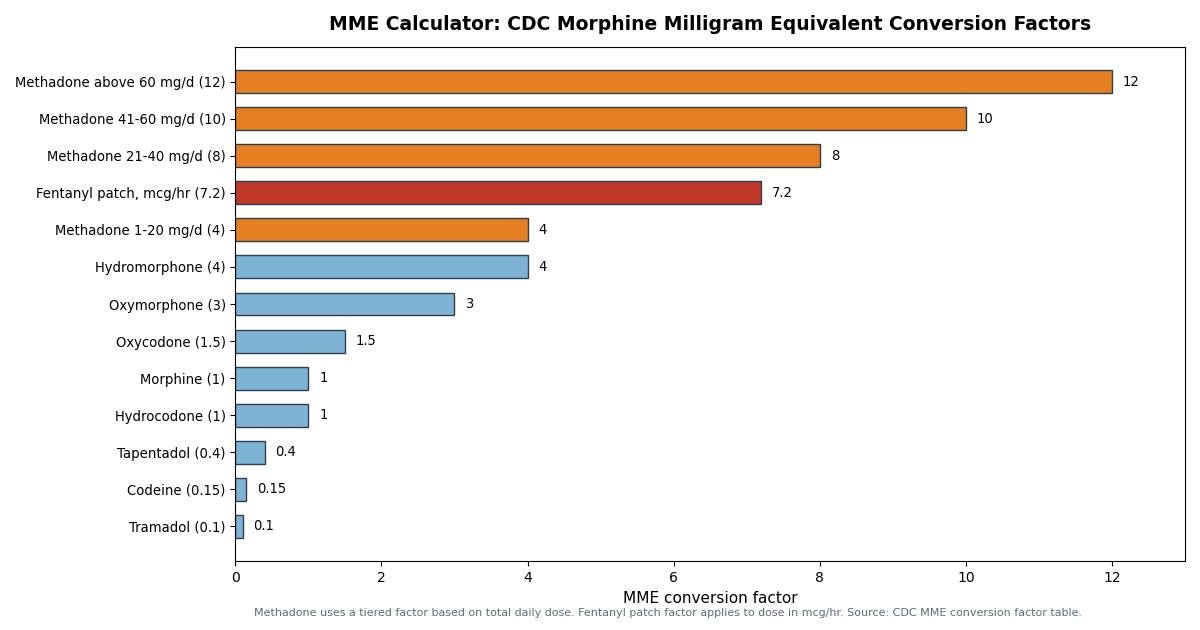
The conversion factors built into the calculator are the ones the US Centers for Disease Control and Prevention (CDC) published in its MME conversion factor table (National Center for Injury Prevention and Control, CDC compilation of benzodiazepines, muscle relaxants, stimulants, zolpidem, and opioid analgesics with oral morphine milligram equivalent conversion factors, 2016 version). Ten opioids are included: codeine (0.15), tramadol (0.1), tapentadol (0.4), hydrocodone (1), morphine (1), oxycodone (1.5), oxymorphone (3), hydromorphone (4), methadone (tiered: 4, 8, 10 or 12 depending on daily dose), and the fentanyl transdermal patch (7.2, applied to the dose in micrograms per hour). These factors were originally derived from comparative potency data compiled by Von Korff and colleagues and published in the Clinical Journal of Pain in 2008, and they remain the standard reference the CDC points to.
The total MME is then compared with the caution bands from the CDC Clinical Practice Guideline for Prescribing Opioids for Pain, United States, 2022 (Dowell D, Ragan KR, Jones CM, Baldwin GT, Chou R. MMWR Recomm Rep 2022;71(No. RR-3):1-95). Below 50 MME per day is the lower-risk range; at 50 MME per day or above the guideline advises carefully reassessing benefits and risks before increasing the dose; at 90 MME per day or above it advises avoiding dose increases or carefully justifying them. These are cautions for clinical decision making, not statements that a given dose will or will not cause harm.
How to use the MME calculator
First, determine the total amount of each opioid the patient takes in one day. For a scheduled opioid this is straightforward: multiply the strength per tablet, capsule or patch by the number of doses per day. A patient on hydrocodone/acetaminophen 5/325 mg, two tablets four times daily, takes 10 tablets per day, which is 50 mg of hydrocodone per day (the acetaminophen component is not an opioid and is not converted). For an as-needed (PRN) opioid, use the average amount actually taken per day, estimated from the prescription record or the patient's report, since the number of doses varies day to day.
Second, enter each opioid and its daily dose into the calculator using the rows above. The dose is entered in milligrams per day for every drug except the fentanyl patch, which is entered in micrograms per hour (see the fentanyl section below). Press "Add another opioid" for each additional drug. Third, press "Calculate MME". The results show each drug's MME, the combined total, and which CDC caution band the total falls into, along with the guideline's recommended actions for that band.
The CDC conversion factors used
The table below lists every factor the calculator applies. Doses are in milligrams per day unless stated otherwise. Methadone is handled separately because its factor depends on the total daily dose.
| Opioid | Dose unit | MME conversion factor |
|---|---|---|
| Codeine | mg/day | 0.15 |
| Tramadol | mg/day | 0.1 |
| Tapentadol | mg/day | 0.4 |
| Hydrocodone | mg/day | 1 |
| Morphine | mg/day | 1 |
| Oxycodone | mg/day | 1.5 |
| Oxymorphone | mg/day | 3 |
| Hydromorphone | mg/day | 4 |
| Fentanyl transdermal patch | mcg/hour | 7.2 |
| Methadone, 1 to 20 mg/day | mg/day | 4 |
| Methadone, 21 to 40 mg/day | mg/day | 8 |
| Methadone, 41 to 60 mg/day | mg/day | 10 |
| Methadone, above 60 mg/day | mg/day | 12 |
The arithmetic is the same for every drug except methadone: MME equals the daily dose multiplied by the conversion factor. A 60 mg daily dose of morphine is 60 MME; a 60 mg daily dose of oxymorphone is 180 MME, because oxymorphone is roughly three times as potent per milligram. This is why total MME, rather than the raw milligram total, is the number guidelines use: 60 mg of morphine and 60 mg of oxymorphone are very different exposures.
Worked examples
Example 1: single opioid. A patient takes oxycodone 20 mg twice daily. The daily dose is 40 mg. Multiplying by the oxycodone factor of 1.5 gives 60 MME per day. That total sits in the 50 to 89 range, so the CDC 2022 guideline advises carefully reassessing benefits and risks before any dose increase.
Example 2: two opioids. A patient takes oxycodone 30 mg per day and hydrocodone 10 mg per day. Oxycodone contributes 30 x 1.5 = 45 MME; hydrocodone contributes 10 x 1 = 10 MME. The combined total is 55 MME per day, again in the 50 to 89 range, so the same reassessment advice applies.
Example 3: methadone. A patient takes methadone 30 mg per day. A 30 mg dose falls in the 21 to 40 mg tier, so the factor is 8, giving 240 MME per day. At 10 mg per day, the 1 to 20 mg tier applies with a factor of 4, giving 40 MME per day. The same drug can land in very different bands depending on dose, which is exactly why methadone gets its own tiered scale.
Example 4: fentanyl patch. A patient wears a 25 microgram per hour fentanyl patch. Entering 25 in the fentanyl row (micrograms per hour, not milligrams per day) and multiplying by 7.2 gives 180 MME per day, which is at or above the 90 threshold.
The CDC 2022 caution bands explained
The 2022 CDC guideline replaced the older 2016 guideline and kept dose thresholds as decision aids, not as rigid limits. Its advice is deliberately graduated. Use caution when prescribing opioids at any dosage and prescribe the lowest effective dose: that principle applies everywhere. When the total reaches 50 MME per day, the guideline advises clinicians to carefully reassess the evidence of individual benefits and risks before increasing the dosage. Practical steps named by the guideline at this point include monitoring and assessing pain and function more frequently, discussing dose reduction or tapering and discontinuing opioids if benefits do not outweigh harms, and considering offering naloxone. When the total reaches 90 MME per day, the guideline advises avoiding increasing the dosage to that level or carefully justifying the decision, with the same extra precautions intensified.
It is important to understand what these bands are not. They are not overdose predictions: a total of 55 MME per day does not mean an overdose is likely, and a total of 40 MME per day does not mean one is impossible. Overdose risk rises gradually and continuously with dose, and it depends on individual factors the MME number cannot see: tolerance, sleep apnoea, concurrent benzodiazepine or alcohol use, liver and kidney function, age, and whether the dose was recently increased. The bands summarise population-level evidence. A CDC analysis cited in the agency's prescribing materials found that patients who died of opioid overdose had been prescribed an average of 98 MME per day, compared with an average of 48 MME per day among other patients. That gap is the evidence base behind the caution bands, and it is a population average, not a personal forecast.
The 2022 guideline also stresses that these recommendations should not be used as an inflexible, one-size-fits-all policy or law. They are voluntary clinical guidance meant to inform individualised decisions, and the guideline explicitly warns against rapid tapering or abrupt discontinuation of opioids in patients already on long-term therapy.
Methadone: why the factor is tiered and approximate
Methadone stands apart from every other opioid in the table. Its conversion factor climbs as the daily dose climbs: 4 for 1 to 20 mg per day, 8 for 21 to 40 mg, 10 for 41 to 60 mg, and 12 above 60 mg per day. The reason is pharmacological. According to FDA-approved methadone labelling, the drug has a plasma elimination half-life of 8 to 59 hours, which is both long and highly variable between patients, while its analgesic effect lasts only 4 to 8 hours after a single dose. With repeated dosing, methadone accumulates in the body, steady-state plasma concentrations are not reached until at least 3 to 5 days on a stable dose, and potency increases as it accumulates. There is also high interpatient variability in absorption, metabolism and relative analgesic potency.
That variability is why the tiered factor is only an approximation, and the calculator says so plainly in the results whenever methadone is entered. The FDA label goes further: it states that population-based equianalgesic conversion ratios between methadone and other opioids are not accurate when applied to individuals. Converting a patient to or from methadone is a specialist task that must account for the patient's prior opioid exposure, tolerance and organ function, and it should never be done from an MME number alone. The calculator's methadone output is useful for flagging that a methadone-containing regimen crosses a caution band, not for planning a switch.
Fentanyl patch: enter micrograms per hour
The fentanyl row works differently from every other row because the patch is dosed as a rate, not a daily amount. A "25 mcg/hr patch" delivers 25 micrograms of fentanyl per hour continuously. The CDC factor of 7.2 multiplies that hourly rate directly: 25 x 7.2 = 180 MME per day. Do not first convert the patch to a daily milligram amount; the calculator expects the number printed on the patch box. The CDC's own materials carry an explicit caution for fentanyl: absorption is affected by heat and other factors, so a patient with fever or one who applies external heat over the patch can absorb more drug than the label rate implies. Treat the fentanyl MME as an estimate.
What MME cannot do
The most important limitation is also the most misunderstood. The CDC states that the MME conversion factors are intended only for analytic purposes where prescription data is used to calculate daily MME, and that they do not constitute clinical guidance or recommendations for converting patients from one opioid to another. In other words, the number this calculator produces must not be used to decide the starting dose when switching opioids. The reason is incomplete cross-tolerance: tolerance developed to one opioid transfers only partially to another, so a patient switched at the "equivalent" dose calculated from MME factors would typically receive too much of the new drug. Safe switching requires following the new drug's prescribing information, starting lower than the calculated equivalent, and titrating carefully. This applies with particular force to methadone, as described above.
MME also cannot capture the clinical context that determines whether a dose is appropriate. It does not account for tolerance, for how long the patient has been on opioids, for concurrent sedatives, for sleep-disordered breathing, for renal or hepatic impairment that slows drug clearance, or for the difference between acute and chronic pain. Two patients with the same total MME can face very different risks. The number is a starting point for the conversation the guideline asks clinicians to have, not a verdict.
Who uses MME calculations
Prescribers use total daily MME to apply the CDC caution bands during medication reviews, to decide when extra monitoring or naloxone co-prescription is warranted, and to track dose changes over time. Pharmacists use it when verifying prescriptions and counselling patients on the risks of dose escalation or of combining opioids with benzodiazepines. Researchers and health systems use it to compare opioid exposure across populations, to study prescribing trends, and to evaluate the effects of prescribing policies, since MME puts every opioid on one comparable scale. Insurers and prescription drug monitoring programmes use it to flag regimens that merit review. For patients and carers, the number can make an abstract regimen concrete: it answers the question "how much opioid am I actually taking, in terms I can compare?" That understanding supports the shared decision making the 2022 guideline calls for.